
I Bonds are likely to get another surge in popularity.
By David Enna, Tipswatch.com
U.S. inflation rose a bit higher than expectations in September, while also setting in stone the variable rate for the Series I Savings Bond and Social Security’s cost of living adjustment for benefits in 2027.
Let’s put off the inflation discussion for a moment and look at the I Bond rate and Social Security COLA
I Bond variable rate
For September, the Bureau of Labor Statistics set the non-seasonally adjusted CPI index at 336.940, an increase of 0.59% over the August index. The I Bond’s new inflation-adjusted variable rate, to be reset November 1, is based on inflation for the months of April to September 2026, which ran at 2.04%. That means the new variable rate will be 4.08%, up from the current rate of 3.34%.
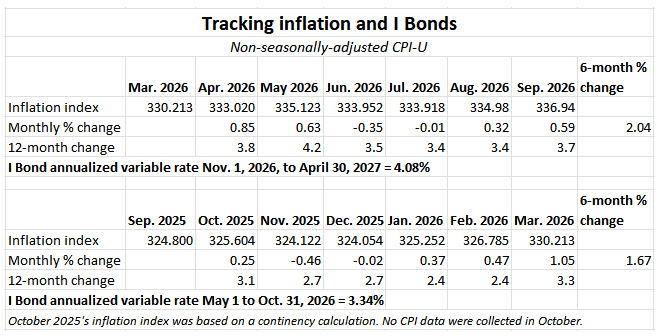
This 4.08% rate will apply to all I Bonds purchased from November 2026 to April 2027, but will eventually roll into effect for all I Bonds no matter when they were purchased. This means that even I Bonds with a fixed rate of 0.0% will earn 4.08% annualized for six months.
I am also expecting the Treasury to raise the I Bond’s fixed rate, currently 0.90%, to at least 1.30% on November 1, and 1.40% is very much possible. (This assumes the Treasury follows past practices.) That would mean I Bonds purchased from November through April will get a composite rate of around 5.4%, or a little higher. That’s highly attractive. I Bonds are going to be a popular investment.
If you have already purchased your I Bond allocation for 2026 — $10,000 per person per year — you will be able to grab the new rate after January 1, when the calendar rests. You can also consider using the “gift-box” option, which I believe is still viable.
I will be writing an update on I Bond strategies next week.
For TIPS. The September inflation report means that principal balances for all TIPS will increase 0.59% in November, after rising 0.32% in October. Here are the new November Inflation Indexes for all TIPS.
Social Security COLA
The September inflation report was the third of three — for July to September — that determine the Social Security Administration’s cost-of-living adjustment for payments in 2027. The SSA uses a three-month average of a different index, the Consumer Price Index for Urban Wage Earners and Clerical Workers (CPI-W), to set its COLA.
For September, the BLS set CPI-W at 330.654, which produced a three-month average of 328.746, an increase of 3.6% over the same average for 2025. That means the Social Security COLA will be 3.6% for payments beginning in January. The numbers:
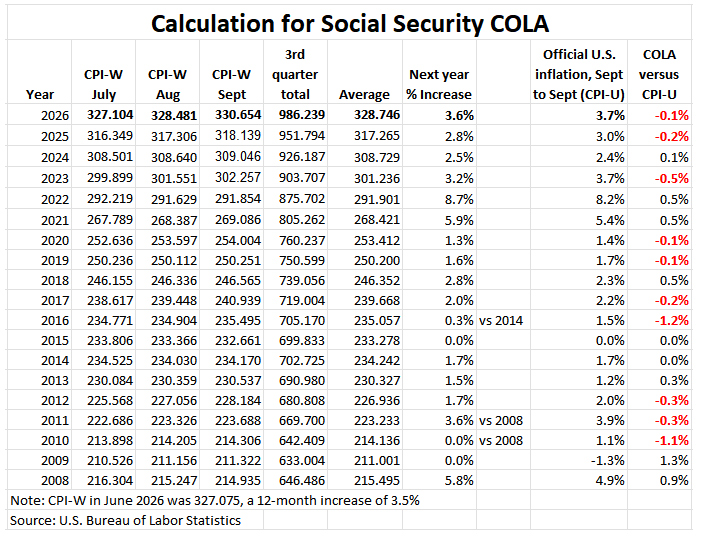
This is the second year in a row that the COLA has lagged overall CPI, which is running at 3.7%.
The average monthly Social Security retirement benefit for 2026 is approximately $2,071, based on SSA data. A 3.6% increase will boost that to $2,146, starting in January. However, we are likely to see off-setting increases in Medicare costs, to be announced in November.
As it turned out, the 3.6% COLA matched my prediction made on July 26: “Forecasting Social Security’s 2027 COLA: My guess is 3.6%.”
The inflation report
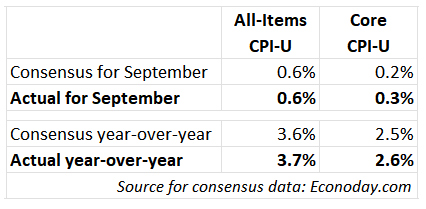
The BLS reported all-items inflation of 0.6% for September and 3.7% for the year, higher than the economists’ estimate of 3.6%. Core inflation came in at 0.3% for the month and 2.6% for the year, which is probably a bit jarring for the financial markets and Federal Reserve. Core inflation had been trending downward for three months.
Gasoline prices, of course, were a huge factor in all-items inflation. Gas prices rose 9.1% for the month, after rising 3.9% in August. Year-over-year, gas prices are up 34.2%. Even more shocking is the increase in fuel oil costs (which aligns with diesel costs), up 15.3% for the month and 74.2% for the year.
On the positive side, prices for food at home fell 0.1% in September and are up only 1.8% for the year. More from the report:
- Shelter costs increased 0.4% for the month and 3.2% for the year.
- Apparel prices rose 0.3% for the month and 3.4% for the year.
- Costs of new vehicles increased 0.2% for the month and only 0.6% for the year.
- Prices for used vehicles jumped 0.7% for the month but are down 1.5% for the year.
- Airline fares increased 1.3% in September after rising 2.7% in August and are now up 22.4% for the year.
- Motor vehicle insurance costs rose 0.1% for the month and are down 5.0% for the year.
- Costs for computer equipment rose 1.4% for the month and 9.7% for the year.
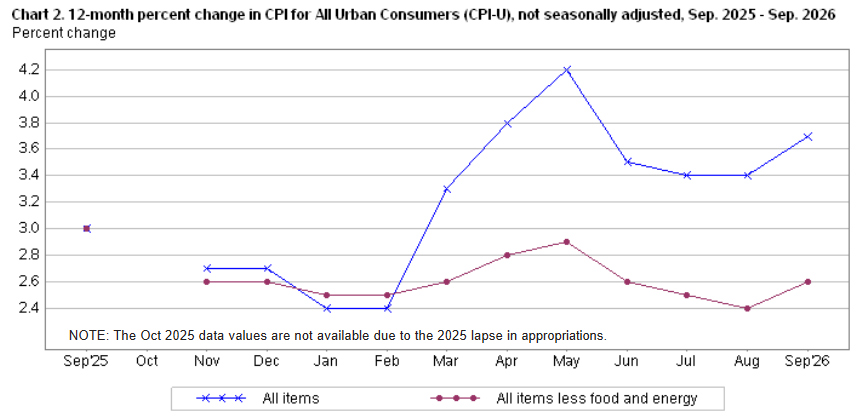
Here is the trend for all-items and core inflation over the last 12 months, clearly showing the dramatic effect of the war/conflict with Iran, which began in March 2026 and continues today:
What this means for interest rates
September’s hotter-than-expected inflation report balances off recent reports showing weaker jobs numbers. Inflation appears to be the Federal Reserve’s number one priority, but raising interest rates will have little effect on the energy shock the U.S. and world are facing. From Bloomberg today:
“It’s clear as ever that inflation is stubborn and moving in the wrong direction,” according to Skyler Weinand at Regan Capital. “While we expect the Fed to pause on any rate changes in October, we expect rate hikes to resume in December.” …
The longer energy inflation stays elevated, the more likely it seeps into core inflation, so it’s a make-or-break moment for seeing whether the oil shock becomes a more systemic problem, noted Brian Jacobsen at Annex Wealth Management. Still, he says the Fed is likely to wait until December to hike again as a lot can happen between now and then.
This is from the Wall Street Journal:
Wall Street traders dialed up their bets that the Fed may indeed raise rates when officials meet in two weeks. Traders now see a roughly 50% chance of an October rate hike, up from 22% before the report was released.
I have been speculating that the Federal Reserve will hold off on increasing short-term rates at its October 27-28 meeting, less than a week before mid-term elections. In fact, if the Fed does rate rates on Oct. 28, it could indicate (to the markets) that the Fed is ‘panicking” over fear of inflation. Maybe it should panic, but holding off to December is probably a much easier path.
Unless the current energy shock is resolved, inflation is likely to remain elevated and more increases in short-term rates are coming.
• Confused by I Bonds? Read my Q&A on I Bonds
• Wise advice: ‘Don’t die with I Bonds’
• Let’s ‘try’ to clarify how an I Bond’s interest is calculated
• Inflation and I Bonds: Track the variable rate changes
• I Bonds: Here’s a simple way to track current value
• I Bond Manifesto: How this investment can work as an emergency fund
—————————

Donate? This site is free and I hope to keep it that way. Some readers have suggested having a way to contribute. I welcome donations, any amount. And FYI, ads on this site pay for about one visit to Costco.
—————————
Follow Tipswatch on X for updates on daily Treasury auctions and real yield trends (when I am not traveling).
Feel free to post comments or questions below. If it is your first-ever comment, it will have to wait for moderation. After that, your comments will automatically appear. Please stay on topic and avoid political tirades. NOTE: Comment threads can only be three responses deep. If you see that you cannot respond, create a new comment and reference the topic.
David Enna is a financial journalist, not a financial adviser. He is not selling or profiting from any investment discussed. I Bonds and TIPS are not “get rich” investments; they are best used for capital preservation and inflation protection. They can be purchased through the Treasury or other providers without fees, commissions or carrying charges. Please do your own research before investing.


Thank you so much David!
The very high cost of diesel fuel and fertilizer is going to push up the costs of most everything else up.
I came here before reading mainstream press. Thank you!
Thanks for being all over this story.