
Plus: Reaction to Kevin Warsh’s speech at Jackson Hole.
By David Enna, Tipswatch.com
A week ago, Treasury Secretary Scott Bessent announced plans to double the Treasury’s buy-back of long-term U.S. debt, up from $2 billion to $4 billion a week through the fall. And bigger buy-backs could be coming.

The announcement, coming one day before the Treasury’s auction of a reopened 30-year TIPS, managed to drop long-term yields by 9 or 10 basis points. The effect lasted a few hours. The market quickly noticed the “drop in the bucket” amount and moved yields higher.
Why would the Treasury do this? In my opinion, it was an attempt to shift borrowing costs from the long-term (5.18%) to short-term (3.80%) to help the U.S. finance a massive (and fast-growing) federal deficit. The fiscal 2025 federal deficit was $1.75 trillion and that will grow to about $1.9 trillion in fiscal 2026.
And, in theory, the buy-backs could nudge long-term yields a bit lower, a long-time goal of the Trump administration.
This led to a savage analysis from renowned investor Stanley Druckenmiller in a Wall Street Journal op-ed titled, “Let the Bond Market Speak.” (Gift link.) Druckenmiller, it should be noted, has been a mentor to both Bessent and Federal Reserve Chairman Kevin Warsh. I advise reading the entire op-ed, but here are some excerpts:
The market’s verdict was swift and correct: This wasn’t liquidity management, it was price management—and a mistake far larger than $4 billion suggests. …
Inflation is 3% to 4% and has been above the Fed’s target since 2021. Unemployment is 4.1%, full employment by any definition. The deficit is running near 6% of gross domestic product, a number America has never before produced in peacetime at full employment. The national debt crossed $40 trillion the same week Treasury intervened. Net interest will exceed $1.1 trillion this fiscal year, more than the defense budget. …
The long-term Treasury yield is the most important price in the world. It is also the only fiscal disciplinarian the U.S. has left. …
Governments defending prices against fundamentals always lose. The only variable is how much they spend before conceding. The U.S. shouldn’t put itself on the wrong side of that trade.
Please, no more manipulation
I started writing Tipswatch in March 2011, just before the Federal Reserve launched into a decade of on-and-off bond-buying known as quantitative easing. QE is outright bond-market manipulation. This is not a conspiracy theory; it is the admitted goal of QE — to force interest rates down (and spur the economy higher).
What was the effect of this QE? It pushed real yields deeply negative and nominal yields down to as low as 0.52% on the 10-year note in August 2020. This manipulation, combined with supply shortages, lavish government spending, and generous U.S. stimulus checks, sent U.S. inflation soaring to a 40-year high less than two years later.
Here is the trend in the 10-year nominal yield over the last 56 years.
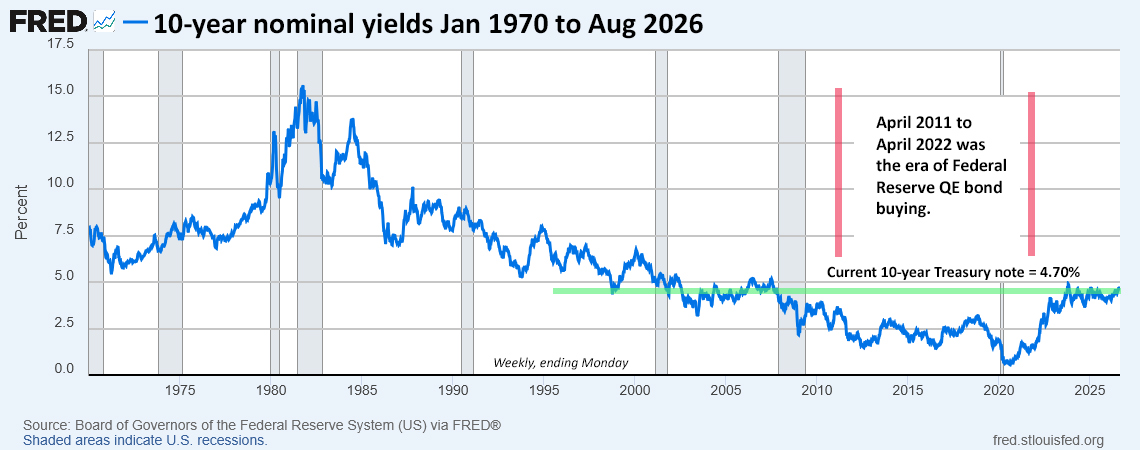
Note that the current 10-year yield of around 4.7% is actually historically low, if you remove the decade of quantitative easing. To make this perfectly clear, I created these charts of 5-, 10-and 30-year nominal yields removing the decade-plus of QE manipulation:
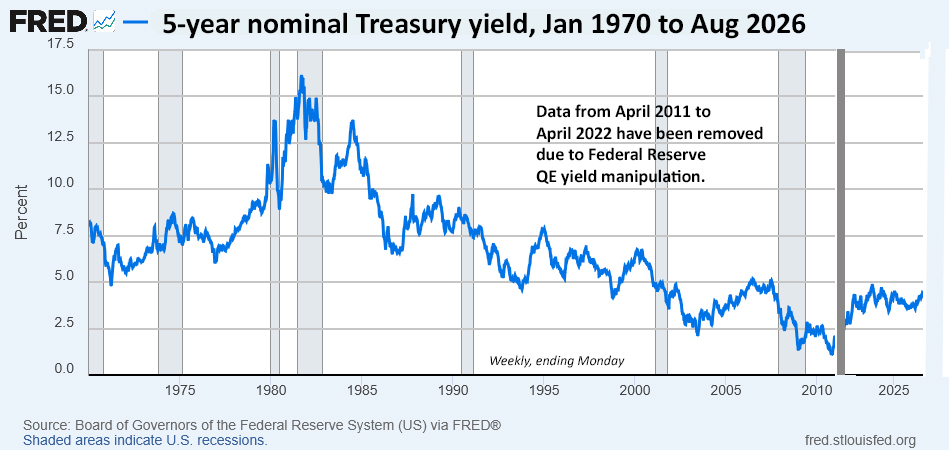
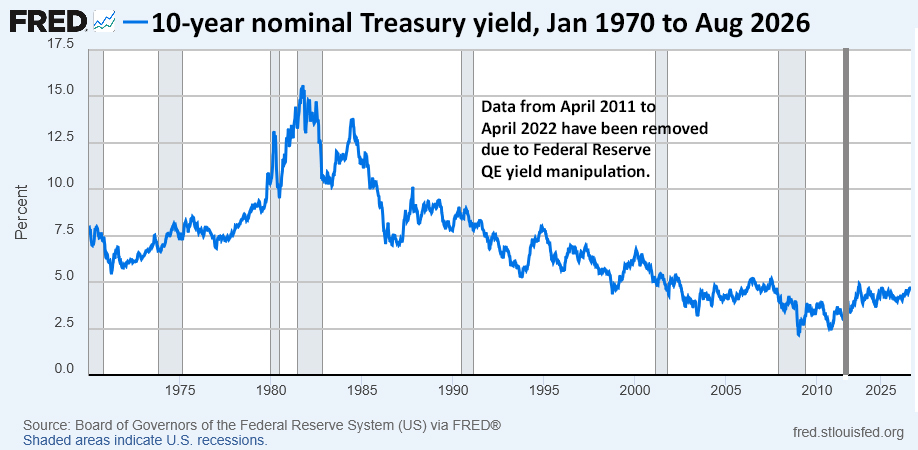
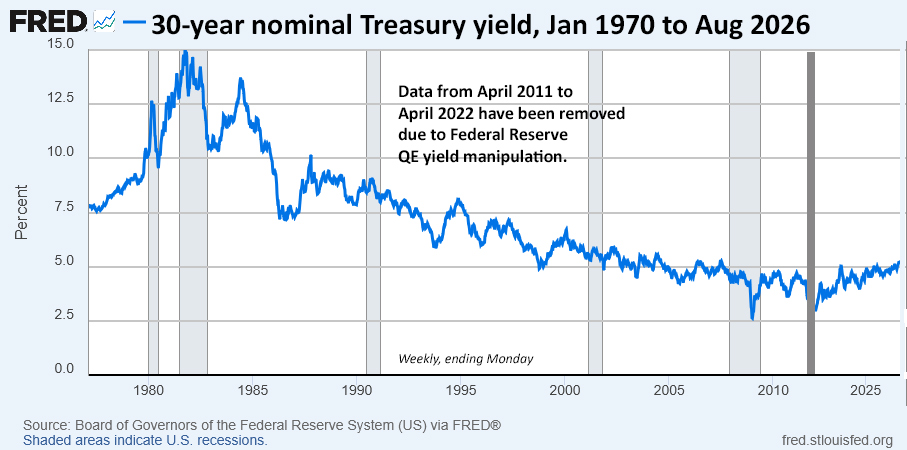
These three charts demonstrate that the mid-2026 longer-term nominal yields are solidly in the “normal” range, especially at a time of eternally increasing federal deficits, along with a relatively solid U.S. economy and strong demand for corporate financing for the AI buildout.
This is not the time for the Treasury to interfere, unless the real motive is to lower U.S. borrowing costs to pay for even higher deficit spending.
As a side note, Bessent’s move struck at the world’s confidence in the U.S. dollar, with the dollar index losing about 0.5% of its value since Aug. 18. More significantly, the buy-back announcement caused a surge in alternative currencies like Bitcoin, up 24% since Aug. 18.
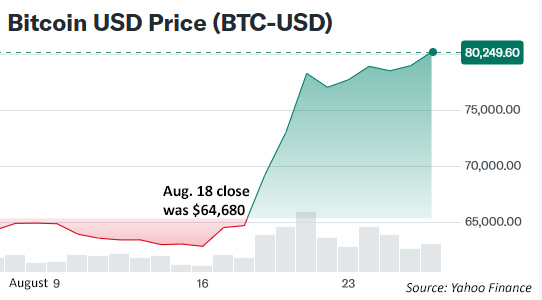
If anyone wants to offer a conspiracy theory on this, I am willing to listen.
Is inflation a factor?
Certainly. Those very high interest rates of the 1980s brought the pain needed to bring down exceptionally high inflation after the oil shock of 1973. Annual U.S. inflation rose to 13.5% in 1980. The high interest rates imposed by Fed Chairman Paul Volcker (he took that role in late 1979) broke the inflation trend, with the annual rate falling to 3.2% by 1983. Here is the trend in July-to-July annual inflation from 1971 to 2026:
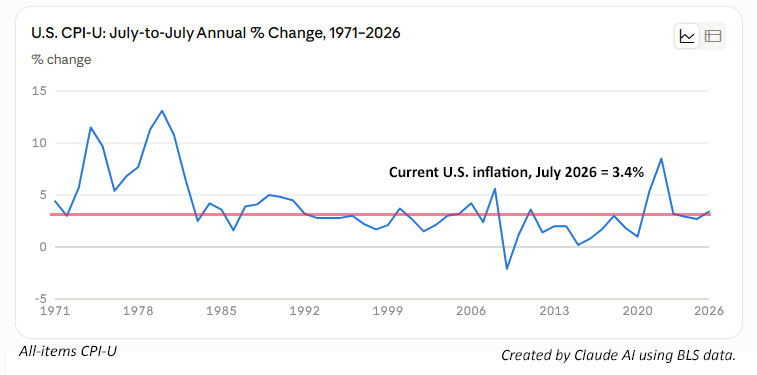
The main point of this chart is to show that today’s annual inflation rate of 3.4% is certainly not “low” and the bond market reflects this in the cost of borrowing.
Chairman Warsh’s dilemma
At his last news conference on July 25, Fed Chairman Kevin Warsh said he wants to limit the Fed’s forward guidance and let the financial markets set the way. He said:
Monetary policy matters not just by what we say or even what we do; monetary policy matters by how it affects the real economy. And these prices that we see in financial markets is one of the many ways in which it affects the real economy. We’ll be continuing to watch that market information, see how it responds to incoming events, and that can help inform our decision-making when we meet in seven or eight weeks. …
I was comforted that markets in the inter-meeting period weren’t reacting to us. They weren’t reacting to dots or to speeches. They appeared more than ever to be reacting to real-time events.
Warsh also wants to reduce the Fed’s balance sheet built through years of aggressive QE, and that means the Treasury buy-backs are working in the opposite direction from his goal.
The problem for Warsh is that Bessent’s initiative came without any actual “market” justification, except to benefit the Treasury by moving borrowing costs to lower-yielding T-bills, where the Federal Reserve has control over rates.
And there is the problem. Is Warsh now facing pressure to hold short-term rates stable, or even to lower them, to accommodate the Treasury’s gambit? From a Reuters report today:
Many investors say Bessent is fighting the wrong fight. They say strong growth, sticky inflation, likely Fed hikes and heavy bond supply, including from AI-driven corporate borrowing, are what’s pushing yields up, along with a widening fiscal premium tied to the deficit — not market dysfunction. …
Warsh has long criticized the Fed’s large-scale asset purchases, arguing such interventions should be reserved for genuine market dysfunction, with rate policy driving the employment and inflation mandates.
Update: Warsh at Jackson Hole
I just finished watching Kevin Warsh speaking at the Jackson Hole Economic Policy Symposium. My immediate reaction was that this was a good speech: somewhat specific, somewhat hawkish, and a strong statement that fighting inflation is the priority. Read the full text here.
For example, Warsh was very specific about the Fed’s favored measure of inflation (as opposed to his past attractions to alternative measures):
The Fed’s price-stability objective of 2 percent, as measured by the personal consumption expenditures (PCE) price index, is a firm, fixed target.” …
And he added this:
“The Fed’s preferred measure of inflation, the 12-month change in the PCE price index, stands at 3.7 percent, while the six-month change is 4.1 percent. … And while this summer’s PCE and CPI readings were better than expected, they do not tell me that underlying trends have meaningfully improved.”
And that the economy can handle higher interest rates:
Credit and loan markets are showing few signs of policy restraint. Certain sectors—like housing and agriculture—are showing strains. But, on balance, I would be hard pressed to describe broad financial conditions as restrictive.
Maybe I am reading too much into this, but did he give Bessent a soft slap in the face with this?
“Short-term interest rates are the predominant tool to achieve the dual mandate. Unconventional policies to spur economic activity may suit genuine crises but should otherwise be used sparingly, if at all.”
And concluded with this:
There is one signal nobody can miss: The responsibility for 65 months of sustained, elevated inflation sits squarely with the central bank. And that is where it belongs.
Here is my standard: We must be confident that underlying inflation is moving to our objective, clearly and at sufficient speed. Otherwise, we have work to do. That’s our job . . . our mandate . . . and our charge to keep.
If the stock and bond markets were looking for “future guidance,” they didn’t get it. But they did get the specific and strongly-stated goal of hitting the Fed’s inflation goal.
Conclusion
Even though longer-term Treasury yields are reaching 15- to 20-year highs, those yields can be considered “normal” if you remove 10-plus years of bond market manipulation by the Federal Reserve.
What Bessent is planning is not quantitative easing; it is shifting U.S. debt from long-term to short-term, and an attempt to nudge long-term yields down.
This is not the time for a new course of manipulation by the Treasury. It is the time for Congress and the president to get serious about reducing the upward trend in the federal deficit, whether by spending cuts, tax increases, or more probably … both.
And that won’t happen in 2026.
Also read: Federal Reserve is losing credibility, at the worst possible time
—————————
Donate? This site is free and I hope to keep it that way. Some readers have suggested having a way to contribute. I welcome donations, any amount. And FYI, ads on this site pay for about one visit to Costco.
—————————
Follow Tipswatch on X for updates on daily Treasury auctions and real yield trends (when I am not traveling).
Feel free to post comments or questions below. If it is your first-ever comment, it will have to wait for moderation. After that, your comments will automatically appear. Please stay on topic and avoid political tirades. NOTE: Comment threads can only be three responses deep. If you see that you cannot respond, create a new comment and reference the topic.
David Enna is a financial journalist, not a financial adviser. He is not selling or profiting from any investment discussed. I Bonds and TIPS are not “get rich” investments; they are best used for capital preservation and inflation protection. They can be purchased through the Treasury or other providers without fees, commissions or carrying charges. Please do your own research before investing.


My interpretation of what Warsh said:
PPE is 3.7%
The Target is 2%.
The Fed will do its job.
It sure seems like the Fed has to raise rates to do its job. We will see.
Secretary Bessent always has an insufferably smug expression on his backpfeifengesicht.
I agree. Smarmy is exactly what I think of whenever I see or hear him speak.
I still think Hassett wins the prize.
As I have posted before, and this article points out, interest rates have merely normalized from the abnormal ZIRP period. A few more thoughts.
Fredd Bloggs – the twist is insignificant, however, buybacks are announced as part of the quarterly refunding announcement; deviating from the QRA in the absence of changed conditions is suspect. Long rates around the 8/5 QRA were 5.18-5.25ish, hardly different conditions.
QE was not a major contributing factor to the post covid inflation, imo. However, to the extent it suppressed mortgage rates, it did contribute to housing inflation with knock on effects, and housing prices have yet to adjust to the normalization.
The Fed does not control or set inflation, and it is hubris on Warsh’s part to say it is a choice made by the Fed. I believe interest rate changes at this point, given changes in financial markets, are fairly impotent in their effect on the economy, unless taken to extremes. Every interest rate change impacts borrowers and savers differently, so their is more offsetting impact than people think.
Did Volcker tame inflation? That is the accepted belief, but there are some credible folks who have argued that inflation was resolving on its own. I have never dug into the details, but certainly Volcker’s increases changed market attitudes.
Our budget problems are not intractable. Our willingness to solve them is. If you get the deficit down to ~3% of GDP, things become much more manageable. Social Security? Lift the cap and more than half the shortfall is resolved, and the budget deficit reduced.
We pay 18% of GDP for healthcare, with worse outcomes, than the other developed countries that pay 12%. Can’t afford Medicare for All? Sure we can. It is a tax design question as we are already paying 18%. Corporations, individuals, the federal and state and local govts are all involved in paying the 18% – if taxed an equivalent amount, then with single payer the longer slower work of reducing inflated costs in the system can begin. Docs and providers can still be independent, just like they take Medicare today. And somebody has to process and manage claims and payments, something insurance companies are already doing and can pivot to making it their profit model.
Defense spending? We spend more than the top X countries in the world combined, yet we aren’t spending enough and are running out of munitions? That makes no sense.
On the revenue side, it makes no sense to tax capital gains at a lower rate. Dividend income, however, has been taxed previously, so there is a justification for keeping it at a lower rate.
Eliminate not for profit status. Why should citizens pay so a wealthy person can have their name on a university stadium? Deductions are essentially tax expenditures. This simplifies the tax code, eliminates workarounds, and only a small percentage are able to take charitable donation deductions anyway, mainly wealthy.
Raise rates. We became the country we are with much higher rates. We would not collapse with a few percentage points higher. If we had not done OBBA all we would have returned to is what we were doing before. It would not have been catastrophic.
None of that will happen because people have been brainwashed to believe all those things would be catastrophic. Austerity will be far more catastrophic when it comes.
A few of these key points are needed and will solve many economic issues:
Eliminate the Social Security cap
Medicare for all
Increase corporate tax, income tax and capital gains tax rates substantially, working back toward rates in the US 40-60 years ago.
Don’t whine about taxes.
Solved.
“Eliminate not for profit status.“
That would have to include religious donations then too, right?
Thank you, David, what a thoughtful essay, with great responses from your readers.
While I agree with everything you’ve said in principle, and probably also in practice, let me play devil’s advocate a bit. Bessent’s twist, executed with money borrowed short-term, does not seem to me materially different from simply changing the sizes of new offerings to skew them to the short end (there are two small differences I’ll come to in a bit). That’s something that Treasury has been doing since Yellen and no one seems to be too angry about it. But now the twist, and perhaps even moreso the cackhanded way it was messaged, is “manipulation”. Of course it is! And so is the very existence of the Fed, and so is using issuance to shape the curve! If you’re going to be up in arms about one, you should at least acknowledge having a serious problem with all of them.
What’s different? First, Treasury are buying back off-the-runs, which means they’re reducing the liquidity premium of on-the-runs. Presumably that was the justification, flimsy though it is, for messaging it as a liquidity operation. Of course there is and has long been ample liquidity in off-the-runs, but in fact Treasury can book a small profit buying back cheaper paper and issuing new at the full price, even without the twist element (which unlike the off-the-run spread is not risk-free). The second aspect, and the one I suspect is what really angered some traders and drove their messaging that the press picked up, is that any kind of sudden change in policy creates unintended, and in this instance unhelpful, winners and losers among leveraged bond traders. Fortunately the puny size of the change mitigates that. The first slight difference is actually prudent and profitable, and if managed properly is riskless. If the market doesn’t want off-the-runs, Treasury should increase issuance and buybacks until the spread is gone. The second difference is a real problem, but can be managed with more sensible planning and messaging, not only around future buyback programmes but also future issuance.
In other words, if you’re willing to allow Treasury freedom to decide how large each issue should be, I don’t see why the twist bothers you so much, because it’s just as easy to twist slowly with sizing. And if you’re not, then how should the sizes of new issues and reopenings be decided instead? The framers would have had Congress do it, but Congress is now a joke and can barely even manage to buy their own votes with OPM. Legally, the President could do it instead of delegating, but I’m not sure there’s been one in my lifetime who even knows how the Treasury market works. I don’t have an answer here, just a question. Personally, I never liked the twist when Yellen started it and I don’t like it now. And I never understood why Treasury didn’t issue hundred of billions of 10, 20, and 30-years in 2020-21 when they were yielding less than 2% as part of a prolonged era in which term premiums nearly vanished. Long-term rates under 4% are a gift from the market, take full advantage! This mismanagement alone is costing tens of billions a year already, maybe more. Yet all the ink is spilled over a puny $4b operation that would, if not for the twist element, be both profitable and riskless.
Excellent feedback. I think the problem with Bessent’s “gambit” is that it could have been done almost silently with just a press release to bill and bond buyers. Who would have noticed? They were already doing $2 billion, did anyone notice that? Instead, it came as a pronouncement, which I believe was needed to keep the president happy that the Treasury was working to lower longer-term borrowing costs. That, to me, makes this venture somewhat suspicious.
More excellent content. Thank-you Mr. Enna.
According to Merriam-Webster, suspicious is an adjective that means showing distrust, or expressing doubt.
The deficit and debt coming back to bite us has been a long time in coming. Outside of war, pandemic, or recession/depression, we shouldn’t be running such high annual deficits. You can trace it back to the 1989s and supply side trickle down economics — lower taxes, raise revenue, increase spending and we can grow our way out of our debt. You hear this very thing today from Bessent. The nice way to say it is that it is wishful thinking. The blunt way to say it is that it is delusional. It is a lie, and always was a lie.
this is why I am so glad you ended the piece by saying:
It is the time for Congress and the president to get serious about reducing the upward trend in the federal deficit, whether by spending cuts, tax increases, or more probably … both.
Too often you hear “We don’t have a tax problem! We have a spending problem,” as if a deficit is created solely by only one side of the equation. That is false. The truth is that tax rates have decreased and spending has increased, the exact result of which are deficits and debt. Growth is a legitimate third leg of the deficit stool but the stool collapses under its own weight if you don’t have the other two legs solidly in place.
Our politicians realized the sky didn’t fall when we started running large deficits and never had to make any difficult choices, so they just kept doing it. It is true that every Democratic president inherited a larger deficit from his Republican predecessor since the 1990s and left a smaller one to his Republican successor, and the opposite is the case with Republican presidents. They inherited a smaller deficit from their Democratic predecessors and left a higher one to their Democratic successors. But regardless of which party was in charge, the debt has continued to grow and it’s rate of growth has compounded at increasingly higher rates necause in order to truly reverse our national debt, you have to run surpluses and there is no political will to do what is necessary to run surpluses — raise taxes and lower spending at the same time. A few years ago we saw the downgrade of our credit rating by the credit agencies. That was the first reality check. The second one is how the bond market is responding right now. The problems keep mounting and the solutions keep getting kicked down the road. The ironic part is it’s still not too late to fix it. But we need leadership, which is the real supply side shortage.
Looks like they are trying to move the debt problem past the trump presidency.
Past the Trump Administration gives them more credit for long term thinking than they deserve. I doubt they’re looking past November 3rd.
I think this is just a preview of what is to come. In the longer-term, I don’t see how we avoid a regime of WW2 style yield-curve control. More debt leads to higher interest rates, which lead to higher interest costs, leading to bigger deficits and more debt. That spiral is a recipe for a debt crisis.
The Fed will pick the yield curve it wants, say 2% on the 10-year and 2.5% on the 30-year, and commit to buying as much as necessary to keep rates at that level. These rates will be below inflation, to create negative real yields for a decade or two to grind down the real value of the debt.
That seems to be precisely what Ray Dalio is warning about with his latest book (How Countries Go Broke – The Big Cycle) and podcast go -rounds. In fact reading his book is what brought me here and tipsladder.com. He’s a big believer in TIPs.
Thank you David for another excellent piece. A very salient and cutting recap and commentary on the actions of the Treasury, and status of interest rates and inflation when viewed from an historical perspective.
As to Warsh, to me the jury is still out but likely will be powerless and ineffective. That is due in part to political pressure and even more for fear of various repercussions: a fragile dollar, a possible liquidity triggered market breakdown, and a stock market mega bubble ready to burst.
He barks alot but so far no bite. If Volcker came back to life and weighed the unemployment rate, inflation and economic growth, he most surely would be tightening policy.
I agree with you Ralph. Warsh is set to raise rates next month based on everything he has said thus far, yet politically and right before the elections it seems improbable. His credibility is on the line over the next month.
Bessent’s credibility on the other hand is already underwater based on the way he put his thumb on the scale last week in an effort to generate headlines. It shows weakness in how he responded. Similar to his very recent temper tantrum on social media with Senator Warren.
The economy and the country needs both of these guys to separate themselves from the political climate and the daily headlines and stay focused on the important jobs they have. Or else the 65 months of elevated inflation will keep going.
I don’t expect anything but handwaving, gaslighting, and temporary measures designed to avoid market repricing, from both Bessent AND Warsh, through November.
Independent of political party, this is one of the best essays without mentioning the Unitary Executive Theory (UET) on why the UET needs explicit limits. There is currently no political wherewithal to address the deficit directly and I have lost hope in any party’s ability to do so in the near or relatively distant future. Deficits hawks used to be “party poopers” but now don’t even come to the party.
So, we hedge with TIPS and I-bonds, bemoan our state of affairs, and hope, pray or cross our fingers. The State of Michigan where I live has unrealistic budget forecasts too and I expect to experience the painful reality of high spending, insufficient revenue, and enforced budget constraints. Does anyone know of other productive options?
Signed – Looking for hope in all the wrong places?
Agreed. I’d add gold to TIPS and I-bonds.
It’s tough for any politician to get elected on a platform of either true austerity or raising taxes, so the debt marches on.
That’s surely true, but I’ll also note that it’s absolutely impossible for any politician to earn my vote without a platform of large, serious, and detailed reductions in absolute spending levels, and if that platform also includes some modest tax increases (especially tax base broadening) so much the better. Not surprisingly, I end up casting ballots with some blank spaces, but voting for more of the same can only be worse. I can’t control what other people do and I don’t bother shouting, but I get one vote and I do use it every time. Unfortunately we are now in a situation in which more than half the electorate benefits directly from runaway handouts, either owing no taxes at all or being employed by the federal bureaucracy, so meaningful change will have to originate externally. That is every bit as ominous as it sounds. We can at least hope that the bond market, of which we are a part, delivers the force behind the change. It won’t be pleasant but it beats war.
yes, I agree….but cannot blame the politicians only…..the election system itself is faulty ,based on popularity and empty promises.
Maybe we should ” elect ” our lawmakers by lot…like the jury system….with strict term limits.
This might be tough, as nobody wants to give up perks that they may have now.
And tax non useful activities….like sports in schools/colleges, gaming/gambling, many non useful parts of the internet, and special heavy taxes to many companies like Coka Cola and Starbucks that sell unhealthy /