
TIPS are more attractive, but the I Bond’s fixed rate will be rising.

By David Enna, Tipswatch.com
While Treasury Inflation-Protected Securities and Series I Savings Bonds are both inflation-tracking investments, they each have a unique quality:
- TIPS are reactive, with prices and real yields changing by the hour to reflect the current market value on the secondary market.
- I Bonds are retroactive, with a real yield and interest rate locked in place for six months, based on market trends many months ago. There is no secondary market.
These qualities can work in favor of both investments. In past years, when the Federal Reserve was forcing real yields lower (and often negative), I Bonds had a huge advantage in real yield over TIPS, sometimes by as much as 150 basis points. But that is not the case today.
Market real yields have been soaring in 2026, pushing the 5-year real yield from 1.46% on January 1 to 2.55% at the close on Friday. Meanwhile, the I Bond’s fixed rate, which is equivalent to its real yield, has remained at 0.90% through the entire year.
I consider the 5-year TIPS and I Bond to be comparable investments. The I Bond can be redeemed without penalty after 5 years, matching the maturity of the TIPS. So when you see the 5-year TIPS real yield rise 109 basis points compared to zero for the I Bond, this is an easy conclusion: TIPS are the better investment.
It’s true, though, that I Bonds have several advantages over TIPS: tax-deferred interest, much better deflation protection, a flexible maturity, continual compounding of interest, and accumulated principal that can never go down in value. For that reason, I think a “fair value” fixed rate for the I Bond is equal to a ratio of 0.65 applied to the 5-year TIPS real yield.
Today, that ratio is only 0.35 (0.9/2.55 = 0.35). TIPS are a better value. This chart compares the 5-year real yield to the I Bond’s fixed rate since November 2023. Clearly, the ratio has moved way out of whack in recent months, as the I Bond’s fixed rate remains locked in at 0.9%.
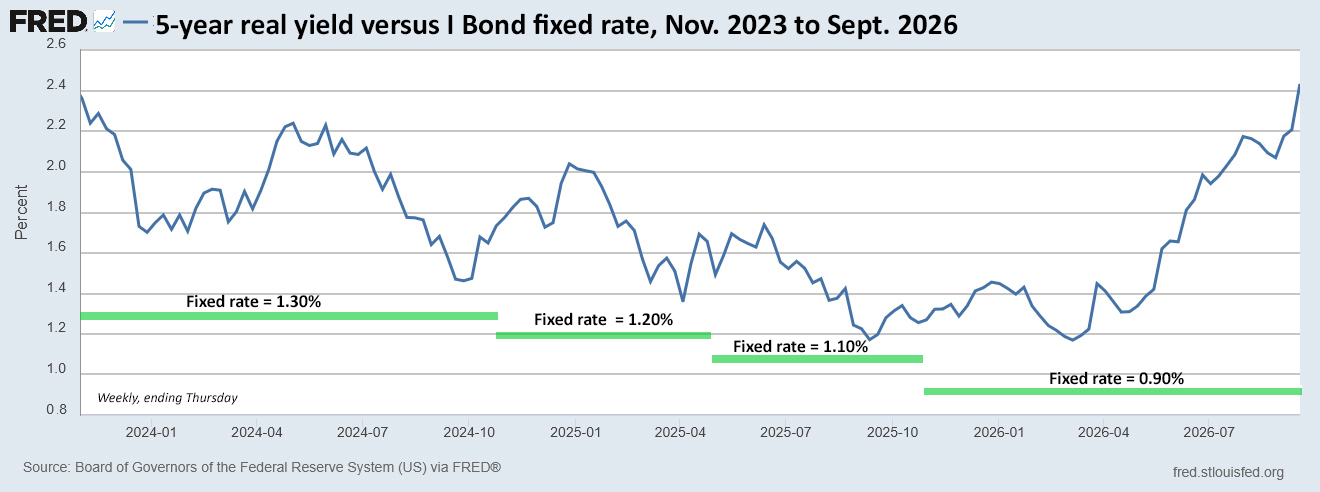
Conclusion. TIPS have a large yield advantage over I Bonds, especially for purchases through October. On November 1, the I Bond’s fixed rate is highly likely to go up, and the new composite rate should be attractive. Let’s scope out that upcoming reset.
Fixed rate: At least 1.30%
All my forecasts for the I Bond’s fixed rate are based on this formula: Take the average 5-year real yield over the preceding 6 months and apply a ratio of 0.65. This formula has been an accurate predictor for more than a decade. But of course, the Treasury could decide to ditch it. Let’s assume they won’t. Here’s the history:
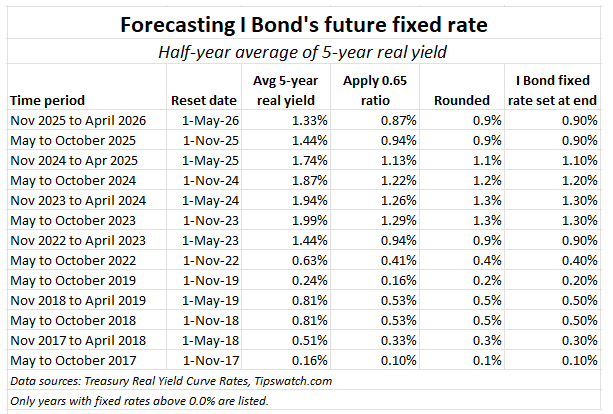
Fixed-rate projection. As of Friday’s market close, the 5-year real yield had averaged 1.951134 from May 1 to September 18. Applying the 0.65 ratio results in a new fixed rate of 1.30%, up from the current 0.90%.
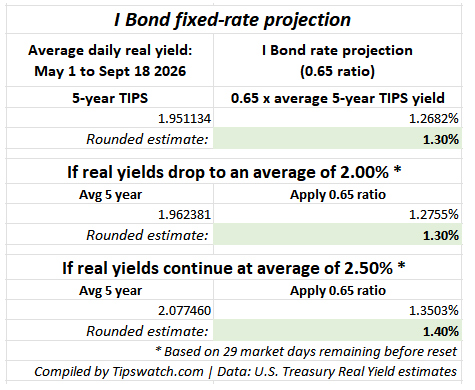
There is nearly zero chance that the fixed rate will fall below 1.30%, if the Treasury follows its traditional rate-setting methods. There are only 29 market days remaining before the reset. As the chart shows, even if the 5-year real yield miraculously dropped to 2.0% for all 29 days, the fixed rate projection remains at 1.30%.
However, if the real yield continues at the current rate of 2.50% or higher, the rate will rise to 1.40%, which would be the highest fixed rate since a reset in November 2006. This is probably a long-shot but is certainly in play.
I think a new fixed rate of 1.30% looks like the most likely result.
Remember that the I Bond’s fixed rate is permanent and is usually the most important factor in an I Bond investment. The exception is for an investor looking for a short-term investment with a high composite rate.
Variable rate
Although just one month of inflation (for September) remains in the six-month rate-setting string, this is a difficult projection. Monthly inflation has been volatile this summer, but rising gas prices this month point to a boost. How much? I’d guess something close to 0.35% to 0.40% for the month.
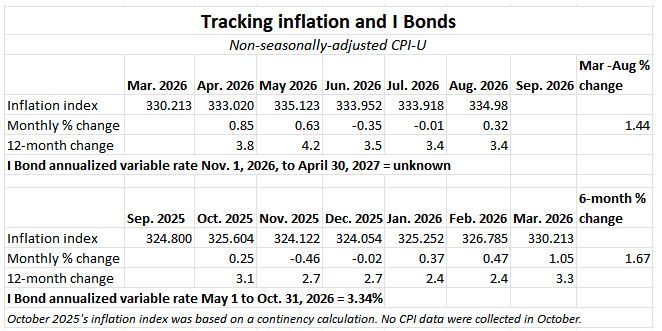
An increase of 0.35% in non-seasonally adjusted inflation in September would give you a 6-month inflation number of 1.79%, which translates to a new variable rate of 3.58%, higher than the current 3.34%. That’s an estimate!
Composite rate
If the reset settles in at 1.30% fixed and 3.58% variable, the resulting composite rate would be 4.90%, much higher than the current 4.26%. That is attractive. Again, this is an estimate. Many readers have told me they were waiting for the November reset to buy their 2026 allocation — $10,000 per person per year. It looks like waiting will have paid off.
Even I Bonds with a 0.0% fixed rate would be getting a composite rate of 3.58% for six months. Not awful. (My Fidelity Treasury money market fund is paying 3.4%.)
Qualifications
Even if the fixed rate rises to 1.40%, the math will favor TIPS. Using the 0.65 ratio versus a 5-year TIPS at 2.55%, the I Bond gets a fair-value fixed rate of 1.70%. At least 1.40% is getting closer.
I would not be surprised, however, if we get a dip in real yields in coming months. The recent run-up has been dramatic. But yields could continue rising if inflation surges higher and the Federal Reserve triggers another rate hike in October or December.
Another qualification for I Bond purchases is TreasuryDirect’s transition to ID.me for login verification, which hard-launches Oct. 28. A lot of people have been troubled by the move, since ID.me is a private company. Does that reduce the attractiveness of I Bonds, which can only be purchased at TreasuryDirect?
My feeling is that a fixed rate of 1.30% or 1.40% will be attractive enough for a purchase in 2027. I can adapt to the ID.me login. The new fixed rate will be available for purchase through April 2027. I will return to this topic in mid-October, after the release of the September inflation report on October 14.
See: TreasuryDirect is launching a controversial login system
And: TreasuryDirect provides more guidance on ID.me transition
• Confused by I Bonds? Read my Q&A on I Bonds
• Wise advice: ‘Don’t die with I Bonds’
• Let’s ‘try’ to clarify how an I Bond’s interest is calculated
• Inflation and I Bonds: Track the variable rate changes
• I Bonds: Here’s a simple way to track current value
• I Bond Manifesto: How this investment can work as an emergency fund
—————————

Donate? This site is free and I hope to keep it that way. Some readers have suggested having a way to contribute. I welcome donations, any amount. And FYI, ads on this site pay for about one visit to Costco.
—————————
Follow Tipswatch on X for updates on daily Treasury auctions and real yield trends (when I am not traveling).
Feel free to post comments or questions below. If it is your first-ever comment, it will have to wait for moderation. After that, your comments will automatically appear. Please stay on topic and avoid political tirades. NOTE: Comment threads can only be three responses deep. If you see that you cannot respond, create a new comment and reference the topic.
David Enna is a financial journalist, not a financial adviser. He is not selling or profiting from any investment discussed. I Bonds and TIPS are not “get rich” investments; they are best used for capital preservation and inflation protection. They can be purchased through the Treasury or other providers without fees, commissions or carrying charges. Please do your own research before investing.


Higher and higher the TIPS real yields go.
Where they stop nobody knows.
I bought a lot of our TIPS ladder months ago, at higher market prices, therefore lower real yields (although all at least 2% regardless of official coupon).
I forgot to tell eveyone here that I’m a contrarian indicator and that TIPS prices were sure to go down if I bought.
This is the same reason a drenching thunderstorm always arrives after I run up our water bill by putting out the sprinkler on a day when there’s been no rain for a week and the forecast predicts only a 20% chance. I’m compelled to take a philosophical approach and view the size and predictive effect of my water bill, like the prices and predictive effect of my TIPS purchases, as a kind of “service” I render to the rest of the neighborhood. 🙂
Just a reminder: Almost every person who bought a TIPS in the last 15 years got a real yield to maturity lower than the yields we were seeing this week. You have a lot of company. With TIPS, I never worry about it, especially if you got real yields above 2.0%.
I was already forced onto the ID.me boat before TreasuryDirect moved to it, so it’s not affected my I-Bond purchase decision, but it bothers me nonetheless. I still look at the silver lining that in late 2028 we could see Login.gov also be offered and ergo a way to at least off-board TreasuryDirect from ID.me.
I’ve my 2026 I-Bond money already aside in a treasury MMF, along with 2027’s IRA backdoor. I’ll have 2027’s I-Bond money aside in the coming months.
It’ll be interesting to see what 2027 brings. Having been in research in hedge funds (and other parts of finance), spending a lot of time in fixed income, my finger in the air tells me the wind likely continues blowing the way it is. Having had a front-row seat to see the warnings signs in the data of upcoming crises, I’m paying attention for when signs are obvious it’ll go sideways again.
I appreciate the posts! It’s made it much easier to have someone be a clear sanity check for sticking to my written Investment Plan Statement. I’m certainly making this year’s purchase on November 2nd, and I look forward to remaining here while I patiently plan when I make my 2027 purchase.
Thanks for the positive feedback. When you purchase I Bonds, try to set the purchase date near the end of the month and you will earn interest for that entire month. This works well right now with cash paying 3.5% to 4.0%. I think Nov. 26 would be a good date for a purchase.
I’m going to buy at the end of November, but I’d think it’d be better to buy a couple days before that. Nov 26 is Thanksgiving so just to be safe I’d do it before then. The Monday after Thanksgiving is the final day of the month so you should be fine if nothing fully processes until that Monday but better safe than sorry.
I prefer TIPS.
TIPS can be bought in an IRA, they are very liquid and, ID.ME issues aside, no need to have yet another account at Treasury.
There are two advantages to I-bonds that I can think of.
The TIPS market is not kind to small sales or purchases. You can only buy 5, 10 and 30 year TIPS at fixed intervals if you want to avoid the small loss on the bid-ask spread. You can buy an I-bond at the offered rate on any day.
Also, if rates are falling, the 6 month delay before a rate reset can work in your favor.
David, where does your .65 “fair value” of I Bonds vs TIPS come from? Do you have the calculations for this?
Why do you feel that I Bonds are comparable investments to 5 year TIPS? As you well know, they are totally different instruments. I get that the I Bond interest rate penalty drops off, but that hardly makes a 30 year I Bond equivalent to a 5 year TIPS.
Can you provide the math for these assumptions?
The Treasury appears to use a 0.65 ratio in setting the I Bond’s fixed rate, based on a six-month average of the 5-year real yield. (There is a decade of evidence for this.) So I consider that 0.65 ratio a “pretty good” estimate of a fair-value fixed rate / real yield for the I Bond versus the 5-year TIPS real yield. Since an I Bond can be redeemed without penalty at exactly 5 years, the 5-year TIPS is a comparable investment. (And it appears the Treasury agrees.) Yes, I Bonds can be held for 30 years, but I don’t recommend committing to a 30-year investment. After 5 years, redeem when you need the money. One of the advantages of I Bond is you can decide when to redeem, after 1 year with a penalty, after 5 years with no penalty, or continue holding for up to 30 years.
Thanks, that explanation makes sense. You might want to reference that in the text, so people will see where the ratio came from.
It’s off topic, but I can’t think of a better place to post!
I’m building a TIPS etf for 2034-42, which will hopefully be some bridge to social security. I’m wondering if it makes more sense to invest in ishares defined TIPS etf instead of actual TIPS. This way, all of the small interest payments along the way reinvested. And I can build the ladder in small increments. True, there’s a 0.10% management fee, but that’s pretty small.
For example, the etf maturing October 2033 (for 2024 spending) has a real yield of 2.58%. If my math is correct, I’d need $50,201 today to achieve $60,000 in October 2033.
Seems too easy, so I’m wondering if I’m missing something.
Thanks!
TIP was $130 or so 5 years ago and about $104 today. What it will be worth in 2033 is unpredictable.
I like the tax deferral characteristics of I-bonds. Almost like a non-deductible IRA. Doesn’t make up for the lower yield at this point in time, but the interest compounds tax free until you redeem. That can make the after tax returns a little higher, but like you said, it’s probably all reflected in the formula.
I like I Bonds for the same reason. But as David points out as the end approaches you have to be aware of when the I Bonds are going to mature. I bought a good amount when the limits were higher. These are going to mature at the same time that my IRA RMDs kick in. I have to figure out a strategy of maybe redeeming some of this starting a few years earlier. It’s too bad because they are paying a good rate, but I don’t see a better alternative with the higher bracket and IRMAA.
Too bad Series HH is no longer around, although I don’t believe it was ever possible to convert a Series I (as opposed to a Series EE) to one.
I was able to buy CUSIP 91282CGW5 maturing 4/15/28 with a 2.39% real yield last week. I believe the last 2 year note auctioned at 4.2%. Even if the Fed manages to get inflation to target in the next 19 months I think the TIP still wins. With rates spiking and bouncing around during the day there are some bargains on the secondary market.
I would add that nominal bonds also look attractive. We have the highest yields in quite a few years across the curve, driven by an ever-growing pile of government and corporate debt. Long term investment grade bond funds yield 6+ %. Cash yields have started to rise. Is now the moment to jump in? I hesitate because all year it has been a steady drip drip drip of bond market price declines and rising yields. Where does it stop? I surmise that technical analysis tells us that the bear market in bonds generally is continuing.
I’ve been wondering the same thing. If the 30 year nominal Treasury hits 6% it will be hard for me to resist that coupon payment. The test will be on November 12 when the 10- and 30-year nominals come up for originating auction.
From where I’m sitting, I-Bonds and TIPS are apples and oranges: The former is taxable the latter are not.
I will purchase I-Bonds in November and April ’27 (thus maxing out my ’26 and ’27 I-Bond purchases), and more 5-year TIPS next month and again in April’ 27, thus adding to my and my wife’s 5-year TIPS ladders in our IRAs, which will start rolling over in April 2027.
A fixed I-Bond rate of 1.3%+ is just too hard to pass up. With the November and April purchases, we will have $50K (plus accrued value) in I-Bonds with at least a 1.3% fixed rate.
(Incidentally, I’m paying the taxes on my I-Bonds now, when I’m in a relatively low tax bracket, in order to avoid a big tax hit when I actually redeem them in the future, which might push me into a higher tax bracket and affect me IRMAA-wise. I regard my I-Bonds as 5-year bonds, that I can redeem anytime I want after I’ve held them for 5 years, but well before I die.)
The only way TIPS would not be taxable is if you hold them in a Roth IRA. In a traditional IRA, which I am sure you know, all future withdrawals are face both a federal and state income tax (if your state has an income tax).
Of course, but the pre-RMD accruals and transactions within the IRA are entirely tax-free.
In 2026, I plan to transfer several thousand in kind (stocks) to partially satisfy my annual RMD, because I want to keep as much cash as possible within in my RMD for future TIPS purchases and RMDs. Ditto 2027.
These are the oranges; I-Bonds are the apples.
That traditional IRAs convert qualified dividends and capital gains to ordinary income is often discussed, but the fact the state income tax exemption on US government obligation interest is also lost doesn’t come up as much. Except in New Jersey apparently, although it seemingly isn’t clear how NJ residents are supposed to actually calculate and claim the excluded amount when they withdraw.
Even if I Bonds go to 2% fixed rate in the next year or two, current TIPS real yield far surpass 2%. I like I Bonds and have them as a % of my allocation, but I won’t buy more for now while TIPS provide such a higher return. I also like the tax predictability of TIPS and don’t mind paying some “phantom” tax each year to not have a huge tax hit later when I will be in a higher tax bracket. I Bonds of course are more flexible with term.
“Remember that the I Bond’s fixed rate is permanent and is usually the most important factor in an I Bond investment. The exception is for an investor looking for a short-term investment with a high composite rate.”Thank you for including the second sentence. It is often overlooked when discussing I Bonds. The 0% Fixed / 7%-9% Inflation rate I Bonds post-pandemic are the prime example.
Any ideas/thoughts about the future of the gift box? Like you, I’ve been anticipating a high fixed rate in November and perhaps in May ‘27 as well. I’d be looking to redeem and convert my lower fixed rate bonds into any current higher ones. If the gift box program remains as is, it shouldn’t be a problem. If not, I might be ‘locked out’, at least in quantity. I suppose if they do eliminate the gift box they will probably increase the purchase limits but who knows? Anybody out there have a crystal ball?
Excellent summary, as always. The ratio of 0.65 got me thinking as to what weights the Treasury assigned to various factors to bring the fixed rate on iBonds in equilibrium with the nominal rate on TIPs.
TreasuryDirect provides this cryptic information:
“The Secretary of the Treasury, or the Secretary’s designee, determines the fixed rate. The rate is based on market rates that have been adjusted to account for the value of components unique to savings bonds. These include the early redemption put option, tax deferral feature, deferred purchase feature, and Treasury’s administrative costs.”
No question that TIPS are the superior investment at this precise moment. But – if the Fed continues it’s rate hiking campaign thru the fall and winter we could easily see 1.8%+ fixed rate on the I Bond when it resets in April 2027.
Id.me transition aside – it’s looking like I Bonds are going to be quite popular going into 2027.
Two years ago I had a gut feeling the I Bond fixed rate might surpass its recent 2024 peak and hit 1.5% or higher in 2027-2028. Looks like that could happen next year (assuming current trends and the Treasury formula holds). I plan to avoid buying I Bonds this year, and will probably wait until May-Oct 2027 for my next purchase.
As for the November fixed rate, I think 1.4% is out of reach at this point. We don’t know if the Treasury makes its decision a few days before the end of each rate-setting period, so there may be fewer than 29 trading days left. If their calculation includes the last few trading days in April when yields were much lower, that would drag down the six-month average.
David – minor typo …month “point point” to a boost
I’m waiting until November for my personal account to save for a future smallish remodeling project. Then buy again in January. My two corporate accounts that I manage for others now have both TIPS from last January and I-bonds so will wait until January 2027.
They are both 501c (7) and do pay taxes at corporate rates on interest in excess of $1000 so the I-Bonds help manage that. I have 5 year TIPS in their accounts, too. Both could have near term capital needs.
Hard to beat what will likely be well above any 5 year CD rate (4.5% is best I can find). Also hard to imagine $7.00 a gallon diesel and $5 a gallon gas being readily absorbed into commodity and delivery prices while economy still appears robust from traditional metrics.
Thanks for the typo alert (and for being a careful reader). It is fixed.
Excellent summary as usual. On your final point (will the ID.me conversion deter users and affect pricing), I’d suggest “no.” I acknowledge that it’s a bit clunky to set up and can cause failures for some folks. But many people are already users of ID.me for SSA payments, Global Entry applications, or other federal govt interactions. Applying this system to Treasury Direct is fairly straightforward. And let’s not forget – the old TD website itself was a deterrent. Outdated, locking you out of accounts, poor / slow service, etc. The amount of people harmed by the ID.me switch may be balanced by those who benefit from it.
I could mistaken–I’ll welcome correction if I am–but ID.me is only a replacement for the traditional log-in path to TreasuryDirect, and will do nothing to improve “poor/slow service” for conversions of paper bonds to electronic, or transfers between accounts, or settlement of estates/trusts for deceased TreasuryDirect account holders, or anything else requiring the involvment of a human employee at the perpetually understaffed behind-the-scenes TreasuryDirect operation.
No argument on this. I meant to suggest that the poor service for password resets and resolving login lockouts should be eliminated. The ID.me conversation feels like a form of a website refresh. The rest of the janky features of TD certainly remain….
It would be incredible of POD/WITH savings bonds could automatically be moved to the survivor’s account upon death of the owner, now that through ID.me (and hopefully login.gov someday), they can map from SSN to account number with more confidence.
I just redeemed my last batch of paper bonds. It was before the id.me announcement. This time the conversion process was like greased lightning. It only took about 6 weeks. I’m guessing they have an employee dedicated to doing it now.
It might be a good time for anyone considering doing it to do it now but as they say. YMMV
For what it’s worth, I have purchased I-bonds in the past and will not be doing so again because of ID.me. There are also other problems with TD, some highlighted in the recent article “don’t die with I bonds”; I’ve also been unable to add a redemption account using their system, which then won’t let me delete the nonfunctional one and try again… taken together, it’s become simply too much trouble. There are rare moments in time when I-bonds are appealing for intermediate-term savings, but I will just forgo the extra returns at those times. If they were to bring back paper bonds, I would consider them again. Otherwise, I’m not interested in new bonds if I have to use TD, and I will be filing form FS 5512 in January to redeem the ones I have. Voting at the ballot box is basically useless, but I also vote with my dollars and they won’t be going to TD ever again. I also sent them a note explaining what I’ve just said here. Obviously they are free to ignore me, but their appetite for borrowing is voracious and they would be wise not to turn away lenders. If Mr. Trump wants lower borrowing costs, he could start by telling Mr. Bessent to listen to his lenders.
Re: “If they were to bring back paper bonds, I would consider them again.”
Another advantage of paper bonds was that Treasury guaranteed to replace them if they were ever lost or stolen. But Treasury makes no such promise concerning electronic bonds. (I’m not commenting on the likelihood that anyone’s electronic bond holdings would ever be stolen or hacked or whatever. I’m just observing that, where paper bonds were concerned, the promise of replacement was explicit, but with electronic bonds it is not.)
My wife and I had a lot of paper I bonds. If making the decision now, with benefit of hindsight, we probably wouldn’t have converted them to electronic–not just from any truly serious concern about theft but combining that Treasury protective disclaimer for electronic bonds plus the glacial slowness of TreasuryDirect customer service plus the barriers to settling an estate or trust with TreasuryDirect holdings plus our distaste for the coming ID.me log-in monopoly.
The problem with paper bonds is that fewer and fewer banks will redeem them. Does Bank of America still do it?
Per Wikipedia’s Saving Bond Entry:
As of 2023, redeeming paper savings bonds is very difficult, as most banks decline to do so. The New York Times reported that the reasons banks gave for this were “the equivalent of ‘sorry, we just don’t feel like it.'”[5] Where bonds are accepted, redeeming them can be a very onerous and time-consuming process.[5]
At any rate, they are no longer issued and it seems virtually impossible that they will be revived.
Also this from Wikipedia:
The fixed rate [I Bonds] is determined by the Treasury Department, which has not disclosed how that rate is set.[14]
The footnote is to Tipswatch Q&A’s