
Yields are soaring. Is inflation the cause? Not exactly.
By David Enna, Tipswatch.com
Treasury Secretary Scott Bessent, when criticized, often says the United States has the “best-performing bond market in the developed world.” As evidence, he points to successful Treasury auctions in recent months.
But then came the $70 billion auction of a 5-year Treasury note on September 23. The auction generated a shocking result: A nominal yield of 5.033%, up 64 basis points from the same auction in August; it was the highest yield for this term since June 2006. The bid-to-cover ratio was weak at 2.21.
That was followed by last week’s 7-year Treasury note auction with a similar result: A high yield of 5.085%, up 57 basis points from the August result.
This led to a troubling Wall Street Journal headline: “A Perfect Storm Is Raging in the Bond Market“.
From an intractable conflict in Iran to a seemingly indestructible U.S. economy, it just “doesn’t make sense to a lot of people to own bonds here,” said Christopher Sullivan, chief investment officer at the United Nations Federal Credit Union. … All in, it was the worst day in nearly 18 months for U.S. government bonds.
Ironically, this surge in longer-term Treasury yields comes a month after Bessent launched a repurchase effort to lower the Treasury’s costs of borrowing, a move that was poorly received by the bond market. Three weeks later, the Federal Reserve raised its key short-term interest rate by 25 basis points, more or less counteracting Bessent’s efforts.
From Bloomberg last week:
“It’s rare you get a move like this in bonds,” said Dave Aspell, co-chief investment officer at Mount Lucas Management LP. “The Fed has hiked again, inflation is clearly not at target. The economy is doing okay and there’s a large amount of government spending.”
Can we talk about U.S. debt?
In my opinion, today’s interest rates are where you would expect them to be in an environment of strong economic growth, excessive federal deficits, soaring corporate borrowing for an AI build-out, falling foreign demand for U.S. debt, and supply-shock inflation rolling across the nation.
Why is there such a great need for the Treasury to borrow? And at lower rates? Let’s take a look.
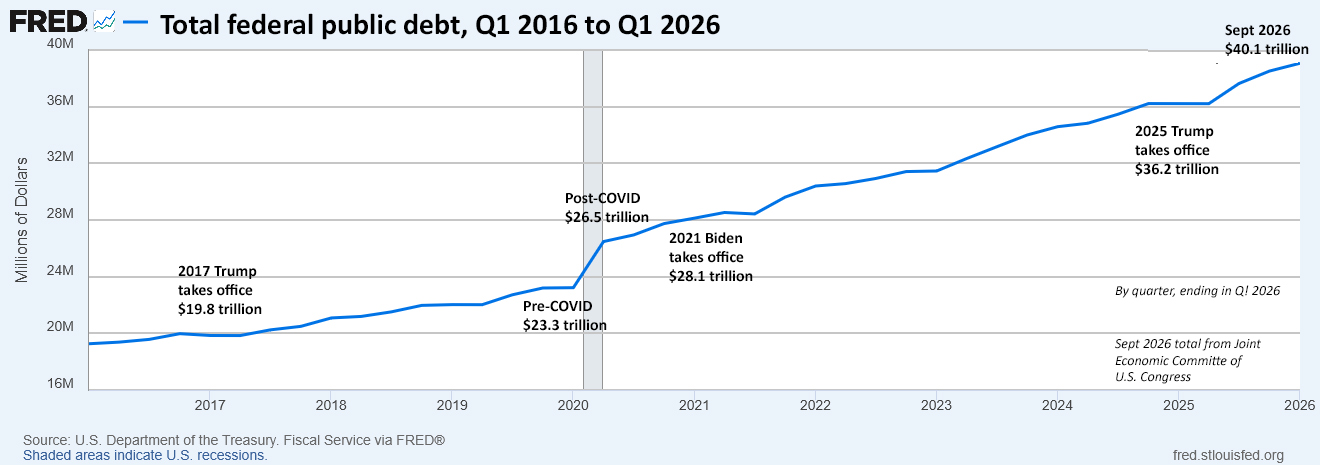
Through the 10 years of Trump-Biden-Trump presidencies, the U.S. debt has more than doubled to $40.2 trillion. The increase appears to be accelerating in the wake of Big Beautiful Bill tax cuts and massive spending dedicated to the war with Iran.
Obviously, higher deficits mean higher borrowing by the Treasury and that is coming at a time of higher interest rates. There you go … a perfect storm.
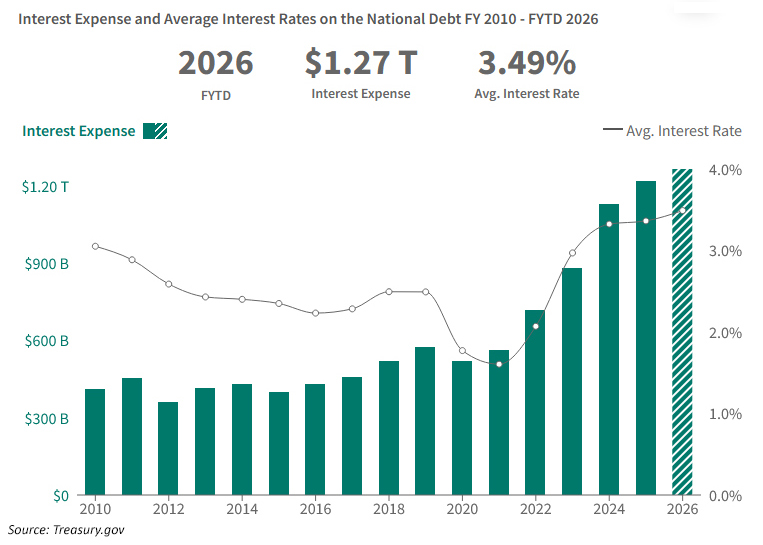
The Treasury is projecting that interest expenses for the U.S. government will increase to $1.27 trillion in fiscal 2026 (which ends this month) — and that was with 3.49% borrowing costs. Both the amount of borrowing and the interest costs will rise in fiscal 2027. The 4-week T-bill is now trading at 4.04% and is likely to go higher.
With the U.S. government expecting about $5.6 trillion in revenue for fiscal 2026, interest expense is now 23% of revenue.
Consider this: The U.S. deficit of $40 trillion caused $1.27 trillion in interest expense this fiscal year, which adds to the deficit. At 4.25%, interest on just that interest will cost well over $55 billion in fiscal 2027.
Foreign demand is slipping
After 20 months of bullying, insulting, and tariffing its strongest allies, the United States could be triggering a buyer’s strike among foreign central banks. This is a difficult premise to confirm, however.
There is some evidence of a buyer’s strike in the Treasury’s report titled “International Capital Data for June“. It shows that net foreign purchases of U.S. T-bills fell from $250.5 billion in the 12 months through June 2025 to just $49.4 billion in the 12 months through June 2026. Inflows to Treasury bonds and notes also fell from $561.1 billion to $329.3 in July 2026.
This is fairly strong evidence that foreign buyers, including central banks, aren’t as willing to pour money into U.S. Treasurys. It could be a side-effect of tariffs, because trade surpluses with the United States result in U.S. dollars that are often invested in the U.S. Treasury market.
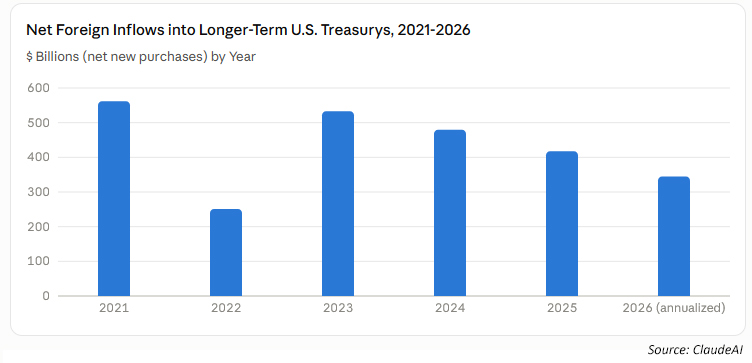
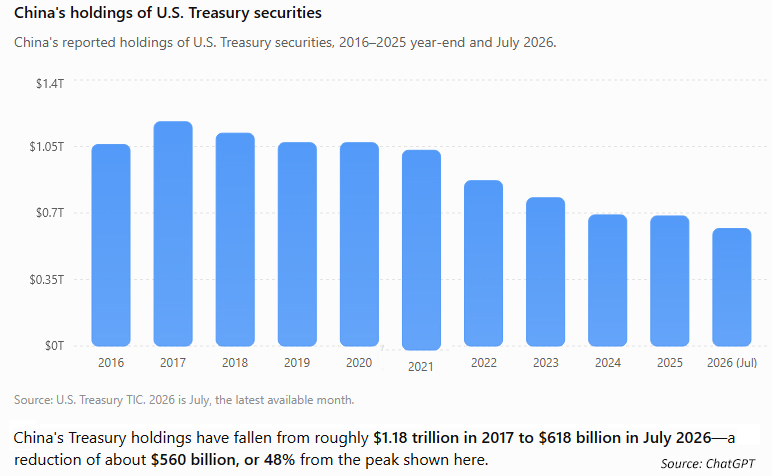
The main point is that declining inflows of foreign investments in U.S. Treasurys — at a time of rising borrowing needs — cause demand to soften and yields to rise, as we have seen.
The inflation factor
I often hear financial commentators point to rising inflation expectations as a root cause of higher Treasury yields. Certainly, inflation is a factor, but not a primary factor. U.S. all-items inflation is currently running at 3.4%, above trends of the last two years because of the oil shock triggered by the Iran war. Take out food and energy and you get core inflation at 2.4%, the lowest rate in more than five years.
Real yields are rising, and so you might assume inflation has to be the reason. But it isn’t. In fact, I would argue that real yields are rising simply because nominal yields are rising. From Reuters last week:
Federal Reserve Bank of Cleveland President Beth Hammack said on Friday that surging bond yields are not being pushed up by inflation fears. When it comes to the jump in government bond yields, “it’s real rates that have moved up more than the inflation expectations,” Hammack said.
“We’re reasonably well anchored from an inflation expectations perspective” and rising bond yields reflect a solid economic outlook, competition for investor cash due to strong tech sector investment, as well as market participants adjusting prices to deal with the monetary policy outlook, the official said.
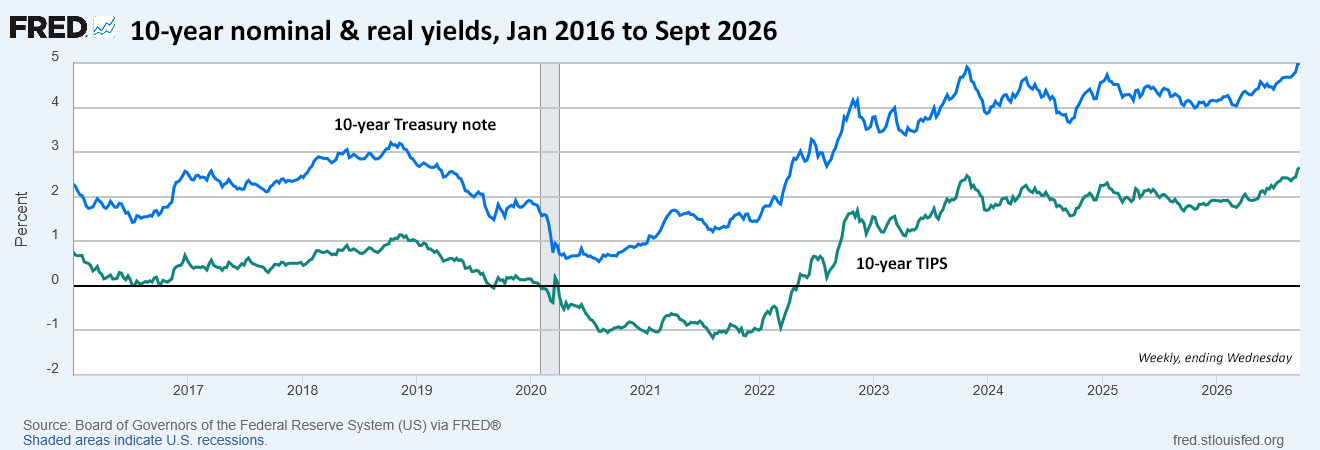
In this chart, notice the gap between the 10-year nominal yield, which is surging, and the 10-year real yield, which is also surging — at nearly the identical pace. The gap is the 10-year inflation breakeven rate, which is a measure of inflation expectations. Here is the breakeven trend for the same period:
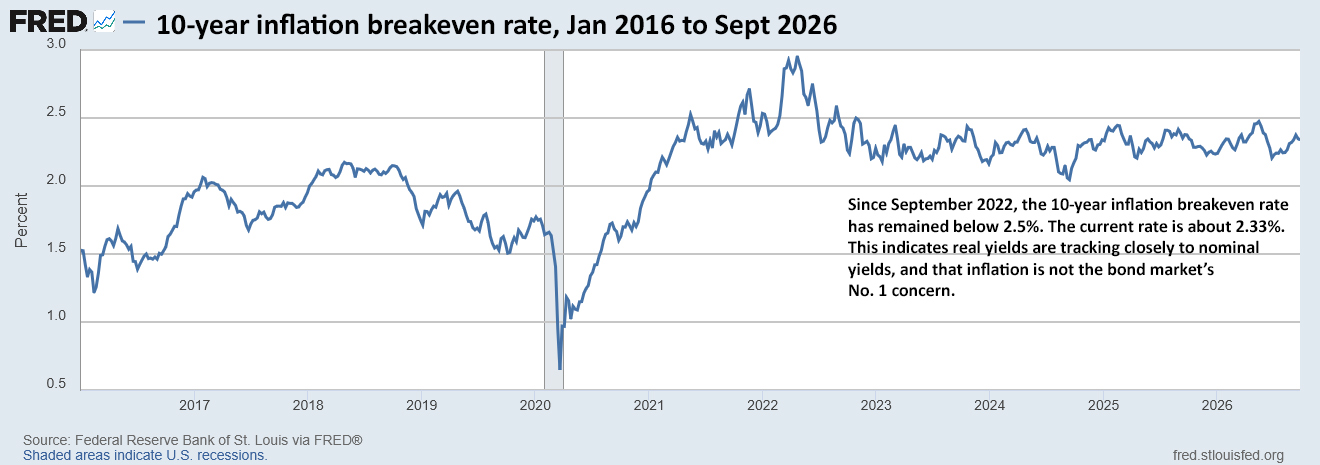
This chart shows inflation expectations have been remarkably stable over the last four years. I consider this pattern highly unusual, and it shows that inflation is NOT the primary cause of elevated real and nominal yields. In fact, if inflation expectations were the key factor, real yields would be declining versus nominal yields, resulting in a higher inflation breakeven rate.
In essence, TIPS and nominal bonds are trading at equilibrium — yields for both are rising, indicating weaker demand for both at a time of higher borrowing needs.
Conclusion
“You can’t keep dumping duration into a market that doesn’t want it.”
That quote is from economist Freya Beamish in her excellent (and entertaining) team podcast, Perkins vs. Beamish. The latest episode is titled, “Buy the Bond Blow-Up?“

I’m going to say again that today’s elevated real and nominal Treasury yields reflect our current reality of a healthy U.S. economy, strong job market, surging borrowing needs, depressed foreign investments, and supply-shock energy prices that could begin spreading across the U.S. economy.
What changed in recent weeks? First, we got the Treasury secretary attempting a slippery run-around to lower longer-term yields (failed). Then the war with Iran expanded into a regional conflict, sending oil prices higher. And then the Federal Reserve raised interest rates, probably the first of several increases into next year.
Add to that about $400 billion in corporate borrowing in 2026 to fund the AI build-out. For the bond market, this is “the new normal.”
For what it’s worth, let’s end with a “more pain to come” video featuring Grace Peters, co-head of JP Morgan Private Banks’s Global Investment Strategy:
Also see:
- Trump just opened the Pandora’s box of inflation
- Secretary Bessent, take note: Treasury yields are not ‘too high’
- Schwab analysts weigh in on bond-market disruptions
—————————

Donate? This site is free and I hope to keep it that way. Some readers have suggested having a way to contribute. I welcome donations, any amount. And FYI, ads on this site pay for about one visit to Costco.
—————————
Follow Tipswatch on X for updates on daily Treasury auctions and real yield trends (when I am not traveling).
Feel free to post comments or questions below. If it is your first-ever comment, it will have to wait for moderation. After that, your comments will automatically appear. Please stay on topic and avoid political tirades. NOTE: Comment threads can only be three responses deep. If you see that you cannot respond, create a new comment and reference the topic.
David Enna is a financial journalist, not a financial adviser. He is not selling or profiting from any investment discussed. I Bonds and TIPS are not “get rich” investments; they are best used for capital preservation and inflation protection. They can be purchased through the Treasury or other providers without fees, commissions or carrying charges. Please do your own research before investing.


There is a lot of noise as to what is going on in the bond market. While many factors contribute or sound rational, simply look at the chart of the ten year.
When did it start rising? End of February. What happened then? We bombed Iran.
Since February, is the economy stronger or weaker in a significant way? Not really. Since February, has CPI gone up in a significant way? Depends on your definition of significant, but you can argue both ways. Since February has the debt and deficit of the US really changed? No. Basically indicators are +/- what they were before, within a bouncing range. Remember, we had rates pretty near current rates in Oct 2023.
The pace of the increase accelerated in September. What happened then? The conflict with Iran escalated/became more intractable, and it became more clear there is no quick resolution forthcoming. Diesel prices rose well above the past highs and became news.
The war is definitely a factor because it creates uncertainty, for both inflation and the deficit. I call tariffs and the Iran war “self-inflicted wounds.” Without those factors, inflation would probably be closing in on the 2.0% target, the budget deficit would be lower, foreign investors would have kept in Treasury investments, and the Fed would have moved to cut interest rates. There’s the alternate reality.
On the other hand, the AI borrowing boom would be continuing, the job market would be solid, and economic growth humming. So rates would need to stay elevated, I think, without the turmoil.
On the other hand, we’d have a nuclear armed Iran capable of hitting mainland US… so there’s that….
Sleepy, no politics, just information here. You must’ve forgotten we were told from the horse’s mouth that Iran’s nuclear weapons program was completely obliterated last year (not diminished, not set back, obliterated).
And you must’ve been unaware of our intelligence agency consensus assessment stated under oath before Congress by the Director of National Intelligence that indicated Iran was not actively developing a nuclear weapon before the war started.
So we went to war to prevent a non-existing non-event or for unjustifiable reasons left unsaid. David describing tariffs and a war started on false pretenses as “self-inflicted wounds” couldn’t be more apt given the information above and the lack of any urgency to act in such an extreme manner.
And before Liberation Day in April 2025, inflation had declined from 2.9% inherited to 2.4%. It was indeed headed to the Fed’s 2% target. Instead, it has risen 1% since then, and as David reports here, the financial ramifications we are experiencing as a result of these two choices include higher interest rates, worse deficits and debt ($20 trillion in 2017, $40 trillion today), depressed foreign investments, supply-shock energy prices, and increased debt payments at higher rates which were already unsustainable beforehand.
Wait, it turns out that ticking off all of your potential lenders when you need to borrow constantly is potentially problematic?
So if other countries are reducing their holdings of Treasuries to reduce dependence in the U.S. and are buying other things like gold instead, at what point does the Fed have to step back in to buy our government’s debt (at all maturities) to compensate for the waning demand and high level of interest rates to service the growing national debt?
An interest bill of $1.27 Trillion in Fiscal 2026 alone is staggering to say the least…
It’s certainly fair to assess recent (and even not so recent!) fiscal policy as “irresponsible”; But David uses the term “stagflation” as a possible scenario–now that is very bad–and hard to fix. Hope that is not where we are headed!
David, what concerns me most is the doubling of the debt from 20t to 40t so quickly. If the endgame on that is for a country to inflate it’s way out of debt, then it makes me fear auction on note and bonds will continue to be poor like last week’s 5Y. And if that happens then why should an individual investor such as me get excited for these ‘juicy yields’ if I think they will continue higher? It would seem that TIPS would therefore be the best play for now.
Since I write about TIPS and follow them closely, I am always going to prefer TIPS over a nominal Treasury, especially with real yields reaching 2.5% and higher. But I sometimes use T-bills and notes for money set aside for 2 years or less.
Does the Social Security Trust Fund increasingly liquidating the nonmarketable Treasurys in the fund have any role in the public debt market and rising yields? Or is it still small relative to the total debt? I have seen Gundlach remark about this.
For background, before 2010, Social Security tax revenue plus revenue from the income taxation of Social Security benefits was enough to cover the benefits. Every year, the trustees had extra tax revenue, plus reinvested interest, to return to the Treasury in exchange for nonmarketable, redeemable on demand securities to hold in the trust fund. From 2010-2020, the trustees dipped into the interest but not the principal to cover payouts. Then in 2021 the reserves started dropping as the trustees had to start liquidating the nonmarketable securities to cover benefits: $56 billion in 2021, 22 billion in 2022, 41 billion in 2023, 67 billion in 2024, and 160 billion in 2025. Those are from the “trust fund financial operation” sections of the annual trustee’s reports. The 2022 interest rate spike lines up well, but of course correlation does not imply causation.
I am convinced that the standard Treasury market and the TIPS market have become independent of each other and have lost any predictive value.
I came to this conclusion because 5 years ago when 5 year Treasuries were yielding 1% when inflation over the past year had already been 5.4%. IOW a five year return would be been wiped out by inflation in its first year. What sane investor would invest in such a product, particularly since breakeven inflation was 2.4% and consumer expectations were showing 5.3% for the next year and 4.2% for three years into the future?
The early 2020s were an extreme example of how badly breakeven inflation forecasts of actual inflation perform. Since then TIPS have pretty consistently outperformed regular Treasuries, indicating that either bond investors are consistently stupid or that the markets just operate independently, driven by different investment metrics.
Five years ago (and earlier) the Federal Reserve was using quantitative easing (“financial repression”) to hold interest rates very close to zero. At the time, I Bonds were the investment choice because they would at least track official inflation, independent of any set interest rate. TIPS were yielding well into negative real yields, but as inflation surged higher, TIPS out-performed nominal Treasurys, and that has been true for a decade. See: https://tipswatch.com/tips-vs-nominal-treasurys/
I repeatedly say that the inflation-breakeven rate is a measure of sentiment and is a lousy predictor of future inflation.
I just got around to reading JK Galbraith’s A Short History of Financial Euphoria (1990) and it of course brings up the 1987 stock market crash. Afterwards, there were apparently congressional hearings that blamed the federal deficit, and even the trade “deficit”…
The reality that massive speculation, leverage, and manic greed ran the market up and down was basically brushed aside at the time.
We’re heading down that road again.
But in the bond market… in addition to the insults, tariffs, and warmongering that have cloaked massive self-enrichment and corruption… it’s been clearly stated that the people running things want the USD to go down. So I don’t understand why anyone would be curious as to why foreign buyers might perchance not gobble up US treasuries. The White House has been partly knocked over, do you look at that and trust it?
I believe I will just continue to purchase a mixture of bonds including TIPS at these rates.
Mark, I think Scott is referring to the Greatest Generation who are long gone and mostly lived within their means. You seem to be referring to those of us who currently are grandparents. I cant say you are wrong on the pointless wars. The entitlements argument I have heard since I was your age
What’s your take on this?
”When rates climb at such a rapid pace, history tells them something bad tends to happen.”
The 10-year yield saw its most rapid one-day increase since April 7, 2025, on Wednesday, rising further on Thursday to top 5.17%, quite a move considering two weeks ago it was below 4.8% and at one point in August, it was below 4.6%.
“Something always breaks,” proclaimed a recent note from John Roque, head of technical analysis at 22V Research.
Roque pointed out on a chart of the 10-year Treasury yield going back the last five decades 16 instances where it experienced a rapid advance like it is now. During each and every move, some sort of financial calamity resulted. While the scale of the crises varied in their market impact (from the jarring-but-short-lived Silicon Valley Bank failure of 2023 to the 1987 stock market crash), the jump in yields almost always led to some sort of disruption to financial markets that weighed on risk assets.
https://www.cnbc.com/2026/09/24/history-shows-financial-calamities-occur-when-rates-rise-rapidly-like-this-something-always-breaks.html
“Roque pointed out on a chart of the 10-year Treasury yield going back the last five decades 16 instances where it experienced a rapid advance like it is now. During each and every move, some sort of financial calamity resulted.“
In my uneducated opinion this is thinking about it backwards. The yield is set by what the buyers believe will happen. That in and of itself shouldn’t be enough to cause what follows.
Marce, sure there is a potential for something breaking. The danger is that some “very big” financial institution was betting the wrong way and will go down in flames. Just a few months ago, the market was pricing in two rate cuts and now is pricing in two or three rate increases, or more.
Anyone have opinion on the various repricing of the debt ideas going around? Stable coin, reprice gold reserves, etc?
Since you haven’t specified what ideas those are, or what “repricing of the debt” means, no. The US Treasury almost certainly cannot unilaterally change either the coupon or maturity date of any outstanding security; the 14th amendment to the Constitution states that the “validity of the public debt of the United States, authorized by law… shall not be questioned.” The Supreme Court held in 1935 that Congress could not override the gold clause in the outstanding Liberty Loan bonds (i.e., devaluing the dollar did not alter the government’s obligation to pay these bonds in gold at the exchange rate in effect when they were issued). Today’s Treasuries don’t have such a clause, so the dollar could be devalued and the bonds paid in less valuable dollars, which of course in fact happens continuously. But given the Court’s interpretation, it is difficult to imagine that any unliteral change, either into some other currency or to the maturity date or coupon rate of any outstanding bond would be possible even for Congress, much less the Treasury itself. This is pretty much at the very bottom of my list of risks when it comes to buying Treasury securities. Straight up default seems more likely.
What would be more interesting is a challenge to a redefinition of the CPI-U made (one might think) solely for the purpose of reducing the government’s obligations on TIPS. The problem is that such redefinitions have been made before and I have not found any record that they were challenged at that time on this basis. Still, the TIPS market is still pretty new and it might depend on exactly how the index is changed and what the messaging is around it. Let’s hope such a case never becomes necessary. But TIPS are a tiny fraction of outstanding debt, so even redefining the CPI-U as “100, always” wouldn’t have any material effect on the debt problem, other than making it permanently impossible to issue TIPS again. So I assume you mean something else, which I think I covered above.
The most likely scenario is simply that the Fed continues to hold interest rates artificially low to inflate away the debt, as it has been doing since the 1950s (in fact, much longer). The problem of the moment is that Congress has become so profligate that even that isn’t enough any more. There isn’t any way out but to cut spending deeply and permanently, and probably raise taxes as well, and Congress has shown no political will to do that. That’s the sum total of the story in the bond market: the fear has become real. The whole so-called AI buildout is malinvestment on a massive scale and certainly contributes something, but those risks are concentrated in a relatively small part of the corporate sector and for the most part would only lead to higher spreads. The Treasury market weakness is about the political failure of the United States. Nothing else.
1.The GENIUS Act was signed into law on July 18, 2025, and establishes the first comprehensive federal framework for payment stablecoins in the United States. Payment stablecoins are digital assets pegged to a fixed value, typically $1, and used for payment or settlement. Under the GENIUS Act, issuers must hold at least $1 in permitted reserves for every $1 of stablecoins issued, with permitted reserves limited to low-risk, government-backed assets such as Treasury bills, insured bank deposits, repos backed by T-bills, and central bank reserves.
Potentially, More demand for our debt. More demand at auction is good for debt, bad for little guys like us.
2. Repricing gold reserves, to market price, could improve the Treasury’s balance sheet and fiscal optics, potentially making it easier to manage the debt.
@gg80108, the Treasury’s gold holdings are irrelevant. Their book value even moreso. At current market exchange rates, their gold would buy a little over $1t. If they tried to do that quickly, it would be more like $700b. A drop in the $40t bucket of debt. No one in the bond market cares in the least. Promise.
As for the “GENIUS Act”, well I hate to break it to you, but Congress’s naming of bills has become newspeak. The only thing you can be sure about is that a bill’s effect will be the exact opposite of it’s name. We already have plenty of money market funds that issue shares on a full reserve basis backed by Treasury bills. Hundreds of them. There is no reason to think there would be more demand for debt securities denominated in such a currency, and of course even more bills would also have to be issued to back them. Really. Adding another middleman (and associated counterparty risk) will not get anyone excited about Treasuries. Promise.
There are only a few things that could happen to bring down intermediate to long term Treasury yields. A substantial recession. Deep and permanent spending cuts enacted by Congress. Dramatic changes in global trade that somehow result in a large US surplus. Geopolitical changes, probably resulting either from war or the resolution of war. There’s not much else. All of these things have happened before. They could happen again. Whether they do, for now, is politics, not economics. In the long term, it’s all economics, and what must happen will happen. The things you’re talking about won’t be included because they are neither necessary nor relevant.
Thanks David. Would you agree that this unusual situation make TIPS particularly attractive (cheap) right now? I mean, TIPS perform best when bought ahead of unexpected inflation. Now, we have a TIPS market seemingly looking through a supply shock and ‘not expecting’ at least some short-term inflation in the coming months, which seems an obvious result to me. I bought some 5 year TIPS last week at 2.65%. Yields can always go higher but if they do I’ll probably buy more.
I’d say TIPS do look very attractive, even without unexpected inflation. That does depend on avoiding a U.S. recession. In that case, possibly, inflation could go down strongly and nominal Treasurys would win out. Seems like stagflation is the more likely scenario. Inflation staying high but downward pressure on interest rates. TIPS funds do well in that scenario.
Which to mind augurs for 5 year nominal purchases as well. Coming soon….
If there is a recession and the Fed lowers interest rates via the Fed Funds rate and possibly even QE, bond prices should rise…the opposite of what is happening now. Who knows, today’s fixed rates new TIPS might even exceed coupon rates on standard 5 year Treasuries, which yielded less than 2% from 2019 to 2022.
The real problem is if rates rise and stay stubbornly higher, and you have to sell before maturity, you’ll take a loss.
Thank you for this clear and concise explanation of the crazy fiscal environment we are in. I look forward to your articles and try not to miss any.
I “second the motion.” This David column is a really superb synthesis of why things are the way they are, and what it means (or may come to mean, depending on the path things take in the future). A sort of round-up of information which makes far more sense when gathered like this than it does in day-by-day, hour-by-hour, event-by-event news articles in the financial and mainstream press.
If only Congress had been following our grandparent’s common sense of living within our means; we’d have a balanced Federal budget, low debt to GDP ratio, low interest rates, low inflation, greater prosperity … oh wait, you mean the mess we’re in was 100% avoidable after all?
Our grandparents created this mess by voting themselves entitlements that we were expected to pay for. At the same time, they sent politicians to Washington, D.C., who mortgaged our future in pointless foreign wars while blaming “others” when we grumbled! Nostalgia is a myth!
you mean the ones who fought and died in wars for freedom?
The Treasury Department decided to fund the deficits by issuing short term Treasurys as the long term debt instruments matured. That worked fine when we had a steep yield curve and short term rates were low. Short term rates were low as an accommodation for the pandemic.
I anticipate a series of rate hikes to slow the economy. Look at the “dot plots”. “The Fed” will get lower inflation but we will get unemployment. As the *economic cycle* progresses to a slow down, the government will not have the capability to stimulate the economy with tax-cuts or spending programs because “high cost” debt financing will be gobbling up the resources. Then what?
Appreciate the author’s measured language as we are experiencing the most irresponsible government fiscal policy.