New 10-year TIPS gets real yield of 1.985% to solid investor demand

By David Enna, Tipswatch.com

The Treasury’s largest 10-year TIPS auction in history got a warm welcome from investors, generating a real yield to maturity of 1.985% — a bit below expectations, an indication of solid demand.

The auction size was $21 billion, up from $20 billion at the most recent originating auction in January, and up from $19 billion last July. But investors were not daunted. The “when-issued” yield prediction for this auction was 1.99%, but the result came in slightly lower, a good indication of demand. The bid-to-cover ratio was 2.41, also showing decent demand.

This is CUSIP 91282CNS6, a new 10-year Treasury Inflation-Protected Security that will mature on July 15, 2035. Its coupon rate was set at 1.875%.

Definition: The “real yield to maturity” of a TIPS is its yield above official future U.S. inflation, over the term of the TIPS. So a real yield of 1.985% means an investment in this TIPS would provide a return that exceeds U.S. inflation by 1.985% for 10 years.

The auctioned yield was slightly below recent trading in the 10-year TIPS market, which has seen real yields hovering around 2.0%. Here is the trend in the 10-year real yield over the last 2 1/2 years:

Click on image for larger version

Pricing

Because the real yield of 1.985% was above the coupon rate of 1.875% — which is always the case with a new TIPS — CUSIP 91282CNS6 auctioned at a discounted unadjusted price of 99.009902. In addition, this TIPS will carry an inflation index of 1.00108 on the settlement date of July 31. With that information, we can calculate the exact cost of a $10,000 par value investment at today’s auction:

  • Par value: $10,000
  • Actual principal purchased: $10,000 x 1.00108 = $10,010.80
  • Cost of investment: $10,010.80 x 0.99009902 = $9.911.68
  • + accrued interest of $8.16.

In summary, an investor purchasing $10,000 of this TIPS at today’s auction paid $9.911.68 for $10,010.80 of principal as of the July 31 settlement. From that point on, the investor will earn accruals matching U.S. inflation, plus an annual coupon rate of 1.875% applied to inflation-adjusted principal.

Inflation breakeven rate

With the nominal 10-year Treasury note trading with a yield of 4.40% at the auction’s close, this TIPS gets an inflation breakeven rate of 2.41%, a bit higher than recent results. This means the TIPS will outperform the nominal Treasury if inflation averages more than 2.41% over the next 10 years. (I’d rule this as a toss-up, but I’d prefer the TIPS for its built-in inflation protection.)

Here is the trend in the 10-year inflation breakeven rate over the last 2 1/2 years, showing the high volatility in inflation sentiment:

Click on image for larger version.

Auction thoughts

I wasn’t an investor (the 2035 rung is full on my TIPS ladder) but nevertheless I was holding out hope for the real yield to break higher than 2.0%, a nice milestone. It was close, but apparently solid demand kept a lid on the real yield.

No matter. The real yield of 1.985% is a solid result. No need for investor despair.

This TIPS will get reopening auctions in September and November and another new 10-year TIPS will be auctioned in January. It will be interesting to watch where the longer-term Treasury yields head in upcoming months. Here is a history of 9- to 10-year TIPS auctions over the last 3 1/2 years:

Now is an ideal time to build a TIPS ladder

Confused by TIPS? Read my Q&A on TIPS

TIPS in depth: Understand the language

TIPS on the secondary market: Things to consider

TIPS investor: Don’t over-think the threat of deflation

Upcoming schedule of TIPS auctions

—————————

Donate? This site is free and I plan to keep it that way. Some readers have suggested having a way to contribute. I would welcome donations. Any amount, or skip it, your choice. This is completely optional.

PayPal link / Venmo link

—————————

Follow Tipswatch on X for updates on daily Treasury auctions and real yield trends (when I am not traveling).

Feel free to post comments or questions below. If it is your first-ever comment, it will have to wait for moderation. After that, your comments will automatically appear. Please stay on topic and avoid political tirades. NOTE: Comment threads can only be three responses deep. If you see that you cannot respond, create a new comment and reference the topic.

David Enna is a financial journalist, not a financial adviser. He is not selling or profiting from any investment discussed. I Bonds and TIPS are not “get rich” investments; they are best used for capital preservation and inflation protection. They can be purchased through the Treasury or other providers without fees, commissions or carrying charges. Please do your own research before investing.
Posted in Federal Reserve, Inflation, Investing in TIPS, TreasuryDirect | Tagged , , | 10 Comments

10-year TIPS auction offers another attractive opportunity

July 24 update: New 10-year TIPS gets real yield of 1.985% to solid investor demand

By David Enna, Tipswatch.com

On Thursday, July 24, the U.S. Treasury will offer $21 billion in a new 10-year Treasury Inflation-Protected Security, CUSIP 91282CNS6. This is shaping up to be an attractive auction, likely generating a real yield to maturity close to 2%, or higher.

The coupon rate and real yield will be set by the results of the auction, which closes at 1 p.m. EDT. But you can get a fairly accurate idea of the likely real yield by checking the Treasury’s Real Yield Curve estimates, which update at market close each day.

Each day since July 2, the 10-year real yield has closed above the 2.0% level, which is traditionally an attractive milestone. Anything can happen by Thursday’s auction, but a range around 2% seems likely.

This auction size of $21 billion, by the way, is the largest in history for a new or reopened 10-year TIPS. It is up from $20 billion at the most recent originating auction in January, and up from $19 billion last July.

So far, these larger auction sizes haven’t greatly affected demand. The bigger issue seems to be the market’s acceptance of longer-term Treasurys at a time of rising future deficits.

Definition: The “real yield to maturity” of a TIPS is its yield above official future U.S. inflation, over the term of the TIPS. So a real yield of 2.03% means an investment in this TIPS would provide a return that exceeds U.S. inflation by 2.03% for 10 years.

Note that the January auction of a new 10-year TIPS (CUSIP 91282CML2) got a real yield of 2.243%, the highest for this term at auction in 16 years.

So is a real yield of 2.03% attractive? Yes, in a historical perspective. Real yields could certainly continue climbing higher, but 2% is a solid above-inflation return. Here is the trend in the 10-year real yield over the last 20 years, showing the huge gap from 2011 to 2022 when the 10-year real yield rarely exceeded 1%:

Click on image for larger version.

Pricing

Because this is an originating auction, this TIPS should get a price close to, or a bit below, par value. The coupon rate will be set at the 1/8th percentage fraction below the auctioned real yield (for example, 2.00% for a real yield of 2.05%), so the unadjusted price will be slightly discounted. In addition, this TIPS will have a minimal inflation index of 1.00108 on the settlement date of July 31.

In the end, the adjusted price should be close to 100, meaning the investor will be paying par value, or very slightly less or slightly more. Order $10,000 of this TIPS and you will probably have an investment cost of about $10,000.

Inflation breakeven rate

The 10-year Treasury note closed Friday with a nominal yield of 4.44%, setting up an inflation breakeven rate of 2.41%, which is higher than the result of any auction of this term going back to a May 2022 reopening at 2.61%. (But it is still well below the 20-year high of 3.02% hit in April 2022.) A high inflation breakeven rate indicates that a TIPS is “expensive” versus the nominal Treasury.

This rate is likely to change by Thursday, and I wouldn’t be surprised to see it go lower. But the market is facing a lot of uncertainty about future inflation. Here is the trend in the 10-year inflation breakeven rate over the last 20 years, showing the recent trend of breakevens in the range of 2.0% to 2.5%:

Click on image for larger version.

Thoughts

This is a new TIPS, so it isn’t available on the secondary market. If you want a TIPS maturing in July 2035, you can either buy at this auction or wait for later opportunities on the secondary market. (Trading in a new TIPS can sometimes be slim in initial weeks.)

I won’t be a buyer because I filled the 2035 rung of my TIPS ladder at the January auction. (The higher real yield was just luck, not a clever strategy.) Now my next purchase will be in January 2026, to fill the 2036 rung.

If the auctioned real yield maintains around 2% or above, the result will be attractive for investors who plan to hold to maturity. Real yields could go higher, but collecting 2% above inflation for 10 years is sound. (And a reminder: Investing in TIPS won’t make you rich; it is a strategy for preserving capital.)

This TIPS auction closes Thursday at 1 p.m. EDT. Non-competitive bids at TreasuryDirect must be placed by noon Thursday. If you are putting an order in through a brokerage, make sure to place your order Wednesday or very early Thursday, because brokers cut off auction orders before the noon deadline.

I will be posting the auction results soon after the close on Thursday. Here is a history of auction results for this term over the last 5 years:

Now is an ideal time to build a TIPS ladder

Confused by TIPS? Read my Q&A on TIPS

TIPS in depth: Understand the language

TIPS on the secondary market: Things to consider

TIPS investor: Don’t over-think the threat of deflation

Upcoming schedule of TIPS auctions

—————————

Donate? This site is free and I plan to keep it that way. Some readers have suggested having a way to contribute. I would welcome donations. Any amount, or skip it, your choice. This is completely optional.

PayPal link / Venmo link

—————————

Follow Tipswatch on X for updates on daily Treasury auctions and real yield trends (when I am not traveling).

Feel free to post comments or questions below. If it is your first-ever comment, it will have to wait for moderation. After that, your comments will automatically appear. Please stay on topic and avoid political tirades. NOTE: Comment threads can only be three responses deep. If you see that you cannot respond, create a new comment and reference the topic.

David Enna is a financial journalist, not a financial adviser. He is not selling or profiting from any investment discussed. I Bonds and TIPS are not “get rich” investments; they are best used for capital preservation and inflation protection. They can be purchased through the Treasury or other providers without fees, commissions or carrying charges. Please do your own research before investing.
Posted in Inflation, Investing in TIPS, TreasuryDirect | Tagged , , | 33 Comments

Forecast: Social Security COLA for 2026 should be around 2.8%

Of course, this forecast, and every other one you read, may be wrong.

AI image for “Social Security COLA.” Classic! Source: Perchance.org

By David Enna, Tipswatch.com

It’s July, and that means it is time for my annual adventure trying to forecast next year’s Social Security cost-of-living adjustment. I’m usually fairly accurate, but rarely 100% correct.

Last year, on July 28, I predicted the COLA would come in at 2.7%. Instead it was 2.5%. In 2023, I projected a range of 3.0% to 3.2%, and the result was 3.2%. You get the picture. This is not an exact science. But it is important to understand the needlessly complex way the COLA is calculated, which is rarely explained in mainstream media.

  • The index. The Social Security Administration does not use the standard measure of inflation that you see reported each month. Instead it uses CPI-W, the Consumer Price Index for Urban Wage Earners and Clerical Workers, which often runs slightly lower than the standard CPI-U. See this.
  • The time period. Instead of using a specific annual rate of inflation, the SSA looks at an average of CPI-W indexes for three months, July to September, and compares that to the average from a year earlier. In 2024, for example, the three-month average was 308.729, an increase of 2.5% over the average for 2023. So the COLA for 2025 was set at 2.5%.
  • The summer months. Inflation can be notoriously volatile in the months of July to September. We could easily see a month of high-ish inflation, or a month of deflation. That means any Social Security COLA projection — including mine — is just an educated guess.

The June inflation report, released this week, set the baseline for this COLA calculation. For June, the BLS set the CPI-W index at 315.945, an increase of 2.6% over the last year. So does that mean the Social Security COLA will end up being 2.6%? No, that is the baseline, but the actual COLA calculation will be based on the average of CPI-W indexes for July to September.

In this chart, I have provided five potential monthly inflation scenarios for the July to September period — 0.0% per month to 0.4% per month — and then calculated the effect on the eventual Social Security COLA.

Most likely, none of these scenarios will end up being accurate. Anything can happen, including a bout of deflation. But I think the scenario with the highest probability is inflation averaging close to 0.3% a month over the three months, resulting in a Social Security COLA in the range of 2.8% to 3.0%. So in my headline I said “around 2.8%.”

That’s a conservative estimate (the COLA could be higher). This is a risky prediction because inflation often flops around in the summer months — some months higher, some months lower. But 2025 is an unusual year, because 1) the inflationary effect of U.S. tariffs is starting to be felt across the economy, and 2) the baseline inflation numbers for 2024 were quite low, making a higher increase this year more likely.

No summer month in 2024 recorded an inflation rate of 0.2%, and in fact in August CPI-W inflation was very close to zero. I based my projection last year (conservatively, I must say) at 0.2% a month. That is why my prediction was too high.

According to the SSA, the average Social Security benefit payment for retired workers in June 2025 was $1,952. Increase that amount by 2.8% and you get a monthly payment of $2007, an increase of about $55 a month.

What others are saying

Everything I wrote up to this point was done before checking any other forecasts (my annual tradition). So let’s now see what others are predicting:

This is from Money.com:

New estimates released Tuesday from both The Senior Citizens League, or TSCL, and independent Social Security and Medicare policy analyst Mary Johnson put the upcoming COLA between 2.6% and 2.7%, based on inflation data through June.

The Senior Citizens League puts a lot of research behind its forecast, so it has credibility. Its prediction is lower than mine, so there you go. I would tend to lean on the higher side this year. (Last year, the League predicted an increase of 2.6%, better than my prediction of 2.7%.)

Rising Medicare costs

And now the bad news … Medicare Part B monthly premiums are automatically deducted from Social Security for most enrollees. Medicare is predicting that the standard Part B premium will increase from $185 to $206.50 in 2026. That’s an 11.6% jump, much higher than the likely increase in the Social Security COLA.

The same thing happened this year, when the COLA increased 3.2% but Part B costs increased about 6%. See more on this topic. The net effect is that retiree benefits will be falling behind inflation. But some of that pain will be eased by the new $6,000 boost in the standard deduction for many people over 65.

SSA COLA versus CPI

The combination of using CPI-W and the smoothing effect of a three-month average often results in the Social Security COLA being lower than annual CPI. The Senior Citizens League has lobbied for years to replace CPI-W with CPI-E, an index that more accurately reflects costs faced by older Americans.

However, for benefits in 2025 the COLA was 2.5%, slightly surpassing CPI-U at 2.4%. The reverse could happen this year, even if the COLA reaches 2.8%.

Also see: Medicare costs for 2024 are rising faster than U.S. inflation

Does The Social Security COLA Shortchange Seniors?

—————————

Donate? This site is free and I plan to keep it that way. Some readers have suggested having a way to contribute. I would welcome donations. Any amount, or skip it, your choice. This is completely optional.

PayPal link / Venmo link

—————————

Follow Tipswatch on X for updates on daily Treasury auctions and real yield trends (when I am not traveling).

Feel free to post comments or questions below. If it is your first-ever comment, it will have to wait for moderation. After that, your comments will automatically appear. Please stay on topic and avoid political tirades. NOTE: Comment threads can only be three responses deep. If you see that you cannot respond, create a new comment and reference the topic.

David Enna is a financial journalist, not a financial adviser. He is not selling or profiting from any investment discussed. I Bonds and TIPS are not “get rich” investments; they are best used for capital preservation and inflation protection. They can be purchased through the Treasury or other providers without fees, commissions or carrying charges. Please do your own research before investing.
Posted in Inflation, Medicare, Retirement, Social Security | 11 Comments

Inflation jumped higher in June to annual rate of 2.7%

By David Enna, Tipswatch.com

As economists expected, U.S. all-items inflation moved higher in June, up 0.3% for the month and 2.7% year over year, well above the annual rate in May of 2.4%, the Bureau of Labor Statistics reported.

Core inflation, which removes food and energy, was up 0.2% for the month and 2.9% for the year, up from 2.8% in May. These numbers are seasonally adjusted.

The monthly increases may be showing some effects of U.S. tariffs, but the annual increases can also partly be explained by weak inflation a year ago in June 2024, which surprisingly dipped into deflation at -0.1%. So this year’s annual increase can partly be explained by that low base number a year ago.

Let’s dive into the June details:

  • Shelter costs rose a moderate 0.2% in June, helping to keep a lid on core inflation. But these costs are up 3.8% over the 12 months.
  • Costs of medical care services increased 0.6% for the month and are up 3.4% for the year.
  • Gasoline prices rose 1.0% for the month after falling 2.6% in May. Over the 12 months gas prices have declined 8.3%.
  • Electricity costs rose 1% for the month and 5.8% for the year.
  • Food at home costs rose 0.3% for the month and are up 2.4% for the year.
  • The index for coffee rose 2.2% in June. (Tariffs?)
  • Costs of fruits and vegetables increased 0.9% for the month. (Tariffs?)
  • Apparel costs rose 0.4% in June after falling 0.4% in May. (Tariffs?)
  • Costs of household furnishings rose 1.0% for the month. (Tariffs?)
  • Costs of new vehicles fell 0.3% in June, same as in May and are up only 0.2% year over year.
  • Costs of used cars and trucks fell 0.7% for the month.

Overall, this is a fairly tame inflation report, matching expectations. There does appear to be some tariff effect in these price increases, but at this point it is not substantial. Eventually, I’d expect to see prices for new and used vehicles to begin rising, as permanent tariff rates settle in.

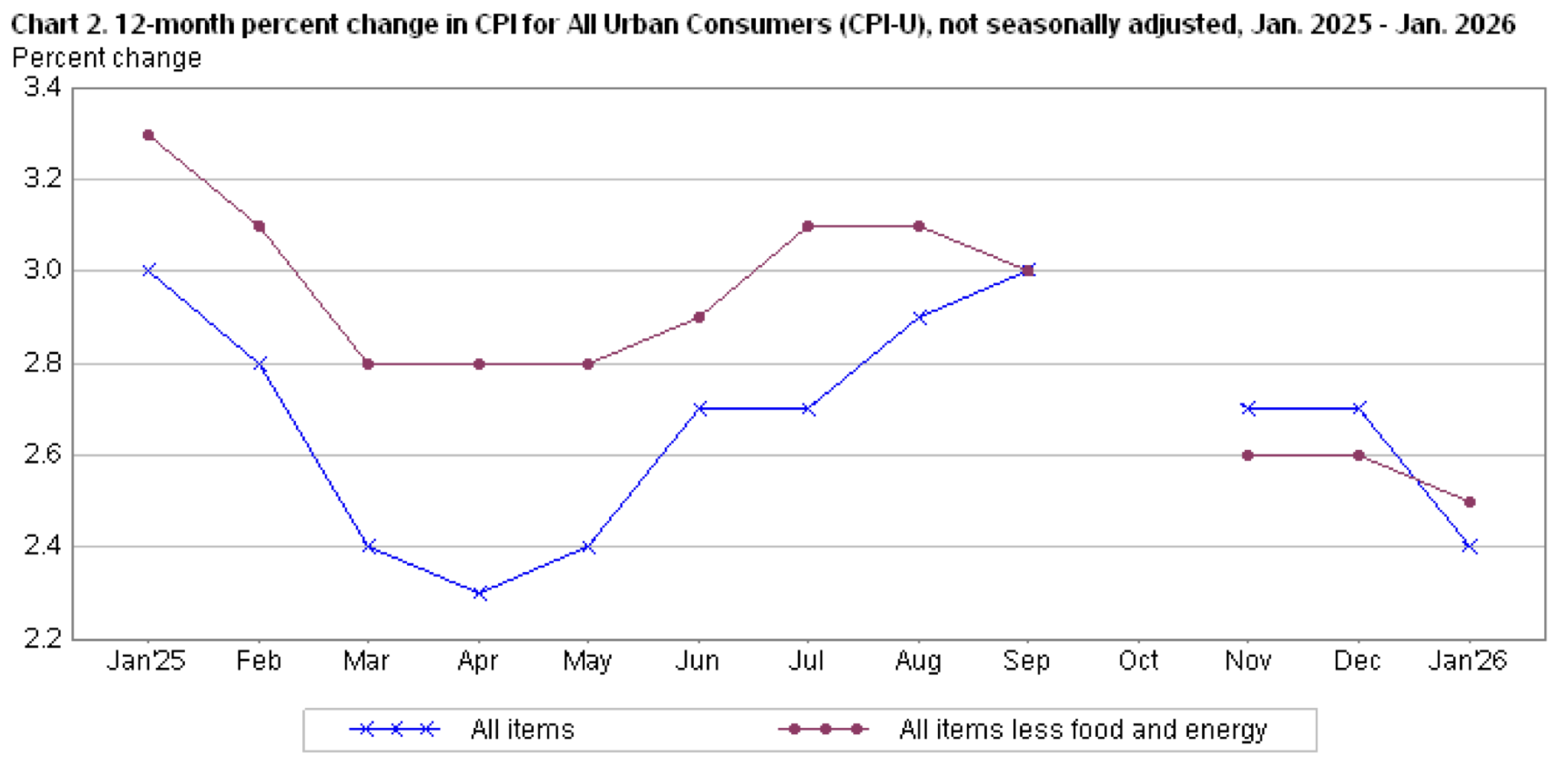
Here is the trend in annual all-items and core inflation over the last 12 months, with all-items inflation showing a clear upswing higher.:

And this trend could continue for several months because of “base-effect” increases from weak inflation a year ago. It seems likely that all-items inflation could rise above 3.0% in coming months:

What this means for TIPS and I Bonds

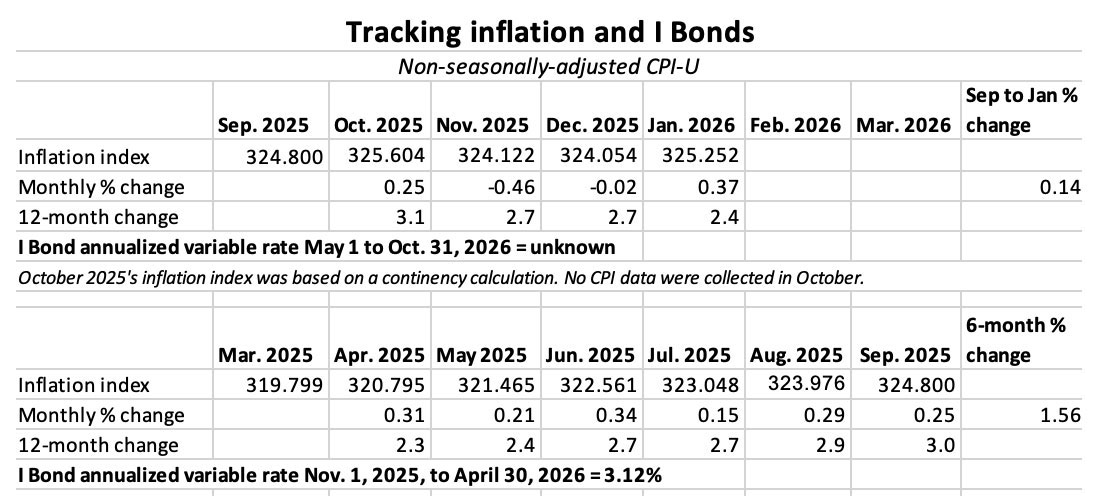
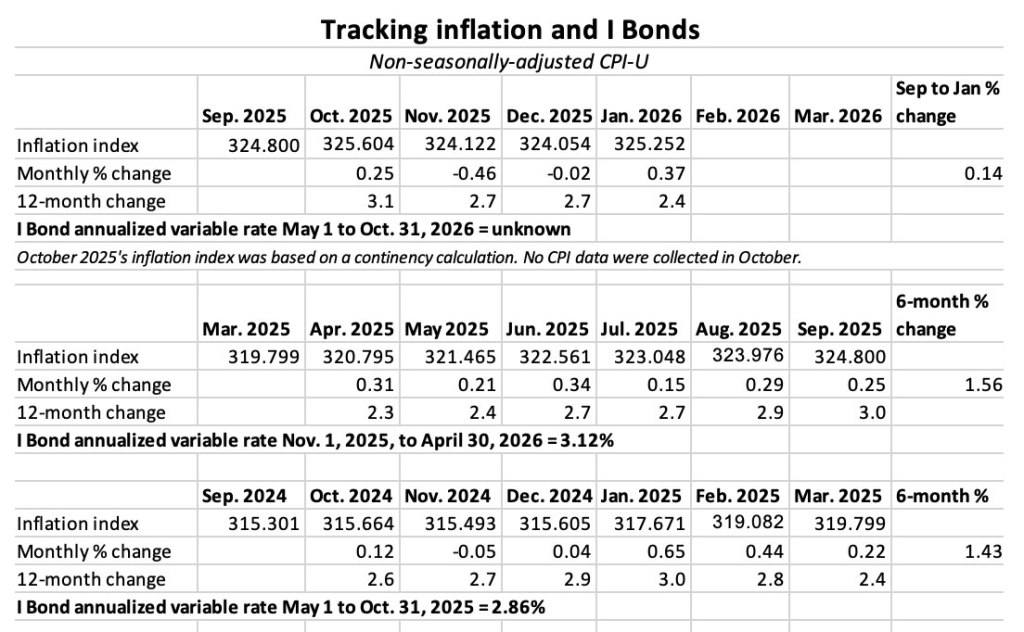
Investors in Treasury Inflation-Protected Securities and U.S. Series I Savings Bonds are also interested in non-seasonally adjusted inflation, which is used to adjust principal balances for TIPS and set future interest rates for I Bonds. For June, the BLS set the inflation index at 322.561, an increase of 0.34% over May’s number.

For TIPS. The June inflation index means that principal balances for all TIPS will increase by 0.34% in August, after a 0.21% increase in July. Here are the new August Inflation Indexes for all TIPS.

For I Bonds. June marks the mid-point of a six-month stretch that will determine the I Bond’s new inflation-adjusted variable rate, which will be reset on November 1. So far, three months in, inflation has increased 0.86%. That translates to a variable rate of 1.72%, but it’s too early to make any judgments, especially because of coming tariff uncertainty. Here are the data:

View historical data on my Inflation and I Bonds page.

What this means for the Social Security COLA

June inflation sets the baseline for determining Social Security’s cost-of-living adjustment for 2026. The actual calculation depends on the average of a different index — the Consumer Price Index for Urban Wage Earners and Clerical Workers (CPI-W) — over the months of July to September.

As of June, CPI-W has increased 2.6% year over year. That’s the baseline and it most likely will NOT be next year’s increase. I will be writing more on this topic in coming days. You will soon see a lot of projections in the media — most of them should be ignored.

What this means for future interest rates

I’d say “not much.” The core inflation monthly number — at 0.2% — was below expectations, even though the annual rate ticked higher to 2.9%. This isn’t a horrible inflation report, but it is showing hints of the effects of U.S. tariffs, which could magnify in future months. Plus, the weak inflation numbers from summer 2024 are going to put 2025 inflation on a higher track.

From Bloomberg’s Anna Wong:

Monthly core CPI inflation picked up from very soft to soft in June as firms passed tariff costs through to consumer prices at a brisker pace. Those gains were offset by disinflation for vehicles and hotels as consumers pull back on non-essential expenses. …

While the soft CPI might appear to boost the odds of a September rate cut, we expect a hot June print for the Fed’s preferred inflation gauge — the core PCE deflator, due out July 31. PCE prints may stay elevated all summer.

At this point, I’d say the Fed will continue to be on hold through the summer as it waits to see how the tariff rollout proceeds.

—————————

Donate? This site is free and I plan to keep it that way. Some readers have suggested having a way to contribute. I would welcome donations. Any amount, or skip it, your choice. This is completely optional.

PayPal link / Venmo link

—————————

Follow Tipswatch on X for updates on daily Treasury auctions and real yield trends (when I am not traveling).

Feel free to post comments or questions below. If it is your first-ever comment, it will have to wait for moderation. After that, your comments will automatically appear. Please stay on topic and avoid political tirades. NOTE: Comment threads can only be three responses deep. If you see that you cannot respond, create a new comment and reference the topic.

David Enna is a financial journalist, not a financial adviser. He is not selling or profiting from any investment discussed. I Bonds and TIPS are not “get rich” investments; they are best used for capital preservation and inflation protection. They can be purchased through the Treasury or other providers without

Posted in Federal Reserve, I Bond, Inflation, Investing in TIPS, Social Security, Tariffs | Tagged , , , , , , | 14 Comments

A 10-year TIPS is maturing July 15. How did it do as an investment?

Answer: Very well, in keeping with recent trends.

By David Enna, Tipswatch.com

Back on July 23, 2015, the U.S. Treasury auctioned a fairly routine 10-year TIPS, CUSIP 912828XL9, generating a real yield to maturity of 0.491% and a coupon rate of 0.375%.

That’s a low real yield by today’s standards, but fairly normal during the Federal Reserve’s era of bond-buying quantitative easing. A real yield of 0.491% was actually a nice step up from the negative-yield depths of 2012 to mid 2013.

Treasury estimates, close of market. Click on image for larger version.

In my preview article for this auction, I noted, “This auction is shaping up as ‘upper middle of the recent pack.’ Not exciting, but also not horribly unattractive.”

Inflation breakeven rate. At the auction’s close, a 10-year nominal Treasury note was trading with a yield of 2.29%, setting up an inflation-breakeven rate of 1.79%, which I noted back then was “solidly in the ‘cheap’ range for a 10-year TIPS.”

Now, 10-years later, that low inflation breakeven rate made CUSIP 912828XL9 a very attractive investment, at least compared to the nominal 10-year Treasury of the time. Annual inflation over that decade averaged 3.1%, well above the inflation breakeven rate. The TIPS was easily the superior investment.

The final investment results for this TIPS were set by the May inflation report released June 11. Data from Eyebonds.info show this TIPS generated a 10-year nominal annual return of 3.529%, easily exceeding the comparable T-note at 2.29%.

For its time, CUSIP 912828XL9 was a very good investment.

TIPS versus an I Bond

An I Bond issued in July 2015 had a fixed rate of 0.0%, which means its return should be lower than a TIPS with a real yield of 0.491%. According to Eyebonds.info, that July 2015 I Bond will have had, through January 2026, an annual nominal return of 2.91%. That is better than the nominal Treasury at 2.29%, but lags behind the TIPS.

TIPS versus other alternatives

The total bond market, defined by Vanguard’s Total Bond ETF (BND), has had an average annual return of 1.69% over the last 10 years. This lagging performance was primarily triggered by a -13.1% total return in 2022 as the Fed began aggressively raising interest rates.

The TIP ETF, which hold all maturities of TIPS, has had an average total return of 2.49% over the 10 years. VTIP, the short-term TIPS ETF, had an average return of 2.84%.

Thoughts

There is an obvious lesson here: TIPS do well when inflation is higher than expected, and that is exactly why we invest in TIPS — to protect against that possibility. When compared to similar investments, buying this 10-year TIPS in July 2015 and holding to maturity was a sound move. (I nibbled into this TIPS with a very small investment at the July 2015 auction.)

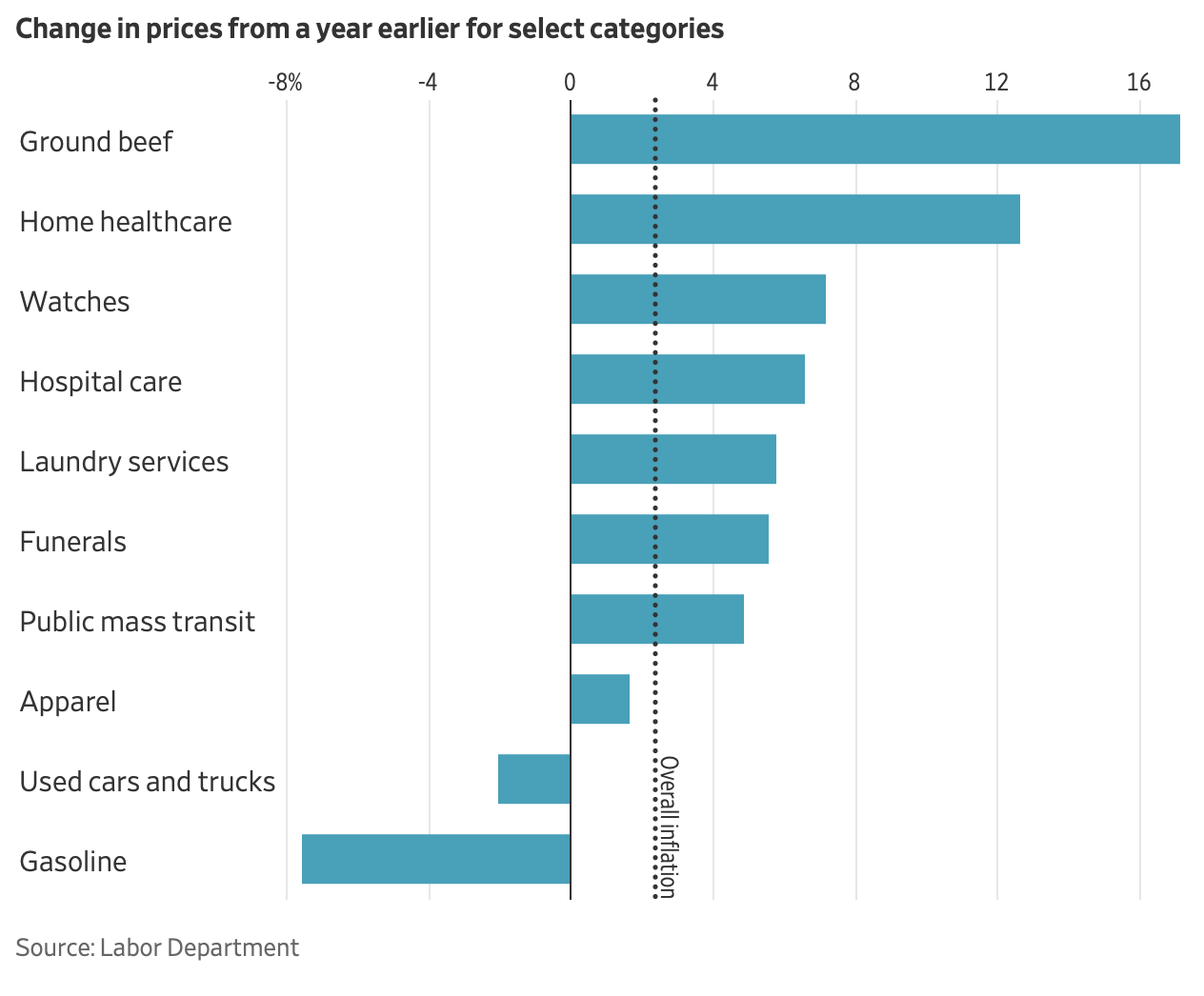
TIPS have been on a winning streak for several years, caused by the surge to 40-year high inflation that peaked in June 2022 at 9.1%. Even today, annual inflation (2.4%) is running higher than the auctioned breakeven rates of 2015. And so TIPS have been the winners versus nominal Treasurys in recent years.

10-year TIPS vs nominal
Click on image for larger version. More data on my TIPS vs. nominal page.

Notes and qualifications

My chart is an estimate of performance comparing inflation breakeven rates versus actual inflation.

Keep in mind that interest on a nominal Treasury and the TIPS coupon rate is paid out as current-year income and not reinvested. So in the case of a nominal Treasury, the interest earned could be reinvested elsewhere, which would potentially boost the gain. For certain, we don’t know what the investor could have earned precisely on an investment after re-investments.

In the case of a TIPS, the inflation adjustment compounds over time, and that will give TIPS a slight boost in return that isn’t reflected in the “average inflation” numbers presented in the chart.

Now is an ideal time to build a TIPS ladder

Confused by TIPS? Read my Q&A on TIPS

TIPS in depth: Understand the language

TIPS on the secondary market: Things to consider

TIPS investor: Don’t over-think the threat of deflation

Upcoming schedule of TIPS auctions

—————————

Donate? This site is free and I plan to keep it that way. Some readers have suggested having a way to contribute. I would welcome donations. Any amount, or skip it, your choice. This is completely optional.

PayPal link / Venmo link

—————————

Follow Tipswatch on X for updates on daily Treasury auctions and real yield trends (when I am not traveling).

Feel free to post comments or questions below. If it is your first-ever comment, it will have to wait for moderation. After that, your comments will automatically appear. Please stay on topic and avoid political tirades. NOTE: Comment threads can only be three responses deep. If you see that you cannot respond, create a new comment and reference the topic.

David Enna is a financial journalist, not a financial adviser. He is not selling or profiting from any investment discussed. I Bonds and TIPS are not “get rich” investments; they are best used for capital preservation and inflation protection. They can be purchased through the Treasury or other providers without fees, commissions or carrying charges. Please do your own research before investing.
Posted in Federal Reserve, I Bond, Inflation, Investing in TIPS, TreasuryDirect | 14 Comments