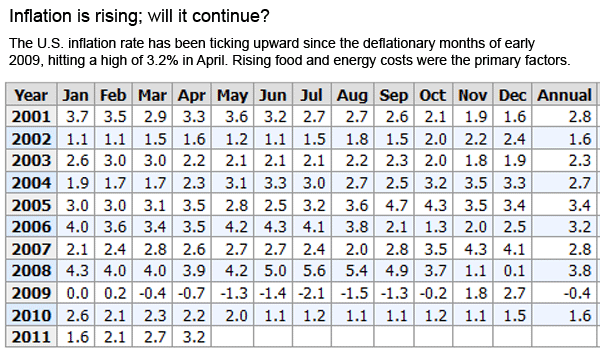
 Buyers of Treasury Inflation Protected Securities care about inflation; in fact, protection against inflation is the whole purpose of TIPS. If you aren’t concerned about inflation, you buy regular Treasury issues.
TIPS are insurance against inflation. When you buy insurance against a danger, it’s sometimes a good thing when the danger never arises. We pay lots of money for house insurance each year, but it’s always better when the house doesn’t burn down.
With TIPS, you get a lower yield than on regular Treasuries, but your principal keeps rising with the rate of inflation. So both your principal and interest payments rise over time, as long as there is inflation.
So if inflation ends up being less than expected – or if deflation strikes – you lose. If inflation runs about as expected, you are OK. And if inflation runs rampant, you win big.
But that doesn’t mean TIPS investors are cheering for rampant inflation. They just fear it and insure against it.
Bernanke speaks
Federal Reserve Chairman Ben Bernanke spoke June 8 at the International Monetary Conference in Atlanta. Here are some excerpts about the economy and the risk of inflation:
Consumer confidence. On the negative side, households are facing some significant headwinds, including increases in food and energy prices, declining home values, continued tightness in some credit markets, and still-high unemployment, all of which have taken a toll on consumer confidence.
What it means: Consumer confidence is shaky, and that puts a damper on future inflation.
Housing. Uncertainties about job prospects and the future course of house prices have also deterred potential buyers. Given these constraints on the demand for housing, and with a large inventory of vacant and foreclosed properties overhanging the market, construction of new single-family homes has remained at very low levels, and house prices have continued to fall.
What it means: The housing market still has not hit bottom.
High government deficits. If the nation is to have a healthy economic future, policymakers urgently need to put the federal government’s finances on a sustainable trajectory. But, on the other hand, a sharp fiscal consolidation focused on the very near term could be self-defeating if it were to undercut the still-fragile recovery. … Consequently, the appropriate response is to move quickly to enact a credible, long-term plan for fiscal consolidation.
What it means: The U.S. desperately needs a plan to cut spending, raise taxes and trim down entitlements
Inflation. As you all know, over the past year, prices for many commodities have risen sharply, resulting in significantly higher consumer prices for gasoline and other energy products and, to a somewhat lesser extent, for food. Overall inflation measures reflect these price increases: For example, over the six months through April, the price index for personal consumption expenditures has risen at an annual rate of about 3-1/2 percent, compared with an average of less than 1 percent over the preceding two years.
… Although the recent increase in inflation is a concern, the appropriate diagnosis and policy response depend on whether the rise in inflation is likely to persist. So far at least, there is not much evidence that inflation is becoming broad-based or ingrained in our economy; indeed, increases in the price of a single product–gasoline–account for the bulk of the recent increase in consumer price inflation.
… An important implication is that if the prices of energy and other commodities stabilize in ranges near current levels, as futures markets and many forecasters predict, the upward impetus to overall price inflation will wane and the recent increase in inflation will prove transitory.
… the still-substantial slack in U.S. labor and product markets should continue to have a moderating effect on inflationary pressures.
… As long as longer-term inflation expectations are stable, increases in global commodity prices are unlikely to be built into domestic wage- and price-setting processes, and they should therefore have only transitory effects on the rate of inflation.
What it means: Inflation is not a short-term problem. Long-term? Who knows.
Monetary policy. … the Federal Open Market Committee (FOMC) has maintained a highly accommodative monetary policy, keeping its target for the federal funds rate close to zero. … The Committee also continues to anticipate that economic conditions are likely to warrant exceptionally low levels for the federal funds rate for an extended period.
What it means: Interest rates are going to stay at very low levels for the near future. The U.S. dollar will remain weak, but the euro is also suffering.

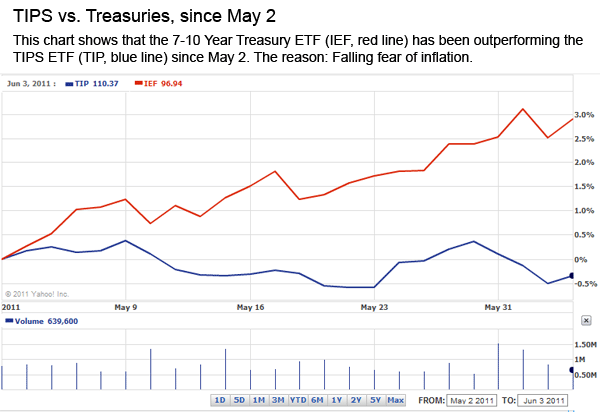
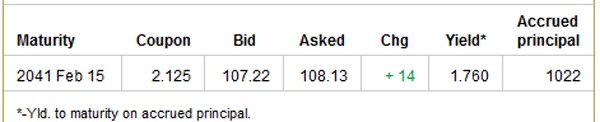
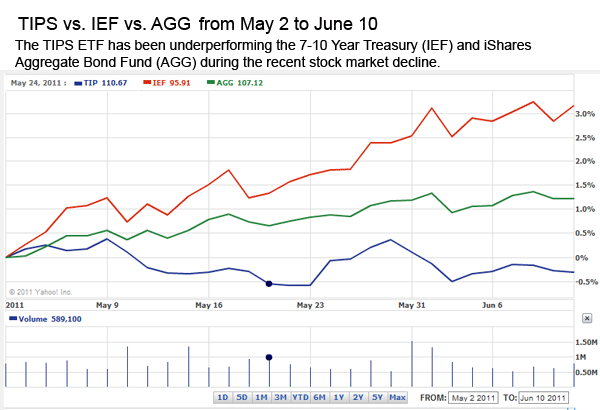 The real safe harbor? I contend that buying Treasury Inflation-Protected Securities directly through TreasuryDirect.gov, or through your broker in a retirement account, is a true safe harbor. This investment will produce a real return over inflation, and it is super safe.



Isnt LTCG just the same as ROC with one more letter?