
By David Enna, Tipswatch.com
While the news was expected, the May inflation report issued today by the Bureau of Labor Statistics is disturbing: U.S. all-items inflation rose 0.5% for the month on a seasonally-adjusted basis, rising to an annual rate of 4.2%, the highest since April 2023.
Core inflation, which strips out food and energy, was a bit tamer with a rise of 0.2% for the month and 2.9% for the year, up from 2.8% in April. The monthly core rate was below expectations — the one sliver of good news this morning.
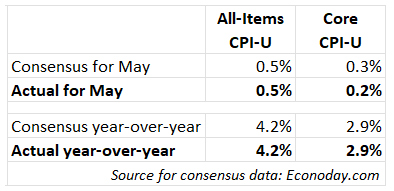
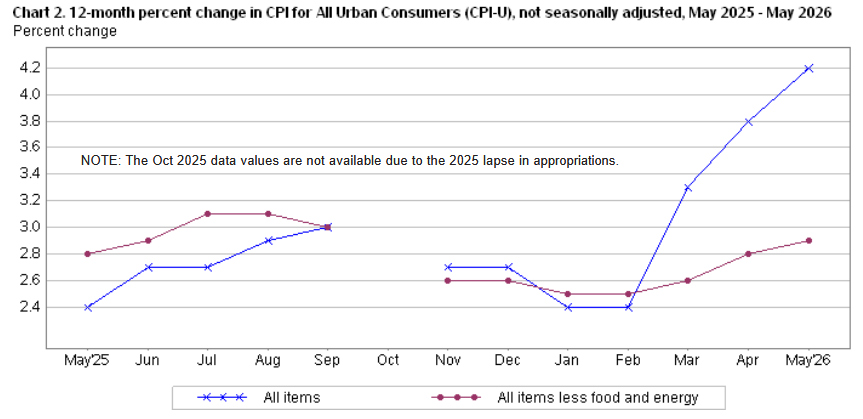
In just over three months since the beginning of the Iran conflict, U.S. annual inflation has increased from 2.4% in February to 4.2% in May. The rate of increase may ease going forward, but U.S. inflation is likely to linger above 4.0% for many months.
The BLS noted that the energy index rose 3.9% in May, accounting for about 60% of the increase in all-items inflation. Gasoline prices were up 7.0% in May and are now up 40.5% over the last 12 months. Also from the report:
- Food at home prices rose a moderate 0.1% for the month and are now up 2.7% for the year. These costs could rise as higher transportation costs are passed through.
- Beef prices fell 1.6% for the month, but are up 12.9% for the year.
- Egg prices rose a surprising 4.0% for the month but are down 35.2% for the year.
- Shelter costs rose 0.3% for the month and 3.4% for the year.
- Apparel prices rose 0.3% for the month and 4.8% for the year.
- Airline fares rose 2.7% for the month and are now up 26.7% for the year.
- Costs for new vehicles fell 0.3% in May and are up only 0.2% for the year.
- Prices for used vehicles rose 0.1% for the month and were down 0.2% for the year.
The report shows the huge effect gasoline prices are having on U.S. inflation, which could be causing some deflationary pressures for other categories as consumers deal with higher commuting costs. The gas-price effect could ease if the conflict with Iran is resolved, but benefits could be many months away.
Meanwhile, inflation expectations will be rising, a dangerous trend. Here is the 12-month trend for all-items and core inflation, showing the burst higher since the war began on Feb. 28. Notice, however, that core inflation continues to inch higher even without the effect of higher gas prices.
What this means for TIPS and I Bonds
Investors in Treasury Inflation-Protected Securities and Series I Savings Bonds are also interested in non-seasonally-adjusted inflation, which is used to adjust principal balances on TIPS and set future interest rates for I Bonds.
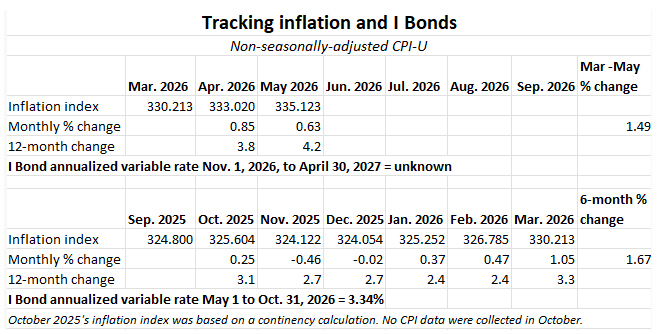
The BLS set May’s CPI index at 335.123, an increase of 0.63% for the month, following an increase of 0.85% in April. These increases are higher than “headline” inflation because of the effects of seasonal adjustments. Later in the year, this trend will reverse.
For TIPS. The May report means principal balances for all TIPS will increase 0.63% in July, after rising 0.85% in June. Over the last year, principal balances will have increased 4.2% at the end of July. Here are the new July Inflation Indexes for all TIPS.
For I Bonds. The May report was the second of a six-month string that will determine the I Bond’s new variable rate, to be reset November 1 based on inflation for the months of April to September. So far, after just two months, inflation has increased 1.49%, which translates to a variable rate of 2.98%. But there are four months left to go. Prediction: I Bonds are going to get very popular later this year.
What this means for future interest rates
Here is a key point: The U.S. inflation rate at 4.2% is now well above the effective Federal Funds rate of 3.61%. This can’t be tolerated for long. So either inflation needs to start trending lower, or the Federal Reserve will have to signal the possibility of higher rates.
This is complex. Gas prices could be causing a “transitory” spike, and actually causing some deflation in other economic areas. It will take time to see the end result.
The Fed’s Open Market Committee will meet next week under the leadership of new Chairman Kevin Warsh. Prediction: the Fed will stand pat on rates, but will need to signal that rate increases are under consideration. Warsh will be walking a tightrope.
On the positive side, core inflation has not yet surged higher. That would be a dangerous trend. From Anna Wong and Troy Durie of Bloomberg Economics this morning:
Overall, the CPI report sent a clear signal that consumers are pulling back on nonessential spending, pushing back against business attempt at price hikes. This should ease fears of Fed rate hikes following the blowout May payrolls report. We still expect policymakers to cut rates by 25 basis points in the fourth quarter of the year.
This is from Olu Sonola, head of U.S. economics at Fitch Ratings:
Headline inflation is hot — and getting hotter — an unwelcome handoff as the new Fed Chair takes the wheel. But this is not yet a panic-hike story. Core inflation remains relatively contained, giving the Fed room to stay on hold for a while longer. The burden now falls on the next few core readings and inflation-expectations data: if they stay contained, the Fed can look through the headline heat; if they crack, the rate-hike debate moves front and center.
From Seema Shah, chief global strategist for Principal Asset Management:
Inflation remains uncomfortably high at 4%, but the softer-than-expected core reading takes some of the pressure off. With energy driving much of the increase and shelter easing, we’re not yet seeing clear sign of broader second-round effects. This should allow the Fed to remain patient.
From this analysis, and because of the political pressures involved, I think we won’t see any change in the federal funds rate for several months. Longer-term interest rates could continue rising, however.
—————————
Donate? This site is free and I hope to keep it that way. Some readers have suggested having a way to contribute. I welcome donations, any amount. And FYI, ads on this site pay for about one visit to Costco.
—————————
Follow Tipswatch on X for updates on daily Treasury auctions and real yield trends (when I am not traveling).
Feel free to post comments or questions below. If it is your first-ever comment, it will have to wait for moderation. After that, your comments will automatically appear. Please stay on topic and avoid political tirades. NOTE: Comment threads can only be three responses deep. If you see that you cannot respond, create a new comment and reference the topic.
David Enna is a financial journalist, not a financial adviser. He is not selling or profiting from any investment discussed. I Bonds and TIPS are not “get rich” investments; they are best used for capital preservation and inflation protection. They can be purchased through the Treasury or other providers without fees, commissions or carrying charges. Please do your own research before investing.


 Treasury Inflation-Protected Securities
Wow – I had to come back here, to your site, just to validate why my mind was blown when updating my Quicken file (which tracks all my TIPS) and seeing the huge increase in the inflation index through the end of June. I use the inflation index as a price, inside Quicken, with the understanding that the secondary market may offer these TIPS at a premium or discount.
It was staggering to see how quickly it climbed… so thank you for explaining the seasonal adjustments.
Pingback: Should you buy I Bonds now or wait? Latest rates, November outlook - Fund Focus News
If interest rates go up, and I intend to sell my TIPS this year, is it better to sell after the rate is announced or before?
That’s a toss-up, depending on how the auction goes. So no real predictable answer.
I’m betting on significantly higher inflation to stick around for a while. And I expect that “normalcy bias” will keep demand for Treasuries rates low, along with prices.
If you remember back in 2020, inflation started spiraling upwards in June. Yet in December, the TIPS breakeven inflation rate was still under 2%. By June 2021, the YOY CPI had risen 5.3%; by June, 2022, it has risen another 9%. What a TIPS opportunity for those who believed that the supply chain disruptions and inflation were not as transitory as advertised!
Now why do I believe that the next few years will be a repeat? In sum, Strait of Hormuz. Many analysts have been talking about steeply declining oil inventories, even potentially bottoming out in the next three months. Current spot prices far exceeding futures. Moreover, return to pre-2026 levels of supply will take a lot of time, meaning that medium term shortages will continue along with persistently higher prices. Since other critical supplies depend on oil–fertilizer, helium and sulphatic acid for computer chip fabrication, diesel fuel for transportation, etc,. etc.–shortages and higher prices will impact the food supply and other, critical industries as well.
Personally, I’m waiting for the 5 year yield to maturity to top 2% and then stock up.
If my analysis is incorrect, I’ll still have realized a good return in 2031…unless the oil shock is so severe that it leads to deflation.
Disconnected Oil Futures Market Could See Price Spike within Weeks | OilPrice.com
The oil shock doesn’t even have to be severe to lead to some short term deflation. Global slowdown seems baked in, the only question is how severe. Throw in things like changes to global trade, and a highly valued stock market with greater individual ownership than in the past and increasing deficits and accelerating debt levels and things could get ugly. Or not!
I suppose that since “Over the last year, principal balances will have increased 4.2% at the end of July”,
then the TIP bonds paying a 2.125% coupon are really now annually yielding equivalent of up to 6.325% nominally (with rate changing some monthly)?
Or perhaps yielding more nominally since the coupon payment is also adjusted up with the principle growing causing the cash coupon payments to also increase as well as the principal value increasing?
I don’t like mixing the inflation adjustment in with the coupon rate, but if your TIPS investment has a coupon rate of 2.125%, then that will be paid out on the rising principal, which was up 4.2% over the last year. In other words: Pretty darn good return. The coupon rate can be considered the “proxy” for the real yield, in most cases.
At least if the I Bond fixed rate goes up in November people can buy that rate in 2027. I am still on the five year rollover track, though, especially for the I Bonds in the early 2020’s which had the 0% interest rate. $100k in inflation adjusted savings, when my personal and my sole proprietorship account are counted together, is plenty. (I don’t think the three month penalty is that significant if I needed the money unexpectedly.)
I’m planning to purchase $20K of I-Bonds in October and/or November. Any thoughts at the moment on the November fixed rate. Up? down? no change?
Also, what about the 5-Year TIPS reopen this month?
Bill, I will be posting a preview of the 5-year TIPS auction on Sunday morning. Right now, current market rate is about 1.83%, pretty strong.
Semi-related, we now have 9 months of inflation to use in calculating the IRMAA limits which will be announced in Oct/Nov. I currently estimate the first three IRMAA limits, for a single filer, will be 112,000/142,000/177,000. Married filing joint will be 224,000/284,000/354,000 (double single).
There is a chance the first bracket could go up to 113,000 single, 226,000 MFJ.
Remember, the IRMAA limits announced in Oct/Nov 2026 are for comparison to your 2025 Modified AGI, for determining your 2027 Medicare premiums.
For some speculative planning, you can inflate the expected 2025 amounts to calculate a rough estimate of the limits that might apply to 2026 income. It is not a straightforward calculation and the cliff nature of IRMAA suggests you be conservative. For example, if we end this August with headline inflation of 4.6%, the inflation adjustment is 3.4%.
So take your inflation expectations and haircut it.
If the inflation adjustment announced in Nov 2027 were to be 2%, then the limits applied to your 2026 MAGI would be 115/144/180, and 230/288/360.
I love your attention to this. Combinations of RMDs, Roth conversions, capital gains, even Social Security increases, can easily get anyone near those cliff limits. Too late for the 2025 filing, of course.
David, in one of your previous articles, you had mentioned a very good website where the author forecasts IRMAA brackets for future years. Could you please provide that again? Thank you!
Josephine, it wasn’t me, but one of the commenters. And the link is in a comment a few below this one.
So what does this mean for the 10 year TIPS auction next month? I’m building out my ladder now with $5000 purchases in both January and July. I already have rungs 2046-55 in place, so now I’m filling in the earlier years.
At this point, the 10-year auction is looking good, with an estimated yield of 2.20%, per the Treasury. Things can change in a month, of course.
This is a fantastic site for keeping track of IRMAA income limits https://thefinancebuff.com/medicare-irmaa-income-brackets.html#htoc-2028-irmaa-brackets
Iran conflict —> *Iran War
We still expect policymakers to cut rates by 25 basis points in the fourth quarter of the year. —> On what basis is Bloomberg asserting this expectation? The data doesn’t seem to support it.
So far, after just two months, inflation has increased 1.49%, which translates to a variable rate of 2.98%. But there are four months left to go. Prediction: I Bonds are going to get very popular later this year. —> That’s a safe prediction. With four months to go, we are looking at a historically high variable rate for the I Bond (perhaps not as high as it hit in 2022 but very high). Everyone holding I Bonds will benefit, and if you own an EV or commute by train or drive only locally, you aren’t absorbing the brunt of the inflatiom (although the price of oil does affect many other sectors). It’s hard to believe the fixed rate will only increase by a modest 0.1% given the overall situation. One benefit of the timing is that if the next reset is a high point, those interested in buying I Bonds who have held off in 2026 so far can buy the next reset twice, once at the end of 2026 and again at the beginning of 2027. That is my plan.
Thank you for your focus on … words. I too was intrigued by the semantic downgrade from “War” to “Conflict”. And don’t get me started on the reemergence of “transitory”, lol. Let the mockery begin – oh, wait, I guess it’s different when it’s a self-induced phenomenon of choice? Whatever the framing, you can’t trust BLS statistics anyway: our current POTUS has repeatedly told us so.
Marce & MLS, I appreciate the feedback on the word “conflict.” At this point, we are in a tense ceasefire with a couple of shooting incidents a week. Israel and Lebanon? Worse. In past posts I have used “war” more than conflict, even in a headline. But right now this leans more toward conflict than war. In a day or a week or a month, it could be a war.
Okay, fine. I thought it was worth noting. But what about Bloomberg still predicting a rate cut later in the year. Based on what data?
Marce, I should have noted that was an opinion from two economists quoted by Bloomberg, not Bloomberg itself. I added that to the story. I personally don’t think we will see a rate cut this year.
That may be a distinction without a difference since they are amplifying it, but thanks for the clarification and your excellent reporting on these topics. I’d still like to know the underlying data used by those economists to justify their prediction which seems counterintuitive to the data we do have. I guess they are counting on a swift resolution to the war, a quick restoration of oil supply, a substantial drop in oil prices, and receding inflation. I guess that’s a plausible scenario, but wishful thinking based on escalating tensions and real world events today. Count me as a major skeptic.
Im not a wait and see person, I found I missed the move or worse left holding the bag. https://markets.financialcontent.com/wral/article/marketminute-2025-12-10-federal-reserve-unveils-t-bill-buying-spree-signals-new-era-for-market-liquidity Next year Stable Coin has to be backed the treasuries more demand lower rates. Of course Inflation will go through the roof. Long term is different, global is dumping our bonds and demand will be lower demanding higher rates. Doesn’t matter the fixed rate on IBonds your gonna clean up on the inflation kicker. Yes I’ll eventually need to make a decision or not to move my money market funds to something that might track inflation, like those TIP funds. Of course a higher fixed rate ibond cushions the blow if wrong. Also the outcome of the IRAN war could signal the end of the Petro Dollar. Stable Coin back by YUAN Id definitely take a look at.
5-Year TIPS real yields are hovering around a 1.8%, which would mean a 1.2% fixed rate in November if this holds. Would you care to speculate on the direction of the next fixed rate?
I agree that the fixed rate looks likely to rise to at least 1.0%, and could be higher. The key question is how long these elevated real yields will continue. Way too early to say.
David – I don’t mean to put you on the spot, but if someone hasn’t purchased their 2026 I Bond allotment yet, would it make sense to wait at this point?
Yes, it definitely makes sense to wait at least until mid-October.
The only “guarantee” is the current rate of .9 and it starts the one year hold…the focus on the current rate of funds verses alternatives is wanting at best. Waiting to October is “nice” but in the interim those incoming funds get …percent with a net of X? Max out when your effective rate is “good.”