A quick update on Thursday’s 5-year TIPS auction

There is an explanation for everything, right?

By David Enna, Tipswatch.com

As they say, “You learn something every day.” At least you should learn something every day. Thursday’s TIPS auction result, which you can read about here, caused some angst among readers: Why did the real yield come in below the market?

I was especially curious when I saw that the “when-issued” real yield prediction used by bond traders was 2.42%, well below the Treasury’s yield prediction of 2.57% for a 5-year TIPS (that prediction dropped to 2.43% after the market closed yesterday.)

Unfortunately, I can’t see the when-issued prediction until the auction closes. But if it was 2.42%, that indicated bond traders knew the Treasury estimate was too high. The auction actually got fairly lukewarm demand, and the resulting real yield ended up at 2.44%, above the when-issued prediction.

So what happened, and what can we learn from this?

Thursday’s lesson was about relearning something: Seasonal variations in TIPS yields. I discussed this topic in a post on Sept. 10: “‘Inflation Guy’ explains seasonal adjustment (or lack thereof)“, where inflation expert Michael Ashton explained why there are seasonal variations in TIPS yields.

But I clearly did not realize how much these seasonal variations affect one particular auction a year: the new 5-year TIPS issued each October since 2019. Could seasonal variations be the reason bond traders saw a yield of 2.42% while the Treasury and secondary market seemed to pointing to 2.57%?

The answer seems to be yes.

Beth Stanton, an editor for U.S. interest rates at Bloomberg, posted an excellent explanation on Twitter yesterday (I refuse to call it X, by the way). Here is how the series of tweets began:

And this is her explanation that followed:

Auctions of new 5Y TIPS have been held twice a year — in April & October — since 2019. (The June and Dec 5Y TIPS auctions are reopenings of one or the other.) …

The October auction usually produces a yield *significantly lower* than the current market yield of the one from April, despite maturing 6 months later. Normally in bonds (tho not so much lately), a longer maturity warrants a *higher* yield. …

The 5Y TIPS being sold on Thursday is trading at a yield of around 2.42%. The one sold in April (auction yield 1.32%) now yields around 2.53%. That’s a big gap for 6 months, especially since the new issue is the biggest-ever TIPS auction at $22b. …

The question is, why would someone buy the new issue at a yield of 2.42% when the old one can be had at 2.53%? The main reason is what inflation people call seasonality premium. …

Interest on TIPS is paid on a principal amount that’s indexed to the CPI — with a lag. The final index values for TIPS that mature in Oct are determined by the Aug CPI. The final index values for TIPS that mature in April are determined by the Feb CPI. …

The CPI used to adjust TIPS is the not-seasonally-adjusted one. And inflation has had a strong seasonal pattern. The pattern fell apart in 2020, but prior to that, prices reliably rose more early in the year than late in the year (when discounting is rampant). …

The Oct 5Y gets inflation accruals for six months after the April one matures. The months are March-Aug, which historically have been “better” overall than Sept-Feb. That gives the Oct issue extra value that gets reflected in a lower yield (i.e. higher price) than the April one. …

Other factors contribute to the Oct 5Y TIPS yielding less than the April, such the inverted yield curve (longer maturities in general command lower yields than shorter ones) & a liquidity premium for the new issue. But inflation seasonality is the biggest piece. /END

Again, this is something I knew about, but I hadn’t associated these seasonal fluctuations directly with the auction of a new 5-year TIPS each October . It’s a hard trend to decipher because these October auctions only have a 5-year history, dating to October 2019.

This chart proves Stanton’s point quite clearly:

The yield spreads get larger as the maturity date gets closer, because the effect of seasonality is strongest when fewer months remain. So, based on this analysis, a 14-basis-point yield spread looked predictable coming into Thursday’s auction. And it also indicates that investors at Thursday’s auction didn’t get “ripped off.”

Lesson learned. File this one away for future October auctions of 5-year TIPS.

* * *

Feel free to post comments or questions below. If it is your first-ever comment, it will have to wait for moderation. After that, your comments will automatically appear. Please stay on topic and avoid political tirades.

David Enna is a financial journalist, not a financial adviser. He is not selling or profiting from any investment discussed. I Bonds and TIPS are not “get rich” investments; they are best used for capital preservation and inflation protection. They can be purchased through the Treasury or other providers without fees, commissions or carrying charges. Please do your own research before investing.

Posted in Inflation, Investing in TIPS | 67 Comments

New 5-year TIPS gets a real yield of 2.440%, again lower than expected

By David Enna, Tipswatch.com

Also: See my update on why this real yield was actually logical (to bond traders).

Today’s Treasury auction of $22 billion in a new 5-year Treasury Inflation-Protected Security generated a real yield to maturity of 2.440%, continuing a recent trend of mildly disappointing results for TIPS at auction.

This is CUSIP 91282CJH5, which will mature Oct. 15, 2028. At yesterday’s market close, the U.S. Treasury estimated the real yield of a full-term 5-year TIPS at 2.57%, and a TIPS with a similar term was trading all morning with a real yield in the range of 2.54% to 2.61%. So the result of 2.440% was a downside surprise, indicating fairly strong demand for this new issue.

I was expecting a real yield and coupon rate topping 2.5%. Nevertheless, this TIPS broke through some historic milestones:

  • The real yield of 2.440% was the highest for any TIPS auction of this term going back to October 2008, during the heart of the U.S. financial crisis.
  • The coupon rate was set at 2.375%, the highest for any 5-year TIPS since the very first TIPS auction of this term in history, which generated a coupon rate of 3.625% on July 9, 1997.
  • The auction size was $22 billion, the largest for this term in history.

While the real yield came in a bit lower than expected, CUSIP 91282CJH5 measures up as a stellar investment, with a real yield 112 basis points higher than a similar auction just six months ago, on April 20.

Investment cost

Because this was an auction of a new TIPS, the coupon rate (2.375%) was set below the auctioned real yield (2.440%) and investors got CUSIP 91282CJH5 at a slight discount. The unadjusted price was 99.697130. Here is how that works out for a $10,000 investment:

  • Par value: $10,000
  • Inflation index on settlement date: 1.00225
  • Adjusted principal: $10,022.50
  • Unadjusted price: 0.99697130
  • Investment cost (adjusted principal x unadjusted price): $9,992.15
  • Plus, accrued interest: $10.41 (will be returned at first coupon payment)
  • Total cost: $10,002.56

Inflation breakeven rate

At the auction’s close, a 5-year Treasury note was trading with a nominal yield of 4.95%, creating an inflation breakeven rate of 2.51% for this TIPS. That is about 30 basis points higher than the breakeven for recent auctions of this term. Hard to explain, but the 5-year nominal yield actually rose today a few basis points, while this TIPS auction came in 10+ basis points lower than expected.

And the bid-to-cover ratio was 2.36, indicating just average demand. But the pre-auction “when issued” measurement of expected yield was 2.42%, below the actual result. So, the when-issued number most likely indicates strong advance orders for this TIPS from big-money investors, orders that are too big for the secondary market. And therefore those buyers were willing to accept a lower real yield.

Anyone have other theories?

Final thoughts

Today’s auction adds another notch to the view that buying TIPS on the secondary market is a wise move, since you know exactly the real yield and price you will be getting. We’ve had a slew of “slightly” disappointing TIPS auctions this year.

I wasn’t a buyer because my TIPS ladder is loaded with maturities in 2028. But honestly, this real yield of 2.440% was highly desirable, even if a little disappointing. Since it is a new issue, there was no direct comparison on the secondary market.

CUSIP 91282CJH5 will be reopened at auction on Dec. 21, 2023. It will be interesting to watch yield trends over the next two months.

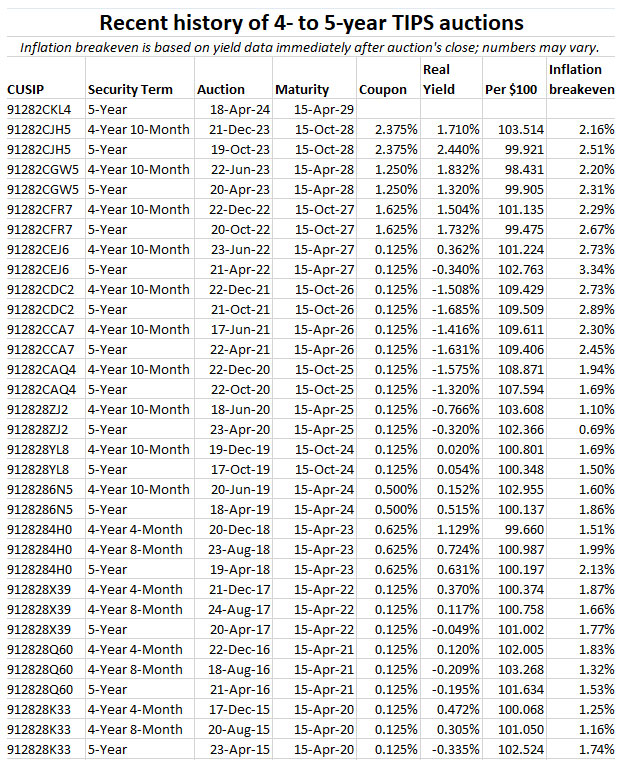
Here is the history of 4- to 5-year TIPS auctions going back to 2017. Note there is nothing on the list that even comes close to a real yield of 2.440%.

* * *

Feel free to post comments or questions below. If it is your first-ever comment, it will have to wait for moderation. After that, your comments will automatically appear. Please stay on topic and avoid political tirades.

David Enna is a financial journalist, not a financial adviser. He is not selling or profiting from any investment discussed. I Bonds and TIPS are not “get rich” investments; they are best used for capital preservation and inflation protection. They can be purchased through the Treasury or other providers without fees, commissions or carrying charges. Please do your own research before investing.
Posted in Investing in TIPS | 54 Comments

Are U.S. Series I Savings Bonds losing their appeal?

As a short-term investment? Yes. But for the long term? I Bonds are still attractive.

By David Enna, Tipswatch.com

Just one year ago, U.S. Series I Savings Bonds were still paying 9.62% annualized for a full six months, followed by an almost-as-attractive 6.48%. Demand was so strong from small-scale investors that the TreasuryDirect website crashed under the flood of orders and new-account creations.

A lot has changed. Back in October 2022, annual inflation was running at 7.7% and a 1-year Treasury bill was yielding about 4.5%. At that time, the I Bond’s yield of 9.62% was irresistibly attractive. Today, annual inflation has slipped to 3.7% and the current I Bond has a composite interest rate of 4.30%, much lower than the yield on a 1-year T-bill at 5.41%.

As a short-term investment — meaning a holding period of about 1 year — the I Bond is no longer the shining star. However, as a longer-term investment, I Bonds are actually more attractive than a year ago, because the permanent fixed rate has increased from 0.0% in 2022 to 0.9% currently and probably higher than 1% at the Treasury’s next rate reset on November 1.

The short-term

The Treasury limits conventional purchases of I Bonds to $10,000 per person per calendar year, plus allows an option for $5,000 in paper I Bonds in lieu of a federal tax refund. I am assuming most I Bond investors have already bought their full 2023 allocation — either before May 1 at the 0.4% fixed rate, or after May 1 at 0.9% — but I have been hearing from people still waiting to make a decision: In October or after?

As I noted in an Oct. 8 article, I believe the I Bond’s fixed rate will be rising at the November 1 reset, probably to something around 1.2%, but even higher is possible. If that’s true, then both the permanent fixed rate and the six-month variable rate will be rising at the reset. So waiting until November or December to purchase makes the most sense, in my opinion.

Investors who have purchased their full allocation in 2023 also have the option to use the “gift-box” strategy, if they have a trusted partner to make the swaps. I have noted that the gift-box strategy is most effective when the fixed rate is high, since that rate is permanent.

If the fixed rate rises to 1.2% at the November 1 reset, here is how the new six-month composite rate will be calculated:

  • Fixed rate: 1.2%
  • Semiannual inflation rate: 1.97%
  • Composite rate formula: [0.012 + (2 x 0.0197) + (0.012 x 0.0197)]
  • Composite rate: 0.012 + 0.0394 + 0.0002364
  • Adding the parts: 0.051636
  • Rounding gives: 0.0516
  • Composite rate = 5.16%

So we could be looking at an annualized composite rate of 5.16% for six months for I Bonds purchased from November 2023 to April 2024. The rate would be higher if the fixed rate is set higher, of course. At a fixed rate of 1.4%, the composite rate would be 5.37%.

While 5.16% or 5.37% are attractive, these annualized yields will only last for six months, and the next variable rate is uncertain. The I Bond’s yield might be able to get close to the 5.41% yield of a 1-year T-bill, but there is a problem: Redeeming an I Bond after 1 year would incur a penalty of three months of interest. That’s not a problem with the T-bill.

Conclusion: As a short-term investment, a 1-year Treasury bill is the superior investment.

The long-term

On my “Q&A on I Bonds” page I have a list of all I Bond fixed rates going back to September 1998. The current fixed rate of 0.90% is the highest for any I Bond going back to November 2007. Before that, fixed rates of 1.0% or higher were the norm, occurring at each reset from September 1998 to November 2007. Here is that information:

So, if my analysis is correct, and the I Bond’s fixed rate rises to 1.2% or above at the November 1 reset, we will be entering a new era for I Bonds. The higher the fixed rate the better, because the fixed rate remains with an I Bond for 30 years or until it is redeemed. The variable rate is important for a short-term investor, but less important in the long term.

Any long-term investor in I Bonds has accumulated a collection of issues with 0.0% fixed rates. Those 0.0% I Bonds will be paying 3.94% after the November reset, rising from the current 3.38%. (The starting month depends on the month you originally purchased the I Bond.) That is well below current nominal yields on short-term Treasurys, bank CDs, even good money market funds.

A fixed rate of 1.2% or 1.4% is much more desirable than a fixed rate of 0.0%.

So, if you are committed to investing in I Bonds as a tax-deferred, inflation-protected savings strategy, the next I Bond is going to be desirable — either as an addition to your current holdings, or as a replacement for a set of 0.0% fixed rate I Bonds. Redeem the 0.0% bonds, buy the new I Bonds with a higher rate.

Should you immediately trash all your 0.0% I Bonds? I don’t think so. But I can see rolling over some issues — year by year — to either fund needed spending or to buy more attractive investments, such as an I Bond with a fixed rate of 1.2% or above.

Conclusion: An I Bond with a historically high fixed rate remains an attractive investment. Why? It creates a super-safe, tax-deferred, compounded-interest savings account with a flexible maturity date. I Bonds have rock-solid deflation protection and can’t ever lose a cent of accumulated value. I Bonds expand your tax-deferred investments and as a bonus the interest you earn is exempt from state income taxes.

But what about TIPS?

Any numbers-savvy financial nerd knows that Treasury Inflation-Protected Securities — right now — offer returns superior to I Bonds. There is a new 5-year TIPS being auctioned Thursday that should get a real yield to maturity of around 2.40%, possibly 100+ basis points over the I Bond’s new fixed rate.

So … 100 basis points? That is a big deal. TIPS are a strongly attractive investment right now. If you told me I could only have one inflation-protected investment, I would go with the TIPS in these market conditions. But you can have both, and I like having both.

My plan, again, for I Bonds is create a tax-deferred, inflation-protected savings account that can never lose a penny of accumulated value. That is a plus over a TIPS, which will rise and fall in market value every day and can lose value in a deflationary period. Although I am holding all my TIPS to maturity, I have to time their maturities to meet my needs. With I Bonds, after 5 years I have access to part or all of the accumulated holdings, with never a risk of losing value.

Conclusion: At times in the recent past, I Bonds with a 0.0% fixed rate were much more attractive than a TIPS with a real yield deeply negative to inflation. Back then, I bought I Bonds but shunned TIPS. Now the reverse is true. I am still buying I Bonds because of the simplicity and flexibility.

In fact: If the Treasury raises the I Bond’s fixed rate to 1.4% or higher, I would likely add to my holdings in 2023 with a “gift-box” swap with my wife, and then most likely buy again before the end of April 2024.

I Bond’s fixed rate should rise at the Nov. 1 reset

Confused by I Bonds? Read my Q&A on I Bonds

Let’s ‘try’ to clarify how an I Bond’s interest is calculated

Inflation and I Bonds: Track the variable rate changes

I Bonds: Here’s a simple way to track current value

* * *

Feel free to post comments or questions below. If it is your first-ever comment, it will have to wait for moderation. After that, your comments will automatically appear. Please stay on topic and avoid political tirades.

David Enna is a financial journalist, not a financial adviser. He is not selling or profiting from any investment discussed. I Bonds and TIPS are not “get rich” investments; they are best used for capital preservation and inflation protection. They can be purchased through the Treasury or other providers without fees, commissions or carrying charges. Please do your own research before investing.

Posted in Cash alternatives, I Bond, Inflation, Investing in TIPS, Treasury Bills, TreasuryDirect | 46 Comments

This week’s 5-year TIPS auction offers a solid investment opportunity

By David Enna, Tipswatch.com

The U.S. Treasury on Thursday will auction $22 billion in a new 5-year Treasury Inflation-Protected Security, and the results should be attractive for investors seeking protection from future inflation. It should generate the highest real yield to maturity for any auction of this term in 15 years.

This is CUSIP 91282CJH5, which will mature Oct. 15, 2028. The $22 billion auction size is the largest ever for this term, up from $21 billion for similar auctions in October 2022 and April 2023. The coupon rate and real yield to maturity will be set by the auction results.

Real yield: What to expect

Definition: A TIPS is an investment that pays a coupon rate well below that of other Treasury investments of the same term. But with a TIPS, the principal balance adjusts each month (usually up, but sometimes down) to match the current U.S. inflation rate. So, the “real yield to maturity” of a TIPS indicates how much an investor will earn above inflation each year until maturity.

As of Friday’s market close, the Treasury was estimating the real yield of a 5-year TIPS at 2.39%, down 21 basis points from a week earlier. Treasury yields have been sliding lower based on a combination of more dovish comments by Federal Reserve officials, and a flight to safety in the wake of turmoil in the Mideast.

Nevertheless, a real yield of 2.39% is historically high. No 4- or 5-year TIPS has auctioned with a real yield above 2% since October 2008 (then at 3.270% in the depths of financial panic). The most recent auction of a new 5-year TIPS, in April, got a real yield of 1.32%, more than 100 basis points lower.

Another positive factor for this auction is that the coupon rate could end up at 2.375% if the real yield remains higher. That would be the highest coupon rate for any 5-year TIPS at auction since April 2006. That means this TIPS would pay out 2.375% annually on top of inflation-adjusted accruals to the principal balance.

Fun fact: As recently as March 2022, a 5-year Treasury note had a nominal yield of 2.33%, less than the likely yield of this TIPS above inflation. Just shows you the mighty move we have seen in bond yields, and why this new TIPS looks attractive.

Here is the 5-year real yield trend over the last 20 years, reinforcing that the current real yield is historically attractive:

Click on the image for a larger version.

Pricing

Because this is a new TIPS, the Treasury will set the coupon rate slightly below the auctioned real yield and investors will get a slightly discounted price. However, the inflation index on the Oct. 31 settlement date will be 1.00225, so the adjusted price will probably come in right around par.

Some investors like these new issues because they are buying very little accrued inflation, which is not protected against deflation. So this new TIPS should fit that profile. (I consider long-term deflation risk to be a minor factor in TIPS investing.)

Also, because this is a new TIPS, there won’t be a viable secondary market alternative for this October 2028 maturity for a few weeks, at least. But there is a TIPS maturing in April 2028 with a coupon rate of 1.25% and a secondary-market price around 95.18. Its real yield is currently 2.381%.

Inflation breakeven rate

With a 5-year nominal Treasury currently yielding 4.65%, this TIPS would have an inflation breakeven rate of 2.26%, a bit lower than recent auction results for this term. This is another factor making this an attractive investment. If you believe annual inflation will average more than 2.26% over five years, buy the TIPS and not the nominal Treasury.

Here is the trend in the 5-year inflation breakeven rate over the last 20 years, showing that the current rate of 2.26% fits into a “normal” range, meaning the TIPS is not expensive versus a nominal Treasury:

Click on the image for a larger version.

Other alternatives?

I Bonds. The U.S. Series I Savings Bond is a good comparable for a 5-year TIPS, since the I Bond can be redeemed after 5 years with no penalty. It currently has a fixed rate of 0.9% (which may go higher for I Bonds purchased after November 1). Still, that is a huge yield gap with a 5-year TIPS yielding 2.39%. For an investor who can handle the complexity, a 5-year TIPS is the superior investment.

Would I still buy I Bonds with a fixed rate of 0.9%, or higher? Yes, in combination with TIPS. For me, I Bonds are a super-safe, inflation-adjusted, tax-deferred savings account.

Bank CDs. Best-in-nation 5-year CDs are currently yielding about 4.85%, according to DepositAccounts.com. That’s a bit better than the nominal 5-year Treasury, but interest would be subject to state income taxes. I’d still prefer the TIPS.

Final thoughts

For anyone looking to fill a 2028 spot in a TIPS ladder or other investment plan, this auction looks like a no-brainer. The result should be attractive, although recent TIPS auctions have not produced stellar yield “surprises.” There’s no way to know what yield a non-competitive bid will get until you see the auction results, which will be announced at 1 p.m. ET Thursday.

I won’t be a buyer. Why? My TIPS ladder is loaded with issues maturing in 2028, so I have been looking to fill other needs, even though this TIPS is more attractive than all my current holdings. Oh, well.

If you are pondering an investment at Thursday’s auction, keep an eye on the Treasury’s Real Yield Curve page, which updates at the market’s close each day. This is an estimate, but can give you a good idea of how yields are trending.

The auction closes at 1 pm EDT. Non-competitive bids at TreasuryDirect must be placed by noon Thursday. If you are putting an order in through a brokerage, make sure to place your order Wednesday or very early Thursday, because brokers cut off auction orders before the noon deadline. I hope to post the results soon after the close.

Here is the history of recent TIPS auctions of the 4- to 5-year term:

Now is an ideal time to build a TIPS ladder

Confused by TIPS? Read my Q&A on TIPS

TIPS in depth: Understand the language

TIPS on the secondary market: Things to consider

Upcoming schedule of TIPS auctions

* * *

Feel free to post comments or questions below. If it is your first-ever comment, it will have to wait for moderation. After that, your comments will automatically appear. Please stay on topic and avoid political tirades.

David Enna is a financial journalist, not a financial adviser. He is not selling or profiting from any investment discussed. I Bonds and TIPS are not “get rich” investments; they are best used for capital preservation and inflation protection. They can be purchased through the Treasury or other providers without fees, commissions or carrying charges. Please do your own research before investing.

Posted in Bank CDs, Investing in TIPS, Savings Bond, TreasuryDirect | 31 Comments

September inflation sets I Bond’s new variable rate at 3.94%; Social Security COLA will be 3.2%

I Bond’s new composite rate could exceed 5% at the November reset.

By David Enna, Tipswatch.com

Investors in U.S. Series I Savings Bonds will see the investment’s annualized inflation-adjusted variable rate rise to 3.94% at the November 1 reset, up from the current rate of 3.38%, based on September inflation data released Thursday by the Bureau of Labor Statistics.

That variable rate, which is updated every six months, is applied to all I Bonds, no matter when they were purchased. The starting month of the change depends on the original month of purchase. The variable rate is combined with a permanent fixed rate to determine each I Bond’s composite interest rate.

At the November reset, the I Bond’s fixed rate should rise above the current 0.9%, if market conditions stay stable through the end of this month. That means the new composite rate — for I Bonds purchased from November 2023 to April 2024 — should be higher than 5%, maybe as high as 5.4%.

But investors holding I Bonds with a 0.0% fixed rate will be getting an annualized return of 3.94% for six months.

The new variable rate was set by non-seasonally adjusted CPI-U from April to September 2023. The BLS set the September inflation index at 307.789, an increase of 0.25% over the August number. Here are the data:

View historical data on my Inflation and I Bonds page.

A variable rate of 3.94% sets up a quandary for investors holding I Bonds with a fixed rate of 0.0% — and there were a lot of those issued over the last decade. In effect, 3.94% will be their new composite rate — more than 100 basis points lower than investments in federal money market funds or short-term T-bills.

Redeem or keep holding? My opinion: Hold if you want the inflation protection. But if this is a short-term investment, redemption probably makes sense.

We don’t know what the new fixed rate will be for the I Bond at the November 1 reset. I have theorized that it could be the range of 1.4% to 1.7% (but this week’s real yield trends may indicate it will be lower). Any I Bond with a fixed rate above 1.0% will be attractive, in my opinion.

I will be writing more about this in coming days. But a quick thought: If the new I Bond fixed rate is 1.2% or higher at the reset, would I be a buyer in 2024? Absolutely, yes.

Social Security COLA

The September inflation report was the third of three — for July to September — that set the Social Security Administration’s cost of living adjustment for payments in 2024. The SSA uses a three-month average of a different index, the Consumer Price Index for Urban Wage Earners and Clerical Workers (CPI-W), to set its COLA.

For September, the BLS set CPI-W at 302.257, which produced a three-month average of 301.236, an increase of 3.2% over the same average for 2022. That means the Social Security COLA will be 3.2% for payments beginning in January. The numbers:

Click on image for a larger version.

Note that the 2024 COLA of 3.2% trails the official U.S. inflation number of 3.7% for the September-to-September period. That is often the case, because the SSA’s formula using a three-month average tends to smooth out sharp increases in inflation. Also, CPI-W tends to run lower than CPI-U. But the increases for 2022 and 2023 payments actually outstripped official U.S. inflation.

Starting in January, the average monthly Social Security retirement benefit will rise by $59, from approximately $1,848 to $1,907, according to the SSA.

What this means for TIPS

Principal balances for Treasury Inflation-Protected Securities are adjusted each month based on non-seasonally adjusted inflation two months earlier. The September inflation index of 307.789 means that TIPS balances will rise 0.25% in November, after rising 0.44% in October. Here are new November inflation indexes for all TIPS.

September inflation

All-items U.S. inflation rose 0.4% in September and 3.7% year over year. Both of those numbers exceeded expectations. Core inflation, which omits food and energy, rose 0.3% for the month (less than the expected 0.4%) and 4.1% year over year (matching expectations).

So, nothing too surprising. The BLS noted that costs of shelter (up 0.6% for the month and 7.2% year over year) were a major factor in both all-items and core inflation. Gasoline prices were up 2.1% in September after rising 10.6% in August. Food at home costs rose a moderate 0.1% and are up only 2.4% over the year. Apparel costs were down 0.8% for the month.

Excluding housing and energy, services prices climbed 0.6% from August, the most in a year, according to Bloomberg calculations.

Here is the 12-month trend for all-items and core inflation, showing that all-items inflation has started climbing higher since June with increases in energy costs:

What this means for future interest rates

The Federal Reserve has been on a publicity campaign over the last 10 days to sell the idea that short-term interest rates “possibly” won’t need to go higher. Why? Because mid- and longer-term Treasury yields have been surging higher, causing the stock market to sell off. The bond market has been doing the Fed’s work.

But that interest-rate trend reversed a bit this week with turmoil in the Mideast and a flight to safety in U.S. Treasurys. Real yields have declined about 20 basis points this week. Still, I think the Fed will stick to the narrative that short-term rates have peaked but will remain elevated well into 2024.

Inflation is nowhere near the Fed’s target of 2.0%, with core inflation currently running at 4.1%. We’ve got a long way to go. From this morning’s Bloomberg report:

“While inflation is slowly edging lower, the strong labor market means that the threat of inflation resurgence cannot be ignored, keeping the Fed on its toes,” said Seema Shah, chief global strategist at Principal Asset Management. “The question around whether or not there will be one more interest rate hike is yet to be answered.” …

Anna Wong of Bloomberg Economics: “The September CPI report won’t convince most Fed officials that interest rates are sufficiently restrictive… Our baseline is for the Fed to hold rates steady for the rest of the year, but we see non-negligible risks of another rate hike, something the market is probably under-pricing.”

In other words, we face more uncertainty. And it is times like this that make investments with inflation protection highly desirable.

I Bonds: A not-so-simple buying guide for 2023

Confused by I Bonds? Read my Q&A on I Bonds

Let’s ‘try’ to clarify how an I Bond’s interest is calculated

Inflation and I Bonds: Track the variable rate changes

I Bonds: Here’s a simple way to track current value

I Bond Manifesto: How this investment can work as an emergency fund

—————————-

Now is an ideal time to build a TIPS ladder

Confused by TIPS? Read my Q&A on TIPS

TIPS in depth: Understand the language

TIPS on the secondary market: Things to consider

Upcoming schedule of TIPS auctions

* * *

Feel free to post comments or questions below. If it is your first-ever comment, it will have to wait for moderation. After that, your comments will automatically appear. Please stay on topic and avoid political tirades.

David Enna is a financial journalist, not a financial adviser. He is not selling or profiting from any investment discussed. I Bonds and TIPS are not “get rich” investments; they are best used for capital preservation and inflation protection. They can be purchased through the Treasury or other providers without fees, commissions or carrying charges. Please do your own research before investing.

Posted in Cash alternatives, I Bond, Inflation, Investing in TIPS, Retirement, Savings Bond, Social Security, Treasury Bills | 39 Comments