The I Bond’s fixed rate will rise. But by how much?

Note: Since I posted this article on Oct. 8, real yields have declined about 20 basis points. That could shift the fixed-rate reset lower than I predicted, if this trend continues.

By David Enna, Tipswatch.com

It’s clear to me that Treasury will increase the fixed rate on the U.S. Series I Bond at the November 1 reset. This is an easy call. But how high can it go?

I Bonds are a U.S. Treasury investment.

I do these projections every April and October, but there is one piece of information you need to know: The U.S. Treasury has no announced formula for setting the I Bond’s fixed rate. TreasuryDirect provides this cryptic information:

The Secretary of the Treasury, or the Secretary’s designee, determines the fixed rate. The rate is based on market rates that have been adjusted to account for the value of components unique to savings bonds. These include the early redemption put option, tax deferral feature, deferred purchase feature, and Treasury’s administrative costs.

Translation: The Treasury looks at current real yields (such as market yields on Treasury Inflation-Protected Securities) and adjusts those yields to reflect the advantages of I Bonds: primarily tax-deferred interest and a flexible maturity.

In my projections I use the real yield of 10-year TIPS as a comparison. Not perfect, I admit. But in the 12 years I have been doing these projections, I have never seen a more compelling case for raising the I Bond’s fixed rate, which is currently 0.9%, a whopping 157 basis points lower than the 10-year TIPS real yield, now 2.47%. That spread is more typically around 50 to 60 basis points.

In refining these projections — based on good feedback from readers — I have more recently been looking at the average 10-year real yield over the November-to-April and May-to-October periods leading up to the fixed-rate reset. I think this gives a better prediction, because it smooths out any sudden rises or falls in real yields.

So here are my current projections, based on real yield data through October 6. Keep in mind that the half-year average is highly likely to rise in the next three weeks. But here is what we are looking at right now:

My projections focus on data from 2013 onward. The chart shows only rate resets higher than 0.0%.

Half-year average: On the left is the projection using the half-year average 10-year real yield, which through Oct. 6 is currently 1.69%. I added a line showing an adjustment for the rest of October, with real yields remaining at 2.4%. That increases the average real yield to 1.78%.

In the last five rate resets, the average ratio of fixed-rate to real yield has been 0.63. If you apply that to the 1.78% half-year average, you end up with a projection of 1.12% for the November 1 rate reset.

Latest 10-year real yield spread: Here is where things get interesting. The current real yield for a 10-year TIPS is 2.47%, much higher than the half-year average of 1.78%. This is because yields have surged nearly 50 basis points higher in the last month.

In recent years, the typical spread between the fixed rate and the 10-year real yield has been in the range of 50 to 60 basis points. I used 55 basis points in this example. The result is a projection of 1.92% for the November 1 rate reset.

Adding this up

If you look at the May 1 reset, it appears the Treasury leaned toward a higher-than-expected fixed rate of 0.9% because the half-year average of 1.36% was higher than the then-current 10-year real yield of 1.26%.

But this month, the reverse is true, dramatically. The adjusted six-month average of 1.78% is going to fall well below the current real yield of 2.47%. Will the Treasury take that into consideration? I think so, because real yields are likely to remain elevated for some time. Without a competitive fixed rate, the I Bond will fall completely out of favor.

Looking way back

You have to go back to November 2007 to find an I Bond fixed rate reset that was 1.00% or higher. Usually, I exclude these earlier I Bonds years from my projections because the bond market changed dramatically after the financial crisis of 2008.

But let’s take a look at the yield spreads in those early years, going back to 2003, the last year with full data available:

The I Bond’s fixed rate was 1.00% or higher for each reset from May 2003 to November 2007, averaging 1.17%. In those years, the 10-year real yield averaged 2.05% (lower than today’s 2.47%) and the average fixed-rate versus 10-year yield spread was 88 basis points.

So, if you subtract 88 basis points from current 10-year real yield of 2.47%, you get 1.59%. This reinforces the case for a sizable increase in the fixed rate on November 1.

A projection + a caution

It’s early. October could be a volatile month. But my current thinking is that the I Bond’s new fixed rate should fall in the range of 1.40% to 1.70%, if the 10-year real yield continues at the current level of about 2.4%.

I am thinking that 1.40% is possible, but anything lower would be a huge disappointment for I Bond investors, putting the fixed rate (which is equivalent to a TIPS real yield) more than 100 basis points lower than the yield on 5- and 10-year TIPS, which are equivalent investments.

In my opinion, a 100-basis point spread is too high. The number should be closer to 60 to 70 basis points. Otherwise, forget I Bonds and buy TIPS. A spread of 70 basis points gets you to 1.77%. Acceptable.

But a caution: In November 2022, the Treasury set the fixed rate at 0.40% at a time when the 10-year real yield had climbed to 1.58%, a gap of 118 basis points. That occurred after a recent rise in real yields, just like we saw in September 2023. So it’s possible we could see a disappointing reset, something like 1.2%. I hope not.

And remember one of my North Star beliefs, repeated often: The Treasury sometimes does strange things.

Coming up

The I Bond’s new variable rate will be revealed on Thursday with the release of the October inflation report. A few days later, I hope to post some ideas on I Bond buying strategies for the rest of 2023 and into 2024.

I Bonds: A not-so-simple buying guide for 2023

Confused by I Bonds? Read my Q&A on I Bonds

Let’s ‘try’ to clarify how an I Bond’s interest is calculated

Inflation and I Bonds: Track the variable rate changes

I Bonds: Here’s a simple way to track current value

I Bond Manifesto: How this investment can work as an emergency fund

* * *

Feel free to post comments or questions below. If it is your first-ever comment, it will have to wait for moderation. After that, your comments will automatically appear. Please stay on topic and avoid political tirades.

David Enna is a financial journalist, not a financial adviser. He is not selling or profiting from any investment discussed. I Bonds and TIPS are not “get rich” investments; they are best used for capital preservation and inflation protection. They can be purchased through the Treasury or other providers without fees, commissions or carrying charges. Please do your own research before investing.

Posted in I Bond, Savings Bond, TreasuryDirect | 36 Comments

September 2023: A month to remember

By David Enna, Tipswatch.com

I am sitting in Vienna International Airport this morning, beginning the trip home after a three-week adventure across northern Greece, Albania, and North Macedonia. I had a great trip, and barely had time to gaze warily at roiling stock and bond markets back home.

So today I will start catching up. My impression is that we’ve encountered a month-long Black Swan event, with mid- and longer-term real and nominal yields surging higher and the stock market slumping in response. What exactly happened? Don’t look to me for the answer: I haven’t been following financial news.

Here is a chart showing real yields over the first four trading days of September versus the first four days of October:

What’s unusual is that real yields had already been climbing since mid-May, reaching levels we haven’t seen in at least a dozen years. So this surge of nearly 50 basis points across the board — in a month — is surprising and seems to be a sign of distress in the bond market. It looks like financial markets are finally realizing that massive deficits do matter.

Here is a chart of 5-, 10- and 30-year real yields over the last month. A lot of the surge higher came after Sept 15, the day I left on this trip. (So am I responsible? Sorry!) At the same time, though, the Federal Reserve decided to hold short-term rates steady and Congress avoided a harmful shutdown. So the news wasn’t so bad, by all appearances.

But now we are heading toward another shutdown crisis with the House of Representatives stuck in a leadership brawl, and it looks like the stock market is heading for another down day, after falling about 5% over the last month.

Exciting times. I have a question: Have you been taking advantage of this surge in yields to build out your TIPS ladder or other bond investments? I will have some investment decisions to make this week, I think.

But first … On Sunday I hope to post a projection of the I Bond’s fixed-rate reset, which is coming November 1. That fixed rate will be rising, but by how much? As you know, my projection is actually a guess, but an informed guess.

It will be good to be back.

• Now is an ideal time to build a TIPS ladder

• Confused by TIPS? Read my Q&A on TIPS

• TIPS in depth: Understand the language

• TIPS on the secondary market: Things to consider

• Upcoming schedule of TIPS auctions

* * *

Feel free to post comments or questions below. If it is your first-ever comment, it will have to wait for moderation. After that, your comments will automatically appear. Please stay on topic and avoid political tirades.

David Enna is a financial journalist, not a financial adviser. He is not selling or profiting from any investment discussed. I Bonds and TIPS are not “get rich” investments; they are best used for capital preservation and inflation protection. They can be purchased through the Treasury or other providers without fees, commissions or carrying charges. Please do your own research before investing.

Posted in Federal Reserve, I Bond, Investing in TIPS | 37 Comments

10-year TIPS reopening gets real yield of 2.094%, highest in 14 years

By David Enna, Tipswatch.com

Today’s reopening auction of CUSIP 91282CHP9 — creating a 9-year, 10-month Treasury Inflation-Protected Security — generated a real yield to maturity of 2.094%, the highest for any auction of this term since January 2009.

Investors at this auction should be pleased with the result. This TIPS trades on the secondary market, and for most of the morning it was trading with a real yield of 2.07% to 2.09%, so the auction came in right on target. The real yield to maturity of 2.094% was about 60 basis points higher than the yield investors got at the originating auction, just 2 months ago.

The bid-to-cover ratio was 2.44, which indicates fair, but not spectacular, demand from investors.

Definition: A TIPS is an investment that pays a coupon rate well below that of other Treasury investments of the same term. But with a TIPS, the principal balance adjusts each month (usually up, but sometimes down) to match the current U.S. inflation rate. So, the “real yield to maturity” of a TIPS indicates how much an investor will earn above inflation each year until maturity.

In essence, this TIPS will outperform U.S. inflation by 2.094% over the next 9 years, 10 months.

Pricing

The originating auction for CUSIP 91282CHP9 set its coupon rate at 1.375%. That means investors at today’s auction got the TIPS at a substantial discount because the auctioned real yield was so much higher.

Here is a rundown of costs for a $10,000 investment:

  • Coupon rate: 1.375%
  • Auction’s high yield: 2.094%
  • Inflation index on Sept 29 settlement date: 1.00640
  • Par value: $10,000
  • Principal on settlement date: $10,064
  • Cost of investment: $9,426.07 (based on unadjusted price of 0.93661317)
  • Plus accrued interest: $28.58
  • Total cost: $9,454.65

In summary, an investor paid $9,426.07 for $10,064 in principal and will now receive accruals matching U.S. inflation plus a coupon rate of 1.375% for the next 9-years, 10 months. The accrued interest will be repaid at the first coupon payment.

Inflation breakeven rate

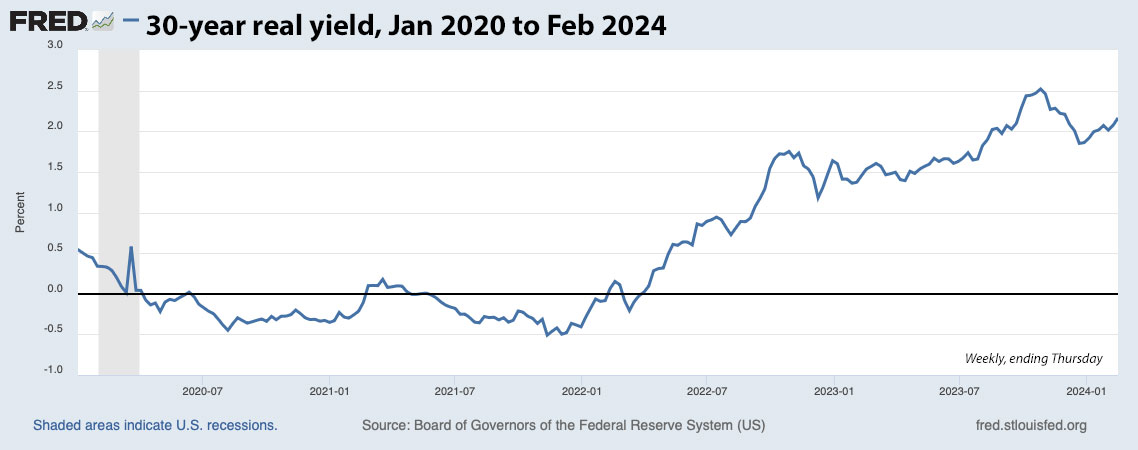
At the auction’s close, a nominal 10-year Treasury note was trading at 4.47%, setting up an inflation breakeven rate of 2.38%, exactly the same as the originating auction’s breakeven rate. Seems reasonable. Here is the trend in the 10-year inflation breakeven rate over the last 5+ years:

Final thoughts

I am traveling in northern Greece at the moment and I haven’t been able to watch financial markets carefully. This looks like a good result for investors. Getting a real yield to maturity of 2.0%+ for 10 years is highly desirable. Will real yields continue climbing higher? That definitely could happen, but today’s result looks like a solid investment.

Here is a history of auctions of this term over the last 5+ years. Today’s result was by far the most attractive in more than a decade of auctions of this term:

• Now is an ideal time to build a TIPS ladder

• Confused by TIPS? Read my Q&A on TIPS

• TIPS in depth: Understand the language

• TIPS on the secondary market: Things to consider

• Upcoming schedule of TIPS auctions

* * *

Feel free to post comments or questions below. If it is your first-ever comment, it will have to wait for moderation. After that, your comments will automatically appear. Please stay on topic and avoid political tirades.

David Enna is a financial journalist, not a financial adviser. He is not selling or profiting from any investment discussed. I Bonds and TIPS are not “get rich” investments; they are best used for capital preservation and inflation protection. They can be purchased through the Treasury or other providers without fees, commissions or carrying charges. Please do your own research before investing.
Posted in Investing in TIPS | 41 Comments

My schedule … and what’s coming up

By David Enna, Tipswatch.com

Mount Olympus

By the time you read this, I will be arriving in Thessaloniki, Greece, to begin a 3-week jaunt across northern Greece, Albania, and North Macedonia. This is the land of Zeus and Alexander the Great, but also probably the land of lousy internet, at times. We’ll be in some remote places.

So over the next couple weeks, I will be slow to provide updates, approve comments, answer questions, and track trends. I will try when I have time and internet. These weeks shouldn’t be particularly newsy but you never know.

What’s coming up?

Wednesday, Sept. 20: At about 2:05 p.m. ET the Federal Reserve will announce the interest-rate decision of its Open Market Committee. I am expecting interest rates to hold steady and then we will hear Jay Powell say some fairly hawkish things in his press conference. “Future rate increases are still possible.”

It’s possible the Federal Reserve has hit its peak short-term interest rate in the range of 5.25% to 5.50%. The short-term T-bill market has been stable for several weeks, which seems to indicate investors think rates will hold at these levels, possibly for many months.

I won’t be writing about this announcement, but you’ll have hundreds of other sources and opinions to read shortly after 2 p.m.

Thursday, Sept. 21: At 1 p.m. Thursday ET (or 8 p.m. in Greece) the Treasury will announce the result of its 10-year TIPS reopening auction. I have posted a preview of the auction, so read that to learn more. Sometime after the auction, I hope to post an abbreviated article on the results.

FYI, CUSIP 91282CHP9 was trading on the secondary market Monday morning with a real yield of 1.98%, so it was still looking attractive, either as a purchase at auction or on the secondary market this week.

Tuesday, Sept. 26: The Treasury will auction a 2-year Treasury note. The key here will be if the high yield ends up above 5%, which is within 50 basis points of much shorter-term T-bills. This would indicate the market believes interest rates will hold at high levels well into 2024.

There are some good nominal yields out there. In Charlotte, a local credit union is offering an 11-month CD with an annual yield of 6.25%, minimum deposit of $5,000.

Huge news coming in October

As Arnold Schwarzenegger famously said, “I’ll be back.”

I’ll be home in time for the September inflation report, which will be issued at 8:30 a.m. Oct. 12. This is the most important inflation report of the year, because it will:

  1. Set the new inflation-adjusted variable rate for the U.S. Series I Savings Bond.
  2. Determine next year’s Social Security COLA.
  3. Set a path for future Federal Reserve interest rate decisions.

* * *

Feel free to post comments or questions below. If it is your first-ever comment, it will have to wait for moderation. After that, your comments will automatically appear. Please stay on topic and avoid political tirades.

David Enna is a financial journalist, not a financial adviser. He is not selling or profiting from any investment discussed. I Bonds and TIPS are not “get rich” investments; they are best used for capital preservation and inflation protection. They can be purchased through the Treasury or other providers without fees, commissions or carrying charges. Please do your own research before investing.
Posted in Federal Reserve, I Bond, Inflation, Investing in TIPS | 10 Comments

10-year TIPS reopening auction should get best real yield in 14 years

By David Enna, Tipswatch.com

This year, for the first time, I’ve soured on buying Treasury Inflation-Protected Securities at auction. Why? Because real yields have often come in a bit below “predicted” market value. That’s been especially true of the 10-year maturity:

  • Jan. 19, 2023: A new 10-year TIPS – CUSIP 91282CGK1 — auctioned with a real yield to maturity of 1.22%, below the when-issued prediction of 1.26%. The coupon rate was set at 1.125%.
  • March 29, 2023: That same TIPS reopened with a real yield of 1.182%. This auction was a winner, because premarket trading had it at 1.15%.
  • May 18, 2023: The same TIPS reopened at 1.395%, below the premarket trading of 1.41%.
  • July 20, 2023: A new TIPS — CUSIP 91282CHP9 — got a real yield of 1.495%, well below the when-issued prediction of 1.546%. The coupon rate was set at 1.375%.

For me, that last auction on July 20 was especially disappointing. (I was hoping for a coupon rate of 1.50% and just missed.) Now CUSIP 91282CHP9 will get its first reopening auction on Thursday. The results are likely to be much more attractive.

At Friday’s close, this TIPS was trading on the secondary market with a real yield to maturity of 1.98% — an increase of nearly 50 basis points in two months. And it is carrying a discounted price of 94.62. If that real yield holds, this auction will result in the highest 10-year auctioned real yield in more than 14 years.

But I won’t be a buyer, because I have filled the 2033 maturity on my TIPS ladder (with real yields of 1.22%, 1.40%, 1.495% and 1.964%). I’m done with 2033. My next purchase will be the 2034 TIPS to be auctioned Jan. 18.

If you are still working on 2033, this TIPS deserves a long look, either at auction or on the secondary market. You can check the current yield and price for this TIPS on the Bloomberg’s Current Yields page. Any real yield above 2.0% deserves consideration.

Definition: A TIPS is an investment that pays a coupon rate well below that of other Treasury investments of the same term. But with a TIPS, the principal balance adjusts each month (usually up, but sometimes down) to match the current U.S. inflation rate. So, the “real yield to maturity” of a TIPS indicates how much an investor will earn above inflation each year until maturity.

Here is the trend in the 10-year real yield over the last 5+ years, a period that includes one dramatic period of Federal Reserve easing (March 2020 to March 2022), one mild period of Fed tightening (2018) and one aggressive period of tightening (April 2022 to today):

Click on image for larger version.

Pricing

CUSIP 91282CHP9 will mature July 15, 2033. It has a coupon rate of 1.375%, well below the current market real yield of 1.98%, so it is selling at a substantial discount with a price of 94.62. This TIPS will have an inflation index of 1.00640 on the settlement date of Sept. 29.

What does this all mean for the price investors will pay? Let’s take a look at a potential $10,000 investment.

  • Par value = $10,000
  • Adjusted principal = $10,064 (based on the inflation index)
  • Cost of investment = $9,523 (based on price of 0.9462)
  • Accrued interest = About $28.40 (will be returned at first coupon payment)
  • Total cost = $9,281

This is a rough estimate, of course, and is based on Friday’s closing value. Things can change before the auction closes at 1 p.m. EDT Thursday. You will find similar pricing on the secondary market, adjusted for a slight bid-ask spread and a slightly lower inflation index.

Inflation breakeven rate

With a nominal 10-year Treasury note currently yielding 4.33%, this TIPS has an inflation breakeven rate of 2.35%, close to the originating auction’s 2.38%. By historic standards, this is a high breakeven rate, but seems reasonable as the Federal Reserve struggles to move inflation to near 2.0%. For the last 10 years ending in August, U.S. inflation has averaged 2.8%.

Here is the trend in the 10-year inflation breakeven rate over the last 5+ years:

Click on image for larger version.

Note that inflation expectations have been gradually declining since last summer, when U.S. inflation peaked at 9.1%. The current rate is 3.7%, still well above the 10-year expectations.

Final thoughts

This is a strong offering, in my opinion. Over the last several weeks I have been pushing hard to fill out my TIPS ladder, which extends to 2043. My primary focus has been on getting real yields around 2.0% for the 2040 to 2043 period. I’d definitely be a re-buyer of CUSIP 91282CHP9 if my 2033 rung wasn’t full.

Can real yields continue higher? Definitely? Maybe? We don’t know. Getting real yields in the 2.0% range for extended maturities is attractive, so it’s a good time to act. It is a sensible purchase and shouldn’t be regretted.

Ponder this: As recently as March 2022, a 10-year nominal Treasury was yielding 1.74%. Now you can get 1.9% to 2.0% above inflation. The trend is good for TIPS investors.

What about secondary market versus auction? My advice is to watch the secondary market for yields you find attractive. That way you can know exactly what you are buying. The auction, however, is a good option for buyers of smaller lots because all investors get the high yield, without any spread.

If you are pondering an investment at Thursday’s auction, keep an eye on Bloomberg’s U.S. Yields page, which updates in real time. It is accurate, but any auction result can bring surprises. The auction closes at 1 pm EDT. Non-competitive bids at TreasuryDirect must be placed by noon Thursday. If you are putting an order in through a brokerage, make sure to place your order Wednesday or very early Thursday, because brokers cut off auction orders before the noon deadline.

By Thursday, I will be traveling in northern Greece so I can’t say for sure when I will be able to post the results.

Now is an ideal time to build a TIPS ladder

Confused by TIPS? Read my Q&A on TIPS

TIPS in depth: Understand the language

TIPS on the secondary market: Things to consider

Upcoming schedule of TIPS auctions

* * *

Feel free to post comments or questions below. If it is your first-ever comment, it will have to wait for moderation. After that, your comments will automatically appear. Please stay on topic and avoid political tirades.

David Enna is a financial journalist, not a financial adviser. He is not selling or profiting from any investment discussed. I Bonds and TIPS are not “get rich” investments; they are best used for capital preservation and inflation protection. They can be purchased through the Treasury or other providers without fees, commissions or carrying charges. Please do your own research before investing.
Posted in Inflation, Investing in TIPS, TreasuryDirect | 17 Comments