U.S. inflation continued sliding lower in May, falling to 4.0% year-over-year

Core inflation, however, remains stubbornly high at 5.3%.

By David Enna, Tipswatch.com

The May inflation report, just released by the Bureau of Labor Statistics, brought some welcome news with seasonally-adjusted prices rising just 0.1% for the month and 4.0% year over year, down from a high of 9.1% in June 2022.

Those numbers came in below expectations, but many economists had shifted their estimates slightly lower, so this was not a surprise. Core inflation, which removes food and energy, came in at 0.4% for the month and 5.3% for the year, matching expectations.

The 4.0% annual inflation rate is the smallest increase recorded since May 2021.

This report is a mixed bag. All-items inflation is falling (partly because of very high inflation numbers a year ago) but core inflation is remaining unacceptably high, and surprisingly stable.

Gasoline prices fell 5.6% in May, after rising 3% in April, and are now down 19.7% year-over-year. Prices for the entire energy sector are down 11.7% for the year, a huge factor in the trend of moderating all-items inflation. Other highlights:

  • Food at home costs rose just 0.1% for the month and are now up 5.8% year-over year. This is a positive trend for American consumers.
  • Shelter costs rose 0.6% for the month and 8.0% year over year. The BLS said shelter costs were the largest factor to the increase in core inflation. Rent costs rose 0.5% for the month.
  • The index for used cars and trucks increased 4.4% for the month, but is down 4.2% year over year.
  • New vehicle prices fell 0.1% for the month.
  • The costs of medical care services fell 0.1% for the month and are down 0.1% year over year.

Here are the 12-month trends in all-items and core inflation, showing the steady decline in overall inflation even as core inflation remains relatively stable above 5.0%:

The decline in the annual inflation rate should continue through June, because U.S. inflation increased 1.37% in June 2022, a shockingly high number. So we should see the official U.S. inflation rate dip below 4.0% in the June report, but after that it should stabilize or potentially rise because year-ago numbers cooled off dramatically from July to the end of 2022.

So while today’s numbers mark a positive trend, in a few months we could see that trend reversing, with U.S. annual inflation inching higher or even moving sharply higher if energy prices reverse.

What this means for TIPS and I Bonds

Investors in Treasury-Inflation Protected Securities and U.S. Series I Savings Bonds are also interested in non-seasonally adjusted inflation, which is used to adjust principal balances on TIPS and set future interest rates for I Bonds. For May, the BLS set the CPI-U inflation index at 304.127, an increase of 0.25% over the April number.

For TIPS. The May inflation report means that principal balances for all TIPS will increase 0.25% in July, after increasing 0.51% in June. Here are the new July Inflation Indexes for all TIPS.

For I Bonds. The May inflation report is the second of a six-month string that will determine the I Bond’s new variable rate, which will be reset November 1. So far, inflation has increased 0.76% in that period, which translates to a variable rate of 1.52%. But four months remain.

Also, in the July to December period, you can expect non-seasonally adjusted inflation to run slightly lower than the official seasonally-adjusted numbers. This happens every year. Here are the numbers I am tracking:

View historical data on my Inflation and I Bonds page.

What this means for future interest rates

My immediate reaction is that the Federal Reserve can go ahead with its planned one-month pause in raising interest rates. That announcement is coming tomorrow. Today’s inflation report matched expectations. But there is nothing here to celebrate, given that core inflation remains stubbornly high and the inflation trend from July through the end of 2023 could move higher.

After this one-month pause, who knows? The June inflation report, coming July 12, is likely to look benign, which would leave the door open for a longer or even permanent pause. From this morning’s Bloomberg report:

“This is a pretty good print in terms of signaling that we are likely to see the core CPI soften materially starting next month,” Omair Sharif, president of Inflation Insights LLC, said in a note. “The way things are going now, I suspect we’ll see a soft core that will tamp down odds of a July hike.”

A lot will depend on the price trend later in 2023. It seems likely the Fed has not yet hit its “terminal rate,” and is highly unlikely to begin cutting interest rates this year.

* * *

Feel free to post comments or questions below. If it is your first-ever comment, it will have to wait for moderation. After that, your comments will automatically appear. Please stay on topic and avoid political tirades.

David Enna is a financial journalist, not a financial adviser. He is not selling or profiting from any investment discussed. I Bonds and TIPS are not “get rich” investments; they are best used for capital preservation and inflation protection. They can be purchased through the Treasury or other providers without fees, commissions or carrying charges. Please do your own research before investing.

Posted in Federal Reserve, I Bond, Inflation, Investing in TIPS | 40 Comments

What’s ahead in this busy news week?

Upcoming: Auctions to watch, decisions from the Federal Reserve, and an important inflation report.

By David Enna, Tipswatch.com

I have to admit that things have seemed pretty sleepy in the peaceful aftermath of the doomsday debt-ceiling crisis. So much “excitement,” and then … naptime.

But things will change this week:

Monday, June 12: The Treasury will auction $65 billion in a 13-week T-bill and $58 billion in a 26-week T-bill. These should provide attractive yields. The auction sizes are larger than normal as the Treasury is working to rebuild its coffers. So far, yields on T-bills have been fairly stable, once the debt-crisis volatility ended. Will the increased issuance cause any cracks?

Also Monday, the Treasury will auction $40 billion in a 3-year Treasury note and $32 billion in a 9-year, 11-month note reopening.

Tuesday, June 13: The Bureau of Labor Statistics will release the May inflation report at 8:30 a.m. EDT. U.S. all-items inflation as of April was running at an annual rate of 4.9%, down from a high of 9.1% in June 2022. Core inflation, though, has been holding steady at around 5.5% through all of 2023.

According to Barron’s, the consensus estimate for May all-items inflation is 0.1%, down from 0.4% in April. But Econoday.com pegs the consensus estimate for all-items inflation at 0.2% for the month and 4.1% year over year.

A 4.1% year-over-year inflation rate would be great news for the Fed — showing the trend it wants — but a high core number could tamp down the optimism. Here is the annual trend through April:

This will be an important inflation report because on Wednesday the Federal Reserve will announce if it will in fact pause increases in short-term interest rates, along with providing future guidance.

Also Tuesday, the Treasury will auction $38 billion in a one-year T-bill. Plus, it will stage a 6-week cash management auction for $45 billion.

And one more thing on Tuesday … Treasury will auction $18 billion in a 29-year, 11-month bond reopening.

Wednesday, June 14. Sometime just after 2 p.m. EDT, the Federal Reserve will announce its decision on short-term interest rates. Because the Fed has signaled strongly that it “may” pause rate hikes this month, that is what I expect will happen. (The Fed uses this signaling as a market-calming strategy.) But markets will be watching closely to see what guidance Fed Chair Jay Powell provides on the Fed’s future plans. I am expecting him to leave the door open to further rate hikes and dismiss any speculation about rate cuts in 2023.

Also Wednesday, the Treasury will auction a 17-week T-bill. The amount has not yet been announced.

Thursday, June 15. Treasury will make a routine announcement about its upcoming reopening auction for CUSIP 91282CGW5, creating a 4-year, 10-month Treasury Inflation Protected Security. The auction will close at 1 p.m. June 22. I will be posting a preview article on that auction next Sunday morning.

Also Thursday, Treasury will auction 4- and 8-week T-bills. The amounts have not yet been announced.

Another thing to watch

I continue to be fascinated by TIPS maturing in the 2040-to-2043 range because real yields remain especially attractive in this 20-year range. My idea is to lock up longer-term real yields of 1.7%+ and hold to maturity. That still isn’t possible for the one year I need for my ladder, 2040. Yields have actually declined slightly in the last few days. From Vanguard:

Click on image for a larger version.

My expectation has been that when the Fed actually halts interest-rate increases, we should see a more-traditional steeping of the yield curve, with the 5-year TIPS declining a bit and the longer-term yields rising. Instead, we currently have an odd pattern of peaks and valleys, with the 10-year having the lowest real yield:

These are U.S. Treasury estimates for full-term TIPS at par value, in other words eliminating any effects from coupon rate premiums or accrued inflation. But as you can see by comparing this to the Vanguard secondary offerings, TIPS in that 2040 to 2043 range remain at attractive yields.

* * *

Feel free to post comments or questions below. If it is your first-ever comment, it will have to wait for moderation. After that, your comments will automatically appear. Please stay on topic and avoid political tirades.

David Enna is a financial journalist, not a financial adviser. He is not selling or profiting from any investment discussed. I Bonds and TIPS are not “get rich” investments; they are best used for capital preservation and inflation protection. They can be purchased through the Treasury or other providers without fees, commissions or carrying charges. Please do your own research before investing.

Posted in Federal Reserve, Inflation, Investing in TIPS, Treasury Bills | 9 Comments

Treasury announces plans to step up T-bill issuance

By David Enna, Tipswatch.com

The U.S. Treasury issued guidance this morning on its plans to increase issuance of Treasury bills in aftermath of the now-resolved debt-ceiling crisis. The Treasury is rebuilding its cash balance, and that means it will stage larger and additional auctions, focusing on shorter-term issues.

From the press release:

Initial increases in bill issuance will be focused on shorter-tenor benchmark securities and cash management bills (CMBs), including the introduction of a regular weekly 6-week CMB (the first of which will be announced on June 8). Treasury has already announced a series of bills for issuance between June 2 and June 13 inclusive that will result in an increase in bill supply of $131 billion, which is expected to bring Treasury’s cash balance to approximately the same level by June 14. Tax receipts on June 15 will further increase Treasury’s cash balance.

As the early June debt ceiling “x-date” approached, the Treasury staged some unusual T-bill auctions, including $15 billion in a 1-day cash management bill on June 2, which got an investment rate of 5.145%, plus $50 billion in a 38-day on the same day, with an investment rate of 5.367%. On June 1, it offered $25 billion in a 3-day CMB, which got an attractive investment rate of 6.256%.

That 1-day auction was the first of its kind since 2007, according to CNN.

The Treasury hasn’t yet posted the auction size for the new 6-week CMB. The announcement should be coming tomorrow. Most likely it will auction with an investment rate of about 5.2%, given current trends.

(Update: The 6-week CMB is sized at $45 billion. Auction date is June 13.)

Cash management bills are used to help manage the Treasury’s short-term financing needs, fitting between regularly scheduled weekly auctions of 4, 8, 13, 17 and 26 weeks. These cash-management auctions are open to the public, but not offered on TreasuryDirect. You have to place orders through a bank or brokerage.

We’ve also seen the size of the regular short-term auctions increasing dramatically this week:

  • The next 4-week T-bill auction on June 8 will be for $72.6 billion, an increase of at least 21% over the more-typical weekly auction size of $50 billion to $60 billion.
  • The next 8-week auction, also June 8, will be for $50 billion, versus a more typical recent size of $35 billion to $45 billion.
  • Monday’s 13-week auction was for $65 billion, up from $57 billion a week ago.
  • Also Monday, the 26-week auction was for $58 billion, versus $48 billion a month ago.

What this all means

So far, the increased size of the Treasury issues hasn’t had much of an effect on yields, which were expected to fall anyway once the debt-ceiling crisis was resolved. Some financial analysts have warned that this deluge of Treasury offerings could affect liquidity and have a negative effect on the stock market. But that doesn’t seem to be the case, so far.

From a MarketWatch report:

“Our key takeaway is that a large amount of T-bill issuance is not necessarily a reason for a broad risk off shift across markets on its own,” a team led by Winnie Cisar, global head of strategy (for CreditSights), wrote in a Wednesday client note. …

“In our view, broad market concerns about T-bill issuance are overblown,” Cisar’s team said, adding that the “upswing in supply,” by itself, isn’t enough for the team to change its constructive view on corporate credit.

For investors, the resolution of the debt-ceiling crisis should remove any apprehension about short-term Treasury bills, which are considered among the safest and most liquid investments in the world. Despite the recent volatility, yields on short-term T-bills remain quite attractive, beautifully shown in this chart:

Click on image for larger version.

* * *

Feel free to post comments or questions below. If it is your first-ever comment, it will have to wait for moderation. After that, your comments will automatically appear. Please stay on topic and avoid political tirades.

David Enna is a financial journalist, not a financial adviser. He is not selling or profiting from any investment discussed. I Bonds and TIPS are not “get rich” investments; they are best used for capital preservation and inflation protection. They can be purchased through the Treasury or other providers without fees, commissions or carrying charges. Please do your own research before investing.

Posted in Cash alternatives, Treasury Bills, TreasuryDirect | 15 Comments

Question: Is inflation dead?

By David Enna, Tipswatch.com

After weeks of financial gloom and omens of disaster, we finally had a “Goldilocks” week in the U.S. financial markets. For example:

  • Debt-limit crisis? Solved.
  • Jobs report? Positive.
  • U.S. dollar? Stronger.
  • Oil prices? Still falling.
  • Stock market? Up 4% in a month.
  • Fed interest rate strategy? Temporary pause.
  • Inflation expectations? Falling.

All is good, right? But that last one — inflation expectations falling — has me wondering: Do we really think inflation is under control, just 11 months after the U.S. annual rate of inflation hit 9.1%? I am not so sure, but the financial markets continue to bet that inflation will fall to traditional levels … very soon.

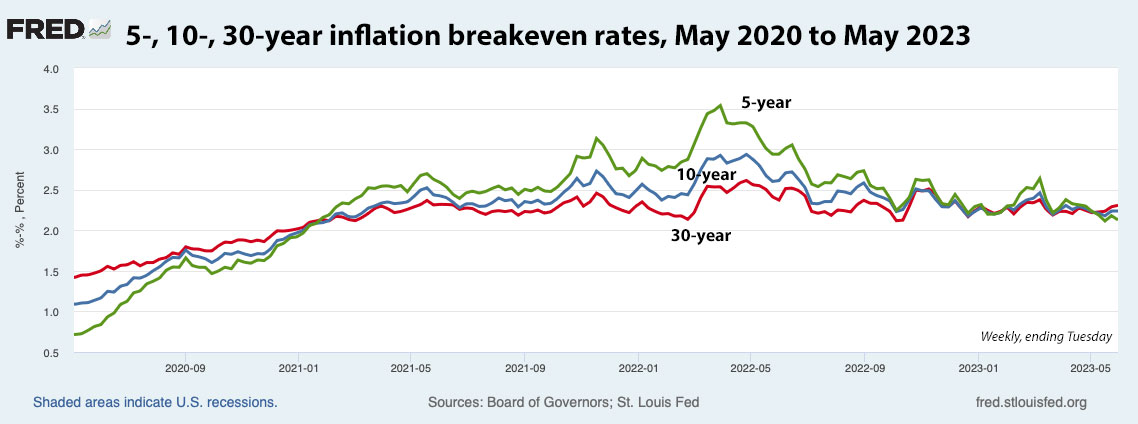
Here is a look at inflation breakeven rates over the last 3 1/2 years, reflecting the difference in yield between a nominal Treasury and a Treasury Inflation-Protected Security of the same term:

One immediate takeaway from this chart is that the inflation breakeven rate is a lousy predictor of future inflation. It measures investor sentiment, and sentiment is often very wrong. Nowhere on this chart can you find inflation expectations signaling future inflation of 9%, 6%, or even 5%, numbers we saw every single month from May 2021 to March 2023.

Click on image for larger version.

This chart shows that inflation expectations did widen out in early 2022, catching a hint from the highest surge in U.S. inflation in 40 years. But only the 5-year breakeven ever touched a level above 3%. (Inflation over the last 5 years has averaged 3.9%. Over 10 years, 2.7%. Over 30 years, 2.5%)

I am amazed that the financial markets believe inflation will average less than 2.25% across the entire maturity spectrum of TIPS, from 5 to 30 years. That certainly could happen, but my gut says inflation will run higher, especially if we have entered a new era of global price pressures.

Instead, the markets seem to be pricing in sunny skies (surging stock market) and economic gloom (falling inflation expectations) at the same time.

This view is shared by inflation analyst Michael Ashton, who posted a commentary this week titled, “Is Inflation Dead … Again?” His focus is on inflation expectations through the end of the year:

But here is something that seems very weird to me. Prices of short-dated inflation swaps in the interbank market suggest that NSA headline inflation is going to rise less than 0.9% for the entire balance of 2023. … The market is pricing that between June’s CPI print and December’s CPI print the overall price level will rise 0.23%…less than ½% annualized! …

Headline inflation between June and December last year rose only 0.16%, leading to disappointing coupons on iBonds and producing proclamations that inflation was nearly beaten. Here’s the thing, though. The second half of 2022 it made perfect sense that headline inflation was mostly unchanged. Oil prices dropped from $120/bbl the first week of June, to $75 by mid-December. Nationwide, average unleaded gasoline prices dropped from $5 to $3.25 during that time period. …

A comparable percentage decline would mean that gasoline would need to drop to $2.32 from the current $3.58 average price at the pump. …

Naturally, it’s possible that inflation will suddenly flatline from here. I just don’t feel like that’s the ‘fair bet’.

The rest of 2023

For I Bond investors and Social Security recipients awaiting new COLA numbers, inflation rates from July to December are likely to be disappointingly low. That is highly likely because non-seasonally adjusted inflation generally runs higher than the headline number from January to June, and then lower from July to December. This has been a consistent result over the last several years.

And I agree that the inflation picture is likely to look more rosy by the end of the year, especially for the all-items number, which includes food and energy. The Cleveland Fed is forecasting that the U.S. inflation rate will fall to 4.13% in the May report, coming June 13. That would be positive news, but I suspect it’s an optimistic forecast. It also sees core inflation falling to 5.3% from the current rate of 5.5%.

But inflation-watchers need to realize that these late 2023 numbers could be a head-fake, setting up a time of continued inflation above the Federal Reserve’s target of 2%. If the markets are right in seeing inflation running at 2.24% for the next 10 years, I’d have to agree that the worst of the inflationary danger has past. But we will have to wait and see. And that’s not a gamble I’m willing to take.

Next steps?

Even though short-term nominal interest rates are very attractive today on safe investments, I recommend sticking with some exposure to longer-term inflation protection. I was buying TIPS and I Bonds through a decade of lower-than-expected inflation, and finally in 2021 to 2023 that strategy paid off with much, much higher-than-expected inflation.

We might see U.S. inflation seem to wane in coming months, and it may or may not reflect a longer-term reality. I’m saying it is smart to hold on to some level of inflation insurance in your portfolio.

* * *

Feel free to post comments or questions below. If it is your first-ever comment, it will have to wait for moderation. After that, your comments will automatically appear. Please stay on topic and avoid political tirades.

David Enna is a financial journalist, not a financial adviser. He is not selling or profiting from any investment discussed. I Bonds and TIPS are not “get rich” investments; they are best used for capital preservation and inflation protection. They can be purchased through the Treasury or other providers without fees, commissions or carrying charges. Please do your own research before investing.

Posted in Federal Reserve, I Bond, Inflation, Investing in TIPS, Social Security | 29 Comments

Follow-up: I pulled the trigger on the February 2042 TIPS

By David Enna, Tipswatch.com

Last week I was doing quite a bit of research on Treasury Inflation-Protected Securities that mature from 2040 to 2045, years that “should be” near the end of my life expectancy. That resulted in an article I posted Thursday: “Looking to invest in longer-term TIPS? There’s a problem.”

Writing that article ended up being similar to volunteering at a cat & dog shelter. I found myself wanting to bring all the puppies and kitties home. Here are the six potential investment options, with prices and yields as of Wednesday afternoon:

As I noted in the article, I carry a bias — possibly overblown — against buying high inflation accruals at a premium price. So that ruled out the TIPS maturing in 2040 and 2041, both with high inflation indexes and higher-than-market coupon rates. Those two looked too pricey.

But the more I thought about it, the rest of the bunch (maturing in 2042 to 2045) looked fine, with attractive real yields and relatively high inflation accruals balanced off by below-market coupon rates. I especially liked CUSIP 912810QV3, maturing in February 2042, because it would fill a rung in my TIPS ladder between 2041 and 2043.

I hunted around Friday and noticed the real yield on CUSIP 912810QV3 had increased slightly, to 1.717% on a $10,000 purchase. So I pulled the trigger.

I know that these secondary market TIPS purchases can be confusing — balancing so many factors of cost and inflation accruals — so I’ve created a summary of that investment:

I bought $10,000 in par value of this TIPS, but because of the inflation factor of 1.33494 I was actually purchasing $13,349.40 of principal. The price was 84.57 for $100 of value, so the cost of the investment was $11,289.59.

In other words, I paid $11,289.59 for $13,349.40 of principal. The accrued interest of $27.70 will be repaid to me at the Aug. 15 coupon payment.

At this point, I have $13,349.40 earning annual interest of 0.750%. The principal total will continue climbing with inflation until maturity on Feb. 15, 2042.

With this investment, I am guaranteed to receive the $10,000 par value at maturity, even if we hit 19 years of deflation. That means $1,289.59 of my original investment is at risk if severe and extended deflation strikes. I am OK with that. The risk is extremely small. And the risk is counter-balanced by the 0.750% annual interest I will collect along the way.

What’s coming up

The June 22 reopening auction of CUSIP 91282CGW5 — creating a 4-year, 10-month TIPS — is starting to look interesting. That TIPS got a real yield of 1.32% at the originating auction on April 20, setting its coupon rate at 1.25%. As of Friday’s market close it was trading with real yield of 1.78%, up 46 basis points in just over a month.

Things can change before the June 22 auction, of course, but remember that this TIPS trades on the secondary market and could be purchased at any time along the way, if you see a real yield you find attractive. It’s inflation index is just 1.005 and the price is discounted at about 97.56.

Confused by TIPS? Read my Q&A on TIPS

TIPS in depth: Understand the language

TIPS on the secondary market: Things to consider

Upcoming schedule of TIPS auctions

* * *

Feel free to post comments or questions below. If it is your first-ever comment, it will have to wait for moderation. After that, your comments will automatically appear. Please stay on topic and avoid political tirades.

David Enna is a financial journalist, not a financial adviser. He is not selling or profiting from any investment discussed. I Bonds and TIPS are not “get rich” investments; they are best used for capital preservation and inflation protection. They can be purchased through the Treasury or other providers without fees, commissions or carrying charges. Please do your own research before investing.

Posted in Investing in TIPS | 25 Comments