
A new fixed rate of 1.30% looks like a real possibility.
By David Enna, Tipswatch.com
We’ve seen a fascinating explosion in real yields in 2026 as the war with Iran, inflationary pressures and soaring federal deficits are straining the U.S. Treasury market.
This move higher is significant for investors in Series I Savings Bonds, a Treasury investment with returns pegged to U.S. inflation through a combination of fixed and variable rates:
- The I Bond’s fixed rate will never change. Purchases through October 2026 have a fixed rate of 0.90%, which means the return will exceed official U.S. inflation by 0.9% until the I Bond is redeemed or matures in 30 years. A new fixed rate will be set Nov. 1, 2026.
- The inflation-adjusted rate (often called the I Bond’s variable rate) changes each six months to reflect the running rate of inflation. That rate is currently 3.34%, annualized, for six months. It will also adjust on Nov. 1, 2026, rolling into effect for all I Bonds, no matter when they were purchased.
- The I Bond’s current composite rate is 4.26%, annualized, for a full six months for any bond purchased from May to October 2026.
For I Bond investors, the fixed rate is the most important factor, especially for investments likely to be held for many years. Once purchased, an I Bond holds that fixed rate forever, while the variable rate will change every six months.
Also see: TIPS vs. I Bonds: Let’s do the math
The fixed rate math
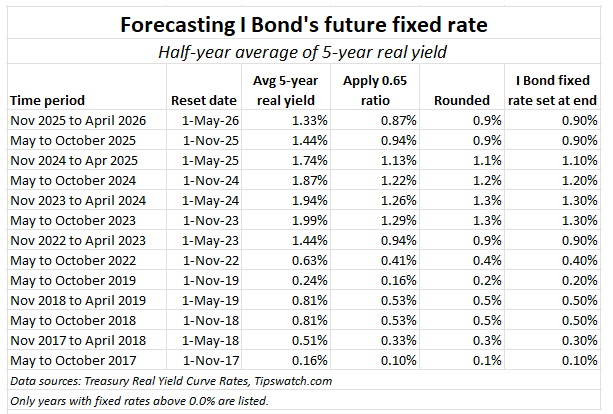
How is the fixed rate set? There is no announced formula and in theory this decision can be made at the discretion of the Treasury Secretary. However, over the last decade the fixed rate could be accurately forecast using this formula: Apply a ratio of 0.65 to the six-month average real yield of the 5-year TIPS. Here are results of that ratio since 2017:
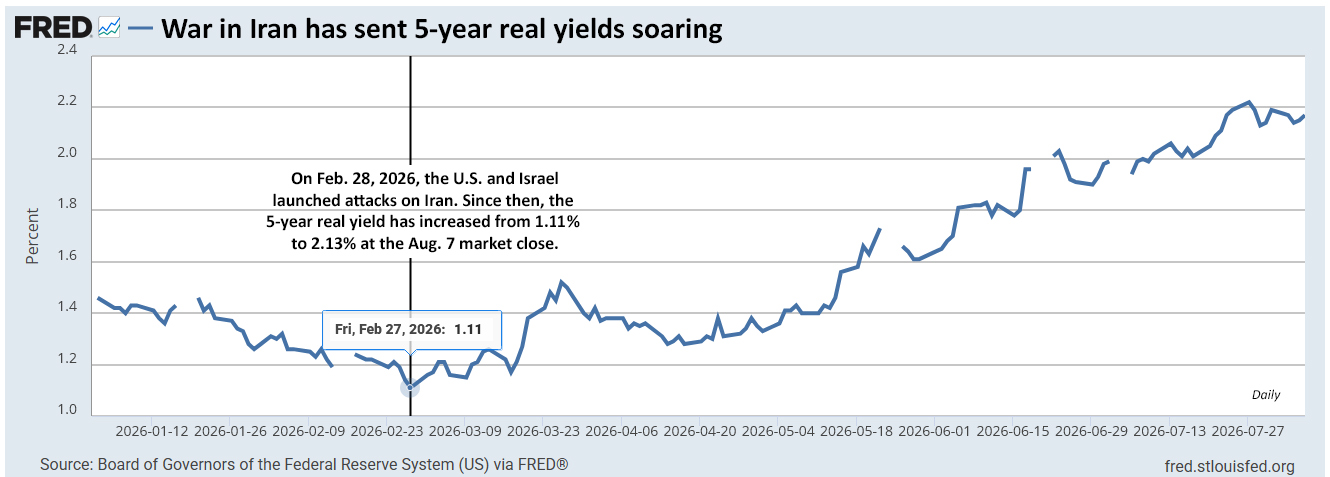
On Jan. 1, 2026, the 5-year TIPS was yielding 1.46%, but that rate began steadily heading lower, right up to the day before the Iran war began on Feb. 28, 2026, when it closed at 1.11%. Since the launch of war, the 5-year real yield has increased 102 basis points, to 2.13%.
So the rate picture has dramatically changed since the I Bond’s May 1 reset. Because of these elevated 5-year real yields, the fixed rate is almost certainly going to increase above the current 0.90%. Let’s look at a projection, based on 5-year real yields from May 1 to Aug. 8, 2026:
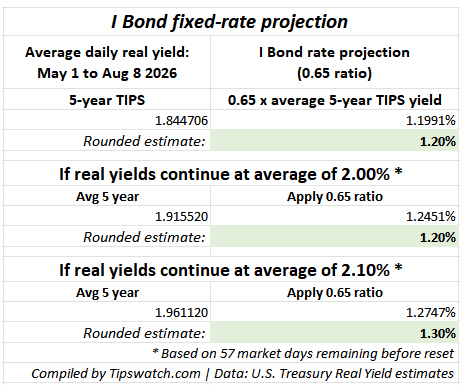
We are just a bit more than halfway through the six-month period from May 1 to Oct. 31. So far, the average 5-year real yield has increased to about 1.84%, which would translate to a new fixed rate of 1.20%. And that projection looks solid if rates continue at elevated levels.
Just a reminder: The Treasury sets the I Bond’s fixed rate to the tenth decimal point, which means that any six-month ratio result of 1.151% or higher will be rounded up to 1.20%, and any ratio result of 1.251% or higher will be rounded to 1.30%. At this point, the current 0.65-ratio of 1.1991% is solidly above the 1.20% trigger.
The current 5-year real yield is 2.13%, as of Friday’s market close.
There are 57 market days remaining before the November 1 reset. In the two calculations above, I projected a rate of 1.20% if the average 5-year real yield falls to 2.00%. But if it continues around 2.10%, the fixed rate will rise to 1.30%.
Conclusion. With 2 1/2 months to go, we are right on the edge of the 1.30% fixed rate. The 1.20% fixed rate looks locked in as long as 5-year real yields remain anywhere near the current average of 1.84%, and the 1.30% rate is highly likely if rates continue at 2.10% or higher.
What about the variable rate?
Because of the recent surge in inflation, I had been expecting the I Bond’s variable rate to also increase from the current 3.34% at the November reset. This is not at all certain, however. Non-seasonally adjusted inflation fell 0.35% in June, a big surprise. The July inflation report, to be released Wednesday, could also be rather tame, with all-items projections hovering around 0.1%.
We will get a lot better idea after that July inflation report is released. I will be posting an analysis Wednesday morning.
Is there an investing strategy?
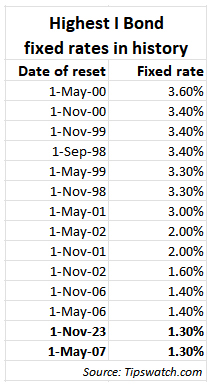
Yes. If you haven’t yet purchased I Bonds up to the $10,000 per person per year limit, hold off on any investment. The November fixed-rate reset is going to be an improvement over the current 0.90%.
If you are like me and already purchased up to the limit, there will be opportunities to use the still-existing gift-box option after the November reset, for people with a trusted partner. Plus, the new rate will be available to everyone from January to April 2027.
I will be writing about this topic often as we get closer to the November reset.
Qualifications
The projection presented in this article is based on 10 years of Treasury history in setting the I Bond’s fixed rate. But the Treasury could change course at any time. So far, in both of President Trump’s terms, the rate formula has remained accurate.
Keep in mind that the Treasury actually saves money by lending to I Bond investors at a real yield of 0.90% or 1.30% as opposed to the current 5-year real yield of 2.13% or 30-year real yield of 2.96%. Plus, savings bonds account for a minuscule portion of Treasury debt.
• Confused by I Bonds? Read my Q&A on I Bonds
• Let’s ‘try’ to clarify how an I Bond’s interest is calculated
• Inflation and I Bonds: Track the variable rate changes
• I Bonds: Here’s a simple way to track current value
• I Bond Manifesto: How this investment can work as an emergency fund
—————————

Donate? This site is free and I hope to keep it that way. Some readers have suggested having a way to contribute. I welcome donations, any amount. And FYI, ads on this site pay for about one visit to Costco.
—————————
Follow Tipswatch on X for updates on daily Treasury auctions and real yield trends (when I am not traveling).
Feel free to post comments or questions below. If it is your first-ever comment, it will have to wait for moderation. After that, your comments will automatically appear. Please stay on topic and avoid political tirades. NOTE: Comment threads can only be three responses deep. If you see that you cannot respond, create a new comment and reference the topic.
David Enna is a financial journalist, not a financial adviser. He is not selling or profiting from any investment discussed. I Bonds and TIPS are not “get rich” investments; they are best used for capital preservation and inflation protection. They can be purchased through the Treasury or other providers without fees, commissions or carrying charges. Please do your own research before investing.


5 yr tips yield currently at 2.646%. So we’re looking good for 1.3% fixed on Ibonds?
Yes, 1.3% looks solid, with a shot at 1.4%. That assumes the Treasury follows past practices.
Pingback: The I Bond Fixed Rate, Explained: Why 4.26% Isn’t the Number That Matters – Bright Purse
Where does this stand after today’s “as expected” CPI report?
Inflation doesn’t directly affect the I Bond’s fixed rate, which relies more on the 5-year real yield. Today that stands at about 2.10%, down a few basis points from Tuesday’s close.
And just so I understand, the rough formula is 65% of that number?
65% of 2.10% = 1.365 = 1.40% fixed rate (as of this moment in time) or is the rough calculation people use not that straight forward?
Marce, no, the formula is 0.65 times the six-month average of the 5-year real yield. As of last week that average was 1.84%, which x 0.65 = 1.196 and rounds to 1.20%.
Got it. Thank you.
A 3% real yield over the next 30 years looks awfully tempting to me as an investment. It would be a good opportunity to rebalance out of some of these high flying stocks and lock in the gains.
I like TIPS and am currently building out my ladder. I also invest in I bonds. Is there any reason to invest in US Savings Bonds? Series EE pays 2.40% but if held for 20 years the bond will double in value. This from TreasuryDirect: For EE bonds you buy now, we guarantee that the bond will double in value in 20 years, even if we have to add money at 20 years to make that happen.
These might make sense in a very low interest environment, for even if they pay only .10% which they did recently, if held for 20 years they will pay 3.6%. But we’re not in a low rate environment anymore. So what is the role for EE Savings Bonds, if any?
I unloaded 0.10% savings bonds when rates shot up because I didn’t see a need, although the 3.6% 20 year rate was attractive when I bought them and paying a 0.9% or 1.9% annual penalty to the market rate for a medium term CD wasn’t that big a deal. There is an edge case of masking your net worth, since at 0.1% you would get a giant lump sum of interest credited in your account at exactly 20 years. So for college financial aid calculation, or asset dissolution in the case of a divorce or judgment, that might save you a few thousand bucks per bond. But that is so niche.
In my opinion, the only time one should buy I-Bonds is when the fixed rate is high; otherwise they’re really not worth it.
Our current I-Bond holdings, purchased in April 2024, have a fixed rate of 1.3%, so that makes the November reset particularly attractive, so I’ll probably be a buyer in November and then again in January.
As an aside, I would like to point that on I-Bonds with a 0% fixed rate, the taxes one pays will be due entirely to inflation, not to any real income. That doesn’t seem right to me. I think that only the interest earned from the fixed rate should be taxed. Ditto TIPS and their coupon rate.
My experience is only the last 4 years, but i agree with your statement – buying I Bonds at a high fixed rate is the goal. I bought I Bonds at 0% fixed rate when the composite rate was crazy (2022?). It was something like 9.6%. But it didn’t last long, and I redeemed the I Bonds, lost the penalty, and then bought I Bonds mostly at 1.1-1.3% a year or two ago (including using a trust and trusted partner gifting). Since I have a good amount of I Bonds now (for me), I probably wouldn’t buy more I Bonds unless the fixed rate was as good as the TIPS real yield. I prefer the TIPS yield currently.
Kindred spirits, Scott, except that our experience with I Bonds goes considerably further back than four years.
Redeemed all our I Bonds with fixed rates of 0%, 0.20%, 0.40%, etc. (some were old enough to escape the interest subtraction for early redemption, others not), then used gift box and trust accounts to “recycle” the proceeds into a current I Bond collection where everything is 1.10% to 1.30%. We don’t expect that we’ll need any of this money before the whole collection passes the five-year mark and becomes interest penalty-free.
Meanwhile, still also constructing a modest collection of TIPS, nothing maturing further out than 10 years, in a Roth IRA, which in my opinion is the best place to hold TIPS, because the value of the inflation earnings won’t be reduced by future taxes or subject to RMDs at times we didn’t choose.
Being taxed on the inflation component of Savings Bonds and TIPS does seem unfair, but then we are also taxed on an implicit inflation rate set by the marketplace on all interest bearing products.
Example: 5 year I Bonds and TIPS csn be compared with the 5 year nominal equivalent 5 year Treasury Notes (I Bonds are redeemable after 5 years without penalty). This morning, Bloomberg was listing 4.39% interest rate for 5 year Notes and a 2..13% real yield for ( year TIPS. This means the marketplace was implying a breakeven inflation rate of 2.26%. Owners of 5 year nominal Notes will be taxed on the full 4.39%, so, in effect, they too will be paying tax on both their real yield and the market based inflation component of 2.26%.
I’m reposting this as a question to any asking where my logic may be off:
I hear about worry of TIPS tax efficiency vs I-bonds from the ‘phantom tax’ in the form of the TIPS principal inflation adjustments each year in a taxable account (but not a problem in an IRA/401K).
It appears to me TIPS taxable principal adjustments might be a few hundred dollars per ten thousand of TIPS per year, or maybe even $3500 or so lately in a taxable account per year per $100K of TIPS holdings, dependent on the inflation rate plus any paid-out coupon cash payments.
It looks to me like for most smaller investors the ‘phantom income’ from TIPS holdings wouldn’t move the taxable income needle very much.
But paying any small annual additional income tax liabilities along the way might help avoid a larger taxable income event that could occur when cashing out old I-bonds where the income taxes likely have been deferred for many years.
Am I off in my figuring it is an advantage is to take the higher real return rate securities, vs overall income tax hit vs some other benefits regarding TIPS vs I-bond investments, even inside a taxable brokerage account?
There seems to be none of these problems taking the higher rate TIPS in a tax-deferred account.
I have TIPS both in a taxable account and a ROTH. I consider myself a small investor. I agree the “phantom tax” in a taxable account is not a large amount for a small investor. I track the CPI changes over the year so I can address the taxes. I like with the TIPS in a taxable account that I pay the tax upfront and not at maturity as with I Bonds. I have been building a TIPS ladder. I also can sell TIPS on the secondary market at any time, which provides additional flexibility. I also have I Bonds, and the yield is not as a good, but I do like the flexibility of when I can withdraw, knowing taxes are due upon withdrawal, and planning for that, and it serves as my emergency fund. At this point if TIPS continue to significantly exceed the yield of I Bonds, I will invest in more TIPS and retain the I Bonds I already have, most at 1.1% to 1.3% real yield (recent investor). I also will be in a higher tax bracket in 4-7 years, so paying taxes now on TIPS in a taxable account is beneficial for me. If all my money was in a ROTH, I’d be happy. I would avoid buying TIPS in a traditional IRA because I am in a high tax state.
As to your original question, yes, for a small investor the phantom tax is not a big deal and I like the higher real yield of TIPS at the moment.
I don’t think it is simply a tax efficiency argument. There is also tax simplicity and tax predictability. I bonds certainly give you the latter two. They also protect you from loss, whereas an unplanned need can cause you to realize a loss on TIPS.
Inflation was 8% a few years back, meaning $8,000 phantom income on $100,000 principal. And if you encounter 8% inflation after the principal has accrued substantially, that 8% might be $12,000 of taxable income. Whether that is a lot or not depends upon your situation.
Maturity matters – long TIPS might not be a good choice even with the higher return for a number of reasons. As Mike Tyson said, everybody has a plan until they get punched in the face. Have you looked at the price of the 2049 TIPS?
I would suggest anyone who only intends to own $10,000 in TIPS to find another investment. The inflation protection benefit is not large enough to be meaningful but you have added complexity and unpredictability and have to live with it for however many years. The comparison in a taxable account shouldn’t be only to I bonds. Nominal treasuries are simple and are priced to include anticipated inflation;TIPS are not always the winners compared to nominal Treasuries.
There are a lot of factors, so the answer is really “it depends.”
I would add that you generally want to hold treasuries in a taxable account if you live in a state with income taxes.
If one is an early retiree on ACA health insurance plan, or is planning to be an early retiree and utilize ACA, having any kind of “phantom income” is very undesirable. It pushes up MAGI affecting one’s eligibility for subsidies, while at the same time not providing any additional spending money.
Worth noting, the fixed rate formula didn’t work nearly as well earlier in the history of I-bonds (formula/actual): 05/01/03: 0.90%/1.10%; 11/01/03: 0.80%/1.10%; 05/01/04: 0.60%/1.00%; 11/01/04: 0.80%/1.00%; 05/01/05: 0.70%/1.20%; 11/01/05: 1.00%/1.00%; 05/01/06: 1.30%/1.40%; 11/01/06: 1.60%/1.40%; 05/01/07: 1.50%/1.30%; 11/01/07: 1.50%/1.20%; 05/01/08: 0.50%/0.00%; 11/01/08: 0.90%/0.70%; 05/01/09: 1.10%/0.10%; 11/01/09: 0.70%/0.30%; 05/01/10: 0.30%/0.20%; 11/01/10: 0.10%/0.00%; 05/01/11: 0.00%/0.00%; 11/01/11: -0.40%/0.00%; 05/01/12: -0.60%/0.00%; 11/01/12: -0.80%/0.00%; 05/01/13: -0.90%/0.00%; 11/01/13: -0.30%/0.20%; 05/01/14: -0.10%/0.10%; 11/01/14: -0.10%/0.00%; 05/01/15: 0.10%/0.00%; 11/01/15: 0.10%/0.10%; 05/01/16: 0.10%/0.10%; 11/01/16: -0.20%/0.00%; 05/01/17: 0.00%/0.00%
By law they can’t go below 0% and when I Bonds were newer there was an incentive to go higher to account for the fact it was an immature product.
This was a useful perspective, thank you.
Keep in mind that the Treasury actually saves money by lending to I Bond investors at a real yield of 0.90% or 1.30% as opposed to the current 5-year real yield of 2.13% or 30-year real yield of 2.96%.
As expected, my patience this year paid off. Granted, this was easy, given relative certainty that it was quite unlikely for the fixed rate to drop.
My I-Bonds serve as extended emergency fund for now, and a small self-funded annuity if they last to retirement to supplement Social Security as an inflation-indexed income floor. 1.30% would get my blended (across my portfolio) fixed rate up to ~0.891%. If maintained into 2027, I’d be up to 0.954% next year.
For capital preservation, it’s hard to argue. Tax deferment also gives me advantage versus yet more funds in a HYSA (which I do have) now, but especially in retirement where instead of federal + state taxes of 40% in a HYSA, I’d only be subject to federal taxes at 22%, given the current tax brackets.
Once we start climbing past a 0.65% blended fixed rate, I-Bonds start to provide a inflation-adjusted real return net of income taxes. For me that wasn’t a goal, but it’s a nice bonus knowing that every $1 may be worth $1.10 or more net of taxes.
I’m still at least 6 (probably 11-15) years away from considering a TIPS ladder to live within my traditional 401K, so until then I continue to accumulate I-Bonds.
I’ve long used I-Bonds as roughly half my emergency fund, helping avoid state income taxes, control when the income hits, and enjoy a slight premium versus online savings.
But given current real yields, and nearing retirement, I’ve been considering updating my plan to add TIPS as a supplementary, long-term holding inside my IRA. I’ve been holding fixed income through BND, so the idea is to shift a quarter to a third of my BND to TIPS; and I suppose I’ve circled a 10-year as a hold-till-maturity position, with a 2.43 yield and 2.25 breakeven.
Am I talking sense and what would I be missing by exiting some BND and making a potentially one and done reallocation play on a 10-year TIPS. Is now a good/good enough time to make this move?
In fall of 2023, I converted holdings in SCHP and BND to a ladder of TIPS extending out to 2043. That was a great time to build a TIPS ladder, but today is even better. From TIPSladder.com: “At current yields (as of 2026-08-07) a 30 year TIPS ladder can provide a Safe Withdrawal Rate of 4.9%, and a real yield of 2.9%.” In your case, you are looking at a single 10-year TIPS? If you can absolutely hold to maturity, you’d probably do fine. (I am not a financial adviser.)
How timely that you share this!
I’m currently 46 and thinking about purchasing $10k in the upcoming 30-Year TIPS auction in a taxable account for no real reason other than income (or maybe in my 401k as part of my fixed income portion).
Trouble is, I live in California and am in the 9.3% state and 22% federal tax rates. Gives me pause about the taxable account route.
I’d love to hear your thoughts if you’re willing. Thank you!
I am not a huge fan of a 30-year TIPS in a taxable account, even though I have bought a couple along the way. But for you? Maybe. With the current real yield approaching 3%, a new TIPS will be cash-flow positive, which is important. The coupon income will pay the yearly tax on inflation accruals. The good thing is that the TIPS inflation accruals and payouts will be free of state income taxes — while in a traditional IRA you’d be paying taxes on all future withdrawals. So in California, because of the high state income tax, a TIPS in a taxable account does make sense.
Thank you, I appreciate the feedback! I didn’t realize the high tax state/TIPS brokerage connection. Apologies for posting this in the wrong spot!
20-year TIPS and 30-year TIPS have very similar real yields on the secondary market right now. Similar yield on a shorter term is another option. It’s also great that treasury interest is not subject to state tax in higher tax states like CA.
FYI, I will be posting a preview of that 30-year TIPS auction Sunday morning, Aug 16.
Excellent, thank you David.
If someone was planning to hold the bonds only 5 years, it looks like the 5-year TIPS is still over 2.1% real yield over inflation these days and longer TIPS are even higher real yield. 1.3% real yield on I-bonds seems pretty low in comparison.
I Bonds have the advantage of flexibility. You can hold it for anywhere from 1 to 30 years. If you know you’re going to hold it for exactly 5 years, then yes TIPS are a better choice. Otherwise I Bonds can be better even at a lower rate.
There’s value to the optionality of choosing your duration. Also, I-bonds are more tax-efficient.
There is a cost for that flexibility, but I-bonds are probably a bit better than a HYSA.
I hear often about this worry of the ‘phantom tax’ from the TIPS principal inflation adjustments each year.
The taxable principal adjustments might be a few hundred dollars per ten thousand of TIPS per year or maybe even $3500 or so in taxable per year per $100K of TIPS holdings depending on the inflation rate.
For most smaller investors the ‘phantom income’ from TIPS holdings wouldn’t seem to move the taxable income needle very much. Plus, paying any small annual tax liabilities along the way may could help avoid a larger taxable income event that can occur when cashing out old I-bonds where the income taxes may have been deferred for many years.
The ability to time the realization of taxable income is incredibly valuable, especially in retirement. I-bonds dominate over TIPS in this regard.
I am excited too about the new upcoming I bond fixed rate which will be higher. Wouldn’t it be nice if Treasury chose to increase the purchase caps when the November reset comes around? I think the formula for taking 5 year yields averaged over the preceding 6 months x 0.65 may also apply to EE bonds. Those rates will increase too and may land at 2.8 or 2.9%. If held for 20 years EE bonds double in value so the effective rate is 3.5%
For those trying to decide between TIPS and I bonds just remember the advantages of savings bonds generally. You can defer the taxes until redemption and the interest payments fully compound. You have a put option after a year. Plus I bonds are not as confusing as TIPS.
What a desert of low interest rates we had to endure during the teens! As a dedicated I bonder I have a large pile of them with fixed rates of 0, 0.1, and 0.2%. The problem is that even at those low rates they have accumulated enough interest that were I to cash them in I would get a significant tax hit. So inertia takes over and I leave them alone. I regard them as a portion of emergency funds if needed.
Throughout this year bonds have only continued to look better as a diversifying asset. Everyone is crazed about stocks while the broad bond market has returned around 0% this year, meaning that yields continue to edge up. They can make a nice income stream. However, the bond vigilantes have started to wonder about U.S. creditworthiness owing to multiple factors– war, tariffs, the president meddling in the Federal Reserve and pushing for lower rates in the face of persistent inflation. Perhaps it’s time to look at German bonds.
I wouldn’t wish for the govt to increase the purchase limit, they could just as easily eliminate the whole program. Just keep it quiet about the I bond program. shh.
I’m in the same boat as you with a bunch of 0% I bonds. Apparently the right thing to do was to sell them or not buy them in the first place. Like you, I’ll just let them sit there.
I’m debating between iBonds & TIPs, a debate that never ends.
I’ve only ever bought TIPs at auction because the secondary market TIPs are so much more confusing to me. Plus, there’s usually a higher minimum to buy. As an alternative to buying a TIPs maturing in 6 years I could buy a one-year CD or iBonds and then a five-year TIPs or a five-year TIPs and then a one-year CD or iBonds. Anyone have any thoughts on these options?
David, I wondered if you might compare 912810FQ6, maturing 4/15/32 with a 3.375% coupon, and 91282CEZ0, maturing 7/15/32 with a 0.625% coupon. The lower coupon one would mean a discount and lower semi-annual payments, but also lower deflation risk, right? And shouldn’t the total yield at the maturity date be similar (barring unlikely deflation)?
Thank you, Karlos
The TIPS maturing April 2032 is an aging 30-year TIPS with that 3.375% coupon rate. It also has an inflation index of 1.886, which means you will be buying 88.6% additional principal that is not protected against deflation (not a huge deal, but there you go.) Because the coupon rate is so high, this TIPS has a price of about 106.55, which means you’d be buying all that additional principal at a steep premium. A $10,000 par value investment in this TIPS will cost about $19,990. It’s yield to maturity is currently 2.141%.
The TIPS maturing July 2032 is selling at a discount (about 91.90) and has an inflation accrual of 1.152, which means you would be buying 15% additional principal — but at a discount. A $10,000 par value in this investment will cost about $10,585. So all in all, I’d say it looks more attractive for a small investor, and that is why its current yield is 2.082%, a bit lower. Also, a TIPS maturing in April is more susceptible to closing months of deflation, so the April TIPS automatically gets a slightly higher yield.
My daughter and son-in-law, both in their late thirties, are looking to diversify some of their Roth IRA accounts from equities to fixed income but with inflation protection. As IRA accounts cannot hold I Bonds, they are considering TIPS. Does it make sense to go for the 30 year, with a real yield of almost 3%, and hold to maturity?
By way of comparison, current YTM on 30 year U.S. Treasury Zero Coupon Bonds is around 5.20%, implying a breakeven inflation rate of around 2.20%.
I am in the same situation with my daughter and son-in-law. As I see it, yes, 30 year TIPS is a good choice, especially with 3% fixed rate, since they can’t have I Bonds in an IRA account. However, the trade off is with investing long-term in equities in something like S&P 500 using VOO, or VGT, or VTI. Time is on their side and they can take risk and be aggressive. But then it depends on their risk tolerance and portfolio make up. I am not a financial advisor. I am one of those DIYs with our little money.
Thank you for sharing your thoughts.
My daughter and her husband do have low risk tolerance and they believe that right now most stocks – and therefore even the most widely diversified mutual and index funds – are grossly overvalued. They said they are willing to pay the opportunity cost of moving some of their assets out of equities and into safe bonds with a reasonable return. Time will tell.
Different financial instruments, different purposes. I-Bonds of course will never get a return anywhere near a low-cost index fund like VOO or VTI but that’s not what my family uses them for. In our case, we’re stockpiling them as insurance for sequence of returns risk when it’s time to use our 529s for college or our investment portfolio for retirement.
There’s no guarantee that the stock market will be at all time highs when it’s time to start withdrawing, and I-Bonds are guaranteed to hold their purchasing power over time and inflation.
They also make me comfortable with a more aggressive equity / bond allocation and most importantly, help me sleep at night.
I agree with you 100%. I will be 70 this month, and my wife and I have been buying I Bonds every year for the last 15+ years. So far, I have not cashed a single one of them. I wish I had started buying sooner. We also bought EE bonds right after our daughter was born in 1990 plus participated in 529. Like you said, they all have their specific purpose. Your point about getting the optionality to be more aggressive if there is sufficient reserves like I Bonds, TIPS, Nominal, etc. helps is also spot on.
Back in 1999, when I was 46, I bought a 30-year TIPS with a coupon rate of 3.875% — in a TreasuryDirect taxable account and for no particular reason. I still hold it. Nice investment. I think for someone in their 30s, it would be good to have a specified goal for holding a 30-year TIPS, and to buy it in a tax-deferred account. One excellent use, for example, would be to buy in consecutive years to provide inflation-adjusted cash to bridge to a later start for Social Security. (Of course, who knows what Social Security will be in 30 years?) Another use would be to retire early and fund medical insurance until Medicare begins.
I bought some the same time for no particular reason. Maybe it was to get points on the charge card? The taxes gonna come do soon. Not looking forward to that. I dont think they get a stepped up basis on the inheritance.
I’m 47 and boy do I wish I could buy an annual max of 30k I Bonds at 3.4% fixed rates! On a credit card!
Alas I was 20 in 1999, didn’t know what I-Bonds were, and earned about $2000 in my summer camp job.
I wouldn’t put TIPS in a Roth, I’d put it in a normal IRA though. Roth space is too precious for TIPS and should be reserved for high-upside investments (i.e. stocks).
I sold all my 0% fixed rate I Bonds when the inflation rate component dropped to 1.90% three months after the November 1, 2024 reset to minimize the 3-month penalty. I’ve been mostly cycling through 4-month and 6-month t-bills the last few years. I still own some 0.4% I Bonds (which I plan to redeem at the five year mark in 2028 for cash) and some 1.1% fixed rate I Bonds (which I plan to hold for five years or possibly longer). I missed out on buying the 1.3% fixed rate I Bonds in mid-2023 to mid-2024 because I had a big expenditure during that period of time, so I my wife and I are planning to buy the next rate change twice, in November 2026 and January 2027 hoping for that elusive (for me) 1.3% fixed rate. But 1.2% will do. Thanks for keeping us informed on the likely trajectory of this inflation hedge investment.
Is it actually prudent to buy I-bonds in the gift box and still deliver them “as soon as possible” to a recipient who has already purchased 10,000? I know it has worked, but Mr. Enna has expressed caution and said in effect that it pays to be conservative and not push the limits. We don’t know when the “changes” they say are coming will happen and bonds in the gift box could be stuck if you use the gift box method too late.
Under current rules — last time I checked — you can deliver gift-box I Bonds 5 days after purchase. (They can’t be redeemed for one year, of course.) They can be delivered to someone who has already purchased up to the limit for that year. That’s the loophole.
Things could change by November. The gift-box strategy will eventually be closed down, in my opinion. Under current rules, the purchase will be allowed. The worst-case scenario would be that TreasuryDirect requires you to wait until January to deliver under the 2027 cap.
First, I am glad that I have not yet bought I Bonds this year. I was looking forward to your update. Perfect timing, thanks!!. I agree with your, as always, excellent analysis and projections. Confession: suddenly my friends and family think that I know something about TIPS, I Bonds and related economic data and analysis. This site has most to do with my learning in this space…. 🙂
When you mentioned gift box, I checked it out for estate planning, another can of worms. When a TreasuryDirect account owner dies, the estate’s legal representative must open a TreasuryDirect account in the estate’s name to manage any securities held in the gift box. If the estate has been settled, the entitled persons can request payment or transfer the securities to their accounts.