
By David Enna, Tipswatch.com
The Treasury’s auction of $8 billion in a reopened 30-year TIPS, CUSIP 912810US5, generated a real yield to maturity of 2.973%, highest for this term since October 2001. While that’s historic, the real yield fell just shy of the 3% milestone, thanks to bond-market intervention by Treasury Secretary Scott Bessent.
Bessent on Wednesday announced the Treasury is doubling its buy-backs of long-term Treasurys, shifting the debt burden to short-term T-bills with much lower yields. That briefly pushed 30-year nominal and real yields down about 9 basis points. Yields recovered a bit Thursday morning as the bond market reacted with skepticism.
No 29- to 30-year TIPS has auctioned with a real yield of 3%+ since October 2001, when a 30-year, 6-month issue got a yield of 3.465%. Soon after, the Treasury suspended issuing 30-year TIPS until February 2010. Today’s real yield was the highest since the resumption of the 30-year.
Definition: The “real yield to maturity” of a TIPS is its yield above future U.S. inflation, over the term of the TIPS. So a real yield of 2.973% means an investment in this TIPS would provide a return that exceeds official U.S. inflation by 2.973% for 29 years, 6 months.
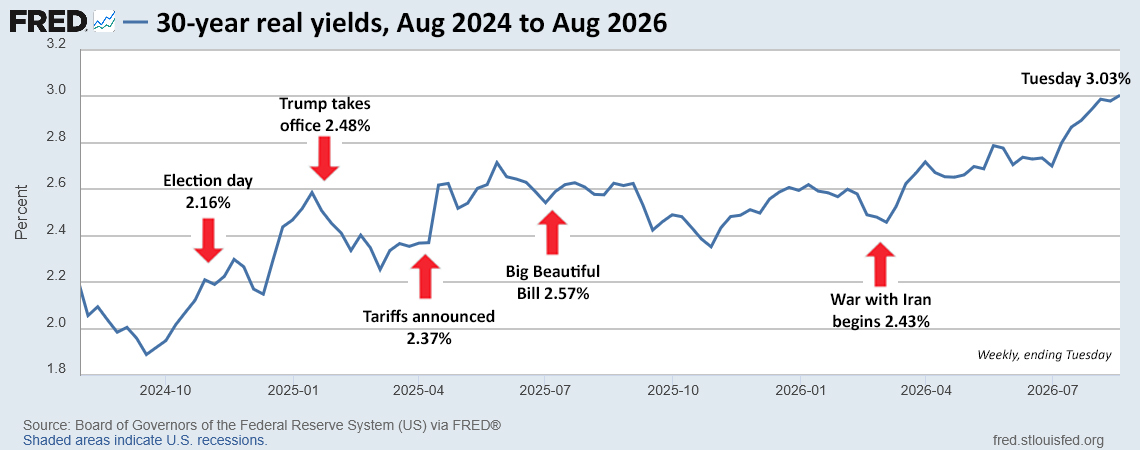
Real yields have been moving higher in 2026, mostly prompted by the inflation shock of the war in Iran, plus intensifying government and corporate borrowing needs. I call the surge a “self-inflicted wound,” as shown in this chart of 30-year real yields over the last two years:
Pricing
CUSIP 912810US5’s coupon rate of 2.375% was set at its originating auction on February 19, which resulted in a real yield to maturity of 2.473%. Because the real yield at today’s auction was dramatically higher, the unadjusted price was discounted to 88.317050, a remarkable fall in just 6 months. This TIPS will carry an inflation index of 1.03055 on the settlement date of August 31. With that information, we can calculate the cost of a $10,000 par value purchase at today’s auction:
- Par value: $10,000.
- Principal purchased on settlement date: $10,000 x 1.03055 =$10,305.50.
- Cost of investment: $10,305.50 x 0.88317050 = $9,101.51.
- + accrued interest of $10.64.
In summary, an investor purchasing $10,000 par value at this auction paid $9,101.51 for $10,305.50 of principal on the settlement date. From then on, the investor will earn accruals matching official future inflation, plus an annual coupon rate of 2.375% paid on inflation-adjusted principal.
Inflation breakeven rate
I was driving through the N.C. mountains at the auction’s close, so I will have to estimate the 30-year nominal bond yield at 5.23%, giving this TIPS an inflation breakeven rate of 2.26%, in line with recent trends. (I hope for our nation inflation averages only 2.26% over the next 30 years, but I am skeptical.)
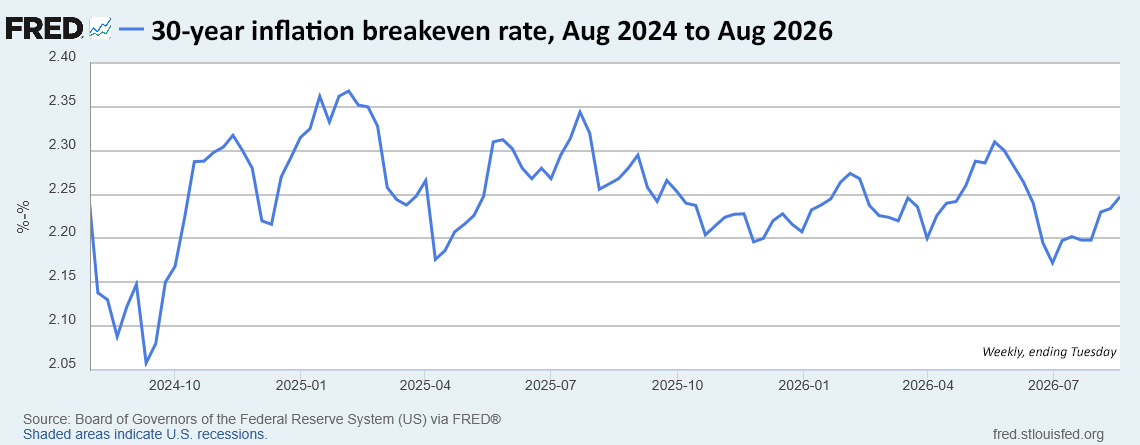
Here is the trend in the 30-year inflation breakeven rate over the last two years showing the solid trend in the range of 2.20% to 2.30%:
Thoughts
Investors at today’s auction got cheated out of a few basis points through Bessent’s tilt at the long-term bond windmill. It amounted to about $2 billion a week in additional bond buying at the longer term, a drop in the ocean of debt. The immediate effect was to weaken the U.S. dollar, which is potentially inflationary. That’s why oil prices and bitcoin moved higher today.
Bessent’s move also puts pressure on Federal Reserve Chairman Kevin Warsh to hold short-term rates stable (or lower) for as long as possible, to allow the Treasury to refinance long-term debt at lower yields. Will Warsh play along?
My feeling is that investors at today’s auction got a very attractive long-term TIPS, especially if held to maturity. That amounts to a near-zero-risk return of 2.973% over inflation for nearly 30 years.
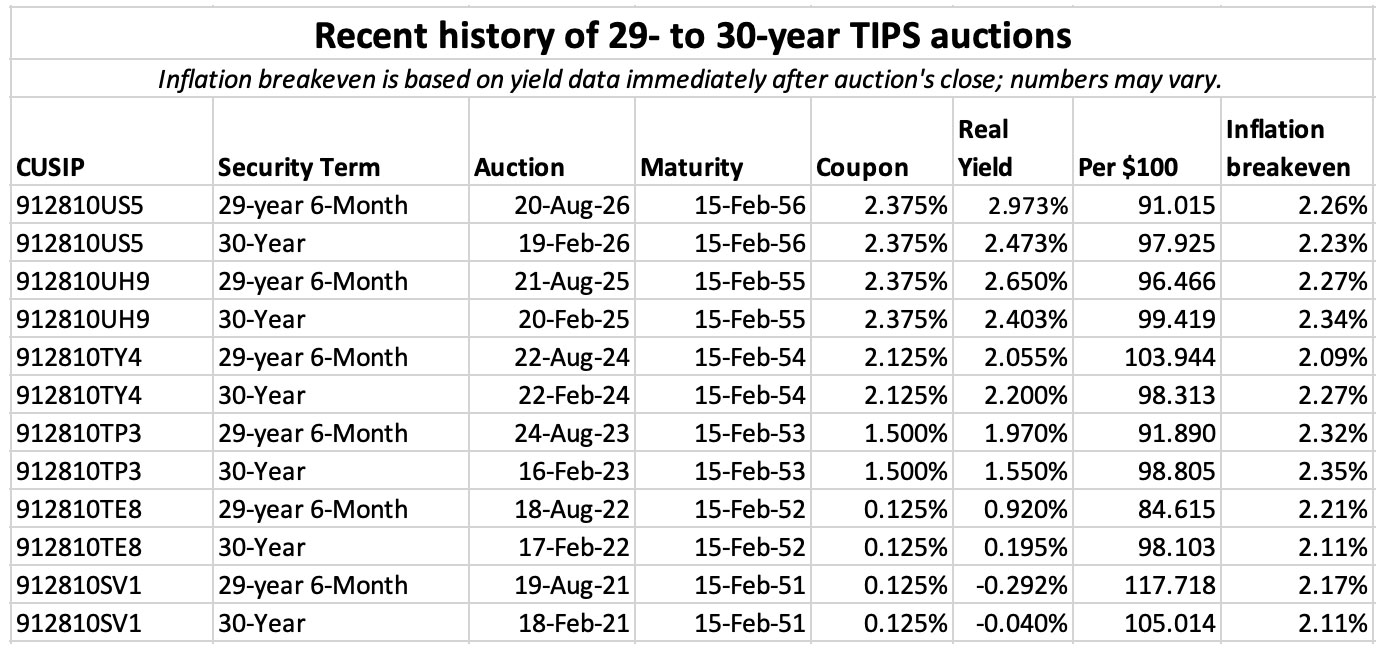
Here is a history of auctions of this term over the last 5 years:
—————————-
• Now is an ideal time to build a TIPS ladder
• Confused by TIPS? Read my Q&A on TIPS
• TIPS in depth: Understand the language
• TIPS on the secondary market: Things to consider
• TIPS investor: Don’t over-think the threat of deflation
• Upcoming schedule of TIPS auctions
—————————

Donate? This site is free and I hope to keep it that way. Some readers have suggested having a way to contribute. I welcome donations, any amount. And FYI, ads on this site pay for about one visit to Costco.
—————————
Follow Tipswatch on X for updates on daily Treasury auctions and real yield trends (when I am not traveling).
Feel free to post comments or questions below. If it is your first-ever comment, it will have to wait for moderation. After that, your comments will automatically appear. Please stay on topic and avoid political tirades. NOTE: Comment threads can only be three responses deep. If you see that you cannot respond, create a new comment and reference the topic.
David Enna is a financial journalist, not a financial adviser. He is not selling or profiting from any investment discussed. I Bonds and TIPS are not “get rich” investments; they are best used for capital preservation and inflation protection. They can be purchased through the Treasury or other providers without fees, commissions or carrying charges. Please do your own research before investing.


Paul Donovan at UBS. What are those changes to the calculated inflation figures?
With amargi making the rounds in newspaper Op-Eds, I have very little faith in lending to the US government and expecting to be repaid in 30 years. It’s sad to say, but we Americans have lost our way.
Can’t trust the US Treasury to honor its commitments! We’ll pass!
You kindly call Bessent’s announcements on Wednesday morning and Thursday morning interventions. If these announcements were made by a corporate CEO during the 36 hours prior to a major debt offering by their corporation, wouldn’t it be characterized as manipulation and prosecuted by the SEC?
Certainly not by this SEC.
Both being the seller/issuer and the buyer of 30-year Treasuries on the same day appears like unethical market manipulation to me too.
Or perhaps desperation…
And apparently not even effective, since the amount of extra Treasury buying involved was a raindrop in the vast overall Treasury market sea.
I enjoyed the humorous titling of Paul Krugman’s column after that day:
Headline: “Scott Bessent Fails to Gaslight the Market”
Sub-headline: “What doth it profit a man if he sell his soul and can’t even manipulate the 30-year?”
Frankly, the government’s yen intervention and the liquidity support program doubling or more makes it seem like the government is panicking over long term treasury rates.
Or maybe they are making it appear so in order to pull off an insider trade of the scale that can only be done in a market as large as the US treasury market.
I have a basic thought and strategy question. No doubt this is an excellent real yield. But I’m in my mid 50’s so if i bought this bond, I’d be around 85 when it matures. If we’re interested in inflation protection, wouldn’t it make more sense to front-load a TIPS ladder to get inflation protection until age 70, and then get inflation protection through an increased social security payment?
It doesn’t seem like this is an appropriate bond for individual savers. Maybe more suited for an insurance company. I’m struggling to see how this might make sense for me.
Thanks!
I like the idea of planning for an inflation-protected income stream until Medicare or Social Security. But beyond that, any guaranteed withdrawal rate remains attractive. Not for everyone, for sure. Too unstable unless held to maturity.
It makes sense mainly as a speculation on interest rate moves, less so as a hold to maturity. Even those not expecting to outlive the bond could look at it as a way to ride the yield curve – in 20 years it will be a 10 year bond, less volatile, closer to par, in the ten year period heirs have to empty your Roth/IRA…
I think for most people, making a ten year ladder, and then rolling over each maturity into another ten year makes far more sense than having a 20 or 30 year ladder. Far less volatility, and far more optionality at each maturity.
Reinvestment risk is the key danger. Right now you can lock in very good yields across all the years. Ten years from now, we might be in another phase of negative real yields. Or not. But we don’t know.
In my opinion, the first thing to go as the US faces its intractable debt crisis will be the Social Security COLA tied to inflation. Doing away with SS is politically unfeasible but removing or gutting the inflation protection is to my mind, a politically doable first step.
They’ll never cut the military, that’s for sure.
It’s an interesting take. I think it’s more likely that they remove the cap on earnings than mess with the inflation protection. After all, the inflation protection in social security helps a lot of low and middle income seniors.
But I’ve also read that some have speculated that Treasury may mess with the inflation calculation for TIPS. I couldn’t guess if this has any credibility. So I guess the best guidance is hedge your bets!
Maybe not cut missile spending, nor to White House mandated dimwitted mods to aircraft carriers, but they’re already actively going after veteran benefits.
This investment would be long term care insurance.
At what point do we stop calling US govt. bonds no-risk?
You are right. I changed that to “near-zero risk”
To be clear, I wasn’t trying to be pedantic in calling you out. Pretty much everyone in finance references the risk-free rate and considers US govt. bonds risk free. That was a genuine question to spark debate: At what point do we stop calling US govt. bonds no-risk?
As soon as I was typing the original sentence, I had second thoughts. I appreciate your call-out.
For me it was August 1, 2023.
The 3 main credit rating agencies downgraded US Treasuries in 2011, 2023, and 2025. All 3 cited increasing debt combined with political dysfunction (a government unlikely to address debt).
I recall hearing about a period in which debt from the top rated US corporate debt carried lower interest rates compared with Treasuries. I see investment grade corporate debt carries a very small spread today – I infer partly due to decreasing trust in US debt. I also own munis as state debt isn’t growing geometrically…
For decades they were called Certificates of Guaranteed Confiscation, which came back into prominence 20 years ago during the last long period of financial repression. I guess technically something that is “guaranteed” is not risky, but the captive press’s favourite phrasing of “risk-free” Treasuries has never been accurate nor accepted outside the elite echo chamber. A Treasury security is riskless only if you borrowed dollars to buy it and cannot be margin-called (the Fed, primary dealers, bureaucracies). For everyone else, the risks are real and obvious: devaluation, politically induced default, and for TIPS, manipulation. That’s why breakevens are so low: we don’t trust Congress to stop spending, and we don’t trust the bureaucrats to leave the CPI-U alone. No debt security is riskless to someone who had to earn the money to buy it, and everyone has known that from time immemorial.
Interesting…and frightening perspective….thank you.
what would be,then, the least risky investment to buy now ?
thank you
The phrase Certificate of Guaranteed Confiscation makes sense when the bonds have negative real yields, which is not the case today.
“we don’t trust the bureaucrats to leave the CPI-U alone”
It’s not the bureaucrats who will be meddling with the CPI. The career folks who cared about accuracy and had little to no vested interest in meddling are not the problem — most of them have been shown the door by this administration. The political appointees and the revolving door bootlickers with an eye on a private sector payday for goosing the numbers are the ones to keep a careful eye on.
I wish that I could buy gold bullion in our qualified accounts. Somehow we ended up with all of our moolah in IRAs. I don’t want that fund: GLD.