New Social Security rules to end ‘file and suspend’ strategy

I’m not much an expert on Social Security (I am not collecting it at the moment), but I was planning to use the widely-encouraged ‘file and suspend’ strategy when my wife reached age 66 in a few years.

Under that strategy, at full retirement age, the higher earner in a couple would file for Social Security benefits, then immediately suspend benefits. The other spouse could then claim the ‘spousal benefit’ – half of the filing spouse’s benefit. That would continue until both spouses reach age 70 and both collect the highest-possible benefit.

While I considered ‘file-and-suspend’ to be a questionable loophole, it was legal and a lot of savvy people were planning to use it to maximize Social Security benefits. There was even a recent book that used file-and-suspend as a core strategy: ‘Get What’s Yours: The Secrets to Maxing Out Your Social Security.‘

But in the new two-year budget deal just hammered out by Congress, this strategy will be gutted. This is from the story in the Wall Street Journal:

Congress is putting an end to two Social Security filing strategies that many couples have used to add tens of thousands of dollars to their retirement incomes. ….

The strategies under fire—known as file-and-suspend and a restricted application for spousal benefits—have made it possible for both members of a couple who are 66 or older to delay claiming benefits based on their own earnings records while one pockets a so-called spousal benefit based on the other’s earnings.

While the new law shuts down the two strategies, some people can still take advantage of them—provided they act fast. For those for whom the strategies will be off limits, meanwhile, claiming decisions may become less complicated but also less lucrative.

I’d advise reading more on this topic, because if you and your spouse are currently 66 (full retirement age) you may have a six-month window to use the strategy. Otherwise, it looks like the loophole is closing.

I am sure we will be hearing more about this in coming days.

Posted in Investing in TIPS | 10 Comments

Buying EE Savings Bonds in 2015? Do it RIGHT NOW.

EE Savings BondAs I noted in my previous post, I’m going to be buying my 2015 allocation of I Bonds next week, even if the fixed rate rate remains at 0.0%. But if I were considering buying EE Bonds, I would do that this week, before any possible change in Treasury policy on Nov. 2.

EE Bonds are an overlooked but very interesting investment, but only if held for 20 years. They currently pay a fixed rate of 0.3%, and that won’t change for 20 years. And then at 20 years, the Treasury guarantees your principal balance will double:

EE Bonds issued on and after May 1, 2005, will reach original maturity at 20 years. These bonds also are guaranteed to double in value from their issue price no later than 20 years after their issue dates. This is the bonds’ original maturity. If a bond does not double in value as the result of applying the fixed rate for 20 years, the Treasury will make a one-time adjustment at original maturity to make up the difference.

Doubling after 20 years means that EE Bonds effectively pay 3.5% interest. That is very generous in today’s market, because a 20-year Treasury is currently paying 2.50%, 100 basis points lower. That is a huge margin on a 20-year investment. (In fact, even 30-year Treasurys are yielding only 2.87%, 63 basis points lower.)

I like the idea of using EE Bonds in combination with I Bonds. If you are in the 55 to 65 age range, earning 3.5% on a 20-year investment is very attractive. With EE Bonds, you get a guaranteed return. With I Bonds, you are protected against unexpected inflation. With both, income is tax deferred until the bond is sold.

So why buy RIGHT NOW?

I don’t think the Treasury will change its policy on EE Bonds doubling in value after 20 years, but the edge they have over 20-year and 30-year nominal Treasurys must be giving Treasury folks the fits. That is out of whack.

So there is at least a small chance the Treasury could change the terms on EE Bonds, possibly stretching out the doubling period to 25 years (resulting in a return of about 2.8%) or even 30 years (about 2.3%).

Will the Treasury do that? I don’t think so. But just to be safe, buy your EE Bonds this week and don’t let the Treasury mess up a nice thing.

Posted in Investing in TIPS | 7 Comments

Will the Treasury raise the I Bond fixed rate on Nov. 2?

Savings-Bond-II Bond investors are going to be getting back in the game on Nov. 2, after suffering through six months of 0.0% returns, which effectively cut off all I Bond sales from May to October 2015. Only a sucker would sign up for 0.0%.

Series I Savings Bonds pay a composite interest rate comprised of two interest rates – the permanent fixed rate (currently 0.0%) and the variable inflation rate (currently -1.60% annualized). On Nov. 2, the variable rate will rise to 1.54% because of a 0.77% rise in inflation from March to September. We won’t know the new fixed rate until the Treasury announcement – probably coming at 10 a.m. on Nov. 2. Tip: This page will update on the Treasury site, you can watch it on Monday.

I will be buying I Bonds next week even if the fixed rate remains at 0.0%. A 1.54% return is decent for a super-safe investment that will track inflation into the future. I Bonds can be sold after a year with a small (three-month) interest penalty, or after five years with no penalty. Income taxes are deferred. I Bonds are deflation proof, too.

Because the Treasury limits us to buying $10,000 per year per person, I think it’s smart to continue building a cache of I Bonds, pushing inflation-protected money into the future. If the fixed rate rises in the future, sell some of your I Bonds with 0.0% fixed rates to buy new ones, up to the limit.

But is there a chance the fixed rate will rise?

Yes, there is a chance. I think it is fairly slim, maybe a 30% chance the fixed rate will rise to 0.1% or even 0.2%. Remember, the Treasury sold practically zero I Bonds from May to October. If it wants to give buyers an incentive, it should raise the fixed rate as a token gesture. That is what it should do, but the Treasury doesn’t come to me for advice.

Back in November 2013, the Treasury shocked everyone by raising the fixed rate to 0.2%. That move came out of the blue. At the time, a 10-year TIPS was yielding 0.5%, meaning it had only a 30 basis point spread over an I Bond. That is the lowest spread in history for any I Bond with a fixed rate higher than 0.0%.

Then, six months later, in May 2014, the Treasury lowered the I Bond fixed rate to 0.1%, resulting in a 33 basis point spread with a 10-year TIPS. Since then, the fixed rate has been 0.0%.

Here is a chart showing the historical spread of the I Bond fixed rate and 10-year TIPS yield. At the top is our current situation, and the resulting spreads for fixed rates of 0.0% to 0.3%.

Month I Bond Fixed Rate 10-Year TIPS Basis Point Difference
Oct 29 2015 0.0 0.63 63
Oct 29 2015 0.1 0.63 53
Oct 29 2015 0.2 0.63 43
Oct 29 2015 0.3 0.63 33
May 2015 0.0 0.18 18
Nov 2014 0.0 0.43 43
May 2014 0.1 0.43 33
Nov 2013 0.2 0.50 30
May 2013 0.0 -0.64 -64
Nov 2012 0.0 -0.77 -77
May 2012 0.0 -0.28 -28
Nov 2011 0.0 -0.04 -4
May 2011 0.0 0.75 75
Nov 2010 0.0 0.49 49
May 2010 0.2 1.32 112
Nov 2009 0.3 1.41 111
May 2009 0.1 1.80 170
Nov 2008 0.7 3.09 239
May 2008 0.0 1.52 152
Nov 2007 1.2 2.00 80
May 2007 1.3 2.19 89
Nov 2006 1.4 2.29 89
May 2006 1.4 2.42 102
Nov 2005 1.0 2.00 100
May 2005 1.2 1.61 41
Nov 2004 1.0 1.67 67
May 2004 1.0 2.09 109

The good news is that even at a fixed rate of 0.3%, the spread drops to only 33 basis points, which is in line with that November 2014 move by the Treasury. The bad news is that over the last 10 years, the Treasury has let the spread rise as high as 239 basis points. It also kept a fixed rate of 0.0% in May 2011, resulting in a spread of 75 basis points.

As a general rule, I think the Treasury would like to keep the I Bond spread 75 to 100 basis points below a 10-year TIPS. I Bonds have a lot of advantages over TIPS. Tax deferral is a big one, and they have a flexible term of 1 to 30 years.

But things have changed dramatically since the mid-2000s, and inflation fears have turned to deflation fears. The Treasury may want to give I Bonds a boost. I hope so.

Conclusion. Whether or not the fixed rate rises, I will be buying I Bonds next week, up the limit. If the fixed rate rises, I will also buy my 2016 allocation in January. If it stays at 0.0%, I will hold off purchasing them until later in 2016.

Posted in Investing in TIPS | 7 Comments

30-year TIPS reopening auctions with a yield of 1.20%

Sorry for the delay — it’s been quite the day. Meeting after meeting, all afternoon. And so, what happened at the 1 p.m. close of today’s TIPS auction?

CUSIP 912810RL4 auctioned with a real yield (after inflation) to maturity of 1.20%. This is a 29-year, 4-month Treasury Inflation-Protected Security with a coupon rate of 0.75%. In addition to that coupon, the TIPS’ principal balance will grow at the rate of inflation.

Because the auctioned yield was much higher than the coupon rate, this TIPS was sold at an unadjusted price of $88.91 for $100 of value. The adjusted price – what buyers actually paid – was higher because this TIPS has will have an inflation index of 1.01213 on the Oct. 30 closing date. That means buyers will actually pay about $89.99 for $101.21 of inflation-adjusted value.

The yield ended up being slightly higher than the result of the last reopening of this TIPS, on June 18. That auction resulted in a yield to maturity of 1.142%.

Inflation breakeven rate. A 30-year nominal Treasury is currently trading with a yield of 2.86%, meaning this TIPS has an inflation breakeven rate of 1.66%. That is awesomely low and puts this TIPS in the ‘ultra-cheap’ range. If inflation averages higher than 1.66% over the next 29 years, this TIPS will outperform a nominal Treasury.

Take a look at this chart showing CPI-U since 1961, and you’ll see that the lowest 30-year average is 2.7%, for the 30 years than ended in June 2015. Here is the trend over the last five years for the 30-year breakeven. Note that at times (during quantitative easing, which raised inflation fears) it was approaching 2.8%. Now inflation fears are sidelined, making this TIPS a strong investment for those who can take the long maturity and high volatility.

30- year

Posted in Investing in TIPS | 5 Comments

Checking in on Thursday’s 30-year TIPS reopening

I’ll be working tomorrow morning – I usually have Thursdays off – so I won’t be able to post an update then. After the auction closes, I’ll post the result, but I won’t be able to post much commentary.

We’re looking at the reopening of CUSIP 912810RL4, creating a 29-year, 4-month Treasury Inflation Protected Security. If you are interested, noncompetitive bids need to be placed by noon. The auction closes at 1 p.m. Thursday.

The TIPS carries a coupon rate of 0.750%, set at the original auction on Feb. 19, 2015. Because tomorrow’s auctioned yield to maturity will be higher, buyers will be getting it at a sizable discount. This TIPS is trading right now on the secondary market, so we can get an idea where it stands.

  •  Bloomberg’s Current Yields page shows it with a real yield (after inflation) to maturity of 1.23% and a price of about $88.16 for $100 of value.
  • The Wall Street Journal’s Closing Prices page show it closing today with a real yield of 1.220% and a bid/asked spread of $87.97 to $88.44. This TIPS is the last one listed on that page, maturing 2045 Feb 15.
  • The Treasury’s Real Yields Curve page estimates that a full-term 30-year TIPS on Tuesday would have had a real yield of 1.26%. Keep in mind that a full-term 30-year TIPS should yield slightly higher than a 29-year, 4-month TIPS. (Wednesday’s number will be posted in a few hours.)

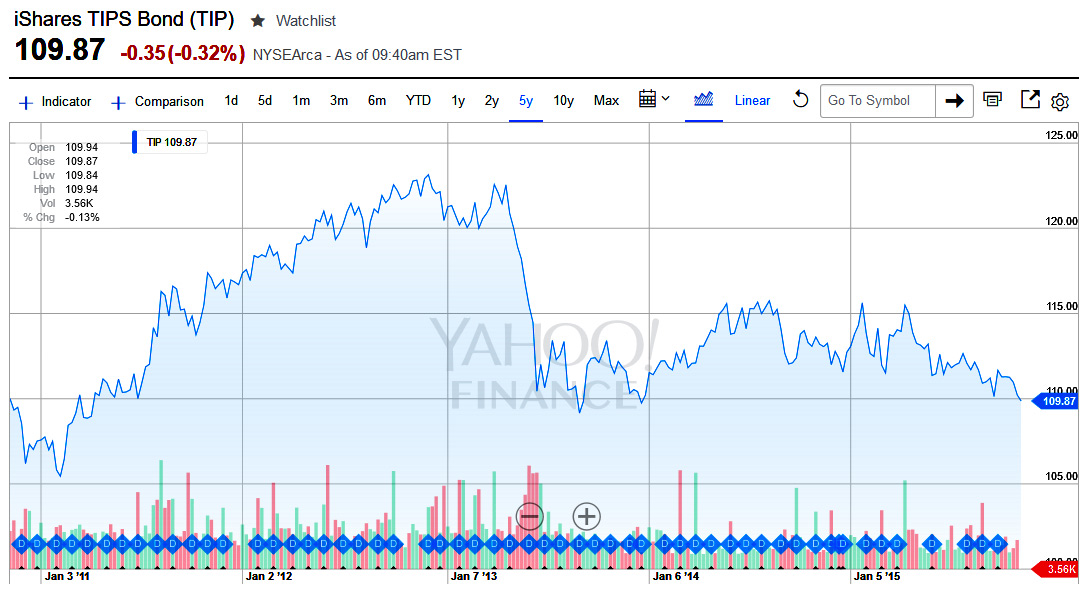
If the auction were taking place this very minute (3:40 pm Wednesday) it would probably generate a real yield around 1.23% and a price near $88.16. But a lot can change before 1 p.m. Thursday. If this TIPS interests you, I suggest keeping an eye on those links above, plus the current price of the TIP ETF. If the price of that ETF is falling sharply tomorrow, that indicates a higher yield is likely. If it is rising sharply, that indicates a lower yield is likely. If it is neutral, the Bloomberg and Wall Street Journal links should provide a pretty good guide.

The inflation adjustment. Also, keep in mind that this TIPS will have an inflation index of 1.01213% on Oct. 30, the settlement date. That means investors will be buying an extra 1.2% of inflation adjustment, and that will raise the cost. The auctioned yield remains the same, you will just buy a little extra principal.

Posted in Investing in TIPS | 1 Comment