Checking in on today’s reopening of a 5-year TIPS

This is the auction of CUSIP 912828C99, creating a 4-year, 4-month Treasury Inflation-Protected Security with a coupon rate of 0.125%. Non-competitive bids must be placed before noon. Here is what we know as of 10:05 a.m.:

  • Bloomberg’s Current Yields page shows this TIPS trading with a yield to maturity of 0.36% and a price of $99 for $100 of value. (But this price does not include about 1.3% of inflation appreciation that will be figured into the final cost.)
  • The Wall Street Journal’s Closing Prices page shows this TIPS – which matures in April 2019 – closed Wednesday with a yield to maturity of 0.294%.
  • The Treasury’s Real Yields Curve page estimates that a full-term 5-year TIPS would have yielded 0.39%.
  • The broad TIPS ETF (ticker TIP) is trading down 0.43% this morning at $112.02, indicating that TIPS yields are on the rise today.

I’d say it’s going to be pretty hard to predict the auction yield for CUSIP 912828C99. Yesterday’s deflationary inflation report could have dampened demand for a short-term TIPS. Non-seasonally adjusted CPI fell 0.54% last month, and that drop will be factored into this TIPS’ built-up principal (it has eight months of history). So buyers will pay for inflation appreciation that they will quickly lose.

However, sharply falling gasoline prices have a way of turning around quickly. When that happens, this TIPS will earn back its inflation appreciation.

I would guess this one is going to auction with a yield of about 0.37% and an adjusted price slightly above par, when inflation appreciation is factored in.

The inflation breakeven rate – versus a nominal 5-year Treasury – is going to come in about 1.29%, which I consider very attractive.

Even if inflation averages 1.5% over the next five years, this TIPS will out-perform a 5-year Treasury and most 5-year bank CDs. I will be a buyer.

I’ll report the results of the auction soon after it closes at 1 p.m., and then return later with market reaction.

Posted in Investing in TIPS | Leave a comment

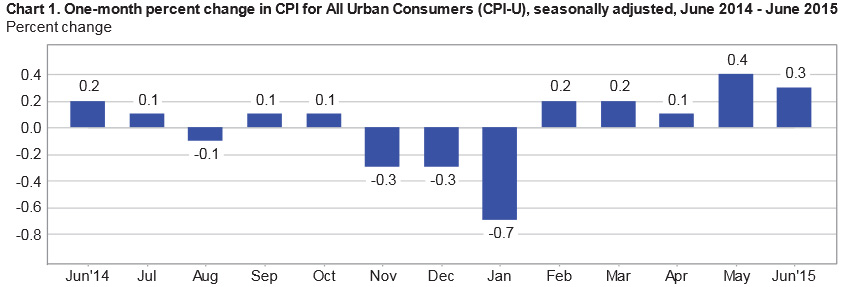
U.S. inflation fell 0.3% in November

The Consumer Price Index for All Urban Consumers (CPI-U) declined 0.3% in November on a seasonally adjusted basis, the U.S. Bureau of Labor Statistics reported today. Over the last 12 months, the all items index – also called ‘headline inflation’ – increased 1.3%.

The BLS noted that the gasoline index – which fell a whopping 6.6% – posted its sharpest decline since December 2008 and was the main cause of November’s deflation. Food prices were up a moderate 0.2%, but apparel prices fell 1.1%. Medical care commodities were up 0.6%, and shelter costs were up 0.3%.

Holders of I Bonds and TIPS are also interested in non-seasonally adjusted inflation, which is used to adjust the principal balance of TIPS and set future interest rates for I Bonds. In November, the CPI-U index fell to 236.151, a drop of 0.54%. For the last 12 months, non-seasonally adjusted inflation rose 1.3%. I have updated my Tracking Inflation and I Bonds page to reflect these new numbers.

‘Core inflation’ – which strips out food and energy – rose 0.1% in November and 1.7% over the last 12 months. This demonstrates that even without the sharp decline in gasoline prices, inflation is running below the Federal Reserve’s implied target of 2.0%. Until inflation becomes a threat, the Fed has little reason to act quickly to raise short-term interest rates.

Here is a chart of the one-year trend for U.S. inflation, showing the sharply deflationary move since mid-2014:

One-year inflation

Posted in Investing in TIPS | 1 Comment

Chart of the day: TIPS yield curve is flattening out

TIPS Yield Curve

Source: Bloomberg

My reaction: “Are my eyes deceiving me?”

A 5-year TIPS is trading on the secondary market with a yield to maturity of 0.31%, just 17 basis points below the yield on a 10-year TIPS, and only 54 basis points below a 30-year TIPS.

This is amazing – and the trend continues to make Thursday’s reopening of CUSIP 912828C99 the year’s most interesting TIPS auction. This is the same 5-year TIPS that is listed in the chart above, with an amazing yield of 0.31%.

One year ago – on Dec. 12, 2013 – TIPS were trading with drastically different yields, according to the Treasury’s Real Yields chart:

  • 5-year: -0.10%, 41 basis points lower than today.
  • 10-year: 0.75%, 27 basis points higher than today
  • 30-year: 1.63%, 78 basis points higher than today

Obviously, the market is pricing in extremely low inflation in the near term, causing the demand for short-term TIPS to plummet, and the yield to rise. The 5-year inflation breakeven rate is down to 1.26%, indicating the market believes inflation will run around that number for the next 4 years, 4 months – the remaining term on this TIPS.

If you think inflation will end up higher, this TIPS is a definite buy versus a nominal 5-year Treasury, which is currently yielding 1.57%.

Posted in Investing in TIPS | Leave a comment

Up next: 5-year TIPS will reopen at auction Thursday, Dec. 18, 2014

Hey TIPS fans, we’re going to close out 2014 with a very interesting auction – one that might actually be worth an investment, especially if you are looking for a short-term TIPS with a positive yield, great inflation breakeven rate and a small discount on price.

The Treasury will announce later this morning (update: here is the announcement) that it will reopen CUSIP 912828C99 on Dec. 18, creating a 4-year, 4-month Treasury Inflation-Protected Security with a coupon rate of 0.125%. Here’s what we know about that issue:

  • It was first auctioned April 17, 2014 with a yield to maturity of -0.213%, requiring buyers to pay up to get the 0.125% coupon rate. The adjusted price was $101.87 for $100 of value.
  • It was reopened Aug. 21, 2014 with a yield to maturity of -0.281% and an adjusted price of $103.62 per $100 of value, which included about a 1.7% bump to principal because of inflation. (Hard to remember that inflation was running higher earlier in the year.)

This TIPS is a great example of odd developments in the Treasury market in 2014. Long-term TIPS yields have fallen, but shorter-term yields have risen. I think this has happened for a couple of reasons: 1) inflation looks to be very mild over the near future, with oil prices plummeting, and 2) the Federal Reserve keeps hinting that a rise in short-term interest rates is coming in 2015.

These numbers are from the Treasury’s Real Yields Chart for 2014:

  • A full-term 5-year TIPS was yielding 0.01% on Jan. 1 and yesterday closed at 0.31%, a rise of 30 basis points.
  • In that same time, yield on a 10-year TIPS fell 27 basis points, from 0.74% to 0.47%.
  • The yield on a 30-year TIPS fell a whopping 70 basis points, from 1.58% to 0.88%.

It’s surprising, because you’d think demand for shorter-term TIPS would be very high, given the threat of higher interest rates in the near future. But no, they are the best bargain in the TIPS world right now.

Next Thursday’s auction of CUSIP 912828C99 will create the shortest possible term (4-year, 4-months) you can get at a TIPS auction from the Treasury. And it might be sold at a small discount, in effect creating a zero-coupon note for the investor. You get a discount, collect a 0.125% coupon and then in April 2019 get back the par principal, plus inflation. What a deal.

Keep in mind, though, that this TIPS will carry about 1.5% in inflation adjustment to principal, which will wipe out the apparent discount. But you’ll get that money back in April 2019.

Here’s how CUSIP 912828C99 looks to be priced this morning:

  • Bloomberg’s Current Yields page shows it trading with a yield to maturity of 0.19%. Since that is above the coupon rate, it is priced at about $99.69 per $100 of value.
  • The Wall Street Journal’s Closing Prices page shows it closed yesterday with a yield of 0.158% and a price of about $99.62.
  • The Treasury’s Real Yields Curve page estimates a full-term 5-year TIPS would yield 0.31%. The Treasury has been flashing some very high yields for 5-year TIPS, as high as 0.43% on Dec. 8. I generally trust these numbers, but the volatility looks suspicious.

Inflation breakeven rate. Another oddity in the TIPS market is the sharply falling inflation breakeven rates. If we go with yesterday’s Treasury numbers, a 5-year TIPS is yielding 0.31% and a 5-year Treasury is yielding 1.58%. This sets up a shockingly low inflation breakeven rate of 1.27%. If inflation averages more than 1.27% over the next five years, this TIPS will outperform a traditional Treasury.

TIPS versus traditional Treasury? Seems like a no-brainer decision. Even if this TIPS ended up under-performing, investors would lose very little. Go with the inflation protection.

A lot can happen in a week, so if you are considering an investment in this TIPS, I’d suggest waiting until closer to the auction. I’ll be checking in on it next Thursday morning, and I’ll add a link to the formal announcement when it comes later today.

Meanwhile, consider that 12 consecutive 4- to 5-year TIPS auctions have resulted in a yield negative to inflation. This one could break the string, a welcome development!

5-year TIPS

Posted in Investing in TIPS | 10 Comments

‘Real’ return: Why TIPS and I Bonds are still attractive

spare changeI was listening to NPR’s Marketplace last night, a story about the gentrification of a Los Angeles neighborhood. And then came this quote from Steve Jones, the owner of a house-flipping business, on how he attracts investors:

“All these people out there that have so much money, it’s sitting in a stupid money-market account making, you know, 2 percent or 3 percent, or whatever their horrible rates are right now …”

Steve Jones may know a lot about house-flipping, but he certainly knows nothing about investing in a money-market account. Fidelity’s main general-purpose money market account is yielding 0.01%, as is Vanguard’s Prime Money Market account. This has been true for more than six years. Vanguard’s fund has returned 0.04% annually over the last five years, and only 1.67% over the last 10 years.

So when someone calls 2% or 3% returns ‘horrible’ …. well, I would say those returns look pretty desirable, and almost impossible to find today in a super-safe investment.

A year ago, I wrote about a great 5-year CD offered by the Pentagon Federal Credit Union, paying 3.04%. It was offered only in December 2013 and January 2014; I speculated it was designed to draw new customers. It worked for me, and I jumped aboard.

I also have a set of 5-year CDs paying 3.0% from my local credit union, Truliant. These mature in various months of 2015. This was also part of a ‘special offer’ and well above market rates of 2010.

But, here we are in December 2014, and these are the rates being offered for Treasurys and non-jumbo CDs (the jumbos pay just slightly higher):

  • 0.01% Vanguard Prime Money Market
  • 0.14% 1-year Treasury
  • 0.26% National average 1-year CD
  • 0.30% Truliant 1-year CD
  • 0.80% Penfed 1-year CD
  • 0.84% National average 5-year CD
  • 1.00% Ally Bank 1-year CD
  • 1.20% Penfed 5-year CD
  • 1.40% Truliant 5-year CD
  • 1.69% 5-year Treasury
  • 2.32% Nationwide Bank 5-year CD

Just as a side note — it’s outrageous that a 5-year Treasury is out-yielding most 5-year bank CDs. There are no state income taxes on Treasurys, and these low rates indicate banks and credit unions are not making any attempt to sell 5-year CDs.

Now, let’s assume that inflation averages 2.0% over the next five years. My feeling is that this is a low number, but inflation has been very muted in recent years, so let’s go with 2.0%. Here are the ‘real’ returns – after inflation – for those investments:

  • – 1.99% Vanguard Prime Money Market
  • -1.86% 1-year Treasury
  • -1.74% National average 1-year CD
  • -1.70% Truliant 1-year CD
  • -1.20% Penfed 1-year CD
  • -1.16% National average 5-year CD
  • -1.00% Ally Bank 1-year CD
  • -0.80% Penfed 5-year CD
  • -0.60% Truliant 5-year CD
  • -0.31% 5 year-Treasury
  • 0.32% Nationwide Bank 5-year CD

Let’s compare this to I Bonds and TIPS. I Bonds purchased through April 30, 2015, will carry a fixed rate of 0.0%. This means they have a real return of 0.0% – and while that sounds bad, it makes I Bonds better than all the investment options on the above list, other than the Nationwide offering.

A five-year TIPS is currently yielding 0.21%. This translates to a real return of 0.21% – better than every investment on our list except for the Nationwide CD.

In addition, TIPS and I Bonds offer ‘inflation protection.’ If inflation rises to unexpected levels, the effective return on these investments also rises. You’re covered – and that is valuable insurance for investors.

A year ago, a 5-year TIPS was yielding -0.17%, 38 basis points lower than it is today. A 5-year Penfed CD was yielding 3.0%, 180 basis points higher than it is today. That is a massive swing – 218 basis points! – in favor of TIPS.

Last year, I argued that a 5-year CD was a better investment than a 5-year TIPS and at least competitive with I Bonds, which were then yielding 0.2% above inflation.

That’s no longer true as we approach 2015.

Posted in Investing in TIPS | 9 Comments