
The Treasury today will create a new 10-year Treasury Inflation-Protected Security – CUSIP 912828H45, with the coupon rate to be determined at auction. Non-competitive bids, like those placed at Treasury Direct, must be made by noon; competitive bids need to be placed before the auction’s close at 1 p.m.
Here is how the auction is shaping up this morning, as of 9:35 a.m.:
- Bloomberg’s Current Yields page shows a 9-year, 6-month TIPS currently trading with a yield to maturity of 0.18%.
- The Wall Street Journal’s TIPS Closing Prices page shows that same TIPS closed yesterday with a yield of 0.213%.
- The Treasury’s Real Yields Curve page estimated yesterday that a full-term 10-year TIPS would yield 0.260%.
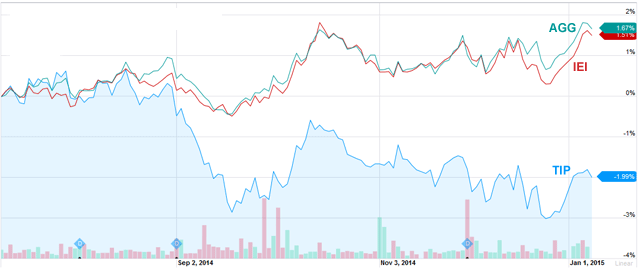
- The TIP ETF – which holds the full range of maturities – is trading at $113.95 this morning, up 0.22%. This indicates that TIPS yields are declining.
There is another TIPS that will share a maturity date with CUSIP 912828H45. It is CUSIP 912810FR4, a 20-year, 6-month TIPS that was first issued July 15, 2004. For what it’s worth, it closed yesterday at 0.287%, but it has lofty accrued inflation and a very high coupon rate of 2.375%. Is it comparable to today’s issue? Who knows? The Treasury hasn’t ever had two TIPS maturing on the same day (at least that I know of). This will be a first.
Adding it up. Both Bloomberg’s Current Yields and the TIP ETF are signaling lower yields this morning. A full-term 10-year TIPS should yield slightly higher than the 9-year, 6-month TIPS Bloomberg is following. Also, watch for volatility today as the European Central Bank unveils its quantitative easing plan, which will strengthen the dollar.
So let’s guess today’s auction will result in a yield to maturity of around 0.2% and a coupon rate of 0.125%, the lowest the Treasury allows. This will be lower than every 9- to 10-year TIPS auction of 2014 – there were six auctions with yields ranging from 0.249% to 0.661%.
It looks like a disappointing auction for buyers. Remember that this TIPS will be reopened in March and May, and could offer a higher yield then.
I’ll be posting the auction results soon after the close at 1 p.m.




Thanks John. Very intriguing.