Barrons: ‘No Exit from Bond Funds?’

Barrons columnist Randall Forsyth is writing this week about an intriguing – and somewhat scary – proposal: That the Federal Reserve is considering placing exit fees on bond mutual funds to prevent a potential run when interest rates rise. Here is his core paragraph:

(I)t might be well that the Federal Reserve appears to be thinking about the consequences of the end — and eventual reversal — of its massive experiment in monetary stimulation. Last week, the Financial Times reported that the central bank is mulling exit fees on bond mutual funds to prevent a potential run when interest rates rise, which, given the ineluctable mathematics of bond investing, means prices fall. Quoting “people familiar with the matter,” the FT said that senior-level discussions had taken place, but no formal policy had been developed.

Forsyth says that Fed Chair Janet Yellen, when asked last week about the possible move, answered that the matter “is under the purview” of the Securities and Exchange Commission. In other words, she didn’t deny it.

That was the first I heard of the proposal. Here’s a link to the Financial Times article: ‘Fed looks at exit fees on bond funds‘ and the core paragraphs:

Officials are concerned that bond funds are becoming “shadow banks”, because investors can withdraw their money on demand, even though the assets held by the funds can be hard to sell in a crisis. The Fed discussions have taken place at a senior level but have not yet developed into formal policy, according to people familiar with the matter. …

Exit fees would seek to discourage retail investors from withdrawing funds, thereby making their claims less liquid and making a fire sale of the assets more unlikely.

The idea of exit fees wouldn’t be popular with investors, who likely would be trying to sell bond funds during an already sharp fall. The exit fee would increase their losses. I haven’t seen any indication how large a fee is being considered.

Interest rates are likely to rise over the next two years. And if bond yields rise, and prices fall, bond-fund holders will benefit from the higher yields, eventually regaining the lost asset value. A sharp decline in bond prices could actually create a buying opportunity, just as many people are selling out.

But an ‘exit fee’ proposal seems to indicate the Fed and SEC are worried about a market reaction to higher interest rates and the potential of a ‘crash’ in the bond market. And that worries me.

Posted in Investing in TIPS | 10 Comments

30-year TIPS reopening auctions with yield of 1.116%

The Treasury just posted that CUSIP 912810RF7 reopened with a yield to maturity of 1.116%, slightly higher than the market rate earlier this morning. This is a 29-year 8-month TIPS with a coupon rate of 1.375%.

Because the yield is well under the coupon rate, buyers will pay up for this issue, with an adjusted price of $108.34 for $100 of value, but buyers are getting about $1.70 of accrued inflation since this TIPS was originated in February. The unadjusted price was $106.51.

Today’s yield is well below yields at the last three 29- to 30-year TIPS auctions — 1.495% on Feb. 20, 2014; 1.330% on Oct. 24, 2013; and 1.420% on June 20, 2013.

Inflation breakeven rate. With the nominal 30-year Treasury trading today at 3.43%, this sets up an inflation breakeven rate for this TIPS of 2.31%. That means if inflation averages more than 2.31% over the next 30 years, this TIPS will outperform the traditional Treasury.

Inflation has been running 2.1% over the last 12 months, but has been showing a rising trend in the last several months.

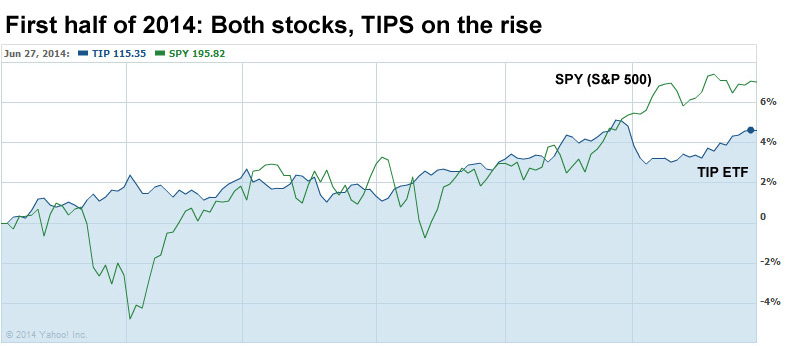
Market reaction. The higher-than-expected yield indicated less-than-stellar demand for this TIPS, and trading in the TIP ETF – which was showing a price increase in the morning – also indicated a negative reaction:

TIPS reaction
Despite that initial reaction, media reports are saying the auction was well received, and that is reflected in the lowest yield for any 29- to 30-year TIPS auction since February 2013, when yields were half what they are today.

From the Wall Street Journal report:

A $7 billion sale of 30-year Treasury inflation bonds drew strong buying interest. Traders said some investors allocated cash out of Treasury bonds to buy TIPS, a popular instrument to hedge against inflation. …

“The TIPS auction was well received, which dovetails with my point that the market isn’t buying [Fed Chairwoman Janet]Yellen’s explanation that the recent hot CPI report was the results of statistical noise,” said Adrian Miller, director of global markets strategy at GMP Securities.

Bloomberg took a more negative outlook, noting the uptick in yield:

Treasury 30-year bonds fell the most in three months after an auction of inflation-protected securities drew a higher-than-forecast yield. …

But Bloomberg also noted the rising concern about inflation:

“It’s the inflation story — clearly people are becoming more concerned about it and the Fed seemed to discount it,” Larry Milstein, managing director in New York of government-debt trading at R.W. Pressprich & Co. discount it. “The Fed came out yesterday and said they’re going to stay at these low levels, probably longer than people had anticipating, after we got the recent inflation prints.”

Posted in Investing in TIPS | Leave a comment

Checking in on today’s 30-year TIPS auction

The Treasury’s reopening of CUSIP 912810RF7 at auction today will create a 29-year 8-month TIPS with a coupon rate of 1.375%. Non-competitive bids (like those made through Treasury Direct) must be received by noon; competitive bids close at 1 p.m.

This one is going to be pricey, because yields have fallen sharply since the initial Feb. 20 auction created a coupon rate of 1.375%.

  • Bloomberg’s Current Yields chart is showing CUSIP 912810RF7 trading today with a yield of 1.08% and a cost of $107.59 for $100 of value, a more-than 7% premium over par.
  • The Wall Street Journal’s closing price chart is showing it closed yesterday at 1.098% and a cost just under $107.
  • The Treasury’s Yield Curve site shows a full-term 30-year TIPS yielding 1.11%.
  • The TIP ETF, which holds a broad range of maturities, is trading today at $114.59, up 0.2%. This indicates solid demand for TIPS and slightly declining yields.

Wild guess prediction. So it looks like this auction will result in yield around 1.08% and price that’s around 7% over par, meaning $10,000 of this TIPS will cost you $10,700.

I’ll be posting after 1 p.m. with the auction results.

Posted in Investing in TIPS | Leave a comment

U.S. inflation rose a sharp 0.4% in May

The Consumer Price Index for All Urban Consumers (CPI-U) increased 0.4% in May on a seasonally adjusted basis, the U.S. Bureau of Labor Statistics reported today. That creates an inflation rate of 2.1% over the last 12 months, the biggest increase since October 2012.

The 0.4% increase in May was double the expected number and resulted from broad-based price increases. The food-at-home index rose 0.7%, its largest increase since August 2011. Overall energy prices were up a strong 0.9%, with the price of gasoline rising 0.7%. Medical care commodities were up 0.5%.

Core inflation – which strips out food and energy – rose 0.3% in May, its largest increase since August 2011. It is up 2.0% in the last 12 months.

Holders of TIPS and I Bonds are also interested in the non-seasonally adjusted CPI-U, because that number is used to set the inflation adjustments to principal on TIPS and the future interest rates of I Bonds. In May, non-seasonally adjusted inflation rose 0.33%. For 12 months it was up 2.1%.

This chart shows the trend toward higher inflation over the last several months:

inflation trend

I have updated my Tracking Inflation and I Bonds page to reflect these new numbers.

Inflation heating up? Here is an interesting analysis posted today by Michael Ashton in his E-piphany blog:

This was potentially a watershed CPI report. … (T)he biggest red flag in all of this is not the size of the increase, and not even the fact that the monthly acceleration has increased for three months in a row while economists keep looking for mean-reversion (which we are getting, but they just have the wrong mean). The biggest red flag is the diffusion of inflation accelerations across big swaths of products and services.

In my mind, this is the worst inflation report in years, largely because there aren’t just one or two things to pin it on. Many prices are going up.

Posted in I Bond, Inflation, Investing in TIPS | 2 Comments

The TIPS problem: ‘Interest rates rose and inflation did not’

Although I’m not a huge fan of TIPS mutual funds, I own a small stake in the Fidelity Inflation-Protected Bond Fund (FINPX) and I appreciate the candor that comes in each annual and semi-annual report from the fund’s managers, William Irving and Franco Castagliuolo.

Well before the steep decline in TIPS values in 2013, Irving and Castagliuolo were noting the risks building in the soaring TIPS market and ultra-low yields. The threat hit home in mid-2013, when TIPS yields began rising about 100 basis points, hitting TIPS mutual funds hard. FINPX returned -6.93% for the year ending March 31, 2014.

This chart shows how FINPX has underperformed Fidelity’s Total Bond Market fund over the last 12 months, despite the recovery in TIPS prices in 2014:

Fidelity fundsSo today, has 2013’s decline brought TIPS funds back into the ‘safety zone’? Here is the discussion from Irving and Castagliuolo printed in the fund’s annual report, dated March 31, 2014:

Q. Bill, how did the fund perform?

FINPX detailsW.I. For the 12 months ending March 31, 2014, its Retail Class shares returned -6.93%, while the Barclays U.S. Treasury Inflation-Protected Securities (TIPS) Index (Series-L) — which tracks the types of securities in which the fund invests — returned -6.49%. The Lipper Treasury Inflation-Protected Securities Funds Average returned -5.81%.

Q. Why did TIPS perform so poorly?

W.I. Simply put, interest rates rose and inflation did not. TIPS suffered steep losses from May through December 2013 after the U.S. Federal Reserve signaled it would eventually begin scaling back its purchases of Treasury and government-backed mortgage securities. Investors pushed bond yields higher and bond prices lower in response. Inflation ran well short of the central bank’s 2% annual target rate during that span, calming inflation worries and cooling investors’ appetite for inflation-protected securities. In fact, the TIPS market experienced some of its largest investor outflows since its inception in 1997. But TIPS enjoyed a bit of a rebound in the first three months of 2014. Slower-than-expected economic growth, instability in emerging markets and investors’ growing comfort with the Fed’s tapering of its bond purchases helped bolster demand for bonds in general. TIPS further benefited from growing demand as rising energy prices and signs of wage growth rekindled inflation worries among some investors.

Q. Turning to you, Franco, what was your investment approach?

F.C. We adhered to our investment mandate, investing virtually all of the fund’s assets in TIPS with maturities ranging from one to 30 years. That helps explain why the fund trailed its Lipper peer group average. Many funds in the peer group were focused solely on the better-performing short-term TIPS, which helped them to significantly outperform those like our fund with its broader mandate to invest in the entire TIPS market. We kept the fund’s risk profile similar to that of the Barclays index by maintaining interest rate sensitivity that was in line with the benchmark. Additionally, our yield-curve positioning — how our holdings were invested in TIPS across the maturity spectrum — was similar to that of the benchmark. We looked for ways to add incremental return through security selection. Various factors, including when a TIP security was issued, can result in mispricing. We sought to take advantage of those inefficiencies by purchasing securities we believed to be undervalued and selling those we felt were fully valued. After accounting for expenses, these strategies helped the fund keep pace with the Barclays index. And while the fund, like the TIPS market itself, experienced significant outflows, they occurred at a consistent pace and, therefore, had generally no impact on the fund’s absolute or relative performance.

Q. What’s ahead for the TIPS market?

W.I. We expect TIPS to post very modest — and possibly negative — returns during the next 12 months or so. The future return of TIPS can be decomposed into three components: starting real yields, price appreciation/depreciation from the real yield, and inflation. The real yield of the fund’s benchmark was roughly 0.50% at the end of the period, which is a fairly low starting point. We expect real yields to rise from here as the Fed continues to pull back its purchases of government bonds. Since bond yields move opposite their prices, bonds — including TIPS — could experience price depreciation. That said, we believe rates will rise more slowly in 2014 than they did in 2013, given our view that anything more would do material harm to the economy.

F.C. As for inflation, one of the most important questions is whether there is still significant slack in the labor market. We think there is. The unemployment rate stood at 6.7% at the end of the period, slightly more than one percentage point above the Fed’s forecast for the longer-run normal unemployment rate. We believe there is additional slack from people working part time for economic reasons and from people doing a job for which they are over-qualified. This “shadow” labor supply should help keep a lid on wage inflation and overall consumer inflation, which we expect to run below 2% during the coming year.

Posted in Investing in TIPS | 1 Comment