U.S. inflation rose 0.3% in June

The Consumer Price Index for All Urban Consumers (CPI-U) increased 0.3% in June on a seasonally adjusted basis, the U.S. Bureau of Labor Statistics reported today. Over the last 12 months, inflation increased 2.1%.

The June increase – which hit the expected number – was primarily driven by the gasoline index, which rose 3.3% and accounted for two-thirds of the all items increase, the BLS reported. Balancing off that increase was a decline of 2.6% in piped gas services and declines in prices for new and used vehicles. Apparel costs were up 0.5% and medical care commodities, 0.7%.

Holders of TIPS and I Bonds are also interested in the non-seasonally adjusted CPI-U, which is used to adjust the principal of Treasury Inflation-Protected Securities and set future interest rates of US Savings I Bonds. This number was up 0.19% in June, and the same 2.1% for the last 12 months.

I have updated my Tracking Inflation and I Bonds page to reflect these new numbers.

Today’s inflation report continues the trend of annual inflation rising above 2.0%, which is the Federal Reserve’s goal, although it does not set policy base on CPI-U. Core inflation, which strips out food and energy, was up 0.1% in June and 1.9% over the last 12 months, down from May’s 2.0% but higher than the 1.7% average annualized increase over the past five years.

Here is the inflation trend for the last 12 months:

12 months

Posted in I Bond, Inflation, Investing in TIPS | 1 Comment

Up next: New 10-year TIPS auction July 24, 2014

The US Treasury hasn’t posted the formal announcement yet (it will be coming later this morning), but we know it will auction a new 10-year Treasury Inflation-Protected Security on Thursday, July 24. It will be CUSIP 912828WU0, and because this is a new issue, both the coupon rate and yield to maturity will be set when the auction ends.

Advantage of a new issue. Some TIPS followers don’t like the uncertainty of buying at auction, especially reopening auctions, because the price they pay can vary from what they expect. This happens when the yield to maturity is well above or below the coupon rate. This happens with reopenings, and the price swings can be dramatic (while somewhat predictable for those who follow the market).

But with a new issue, when the yield to maturity is above zero, the Treasury always sets the coupon rate one ‘click’ below the yield to maturity, meaning that buyers should be getting the TIPS at a slight discount, or at least extremely close to par after accrued interest is added in. The last two new-issue 10-year TIPS auctions demonstrate this:

CUSIP Auction Coupon Yield Per $100
912828B25 23-Jan-14 0.625% 0.661% 99.548
912828VM9 18-Jul-13 0.375% 0.384% 100.004

Disadvantage of a new issue. While there is less uncertainty about the dollar amount you will pay, a new issue isn’t currently trading on the secondary market and thus has no set coupon rate. Until the auction ends, you won’t know the coupon rate, or the yield to maturity, and this can be hard to predict for new issues. A new issue creates added ‘inventory’ for the TIPS market, and the pricing at auction can be slightly volatile.

What we know today about CUSIP 912828WU0. It’s possible that this new TIPS will auction with the lowest yield to maturity for any 9-to 10-year TIPS since May 2013, when the yield was -0.225%. Since then – for six consecutive auctions – the lowest yield to maturity has been 0.339%. Next Thursday’s yield could be lower:

  • Bloomberg’s Current Yields page is flashing a yield of 0.25% for a less-than 10-year TIPS currently trading on the secondary market.
  • The Wall Street Journal’s closing price chart is showing that a TIPS maturing Jan. 15, 2024, closed yesterday at 0.285%.
  • The Treasury’s Real Yield Curve chart – which estimates the price of a full-term 10-year TIPS – is showing a yield of 0.32% at the close Wednesday.

A lot can happen in a week, especially with a new issue, but right now we are looking at a yield of maybe 0.285% to 0.325% for this TIPS, and a coupon rate of 0.25%. The last new issue 10-year TIPS – auctioned Jan. 14, 2014 – went off with a yield of 0.661% and a coupon rate of 0.625%.

That’s a drop of more than 30 basis points in half a year, and it makes a big difference in the secondary market value of that TIPS. The January TIPS auctioned with a price of $99.548 per $100 of value, but now is much more expensive – about $103.15 on the secondary market. This price swing will work in reverse if (when?) interest rates begin to rise.

The inflation factor. One factor driving demand for TIPS – which causes yields to decline – is that inflation has been steadily rising this year. On top of the coupon rate, the principal balance of TIPS rises with the Consumer Price Index for all Urban Consumers (CPI-U). I chart recent inflation rates on my I Bonds page.

Inflation is currently running at 2.1% over the last 12 months. However – and this is crucial for buyers at next Thursday’s auction – the June 2014 inflation number will be announced Tuesday at 8:30 a.m. That number could have an effect on TIPS prices. Wait to see that number, and the reaction in TIPS prices, before making a buying decision.

Inflation breakeven rate. With the nominal 10-year Treasury closing yesterday at 2.55% and a 10-year TIPS at 0.32%, this creates a 10-year inflation breakeven rate of 2.23%. This means that if inflation averages more than 2.23% over the next 10 years, a TIPS will outperform at traditional Treasury. Back in January, the last new TIPS auction generated a breakeven rate of 2.12% — more attractive, in my opinion.

In summary, next week’s TIPS auction is not looking like an attractive buying opportunity. If you believe interest rates will be rising in the next few months, you will have an opportunity to get this same TIPS at a discount at reopening auctions in September and November. On the other hand, if you believe inflation will continue to rise without interest rates rising, this issue could be appealing.

Here is a chart of recent 9- to 10-year TIPS auctions showing how yields have risen from negative levels of 2012 to 2013, but remain well below historical norms:

10-year TIPS history

Posted in Investing in TIPS | 9 Comments

Europe strikes again – and TIPS get more expensive

This is from today’s Wall Street Journal:

Worries over the financial health of a major Portuguese lender spooked global markets Thursday, drubbing shares in southern Europe and sending U.S. stocks on an early swoon.

The broad, sharp market moves were reminiscent of the euro zone’s debt crisis in 2011: A shock in a small country spread across the continent …

And that little jolt, involving a major bank in a small Euro-zone country, resulted in this move in TIP, the ETF holding a wide range of Treasury Inflation-Protected Securities:

tipeuro

Note that the TIP ETF outperformed overall intermediate Treasuries (IEI) and the overall bond market (BND) in the aftermath of a Eurozone banking issue.

The TIP ETF is up 1% this week (so far), outpacing the overall bond market. When you see TIP outperforming intermediate Treasurys (I’m using the IEI ETF here), you know that TIPS are getting more expensive versus the overall bond market.

  • The nominal 10-year Treasury was yielding 2.58% on July 1 and it closed yesterday at 2.51%, down 7 basis points.
  • The 10-year TIPS was yielding 0.32% on July 1 and it is trading right now at .22%, down 10 basis points.

This morning you are looking at a 10-year inflation breakeven point of 2.29%, still in the middle range, but TIPS will be worth watching as reaction to the Euro crisis continues.

If investors believe the crisis will force continued monetary easing, TIPS could be seen as more attractive than traditional Treasuries because of their inflation protection.

Here is the long term trend in inflation breakevens – with a number below 2.0% generally indicating that TIPS are ‘cheap’ versus Treasurys and a number above 2.5% indicating they are expensive:

breakeven trendView interactive version of this chart.

Posted in Investing in TIPS | 2 Comments

Global financial group warns of Fed’s role in ‘risk-taking’ markets

The Bank for International Settlements (BIS) issued its annual report last week, and it got some attention because it warned of excesses building in the financial system, at the same time Fed Chair Janet Yellen was defending the Fed’s policy of maintaining ultra-low interest rates well into the future.

Its opinion does warrant attention. The BIS — based in Basel, Switzerland — defines its purpose as  serving ‘central banks in their pursuit of monetary and financial stability, to foster international cooperation in those areas and to act as a bank for central banks.’

In its annual report, the BIS notes that ‘markets have been acutely sensitive to monetary policy,’ keeping volatility low and forcing investors to search for higher yields. This results in greater risk-taking, and leading to ‘high valuations on equities, narrow credit spreads, low volatility and abundant corporate bond issuance.’

I’ll excerpt some of the findings from the full report:

Monetary policy is boosting markets. “Highly accommodative monetary policies in the advanced economies played a key role in lifting the valuations of risk assets throughout 2013 and the first half of 2014. Low interest rates and subdued volatility encouraged market participants to take positions in the riskier part of the investment spectrum. ”

Ultra-low interest rates create risks. “The search for yield moved into riskier European sovereign bonds, lower-rated corporate debt and emerging market paper… ”

BIS interest ratesLong-term interest rates increased … “The short end of the US yield curve (up to two-year maturities) remained anchored by current rates and forward guidance. But with new uncertainty about the nature and timing of policy normalisation, long-term bond yields rose by 100 basis points by early July (2013), with a corresponding surge in trading volume and volatility. … ”

… And central banks over-reacted. “Responding to mere perceptions of future changes in monetary policy, markets thus induced tighter funding conditions well before major central banks actually slowed their asset purchases or raised rates. To alleviate the market-induced tightening, central banks on both sides of the Atlantic felt compelled to reassure markets.

“Markets in advanced economies quickly shrugged off the tapering scare, and the search for yield resumed.”

Central banks influenced the markets. “The sensitivity of asset prices to monetary policy stands out as a key theme of the past year. Driven by low policy rates and quantitative easing, long-term yields in major bond markets had fallen to record lows by 2012. Since then, markets have become highly responsive to any signs of an eventual reversal of these exceptional conditions. Concerns about the course of US monetary policy played a central role – as demonstrated by the mid-2013 bond market turbulence and other key events during the period under review. But monetary policy also had an impact on asset prices and on the behaviour of investors more broadly.

“The events of the year illustrated that – by influencing market participants’ perceptions and attitudes towards risk – monetary policy can have a powerful effect on financial conditions, as reflected in risk premia and funding terms. Put another way, the effects of the risk-taking channel of monetary policy were highly visible throughout the period.”

Riskier assets became more appealing.”Fuelled by the low-yield environment and supported by an improving economic outlook, equity prices on the major exchanges enjoyed a spectacular climb throughout 2013. In many equity markets, the expected payoff from dividends alone exceeded the real yields on longer-dated high-quality bonds, encouraging market participants to extend their search for yield beyond fixed income markets. Stocks paying high and stable dividends were seen as particularly attractive and posted large gains.”

Central banks had a ‘powerful impact’. “The developments in the year under review thus indicate that monetary policy had a powerful impact on the entire investment spectrum through its effect on perceived value and risk. Accommodative monetary conditions and low benchmark yields – reinforced by subdued volatility – motivated investors to take on more risk and leverage in their search for yield.”

Posted in Investing in TIPS | 7 Comments

The Goldilocks markets: This trend can’t continue

Here it is, July 2, and half of 2014 has already escaped us. It hasn’t been much of a year for new investments: Both stocks and bonds have rallied this year, making them more expensive, bank CD rates have dropped, and even the I Bond fixed rate has dropped from 0.2% to 0.1%. Not much out there is attractively priced.

So here it is: Stocks versus TIPS in the first half of 2014. If you held either, you were a winner. This is the ‘Goldilocks market,’ not too hot, not too cold, just plain perfect.

tipspyBut here is the problem:

  • Stock prices are increasing because the market expects increasing economic growth, and thus, higher corporate profits. Stocks are a leading indicator, and they are indicating a strong economy.
  • Bond prices are increasing (and yields are decreasing) because the markets fear slowing economic growth, as indicated by the shocking decrease of 2.9% in the U.S. gross national product in the first quarter.

Obviously, both of these assumptions can’t be true. The economy is going to 1) grow, 2) decline or 3) stagnate. Either stocks or bonds, and possibly both, are flashing a false signal.

Monetary stimulus in Europe is a factor, because Europe is pouring money into the Euro system in a desperate attempt to keep interest rates low and spur economic growth. And so you get anomalies like this:

  • A 10-year US Treasury is yielding 2.61%.
  • A 10-year German government bond is yielding 1.25%.
  • A 10-year French government bond is yielding 1.72%.
  • A 10-year Spanish government bond is yielding 2.64%.
  • A 10-year Italian government bond is yielding 2.83%.
  • A 10-year Portuguese government bond is yielding 3.59%.

I’d say the risk factor for the German and U.S. bonds are similar: zero. And so why aren’t the yields closer? The risk factors in France, Spain, Italy and Portugal are much higher than zero, but the yields don’t reflect that risk.  The low yields in Europe are placing a cap on U.S. yields — you could argue that 2.61% remains too high in this environment.

TIPS yields have declined. The best day of 2014 to buy a 10-year TIPS on the secondary market was Jan. 3. The yield that day was 0.75%, and has been lower every single day since then, bottoming out at 0.22% on May 29. It stands at 0.32% today.

This decline in yield has returned TIPS to the ‘unattractive’ shelf in the investment store. They are expensive. Although I had two TIPS mature this year, I haven’t yet replaced them. The money is stashed in a short-term corporate ETF, awaiting a better buying opportunity.

Inflation and TIPS. We have seen a gradually rising inflation rate over the last six months, creating a rate of 2.1% over the last 12 months. The Federal Reserve will get uncomfortable if inflation rises much higher. Here is the trend:

inflation trendIs rising inflation good news for holders of TIPS? I’d say yes, if inflation rises to ‘expected’ levels. We buy TIPS to insure against an ‘unexpected’ increase in inflation, but a TIPS will under-perform when inflation lags behind expectations, as it has the last two years.

So if inflation rises to an expected level, the TIPS performs as expected, and that’s boring and fine. If inflation rises to very high levels, the TIPS holder benefits from the ‘insurance’ that this investment provides. But very high inflation could ravage our other holdings. It’s not a desirable thing.

Also, many people think that rising inflation will cause TIPS values to increase on the secondary market — and that TIPS mutual funds, for example, will soar in value. That is true as long as interest rates do not also rise.

If higher inflation results in higher interest rates, the yields on TIPS will rise in lockstep, and the value of TIPS will decline. If the 10-year Treasury rises to 3.5%, you can expect a 10-year TIPS to be yielding at least 1.0%, possibly 1.1% or 1.2%, or higher.

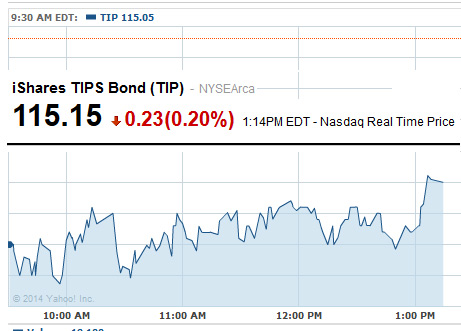
The TIP ETF is trading today at $114.13 and I have speculated in the past that it is heading to $110 as interest rates increase. That is a decline of 4%, which correlates to an increase of 52 basis points in the yield of 10-year TIPS (assuming a duration of 7.66). That would put the yield of a 10-year TIPS at 0.87%, where it closed on Sept. 16, 2013. The TIP ETF closed at $110.14 on that day. In other words: This is entirely possible, not a wild fantasy.

I have no idea where the stock market is heading, but this is what I see as the future of TIPS. How long will it take? Who knows?

This trend can’t continue.

Posted in Investing in TIPS | 7 Comments