5-year TIPS auctions at all-time low -1.080%

The Treasury just completed its auction of a new 5-year Treasury Inflation-Protected security, which resulted in a yield to maturity of -1.080%.

CUSIP 912828SQ4 has a coupon rate of 0.125%, meaning that today’s buyers had to pay up for this issue – $106.38 per $100 of value.

This is the lowest rate ever for a new or reissue of a 5-year TIPS. The previous low was -0.877% for an auction on Dec. 15, 2011.

Reaction to the auction, from Bloomberg:

“There is still significant demand for inflation protection given the accommodative Fed,” said Michael Pond, co- head of interest-rate strategy in New York at Barclays Plc, one of Fed’s 21 primary dealers that are required to bid at U.S. auctions. “For the largest-ever notional tips auction at the lowest-ever real yield, the Treasury has to be very pleased with these results.”

Bloomberg points out that the auction set a 5-year breakeven point of 1.93%, versus a 5-year Treasury trading today at 0.85%. That is …

down from a year-to-date high of 2.22 on March 14. The average during the past decade is 1.94 percentage points.

I think the breakeven rate on a 5-year is pretty distorted, since you can get a 5-year insured bank CD today at about 1.75%, pushing the breakeven point to 2.83%, higher than the current 12-month rate of inflation of 2.7%, even with gas prices soaring.

Nevertheless, I think the Treasury has to be very happy about this record-low yield, and buyers should just shrug and accept a super-safe investment that is protected against an unexpected surge in inflation.

Posted in Investing in TIPS | 7 Comments

Forget the 5-year TIPS, buy I Bonds … today

The Treasury is offering a 5-year TIPS Thursday that will have zero appeal for small investors. CUSIP 912828SQ4 will auction with a coupon rate of 0.125%, but buyers will have to pay up – way up – to get the likely yield to maturity of around -1.10%. That means buyers will accept 1.10% less than the rate of inflation for 5 years.

Absolutely no appeal.

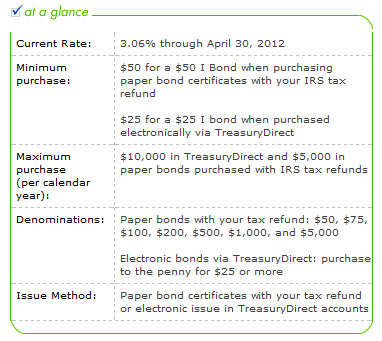
At the same time, this week offers a very attractive buying opportunity, but you need to act fast. Through April 30, you can go to TreasuryDirect.gov to buy I Savings Bonds, up to an annual limit of $10,000  (or $20,000 for a couple), and get an annual rate of 3.06% for six months, and then 2.20% for the next six months.

That is a combined annual interest rate of 2.63%. This assumes you won’t sell the I Bond after a year, but even if you did, and paid a three-month interest penalty, you’d get an annual return of 2.08%.

i bondThe reason you need to act fast? The inflation-adjusted interest rates on I Bonds will readjust on May 1, so all I Bonds purchased after May 1 will earn 2.20% for six months. If you act before May 1, you can lock in the higher rate of 3.06% for six months, then the 2.20% rate for the next six months.

Buy I Bonds up to the limit before May 1. Let me be clear: Do NOT procrastinate.

There is no better super-safe investment out there. An I Bond compares directly with a 5-year TIPS, because you can sell the I Bond after five years with no penalty.

Would you rather earn the rate of inflation for five years (I Bond), or the rate of inflation minus 1.1% for five years (TIPS)?

Plus, I Bonds have tax advantages over TIPS, since interest isn’t reported until you sell them. With TIPS, you pay interest now, even though you don’t get all the money until maturity.

No brainer.

One more thing … I Bonds have a dual interest rate, the base rate (currently zero) and the inflation-adjusted rate (currently 3.06%). We know the inflation-adjusted rate will drop to 2.20% on May 1, but what about the base rate? Is there any possibility it could tick up? No, it will not tick up. It will be zero.

Posted in I Bond, Investing in TIPS, Savings Bond | 14 Comments

Treasury formally announces 5-year TIPS auction on April 19

The U.S. Treasury today posted its formal announcement of the five-year TIPS to be auctioned Thursday, April 19. It is CUSIP 912828SQ4, a new issue. It will most likely auction with a coupon yield of 0.125%.

We already know this is a highly undesirable auction, except for big institutional money funds, pension funds and foreign central banks. For the little guy, this one is not attractive.

Why?

TIPS are near their all-time high values (meaning all-time low yields), and that is magnified in short-term TIPS issues. As of the close today, a TIPS maturing 2017 Jul 15 (very close to 5 years) is paying a yield to maturity of -1.193%. Yes, that is negative. But since TIPS have their principal adjusted to match inflation until maturity, that means this issue will pay 1.193% less than the rate of inflation for five years.

You can go to TreasuryDirect.gov right now, today, and buy an US Savings I Bond paying the rate of inflation (minus nothing!) for 30 years, but sellable after five years without penalty. That I Bond also has preferential tax treatment over TIPS. The problem is you can buy only $10,000 per person, per year, of I Bonds. So that is $20,000 for a couple.

Until you hit the limit, there is no contest … buy I Bonds up to the limit.

Who would buy this TIPS? I have said this many times in the last year: ‘The good thing about a five-year TIPS is that it matures in five years.’ The pain is rather short term. Big money funds, pension funds and foreign nations can afford to lose out to inflation for five years, because every super-safe investment (except I Bonds, which make no sense for big investors) is also paying way less than inflation.

5-year breakeven point? It’s worth comparing this five-year TIPS with a 5-year traditional Treasury. A five-year traditional today is paying 0.85%. I ask you, who would buy that? The same buyers that would consider this five-year TIPS.

For the TIPS to pay off over the Treasury – the ‘breakeven point’ –  inflation would have to run 2.043% over the next five years. That seems like a reasonable bet, and that is why there will be demand for this five-year TIPS from big-money interests who can’t buy I Bonds or bank CDs.

But small investors? No interest.

Posted in I Bond, Investing in TIPS, Savings Bond | 1 Comment

Food, gas costs push up U.S. inflation

The U.S. Labor Department reported today that the Consumer Price Index rose 0.3% in March, mostly because of higher food and gas prices. In 12 months that ended in February, prices rose 2.7 percent. That’s below last year’s peak year-over-year rate of 3.9 percent.

From the Associated Press report:

Core prices have risen 2.3 percent in the 12 months that ended in February, close to the Federal Reserve’s inflation target of 2 percent. … Fed chairman Ben Bernanke has acknowledged that rising gas prices have boosted inflation. But he has maintained that the increases are likely temporary.

From Bloomberg:

“Inflation is going to be slowly decelerating as the energy price impulse that we’ve seen starts to fade,” said Michael Carey, the chief economist for North America at Credit Agricole CIB in New York, who correctly forecast the rise in prices. “The Fed is in wait and see mode. Inflation is not driving policy. They are more concerned about economic growth and the labor market.”

Holders of TIPS get the benefit of a 0.3% increase in principal for all issues. But it does appear that inflation is slowing from the plus-3% annual rate of recent months.


Posted in Investing in TIPS | 4 Comments

Let’s be negative: Making the case for a 5-year TIPS

The Treasury on April 19 will auction a new issue 5-year Treasury Inflation-Protected Security, and it is likely to have a deeply negative base interest rate. I am going to try my best to explain why anyone would buy this issue — skeptics are going to tell you it is a disastrous investment. Negative rates!

Yes, the base rate is negative, but the principal on TIPS continues to grow at the rate of inflation until maturity, at least partly balancing off that negative base rate. So if inflation runs high enough, a 5-year TIPS works out well for the buyer. Otherwise, it can be a loser. But how much of a loser?

Right now, a 5-year TIPS maturing July 15, 2017, is selling on the secondary market with a yield to maturity of -1.148%. The new issue should come in around that rate. (But I suspect the rate will be more favorable, possibly around -1.0%; that has been the trend at recent auctions).

But let’s assume the auction goes off at -1.148%. That looks like a very bad rate, I admit. How does it stack up against similar super-safe investments?

I Bond, zero base rate, plus rate of inflation
5-year TIPS -1.148%, plus rate of inflation
5-year Treasury 1.03% fixed rate
5-year insured CD 1.75% fixed rate

Let’s look at the returns these investments would generate under varying rates of inflation:

Assumption No. 1: Inflation averages 1% over the next five years

  • 5-year insured CD 1.75%
  • 5-year Treasury 1.03%
  • I Bond, 1%
  • 5-year TIPS, -0.148%

The TIPS is the big loser, the bank CD is the winner.

Assumption No. 2: Inflation averages 2% over the next five years

  • I Bond, 2%
  • 5-year insured CD 1.75%
  • 5-year Treasury 1.03%
  • 5-year TIPS, 0.852%

The I Bond edges out the bank CD, the TIPS is the least favorable investment.

Assumption No. 3: Inflation averages 3% over the next five years

  • I Bond, 3%
  • 5-year TIPS, 1.852%
  • 5-year insured CD 1.75%
  • 5-year Treasury 1.03%

The I Bond again leads the way, but now the TIPS has surpassed the bank CD.

Assumption No. 4: Inflation averages 4% over the next five years

  • I Bond, 4%
  • 5-year TIPS, 2.852%
  • 5-year insured CD 1.75%
  • 5-year Treasury 1.03%

Assumption No. 5: Inflation averages 5% over the next five years

  • I Bond, 5%
  • 5-year TIPS, 3.852%
  • 5-year insured CD 1.75%
  • 5-year Treasury 1.03%

The lesson of this exercise: Buy I Bonds, up to the limit ($10,000 per individual and $20,000 for a couple.)

But after you reach that limit, you should weigh a bank CD against a 5-year TIPS. If you can get a rate of 1.75% on a bank CD, you push the TIPS breakeven rate all the way up to 2.898%. The bank CD is a winner unless inflation averages more than 2.9% a year for five years. And with a bank CD, you might be able to get an attractive early withdrawal penalty, making it a more flexible investment.

If you really, really fear inflation in the next five years, this TIPS makes sense for you. If you think inflation will remain under 3%, then a bank CD might be the better option.

Otherwise, it looks like demand for this 5-year TIPS new issue will come from the high-roller investment firms and foreign banks. It isn’t very appealing for the small investor.

Posted in Investing in TIPS | 2 Comments