
Oct. 30 Update: Treasury sets I Bond’s fixed rate at 1.40%; composite rate at 5.51%

By David Enna, Tipswatch.com
It’s late October, and normally I would be writing a tome advising readers on investing in Series I Savings Bonds either before or after the November 1 rate reset.
Not this year. There is zero reason to invest in I Bonds under the current six-month terms: Fixed rate of 0.90%, inflation-adjusted variable rate of 3.34% and composite rate of 4.26%. All of those rates are going to increase with the November 1 reset (which should be announced Friday, Oct. 30).
Variable rate
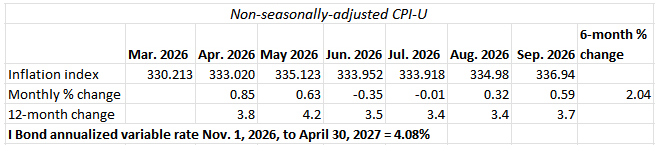
We know the annualized variable rate is going to increase to 4.08%, based on 2.04% inflation from April to September. That’s locked in and it’s a big jump from the current 3.34%. All I Bonds, no matter when they were issued, will get the new variable rate, rolling in for six months depending on the original purchase month.
The fixed rate
The Treasury has no announced formula for setting the I Bond’s fixed rate, and there is no legal requirement to follow any formula. This is up the discretion of Treasury officials, based on current real yield trends. TreasuryDirect provides this cryptic information:
The Secretary of the Treasury, or the Secretary’s designee, determines the fixed rate. The rate is based on market rates that have been adjusted to account for the value of components unique to savings bonds. These include the early redemption put option, tax deferral feature, deferred purchase feature, and Treasury’s administrative costs.
We do know, however, that for a decade this formula has accurately predicted the I Bond’s fixed-rate reset: Apply a ratio of 0.65 to the average 5-year real yield over the preceding six months.
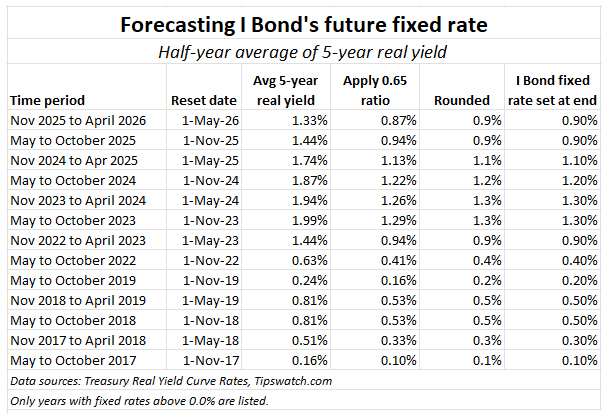
But now — for the first time — we face the question: When does the six-month period begin and end? In my calculations, I have always started the count on the first day of the reset, May 1 and November 1. And I set the end date a day or two before the rate decision, and every time I had the correct forecast.
However, there is another theory used by Boglehead geniuses: Start the six-month period 5 market days before the previous reset and end it 5 days before the next reset. This also has produced the correct result for a decade.
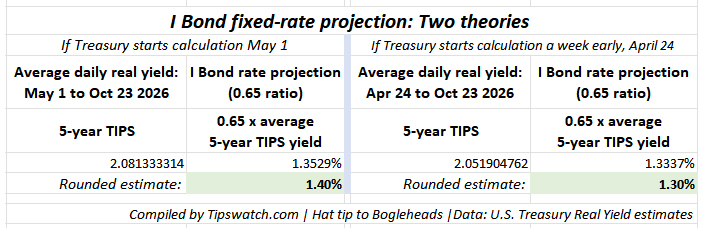
This matters in October 2026 because for the first time, applying the two theoretical formulas results in a different forecast:
Things to keep in mind:
- The Treasury rounds the fixed rate to the tenth decimal point, so now that the ratio for the May 1 start has reached 1.3529%, nothing that happens this week will change the 1.40% forecast, unless the 5-year real yield plummets 33 basis points.
- The April 24 start-date forecast is also locked in, because the Treasury would be ignoring any further data.
- The April 24 start results in a lower forecast because 5-year real yields at the end of April were much lower (about 1.35%) than they are now (about 2.34%).
So we have two different forecasts: 1.40% or 1.30%, and there is no way to know which one is correct. The Treasury’s decision, coming Friday, is going to tell us a lot, assuming it follows practices of the last decade.
I am going to stick with my traditional forecast method and say the fixed rate will be 1.40%. But … 1.30% is certainly possible. Or the Treasury could just abandon past practices and throw us all under the bus.
A fixed rate of 1.40% would be the highest for the I Bond since November 2006.
Composite rate
The composite rate isn’t simply the sum of the fixed rate and the variable rate, it is calculated with this formula:
Composite rate = fixed rate + (2 × semiannual inflation rate) + (fixed rate × semiannual inflation rate)
Here is how the math works for the 1.40% fixed rate:
- Fixed rate: 0.0140
- 2 × 0.0204 = 0.0408
- 0.0140 × 0.0204 = 0.0002856
Add 0.0140 + 0.0408 + 0.0002856 and you get 0.0550856, which rounds to a composite rate of 5.51% annualized.
A six-month composite rate of 5.51% is very attractive at a time of T-bill yields of about 4.11%. Even with a couple Fed rate increases, the I Bond will be attractive.
If the fixed rate is 1.30%, the composite rate will be 5.41%, also very attractive.
An investing strategy?
TreasuryDirect has now posted this rather irrelevant notice on its homepage:
Rate Change Deadline: To receive the current 4.26% rate for I Bonds in TreasuryDirect, you must complete your purchase by 11:59 p.m. on Thursday, October 29. The bond would have an issue date of October 2026 and secure the current interest rate.
Obviously, do not invest in I Bonds this week in the days before the rate reset. Wait until November to get the higher fixed rate, higher variable rate, and higher composite rate. And if you are buying in November, wait until late in the month to make the purchase, since you will earn a full-month’s interest no matter which day you purchase. Maybe set a target of Nov. 25, to allow time to clear after Thanksgiving?
What if you purchased earlier in the year, as I did? You can call yourself “dumb,” but remember that just before the May reset, the 5-year real yield was still very tame in the range of 1.35% and the Fed looked likely to cut rates instead of raise them. No one could really predict the very strong surge in real and nominal yields.
I Bond purchases are limited to $10,000 per person per year unless you add to your holdings through gift-box, trusts, or business-owner strategies. The gift-box strategy still seems to be working, for people with a trusted partner.
Otherwise, wait until 2027. You will have until late April to purchase to get the full six-month benefit of the high composite rate and permanent fixed rate. That’s what I will do.
And a reminder: As of Oct. 28, to access TreasuryDirect you must have created a log-in account with ID.me, a private company that TreasuryDirect is using for verification. More on that here.
I Bonds vs. TIPS
These are two similar investments, both attractive, but in my mind they have different purposes.
I Bonds create a cash-equivalent, inflation-adjusted savings account that you can draw on at any time after 1 year with a small penalty or 5 years with no penalty. The value can never decline and all interest is compounded. That creates a useful pot of tax-deferred money to use when you need the cash.
Treasury Inflation-Protected Securities at the moment have much higher real yields and are perfect to buy and hold to maturity for specific spending needs in the future. TIPS are subject to constant changes in value. Current real yields make TIPS more attractive than I Bonds as a “pure investment.” But I Bonds have better compounding, better deflation protection, tax-deferred interest, and a flexible maturity date.
EE Savings Bonds
I don’t know of a formula for predicting the new fixed rate of EE Bonds, currently 2.40%. I expect this rate to rise, and for the Treasury to continue its policy of doubling the EE Bond’s original value if held for 20 years, creating an effective yield of 3.53%.
Qualifications
The projections presented in this article are based on 10 years of Treasury history in setting the I Bond’s fixed rate. But the Treasury could change course at any time. So far, in both of President Trump’s terms, the rate formula has remained accurate.
Keep in mind that the Treasury actually saves money by lending to I Bond investors at a real yield of 1.40% as opposed to the current 5-year real yield of 2.34% or 30-year real yield of 3.08%. Plus, savings bonds account for a minuscule portion of Treasury debt.
• Confused by I Bonds? Read my Q&A on I Bonds
• Wise advice: ‘Don’t die with I Bonds’
• Let’s ‘try’ to clarify how an I Bond’s interest is calculated
• Inflation and I Bonds: Track the variable rate changes
• I Bonds: Here’s a simple way to track current value
• I Bond Manifesto: How this investment can work as an emergency fund
—————————

Donate? This site is free and I hope to keep it that way. Some readers have suggested having a way to contribute. I welcome donations, any amount. And FYI, ads on this site pay for about one visit to Costco.
—————————
Follow Tipswatch on X for updates on daily Treasury auctions and real yield trends (when I am not traveling).
Feel free to post comments or questions below. If it is your first-ever comment, it will have to wait for moderation. After that, your comments will automatically appear. Please stay on topic and avoid political tirades. NOTE: Comment threads can only be three responses deep. If you see that you cannot respond, create a new comment and reference the topic.
David Enna is a financial journalist, not a financial adviser. He is not selling or profiting from any investment discussed. I Bonds and TIPS are not “get rich” investments; they are best used for capital preservation and inflation protection. They can be purchased through the Treasury or other providers without fees, commissions or carrying charges. Please do your own research before investing.


Pingback: 8 Smart Ways to Invest Your First $1,000 in 2026 – Newmoneyfast
Just posted: 1.40%
Today is the last day of the TD ID.me transition. It seemed important enough to mark with a post.
Tomorrow, all pre-existing TD login accounts will no longer get you into the system. I can’t help but think thousands of users will be locked out tomorrow — including elderly folks snd ex-pats.
FWIW, the change.org petition to modify this mandated and exclusive arrangenent which was rushed and has multiple flaws and issues is up to 433 signatures:
https://www.change.org/p/modify-the-mandatorytreasurydirect-id-me-migration-protect-investor-privacy-and-access
I’m happy to say that I actually BOUGHT a pair of iBonds just today, even knowing that the upcoming rate will be. Why? Because I buy one iBond for each of my kids every single month, with a goal of doing that in perpetuity (or as long as I can) regardless of the rate. I purchase the bonds in their own custodial accounts (which they will legally inherit in appx 12-14 years per the State of Illinois age of 21.) Every month like clockwork I buy them each an iBond, every quarter I buy a new-issue 30Y TBond, and a few times a year I buy them TIPS (especially the 30Y each February.) The earned interest posts to their brokerage accounts (also custodially managed by me) and in those accounts I invest in equities for them. My goal with all this is to establish a sense of a “monthly stipend” (starting 30 years from when I first began this ladder) in which each instrument matures. Can they take it all out when they are of age and blow it on bad decisions? Sure. Could I invest in better, more strategic ways? Maybe. But it makes me feel good knowing that they will have this trickle of extra income reliably each month far in the future. They’re gonna need it!
This is a great, generous plan. They can also use the I Bond proceeds for education, tax free, if they meet the requirements: https://www.treasurydirect.gov/savings-bonds/tax-information-ee-i-bonds/using-bonds-for-higher-education/
I got out of i-bonds (after many years) b/c of Id.me, including selling my 1.3 and 1.2% fixed rates. The new high rates are giving me regrets! Alas. But: I put the money into TIPS.
To get the cash reserves I am using a 1 year T-bill ladder.
I think it’s all a wash. Inflation protection +better than I-bond rate from from TIPS, offset against a lower than I-bond rate from the T-bill ladder.
This is exactly what I did and for the same reasons. Im good with it.
Add me to that list. The coming of the ID.me access monopoly, and just having waited 9 months for an individual-to-joint-trust account I Bonds transfer requiring a TreasuryDirect human employee, and 15 months for another (which never did actually happen), plus horror stories of people trying to settle estates involving TreasuryDirect assets, caused us to “throw in the towel” on I Bonds. We redeemed all of ours but are constructing a TIPS ladder within IRAs. That’s also a situation which, unlike TreasuryDirect, offers actual monthly account statements from the brokerage (so that we don’t have to rely on making online screen shots to “prove” what we own) and which doesn’t force us to find and print our own year-end forms 1099. As I’ve written in comments here before, I think I Bonds are a really attractive product subject to really appalling administrative hassles.
I already have an ID.me account from when I wanted to check my SS history a few years back (since they don’t mail those out every year automatically to my age group anymore) and at the time ID.me was the only option SS gave me for logging in to their website. Using it to connect with TD was rather painless, but IIRC it was a pain in the posterior to set up initially back when I did it, so I fully understand not wanting to deal with that hassle (not to mention the whole not trusting a third party thing!!!!)
It was indeed a bit of a pain in the ass when i did it for myself a few years ago, but I just helped my wife set hers up and it was pretty painless.
Pingback: Financial Planning Roundup: Guest on The Long View Podcast — Oblivious Investor
I have a large pile of I bonds purchased during the era of high fixed rates (1999-2002) and also during the teens and early 20’s when the fixed rate was zero or minuscule. I have been relatively healthy and still working so I haven’t had to redeem them. I’m looking forward to the bump in rates come November 1 for all of those guys. I also bought a ladder of EE’s beginning in 2014 when I realized they double after 20 years. I wish the interest rate on EE’s would improve because I value all the features of savings bonds, but their rates have remained painfully low.
I see the tax bomb on the horizon (beginning 3 years from now) when my older I bonds with high fixed rates mature. I’m not sure what I can do about it other than pay up. RMD’s are another tax bomb on the horizon for me soon after. And if the Democrats return to power, which looks increasingly likely, taxes are certain to rise. Ugh. Maybe now is the time to lean into municipal bonds? Vanguard says munis now have the highest rates in decades.
Thanks as always David for your analysis and ability to look ahead and tell us what the future holds. You are right that I bonds will become popular again.
One thing you can do is spread out the tax hit through partial redemptions over the next three years.
A Midterm win by the Democrats won’t trigger higher taxes (on wealthier folks) even if that is one of their goals because the majorities will be too slim to override a veto. You’ve gotta least another two years of historically low taxes to enjoy.
Munis are an attractive option now especially for those living in taxable states and localities and in high tax brackets.
I agree with Marce on this. Even if Democrats win both houses of Congress (it’s possible) the result will be gridlock because of Trump’s veto power and the fact that Democrats probably can’t get 60 votes in the Senate on most issues. I hate to say this, but gridlock isn’t a bad thing. Both sides will face barriers. A key issue will be extending the debt limit, which if Democrats gain power will be highly contentious. (Or even if Republicans keep power.)
I also suspect you aren’t likely to see any tax changes until after the presidential election, because the “no tax on” provisions (intentionally) expire January 1, 2029.
The thing is, you don’t know if there is no change at all, a fairly conventional change that wouldn’t change how you view TIPS or I bonds all that much (e.g., keep “no tax on” but change the top tax bracket from 37% to 39.6% in exchange), or something more dramatic, like Social Security tax on investment income, where frontloading I bond redemptions from 2029-2032 into December 2028 ahead of time could be well worth it, if you’re going to be in a high bracket anyway.
We purchased the max (non-trust) amount we could purchase each year, including the additional $5K available via tax returns, with our last purchase made in late 2025 via the gift box when it became evident that the next fixed rate opportunity would drop. All of our bonds are between 0% and 1.3% fixed rate at this point.
In each of our accounts, we plan on upgrading our later 0% fixed I-bonds after Nov 1st.
One of the advantages of I-bonds is their tax-deferred nature. We’re in the middle of Roth conversions but it turns out that this year will be a low withdrawal year, giving us a little more MAGI headroom to swap out some of our 0% I-bonds for 1.3%/1.4%, whichever it turns out to be.
I do feel for those who had difficulty with TD, but that’s never been our experience: not with I-bonds and not back when we were rolling T-Bills. There is at least some indication that transfers can happen relatively smoothly when all involved have their own TD accounts and have registrations set up to help facilitate it. We do plan on staying on top of our I-bond registrations to help facilitate that. While the dollar amount we hold in I-bonds is enough to notice, it’s but a fraction of what we have invested. But it will still be enough to be worthwhile for our heir to stay on top of when it’s time for her to inherit what what’s left at TD.
“So we have two different forecasts: 1.40% or 1.30%, and there is no way to know which one is correct. The Treasury’s decision, coming Friday, is going to tell us a lot, assuming it follows practices of the last decade.
I am going to stick with my traditional forecast method and say the fixed rate will be 1.40%. But … 1.30% is certainly possible. Or the Treasury could just abandon past practices and throw us all under the bus.
I am the first to criticize this administration for all sorts of things, but I don’t think this is one of them (at least until it is). They have all sorts of things on their agenda but I don’t see any evidence I Bond rate setting is one of them.
Either fixed rate is a keeper, and a composite rate of around 5.5% is attractive. I’m a buyer of $20K with my wife and then likely another $20K in April or May. At this point, I don’t have the cash to go beyond that with the Gift Box strategy, which I’ve used in the past when rates were above 9% (those 0% fixed eate bonds were sold 3 months after the inflation rate dropped to 1.9% on November 1, 2024 with a minuscule penalty before 5 years). But I’m going to raise cash for the April/May decision in case I decide to go beyond $20K.
Even if they would tweak the fixed rate calculation somehow, it’s not some unprecedented breach of tradition by this administration. The savings bond program has been getting gradually curtailed for about 25 years under both parties: cutting purchase limits, issuing variable EE bonds when rates are high and fixed EE bonds when rates are low, not reducing the EE doubling time when rates increase as used to be routine practice, discontinuing over the counter sales of paper bonds, and discontinuing Tax Time Savings Bonds paper bonds.
A good summary of The Incredible Shrinking Savings Bond Program. Toss in the absurd wait times for TreasuryDirect account actions requiring a human employee and it’s difficult to avoid the conclusion that the program has, over time, intentionally been made more limited and more onerous to deal with, truly attractive only to a population of buyers who persist despite its limits and procedural obstacles.
Unless you’ve already done so, that summary analysis sounds meaty enough and interesting enough for its own article. Just my two cents…
I think ”tweaking” (manipulating) the fixed rate below its typical “formula,” which I stated I don’t believe is on the administration’s radar, would be a lot different than “simplifying” (limiting) the ways in which you can obtain I Bonds (I.e. no more paper I Bonds, no more tax return I Bonds, no more c of i, etc). The reduction in purchase limit is a closer analogy, but I think that was done more to limit the program to a certain economic group, which is a different rationale to me than intentionally reducing yield in a time of high inflation (which the last administration did not do during an even higher inflation spike). The mini-drama of the next fixed rate will likely provide greater clarity to the unofficial formula used and that is all. If I’m wrong, we will have vetted a new phase, imo.
These two types of investments can co-exist. You buy I Bonds in a taxable account and the TIPS in an IRA and get inflation protection in two ways for slightly different purposes.
But isn’t the point of an emergency fund that you have funds in an emergency? With a TIPS (even a 5yr) market conditions may be that your TIPS has lost value and an emergency comes up and you HAVE to sell at a loss. Defeats the purpose of an emergency fund imo. iBonds don’t have that issue though you can’t sell before a year and take a 3mo interest hit if sold before 5 yrs (so it may be that the loss on the TIPS still makes it beat the iBond)???
This is what I’m currently trying to weigh/figure out!
But isn’t the point of an emergency fund that you have funds in an emergency?
Indeed! Something I long wrestled with is, “how much is enough?” At this point in my life, I’ve personally had / seen enough terrible situations that I’ve finally been able to better hone in on an answer.
I chose tiering. Some may say that’s “unnecessarily busy” but I’ve needed 5 mo. ASAP (as in, within 3 weeks!) for a non-job-loss situation, and I’ve also needed 12 mo. to cover loss of income. Neither was fun, but having the reserves allowed me to endure what most couldn’t.
My tiers?
I hate having this much, but it’s been a rocky 8-9 years, and it’s looking likely I’ll need to use my reserves sooner than later. Fortunately I’ve been aggressively shoveling as much as possible into retirement vehicles so if the future is worse than present, the pile is large enough that reduced future contributions (and income) means retirement is fine.
Also planning to do my own thing again. All signs point to it being overdue, and last time I did it, I had a very productive decade.
I’m curious about reactions to this article over at Finance Buff, note that it was released on the day yields dropped around 20 basis points:
https://thefinancebuff.com/sell-i-bonds-buy-tips.html
It’s not wrong when it says, “Both I Bonds and TIPS are adjusted for inflation. Why settle for 1.4% when you can have 2.5%?” It provides counterarguments to I Bond advantages as well (can’t lose principal, etc.). I’m not entirely convinced, but it’s got me thinking.
I suppose it comes down to what you can stomach. One of many great quotes from Morgan Housel is you’re “paid for pain” in the markets. If I replaced my I Bonds in the lower tier of my emergency fund with TIPS, I’d have to be ok with my emergency fund going down in value from time to time. Am I ok with that? Ehhhhhhh probably not.
I am a fan of Harry Sit, author of the article, and quote him often. But I disagree with the concept of selling ALL your I Bonds to buy TIPS. You would take an immediate tax hit, which could increase connected costs like Affordable Care Act phase-outs, Medicare IRMAA, and wipe out the temporary boost to the senior citizen standard deduction. Sell your 0.0% I Bonds and buy 5- or 10-year TIPS? OK, maybe. However, TIPS work best when held to maturity to provide a very certain inflation-adjusted payout. If you need to cash out early, you are subject to market conditions. That doesn’t happen with I Bonds, which continue to accrue inflation-adjusted interest until maturity and never lose a cent of value. I Bonds are a much better choice for a backup emergency fund.
I agree all the way around, which is why we own both, with all of our TIPS being in tax deferred space in the form of ladders.
It’s difficult to compare I-bonds and TIPS in a way that covers both the differences in how they operate and why/how people use them beyond just looking at yields. We like the tax deferred nature of I-bonds, especially as we’re trying to manage MAGI for Roth conversions.
I found this video quite interesting:THE EUROPEAN BOND PANIC: Why French Debt Just Blew Out 32 Points!
I certainly didn’t have riots in France on my US debt market Bingo card. From the CIO at Siebert Financial … a “seasoned” veteran who grew up on bond trading desks. Honestly, I find almost every one of his near daily videos interesting and frequently educational, and I’ve been a casual stock market (but not bond market) observer for a long time. Quotes below from the video description “More” block. I realize this isn’t directly related to the article topic, but I figure most readers, like me, only review the comments on the latest article.
Thanks David–and I hope you are right on the I Bonds fixed rate! We own some of both of these special investments—TIPS and I Bonds–and what I like with the I Bonds are two fairly unique features: no “phantom” taxation (you only pay taxes when you actually receive the interest income); and the full compounding. Like the Ronco Rotisserie, you set it and forget it–until you need the funds.
A 721 page document was just published by the Office of the Comptroller of the Currency entitled “Implementing the Guiding and Establishing National Innovation for U.S. Stablecoins Act for the Issuance of Stablecoins by Entities Subject to the Jurisdiction of the Office of the Comptroller of the Currency”
Under the GENIUS Act and OCC regulations, stablecoin activities are subject to specific boundaries:
This stood out: Issuers cannot pay interest or yield directly to customers solely for holding payment stablecoins.
This yield ban creates a zero-interest environment for the individual holding the stablecoin, while funneling billions of dollars in interest income to issuers, reserve custodians, and institutional partner platforms. Good work Congress…you screwed us again.
https://www.occ.gov/news-issuances/news-releases/2026/nr-occ-2026-92a.pdf
Citigroup estimates that if the stablecoin supply reaches its projected base case of $1.9 trillion by 2030, stablecoin providers could become a top-3 global holder of U.S. national debt, absorbing well over $1 trillion in T-bills.
Banks lobbied strongly for this rule.
I was thinking about getting out of i-bonds, because they don’t compare well with TIPS, as pointed out here several times. That is because I currently have my i-bonds sittting in my fixed income ladder, alongside TIPS. However, another way of looking at i-bonds (thank you for pointing this out) is to use them as my rainy day cash reserve. In this case I need to compare them with my current rainy day cash reserve, which is 6 months of income equivalent sitting in a high interest savings account paying ~3.5%. The rate on the savings account is highly responsive to short term rates. In this latter case, I think I-Bonds compare favorably. Having a ladder of I-bonds is potentially a better rainy day cash holding than a high interest savings account. Thoughts?
Consider also the headaches for your heirs in the event you die with iBonds. David, did an article about it recently.
Yes I use to think a trust solves the problem easier, but the discussion on the trusts ss number account being locked and having to get an EIN from IRS doubles the problem. I got some maturing in 2030, they got me. The fixed is high. Glad it wasn’t a big position. Guess heirs will have to work for it.
Heirs include grieving spouses in spite of the WITH designation. I don’t want my spouse to wait 6, 12, 18 months for the bonds to be transferred.
Could someone please clarify I-Bond ownership WITH spouse (including transaction authority)? I thought that would eliminate complications and long processing time for my surviving spouse who would just cash them in if I pre-decease him.
Thanks for all the education from David and other contributors on this site!
I can’t say what actually happens after death of one spouse. Could you go in and redeem I Bonds in the spouse’s account after death? That might be questionable, although you could do it in the days leading up to death. From what I have heard (others can weigh in), the process of transferring I Bonds in a WITH account after death is not onerous.
What has been published in other places is that once you notify TD, they will lock the deceased’s account. Using transact rights to sell any of the deceased’s I-bonds is legally questionable after death and I wouldn’t do it. Leading up to death, sure, assuming that you have the presence of mind to do so. I personally would prefer that the deceased’s TIPS be transferred to my own TD account instead. YMMV.
There have been some indications that when the WITH registration form is used and BOTH parties have their own TD accounts, that getting the deceased’s I-bonds transferred to the survivor’s account might go smoother/faster. Just know that as soon as TD is notified that an account holder has passed away, their account is locked. There have been comments in some forums about the concept of surviving spouses with transact rights cashing out the deceased’s I-bond holdings before notifying TD but I wouldn’t want to test out what might be questionable legal waters.
We have explicit instructions for each other as part of our checklist in the event that one of us passes before the other. It starts with the survivor changing their own I-bond registrations from WITH deceased to POD heir and then notifying TD of the passing. Once the deceased’s I-bonds have been transferred to the survivor, those I-bonds are also to have their registration changed to POD heir. Our heir already has her own TD account. There are also some indications that this will also help facilitate things.
I do feel for those who have had difficulties with some of this, especially if, as an heir, they’re relying on this for everyday spending. But the fact that some have had good outcomes, and had them recently, gives me some hope. Regardless, we have no intention on bailing on our I-bonds.
Thanks for the insightful column as always, David! Won’t be buying Ibonds now or in the foreseeable future. I’ve had large cash (money market) holdings for some time, which is enough of an emergency fund. They have no one year required holding period or three month penalty for withdrawal before 5 years. I picked up a 6% agency bond last week, which will likely be called at some point, but will enjoy the interest while it lasts. Thanks to you, I also have a nearly complete 10 year ladder of TIPS. Going to let my current Ibonds go dormant and earn interest until I die or they mature.
I understand. At some point — and I have reached that point — it becomes time to start using that I Bond cash and pare down holdings. I have a stash of I Bonds maturing in 2031 with big tax bills ahead, so I am gradually selling those off. I will replace part of that with next year’s I Bond. I Bonds do create a nice reserve in case of future long-term care needs.
30 years seem so far away at the time! Big tax bill here too, SS more taxable, medicare premium higher if I live that long.