
By David Enna, Tipswatch.com
We knew this day would come, after enjoying 5% nominal yields on very safe investments for more than a year. But that era ended Wednesday when the Federal Reserve cut its federal funds rate by 50 basis points, to a range of 4.75% to 5.00%.
Today, the effective federal funds rate is 4.8%, and that means almost all safe investments already have or will soon follow the trend below 5%. Look at this chart to see how the 4-week Treasury bill — the base rate for Treasury money market funds and high-yield savings accounts — follows closely with the federal funds rate.
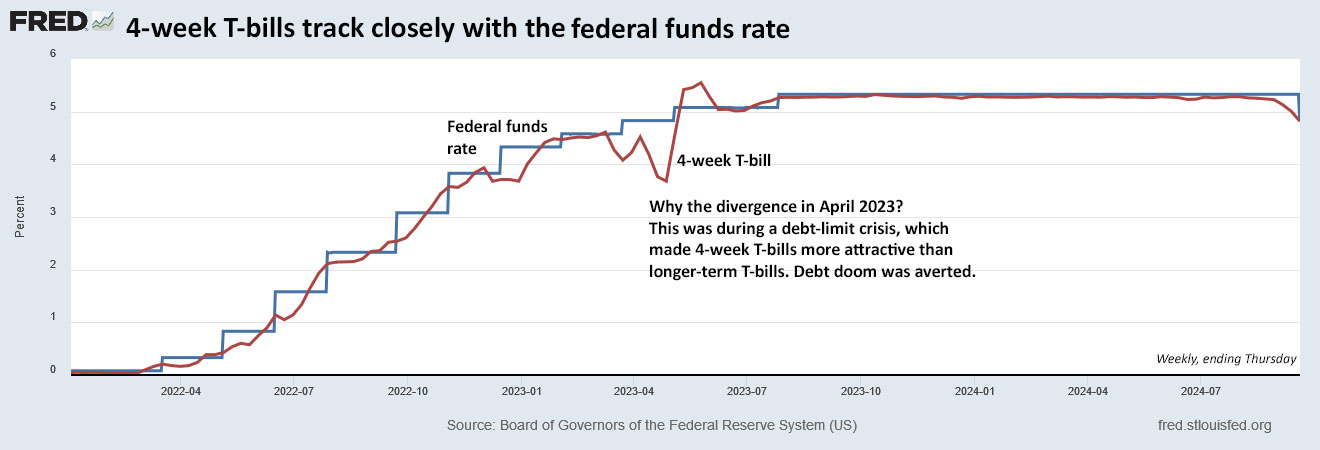
The yield on a 4-week T-bill hit a 2023 high of 6.02% on May 25, 2023, and then a 2024 high of 5.56% on May 24. Thursday, it reached the low for the year, 4.87%. And that yield will continue to decline as the Federal Reserve embarks on a course of rate cuts, probably through much of 2025.

For me, 5% is a magic number. When I was young, my neighborhood Savings and Loan offered a passbook savings account paying a flat 5% and that continued for years. This was the “routine” yield on savings in the 1960s. I remember an episode of the Beverly Hillbillies where banker Mr. Drysdale yelled out, “We’re holding the line on 5% interest!”
I was probably the only kid in America who laughed at that line. More proof I was, and still am, a nerd.
The trend is down
Over the last couple years, I’ve gotten a lot of feedback from readers who were choosing T-bills paying a nominal 5% over TIPS and I Bonds with inflation-protected returns. “Great choice,” I said, if your investment target is short term. But if the goal is longer term, “These rate won’t last forever.”
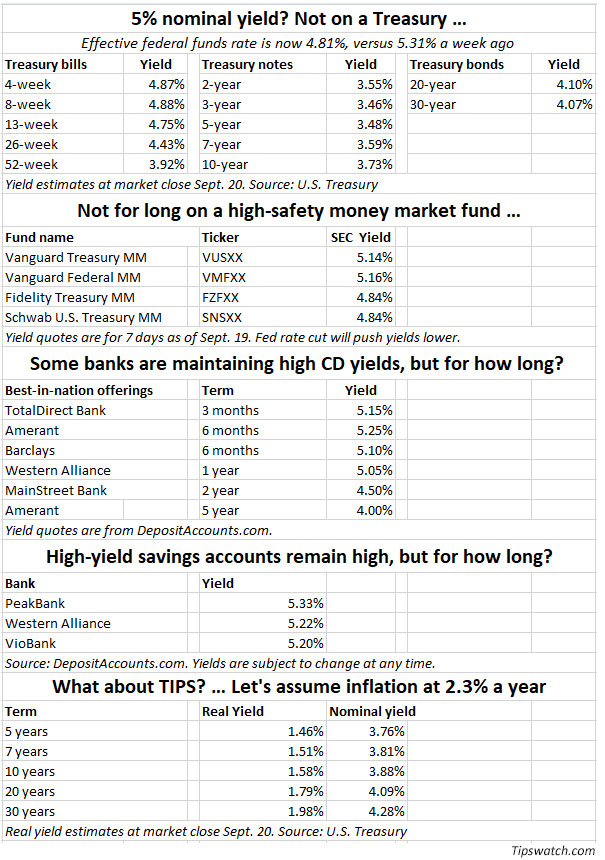
Here is a look at current yields of safe investment choices, both short- and longer-term. Yields across the board have already dropped below 5% or will soon get there.
A new strategy?
Instead of new strategy, maybe investors need new expectations.
“If you haven’t locked into a 5% yield yet, it’s probably too late for terms over one year,” said Ken Tumin, founder of DepositAccounts.com. “But 4%-plus mid-term and long-term CDs are still available. If interest rates keep falling, these too will soon be gone.”
Tumin advises looking for “add-on” CDs, which allow you to continue depositing money into the existing CD at its current rate.
“In addition to standard CDs at online banks and credit unions, there are a few 4%-plus add-on CDs and no-penalty CDs still available. Moving some cash into these can at least help you maintain 4%-plus yields for a few years into a low-rate cycle.”
I have been a strong proponent of investing in T-bills as part of a 2nd-level cash reserve, setting money aside to be used when needed. Back in July 2022 I suggested staggering investments in 13-week and 26-week T-bills, with some maturing every four weeks and then being rolled over. I followed my own advice and was able to ride T-bill rates from about 1.7% in 2022 to 4.87% on a T-bill I reinvested last week.
At this point, I don’t see any need to abandon this strategy. I need this cash reserve for potential spending in retirement, and I don’t want to increase risk in my portfolio. My potential returns will be smaller, but not drastically smaller for the next year, at least.
On the flip side, my core longer-term bond holding — the Vanguard Total Bond Fund ETF (BND) — has recovered nicely since the disastrous performance of 2022, when it was down 13.1%. BND had a total return of 5.66% in 2023 and is up 4.85% so far in 2024. It’s current SEC yield is 4.03%.
While short-term interest rates are almost certain to decline, there’s no certainty about longer-term rates. So there could be future opportunities to extend duration and lock in safe interest rates of nearly 4.0% — either with CDs or Treasury notes. The bond market has to settle down and adapt to the Fed’s actions.
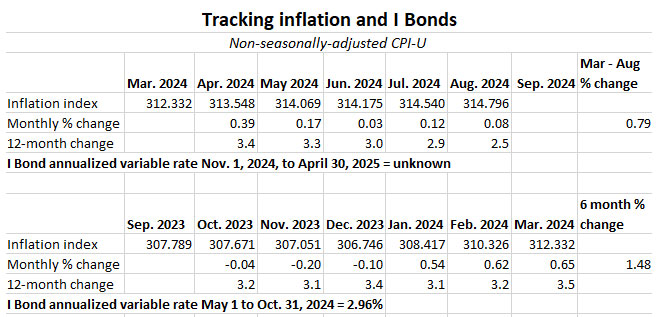
This time around, most probably, short-term interest rates aren’t heading to zero. A more likely “neutral” level will be in the range of 3.00% to 3.50%. Annual U.S. inflation is currently running at 2.5%, and my goal as an investor would be to maintain yields above the rate of inflation. That should be possible over the next year.








One really has to buy whats available. Incomer riders is insurance not an investment, so had nothing to do with…