Looming debt crisis is already roiling Treasury bill market

The 4-week Treasury yield is sending a message of fear.

By David Enna, Tipswatch.com

Update, April 26: ‘The debt limit drama heats up,’ says Moody’s Analytics in new report

On Thursday afternoon, I happened to be watching CNBC during a long on-air interview with Cathie Wood, CEO and founder of Ark Invest, an investment management firm.

Wood is an interesting person, obviously a high-risk investor whose shoot-for -the-moon style is completely opposite mine. I find a lot of her market commentary is designed to bolster the high-risk stocks her funds already own. She’s a believer. But midway through the interview, she said something that made me jump up and say, “NO!”

Listen to the first two minutes of this clip:

Here is the quote that gave me pause:

I think the markets are leading the Fed and I was struck today to learn that the one-month Treasury bill yield is 140 basis points — 1.4% — below the low end of the Fed funds rate. I remember in ’08 and ’09 the Treasury bill rates were an early indicator of how quickly the Fed was going to ease once it realized how much trouble we were in.

What is really happening here?

No, the bond market is not anticipating a quick turnaround by the Fed on short-term interest rates. If that were true, you’d see yields falling across all T-bill maturities. But that isn’t happening. Only the 4-week T-bill has seen yields plummet in the last three weeks, as you can see in this chart:

The chart, from the Treasury’s Yields Curve estimates page, shows that the 4-week T-bill’s yield has fallen 120 basis points in three weeks, while the 8-week is up 8 basis points and the 13-week is up 19 basis points. The same is true across the T-bill spectrum — every issue except the 4-week has seen yields rise in April.

Now, why would that happen? The reason is simple: Investors are pouring into the 4-week T-bill, forcing its yield lower, because of the near-certainty of market turmoil coming with the expiration of the U.S. debt ceiling. This is highly likely to reach “crisis” level by June, about 6 weeks from now. From the Washington Post:

If Congress doesn’t increase the limit on how much the Treasury Department can borrow, the federal government will not have enough money to pay all its obligations by as early as June. Such a breach of the debt ceiling — the legal limit on borrowing — would represent an unprecedented breakdown

If you look at the timing of this highly likely crisis, you can see that the 4-week T-bill can be purchased now and mature with a couple weeks to spare. So, in theory, it is much “safer” than the 8-week, which now has a yield 162 basis points higher. Same with the 13-week, which has a yield 178 basis points higher.

The 4-week and 13-week generally follow a similar trend line, but as the debt crisis gets closer, they have diverted:

Click on the image for a larger version.

To be clear: I am not saying that the United State will begin defaulting on its debt in June or August. That would be an utter disaster and I don’t think it will happen. But I also think there will be no resolution to this issue until we approach the brink of calamity. And that is going to cause market uncertainty.

For one thing, the yield on that 4-week T-bill will begin rising dramatically sometime in May, as we approach a potential government shutdown or debt breach.

This has happened before

2011. Back on March 6, 2023, I wrote an article (Debt-limit crisis: Lessons from the 2011 earthquake) looking back on a very similar crisis in mid-2011. This one was the most serious up to this year, but eventually was resolved on August 1. It triggered a frightening stock market collapse and solidified a near-decade of ultra-low Treasury yields. This chart shows the massive moves in Treasurys and the stock market in a single month, August 2011:

Click on image for a larger version.

The 2011 crisis went to the brink but was resolved. Nevertheless, Standard and Poors lowered its credit rating on U.S. debt from AAA to AA+, a rating that remains in effect today.

But here is the point I wanted to make in this article: The T-bill market began anticipating the approaching crisis, with both the 4-week and 13-week T-bill spiking higher in the days before a potential government shutdown.

Click on the image for a larger version.

Of course, at this time in 2011 the Federal Funds Rate was already as low as it goes, in the range of 0% to 0.25%. So the move higher in the 4-week was only 15 basis points, from 0.01% on July 20 to 0.16% on July 29. But then again, the yield on July 29 was 16 times higher than it was on July 20.

By August 8, two days after the S&P downgrade, the 4-week yield was back down to 0.2%. In other words, the S&P action had zero effect on the U.S. Treasury market. The yield on a 10-year Treasury note was at 2.82% on July 29 and fell to 1.89% on Dec. 30. So when you hear people say, “The 2011 crisis increased U.S. borrowing costs,” just realize this is not true.

2013. A similar debt-ceiling crisis erupted in 2013 after the debt ceiling was technically reached on Dec. 31, 2012. Eventually, the debt ceiling was suspended for a few months, then reinstated. The crisis reached a peak in early October and was resolved on Oct. 16.

Click on the image for a larger version.

The chart shows the extreme, but short-lived, spike in the 4-week T-bill yield as the crisis reached a high point. Again, at the time the Federal Funds Rate was in the range of 0% to 0.25%. The 4-week T-bill yield rose from 0.1% on Sept 9, 2013, to 0.32% on Oct 15, and increase of 32 times.

What happens in a debt-lock?

I don’t think the U.S. is going to default on its debt, but there’s a real possibility we will see a short-term government shutdown and disruption to government payments. No one knows exactly how this would play out.

The Brookings Institution earlier this year issued a paper titled, “How worried should we be if the debt ceiling isn’t lifted?” It starts off with a bang:

“Once again, the debt ceiling is in the news and a cause for concern. If the debt ceiling binds, and the U.S. Treasury does not have the ability to pay its obligations, the negative economic effects would quickly mount and risk triggering a deep recession.”

In speculating on how a debt-lock could be handled, the authors note that the U.S. government created a contingency plan in 2011 at the height of the crisis:

“Under the plan, there would be no default on Treasury securities. Treasury would continue to pay interest on those Treasury securities as it comes due. And, as securities mature, Treasury would pay that principal by auctioning new securities for the same amount (and thus not increasing the overall stock of debt held by the public). Treasury would delay payments for all other obligations until it had at least enough cash to pay a full day’s obligations. In other words, it will delay payments to agencies, contractors, Social Security beneficiaries, and Medicare providers rather than attempting to pick and choose which payments to make that are due on a given day.”

You can read the full contingency plan here.

Also in March, Moody’s Analytics published a paper titled, “Going down the debt limit rabbit hole.” It predicts the actual “X-date” of potential breach is Aug. 18. It notes:

Investors in short-term Treasury securities are coalescing around a similar X-date, demanding higher yields on securities that mature just after the date given worries that a debt limit breach may occur.

Unless the debt limit is increased, suspended, or done away with by then, someone will not get paid in a timely way. The U.S. government will default on its obligations.

In discussing worst-case scenarios, Moody’s notes:

A more worrisome scenario is that the debt limit is breached, and the Treasury prioritizes who gets paid on time and who does not. The department almost certainly would pay investors in Treasury securities first to avoid defaulting on its debt obligations.

But Moody’s also notes the potential political fallout, saying, “Politically it seems a stretch to think that bond investors, who include many foreign investors, would get their money ahead of American seniors, the military, or even the federal government’s electric bill.”

I highly recommend reading through the entire Moody’s report. It presents an unpolitical and unvarnished point of view.

Final thoughts

My main point here was to show that the short-term Treasury market is already being affected by the looming crisis, and things are likely to get a lot more volatile. I don’t have answers to the “What would happen if …” questions readers often ask. We are moving into an uncertain time and the financial markets don’t like uncertainty.

* * *

Feel free to post comments or questions below. If it is your first-ever comment, it will have to wait for moderation. After that, your comments will automatically appear.Please stay on topic and avoid political tirades.

David Enna is a financial journalist, not a financial adviser. He is not selling or profiting from any investment discussed. I Bonds and TIPS are not “get rich” investments; they are best used for capital preservation and inflation protection. They can be purchased through the Treasury or other providers without fees, commissions or carrying charges. Please do your own research before investing.
Posted in Cash alternatives, Retirement, Social Security, Treasury Bills | 47 Comments

New 5-year TIPS gets a real yield of 1.32%, an attractive result

By David Enna, Tipswatch.com

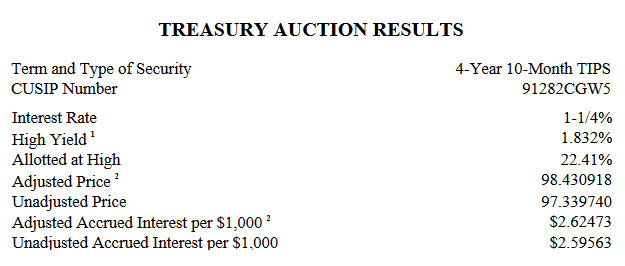
The Treasury’s auction of $21 billion in a new 5-year Treasury Inflation-Protected Security — CUSIP 91282CGW5 — resulted in a real yield to maturity of 1.320%, a bit higher than looked likely through the morning.

Demand appears to have been fairly weak for this 5-year TIPS. The bid-to-cover ratio was 2.34, the lowest for any TIPS auction of this term for as long as I’ve been recording this data (back to June 2019). A similar TIPS was trading on the secondary market all morning with a real yield around 1.29%. So … 1.32% looks good.

Definition: A TIPS is an investment that pays a coupon rate well below that of other Treasury investments of the same term. But with a TIPS, the principal balance adjusts each month (usually up, but sometimes down) to match the current U.S. inflation rate. So, the “real yield to maturity” of a TIPS indicates how much an investor will earn above (or below) inflation.

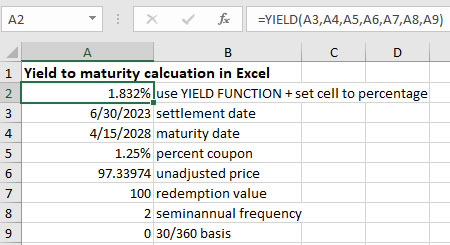
Pricing: The coupon rate for this TIPS was set at 1.25%. Because the real yield was higher, investors paid an unadjusted priced of about 99.664 for $100 of par value. The inflation index will be 1.00241 on the settlement date of April 28, and that means investors will pay an adjusted price of about 99.91 for about $100.24 in principal. (Plus about 4 cents for accrued interest.)

It’s a small thing, but a lot of TIPS investors tell me they relish the idea of buying a TIPS below par value, because par value is guaranteed to be returned at maturity, even if we hit a period of extended deflation. This TIPS delivered.

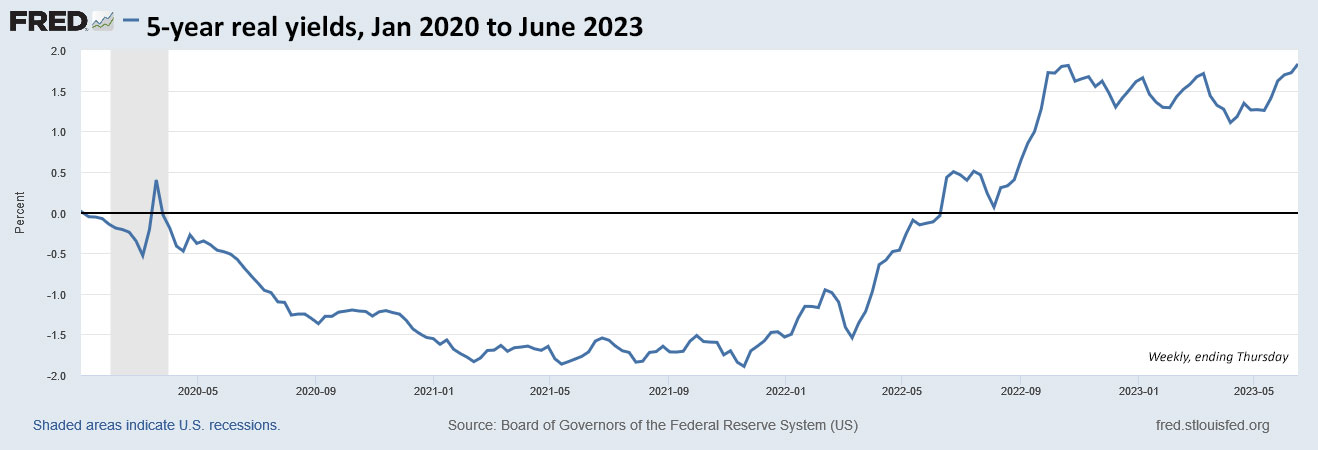
The yield. Real yields for all TIPS have risen sharply over the last year, but peaked in fall 2022 and have slid a bit lower since then. Here is the one year trend in the 5-year real yield:

Click on the image for a larger version.

The auction’s result of 1.320% looks in line with the trading range we’ve seen over the last several months. As recently as March 8, the 5-year real yield hit 1.87% but began falling in reaction to the U.S. banking turmoil. It dipped as low as 1.06% on April 6.

Inflation breakeven rate

At the auction’s close, a 5-year nominal Treasury note was yielding 3.63%, giving this TIPS an inflation breakeven rate of 2.31%, which is historically high but looks attractive with U.S. inflation currently running at 5.0%. I’m a bit surprised we didn’t see higher demand for this auction, because the nominal 5-year at 3.63% isn’t very attractive. At least the TIPS protects against unexpected inflation.

Here is the one-year trend in the 5-year inflation breakeven rate, showing that 2.31% is on the low end of recent rates:

Click on the image for a larger version.

Reaction to the auction

How did the market react to the auction results? With a yawn. The TIP ETF, which holds the full range of maturities, barely budged after the auction’s close at 1 p.m. EDT. So it looks like things went as expected, even though demand was weak.

For investors, getting 1.32% above inflation for the next five years is attractive. Just one year ago, on April 29, 2022, a new 5-year TIPS auctioned with a real yield of -0.340%. Times have changed, huh?

I was a buyer at this auction, fulfilling my wish to bolster the 2028 rung of my TIPS ladder. This TIPS will get a reopening auction on June 22 and then a new 5-year TIPS will be auctioned in October and reopened in December.

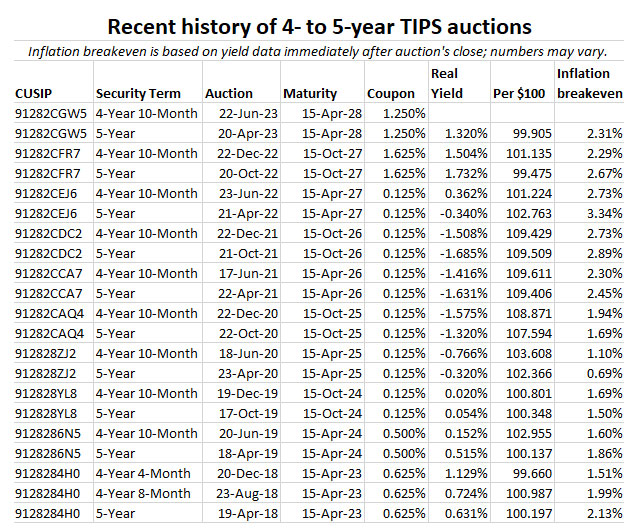
Here is the recent history of TIPS auctions of this term:

Confused by TIPS? Read my Q&A on TIPS

TIPS in depth: Understand the language

TIPS on the secondary market: Things to consider

Upcoming schedule of TIPS auctions

* * *

Feel free to post comments or questions below. If it is your first-ever comment, it will have to wait for moderation. After that, your comments will automatically appear.Please stay on topic and avoid political tirades.

David Enna is a financial journalist, not a financial adviser. He is not selling or profiting from any investment discussed. I Bonds and TIPS are not “get rich” investments; they are best used for capital preservation and inflation protection. They can be purchased through the Treasury or other providers without fees, commissions or carrying charges. Please do your own research before investing.

Posted in Inflation, Investing in TIPS | 43 Comments

A 5-year TIPS matured April 15. How did it do as an investment?

By David Enna, Tipswatch.com

Back in spring 2018, the Federal Reserve was continuing its wind-down of quantitative easing, raising its key short term interest rate on March 21 to a range of 1.50 – 1.75%.

That led to a very promising TIPS auction on April 19, 2018 — CUSIP 9128284H0, a new 5-year Treasury Inflation-Protected Security. In my preview article for that TIPS auction, I noted it could be “the most attractive in years.”

The result: At auction CUSIP 9128284H0 generated a real yield to maturity of 0.631%, the highest for any 4- to 5-year TIPS auction since October 2009. The coupon rate was set at 0.625%, the first time in 8 years that any TIPS of this term received a coupon rate higher than 0.125%.

This TIPS got an inflation breakeven rate of 2.13%, compared with a nominal 5-year Treasury note yielding 2.76% at the time.

In other words, everything looked great for an investor in this TIPS. But five years later, how did it actually do as investment? Let’s take a look:

Click on the image for a larger version. Find 10-year data on my TIPS vs. Nominals page.

Conclusion: It did very well

Inflation over the next five years averaged 3.3%, much higher than the inflation breakeven rate of 2.13%. That’s an annual variance of 1.17%. According to data compiled by EyeBonds.info, CUSIP 9128284H0’s compounded rate of return was 4.42%, well above the 2.76% offered by a nominal Treasury (before interest reinvestment).

This TIPS was a winner. Keep in mind that a TIPS investment does especially when inflation runs higher than expected. That’s certainly been the case over the last two years.

I have fond memories of just-matured CUSIP 9128284H0. I invested in it at the opening auction (real yield of 0.631%), first reopening in August (0.724%) and last reopening in December (1.129%).

2018 was a fantastic year for TIPS investment, much like 2023.

Notes and qualifications

This analysis is an estimate of performance.

Keep in mind that interest on a nominal Treasury and the TIPS coupon rate is paid out as current-year income and not reinvested. So in the case of a nominal Treasury, the interest earned could be reinvested elsewhere, which would potentially boost the gain. For certain, we don’t know what the investor could have earned precisely on an investment after re-investments.

In the case of a TIPS, the inflation adjustment compounds over time, and that will give TIPS a slight boost in return that isn’t reflected in the “average inflation” numbers presented in the chart.

Confused by TIPS? Read my Q&A on TIPS

TIPS in depth: Understand the language

TIPS on the secondary market: Things to consider

Upcoming schedule of TIPS auctions

* * *

Feel free to post comments or questions below. If it is your first-ever comment, it will have to wait for moderation. After that, your comments will automatically appear.Please stay on topic and avoid political tirades.

David Enna is a financial journalist, not a financial adviser. He is not selling or profiting from any investment discussed. I Bonds and TIPS are not “get rich” investments; they are best used for capital preservation and inflation protection. They can be purchased through the Treasury or other providers without fees, commissions or carrying charges. Please do your own research before investing.
Posted in Inflation, Investing in TIPS | 8 Comments

Thoughts on this week’s 5-year TIPS auction: It’s complicated

By David Enna, Tipswatch.com

The U.S. Treasury on Thursday will auction $21 billion of a new 5-year Treasury Inflation-Protected Security, CUSIP 91282CGW5. The coupon rate and real yield to maturity will be set by the auction results.

For months, I have been considering this auction as a sure-fire purchase, because my TIPS ladder is quite weak for the year this one matures, 2028. I will still be a buyer, but I can see why some investors might opt out. There are equally safe and equally attractive nominal investments out there. And that makes this investment decision complicated.

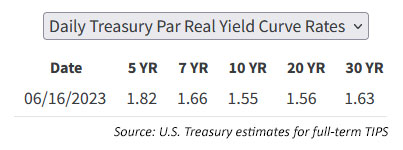
As of Friday, the U.S. Treasury was estimating the real yield (meaning the yield above inflation) of a 5-year TIPS at 1.29%, well below the 2023-high of 1.87%, set on March 8 just before the Silicon Valley Bank collapse. But 1.29% is okay, in my opinion. Take a look at 5-year real yields over the last 8 years:

Click on the image for a larger version.

After a decade-plus of extremely low or even negative real yields, I can’t complain about getting 1.29% above inflation. It’s fine.

The complicating issue is that you can capture nominal yields with non-callable 5-year bank CDs — either direct or brokered — that are competitive with this 5-year TIPS. A best-in-nation 5-year CD paying around 4.50% creates an inflation breakeven rate of 3.21% against this TIPS, meaning the CD will out-perform if inflation averages less than 3.21% over the next five years.

Will inflation average more than 3.21% through April 2028? I think it’s possible, even likely, but it is going to be close. The CD also looks like a sensible investment. However, forget about the 5-year nominal Treasury note, with a current yield of just 3.60%. The CD and TIPS are much more attractive.

This chart shows how each 5-year investment will perform under different inflation scenarios. At low inflation rates, the bank CD is the winner, with even better real returns if deflation strikes. When inflation rises above 3.21%, the TIPS is the winner, with unlimited upside potential if severe inflation strikes. But there is no scenario where the 5-year Treasury note is the winner.

One thing to consider is that interest from TIPS is exempt from state income taxes, which isn’t true for bank CDs. But if you are putting these in a tax-exempt account, that issue is moot.

So is this Thursday’s 5-year TIPS auction attractive? Yes, it is, as long as real yields hold around current levels through the week. But you could consider pairing it with nominal investments like T-bills (paying 5%+ for a six-month term) or solid bank CDs (paying around 5.15% for 1 year or 4.50% for 5 years.)

Or, just buy the TIPS. It will do fine if you hold it to maturity.

Pricing

If the real yield holds at 1.29%, this new TIPS will get a coupon rate of 1.25% and should be priced just below par. It also will carry an inflation index of 1.00241 on the settlement date of April 28. So at this point the price should be very close to $100 for $100 of par. There will also be a very small amount of accrued interest.

Inflation breakeven rate

The official inflation breakeven rate will be set by the spread in yield between the 5-year Treasury note (currently yielding 3.60%) and the TIPS real yield (let’s estimate 1.29%). That creates an inflation breakeven rate of 2.31%, fairly high by historical standards but fairly low compared with recent auctions.

Here is the trend in the 5-year inflation breakeven rate over the last 8 years:

Click on the image for a larger version.

U.S. inflation has been trending downward over the last year, going from an annual rate of 9.1% in June 2022 to 5.0% in March 2023. I think that trend will continue for several more months before stabilizing around 3.5%. But that is a guess, of course. No one can accurately predict future inflation.

Over the last 5 years, U.S. inflation has averaged 3.3%.

Final thoughts

Although I still plan to be a buyer at this auction, on April 10 I took half of my planned investment and bought a non-callable 5-year brokered CD yielding 4.61%. It’s hard to pass up these attractive nominal yields, even for an inflation-fighter like me.

We are finally in a prosperous time for ultra-safe fixed-income investing, something we didn’t see for more than a decade. Will this trend continue for years? Possibly. I hope so. But enjoy it while it lasts.

If you are considering bidding at Thursday’s auction, keep an eye on the Treasury’s Yield Curve estimates, which update at the close of the market each day. Non-competitive bids at TreasuryDirect must be placed by noon Thursday. If you are putting an order in through a brokerage, make sure to place your order Wednesday or very early Thursday, because brokers cut off auction orders before the noon deadline.

What are your thoughts on this TIPS auction? Post your comments below.

I’ll be posting results Thursday after the auction closes at 1 p.m. EDT. Here is a look at auctions of this term back to 2015. Note that you only have to go back one year, to April 29, 2022, to find a negative real yield:

Confused by TIPS? Read my Q&A on TIPS

TIPS in depth: Understand the language

TIPS on the secondary market: Things to consider

Upcoming schedule of TIPS auctions

* * *

Feel free to post comments or questions below. If it is your first-ever comment, it will have to wait for moderation. After that, your comments will automatically appear.Please stay on topic and avoid political tirades.

David Enna is a financial journalist, not a financial adviser. He is not selling or profiting from any investment discussed. I Bonds and TIPS are not “get rich” investments; they are best used for capital preservation and inflation protection. They can be purchased through the Treasury or other providers without fees, commissions or carrying charges. Please do your own research before investing.

Posted in Bank CDs, Inflation, Investing in TIPS, TreasuryDirect | 51 Comments

I Bond dilemma: Buy in April, buy in May, or don’t buy at all?

The I Bond’s fixed rate could rise to 0.6% or higher on May 1. Should you wait? Or look at alternatives?

By David Enna, Tipswatch.com

Update, April 28, 2023: Treasury raises I Bond’s fixed rate to 0.9%; new composite rate is 4.30%

So here we are, in April’s magical two-week period where we can make a somewhat informed decision about buying U.S. Series I Savings Bonds in 2023.

I Bonds are a U.S. Treasury investment.

We learned a key piece of information Wednesday with the release of the March inflation report, which set the I Bond’s new variable rate at 3.38%, down dramatically from the current 6.48%. But this drop in yield was expected. U.S. inflation has fallen from a high of 9.1% in June 2022 to the current rate of 5.0%, the lowest since May 2021.

A key thing to understand is that 5.0% is still unacceptably high inflation, reinforcing the importance of long-term inflation protection, which is exactly what the I Bond provides.

But the big difference today versus the last decade is that investors now have equally safe nominal investments with attractively high yields — insured bank CDs, online savings accounts, Treasury money market funds, along with U.S. Treasury bills, notes and bonds.

In addition, there is this obvious alternative: Treasury Inflation-Protected Securities, a more complicated investment that currently offers superior above-inflation returns.

One year ago, in April 2022, you could invest in an I Bond with a yield of 7.12% for six months, then 9.62% for six months. At that time, a 1-year Treasury bill was paying 1.84%. A 5-year TIPS had a real yield of -0.54%. I Bonds were a massively attractive investment in April 2022. Things aren’t so clear today.

So what is an investor to do? First, let’s look at some I Bond basics:

What is an I Bond?

An I Bond is a U.S. government security that earns interest based on combining a fixed rate and an inflation rate.

  • The fixed rate will never change. Purchases through April 30, 2023, will have a fixed rate of 0.4%. That could change on May 1, when the Treasury resets the rate. It’s possible that rate could go higher, which would benefit people buying after May 1.
  • The inflation-adjusted rate (often called the variable rate) changes each six months to reflect the running rate of inflation. That rate is currently set at 6.48% annualized. It will adjust on May 1 to 3.38% annualized, based on U.S. inflation from September 2022 to March 2023. The new variable rate will eventually roll out to all I Bonds, depending on the original month of purchase.
  • The combination of these two creates the I Bond’s composite rate, which is currently 6.89%. The rate after May 1 will depend on how the Treasury sets the fixed rate. If it remains at 0.4%, then the new composite rate will be 3.79%. But remember it could be higher, but only for I Bonds purchased after May 1.

When you purchase an I Bond, you get the current composite/variable rate for a full six months, and then you transition to the next variable rate for a full six months.

Buying in April. April buyers know both the current composite rate (6.89%) and the next one (3.79%), locking in a compounded return of about 5.4% over the next year.

Buying in May. For a May purchase, investors only know the first six-month variable rate of 3.38%. The new fixed rate won’t be announced until May 1.

One key “negative” of I Bonds is that the Treasury limits purchases to $10,000 per person per calendar year. For this reason, I advise people interested in inflation protection to invest in I Bonds up to the limit each year, and continue holding until they really need the money.

Also, I Bonds cannot be redeemed until you own them 12 months. If you redeem them after 1 year but before 5 years, you will lose the last three months of interest. After five years, you can redeem any amount at any time with no penalty.

Is the fixed rate heading higher?

Back on March 9, I wrote an analysis suggesting that Treasury would be likely to raise the I Bond’s fixed rate to somewhere around 0.6% to 1.0% — leading to a guess of 0.8%. But on that very day, Silicon Valley Bank collapsed and we began weeks of financial turmoil, forcing real yields down dramatically. The equation of my highly-thought-out “guess” has changed.

The Treasury has no announced formula for setting the I Bond’s fixed rate, so that means anything I am saying is pure speculation. But my observations — and those of many savvy Bogleheads — indicate that the fixed rate tends to track higher when the real yield of a 10-year TIPS tracks higher. In other words, there is a correlation, but it is not a set formula. It appears to be a formula combined with the whim of the Treasury Department.

The fixed rate is extremely important for an I Bond investor, especially a long-term investor, because it stays with the I Bond for 30 years, or until the I Bond is redeemed. A higher fixed rate is very desirable.

In recent days, without giving this a lot of thought, I have been saying I think the May 1 reset of the fixed rate will fall into a range of 0.4% to 0.6%, but I’d lean more toward 0.6%. Here is an updated chart of the information I am using to make my “guess”:

Most recent real yield theory. On the right side is the equation I have used for years, comparing the potential fixed rate with the most recent real yield of a 10-year TIPS. This technique is hugely inconsistent, but it does a good job of predicting a rise or fall in the fixed rate.

In November 2022, the Treasury set the fixed rate at 0.4%, creating a spread of 118 basis points with the 10-year TIPS. The typical spread in recent years was around 50 basis points, so that 0.4% fixed rate was too low, in my opinion.

But note that since November 2022, the 10-year TIPS real yield has fallen from 1.58% to 1.14%. If you take 50 basis points from 1.14% you get 0.64%, so using this method I think we could see a new fixed rate of 0.6%.

Half-year average theory. On the left hand side of the chart is my newer theory, suggested by readers. To apply this theory, I determined the average 10-year real yield over the rate-setting periods — May to October and November to April for each period the fixed rate was set above 0.0%. Then I calculated the ratio of the new fixed rate to the six-month average.

In the most recent rate reset in November 2022, the fixed rate of 0.40% was 56% of the 0.72% six-month average for the 10-year real yield. If you applied that ratio to current 10-year real yield average of 1.37%, you get a fixed rate of 0.80%, rounded to the tenth decimal point. (Fixed rates are always set to the tenth decimal point, such as 0.40% currently.)

This method lessens the importance of the recent fall in 10-year real yields and points to a new fixed rate of 0.8%, which would be highly attractive.

Conclusion. I’m now guessing a fixed rate of 0.6% to 0.8%. But remember, this is a guess backed up by data, but still a guess.

Higher yield vs. higher fixed rate

Investors buying I Bonds in April get the advantage of locking in a 6.89% composite rate for six months and then 3.79% for six months. So even if the fixed rate rises, buyers in May will need several years to catch up. One of my readers, an Excel whiz who goes by “hoyawildcat,” came up with this explanation of the breakeven periods:

Here are the breakeven dates for I Bonds bought in May (at the new 3.38% variable rate and different fixed rates) vs. I Bonds bought this month (at the current 6.48% variable rate and 0.4% fixed rate).

0.4% — Breakeven: Never
0.5% — Breakeven: April 2040 (16 years 11 months)
0.6% — Breakeven: May 2032 (9 years)
0.7% — Breakeven: June 2029 (6 years 1 month)
0.8% — Breakeven: October 2027 (4 years 5 months)
0.9% — Breakeven: January 2027 (3 years 8 months)
1.0% — Breakeven: May 2026 (3 years)

I’ve seen similar breakeven numbers posted in the Boglehead forum, slightly different, but close enough to get an idea of the April vs. May purchase decision. Most of the Bogleheads seem to be opting for an April purchase.

Remember, you get a ‘mulligan’

While the Treasury limits I Bond purchases to $10,000 per person per year, savvy investors have uncovered a loophole that bypasses that limit: the gift box. This technique works best for spouses or family members, who can each purchase another $10,000 (or more) in I Bonds for each other, deposited in separate gift boxes.

I Bonds placed in the gift box begin earning interest immediately and capture the current fixed rate. When they are delivered in a future year, they apply to that year’s purchase cap for the recipient.

Harry Sit of the TheFinanceBuff.com was the first to write about this strategy on Dec. 27, 2021, in an article titled “Buy I Bonds as a Gift: What Works and What Doesn’t.” When people ask me about the gift box, I point them to this article, which was well researched and thorough. So, go read that article if you don’t know about the strategy.

Some basics of the gift box strategy:

  1. When you place an I Bond into the gift box, it begins earning interest in the month of purchase, just like any other I Bond, and continues earning interest just like any I Bond. However, this money is no longer yours. It belongs to the recipient of the gift.
  2. The purchase does not count against your purchase limit for that year. It will count against the purchase limit for the recipient, in the year it is granted.
  3. Gift purchases are limited to $10,000 for each gift, but you can make multiple gift purchases of $10,000 for the same person. But the recipient can only receive one $10,000 gift a year, and that gift counts against their purchase limit for that year.
  4. You must provide the recipient’s name and Social Security Number when you buy a gift. The recipient doesn’t need to have a TreasuryDirect account … yet. Only a personal account can buy or receive gifts. A trust or a business can’t buy a gift or receive a gift.
  5. “I Bonds stored in your gift box are in limbo,” Harry Sit notes in his article. “You can’t cash them out because they’re not yours. The recipient can’t cash them out either because the bonds aren’t in their account yet.”
  6. The recipient will need to open a TreasuryDirect account to receive the I Bond. Once it is delivered, the money is the recipient’s, who can then cash out or continue to hold the I Bond.

Investment alternatives

A lot of investors have flooded into I Bonds in the last two years, enticed by extremely attractive yields and near-total safety. Those investors were often looking for immediate, short-term returns at a time when savings accounts and money market funds were paying something like 0.05%.

But now, things are totally different. There are many attractive alternatives to I Bonds, such as:

  • 1-year insured bank CD paying 5.1%.
  • 13-week Treasury bill paying 5.02%.
  • 1-year Treasury bill paying 4.64%.
  • A 5-year TIPS with a real yield of 1.17%, well above the I Bond’s 0.4%.
  • Online savings accounts paying about 4.1%.
  • Money market accounts paying more than 4%.

Realistically, I Bonds purchased in April remain competitive, offering a nominal return of 5.4% over one year. But if that I Bond is redeemed in April 2024, the investor loses three months of interest, dropping the yield to about 4.4%. That’s still a good return, but not anything stellar.

I’ve heard from a lot of readers who are planning to bypass buying I Bonds this year and even beginning to redeem I Bonds in coming months as the lower variable rate kicks in. Can’t argue with that, if the investor’s goal is getting the highest near-term yield possible.

I Bonds remain attractive, however, for people seeking to push inflation-protected money into the future, with near-zero risk. I Bonds have better deflation protection than TIPS, have a flexible maturity date and are free of state income taxes. After five years, they become an easily accessible, inflation-protected savings account. You can never lose a penny of principal with an I Bond.

Final thoughts

A month ago, I thought the I Bond’s fixed rate would rise on May 1 to a range of 0.6% to 1.0%. Then came the banking fiasco, and my prediction fell to 0.4% to 0.6%. After writing this article and doing a better analysis, my prediction rises to 0.6% to 0.8%. As I have noted, this is a guess backed up by data.

I am opting to buy our full allocation of I Bonds in April and have set April 26 as the purchase date on TreasuryDirect. If the fixed rate rises dramatically on May 1, I will use the gift-box strategy to add to our holdings. In other words, I can’t lose.

In addition, I most likely will be investing in the new 5-year TIPS going up for auction on April 20. I’ll post a preview article on that April 16.

Later this year, as the lower variable rate kicks in, I may begin redeeming some 0.0% I Bonds that have hit the 5-year mark. Those will become retirement spending money, the reason I bought I Bonds in the first place.

Another viewpoint …

Jennifer Lammer, a YouTube content creator who closely follows I Bonds, just posted this video, reaching a similar conclusion: Buy I Bonds in April, but with a plan to buy more later in the year. There’s a lot of good information here.

What is your strategy? Post your ideas in the comment section below.

Confused by I Bonds? Read my Q&A on I Bonds

Let’s ‘try’ to clarify how an I Bond’s interest is calculated

Inflation and I Bonds: Track the variable rate changes

I Bonds: Here’s a simple way to track current value

I Bond Manifesto: How this investment can work as an emergency fund

* * *

Feel free to post comments or questions below. If it is your first-ever comment, it will have to wait for moderation. After that, your comments will automatically appear.Please stay on topic and avoid political tirades.

David Enna is a financial journalist, not a financial adviser. He is not selling or profiting from any investment discussed. I Bonds and TIPS are not “get rich” investments; they are best used for capital preservation and inflation protection. They can be purchased through the Treasury or other providers without fees, commissions or carrying charges. Please do your own research before investing.

Posted in Bank CDs, Cash alternatives, I Bond, Investing in TIPS, Savings Bond, TreasuryDirect | 77 Comments