
Quantitative tightening will have to ramp up in coming months if the Fed wants to bring U.S. inflation down.
By David Enna, Tipswatch.com
The basic monetary rule of the last two decades has been this: When the economy slips lower and the stock market stumbles, the Federal Reserve steps in with aggressive stimulus. But when the economy is thriving, and the stock market is soaring, the Fed sits on the sidelines and watches.
That rule has been crushed in 2022, because U.S. inflation has soared to a 41-year high of 9.1%. Now the Fed has been forced to act, and it is aggressively raising interest rates and beginning to reduce its massive balance sheet of Treasurys and mortgage-backed securities.
Amassing the Fed’s current $8.8 trillion balance sheet has taken more than a decade in a process known as quantitative easing. What is quantitative easing? Here is a concise definition from Investopedia:
Quantitative easing (QE) is a form of monetary policy in which a central bank, like the U.S. Federal Reserve, purchases securities from the open market to reduce interest rates and increase the money supply. … As money is increased in an economy, the risk of inflation looms.
When the Fed reduces its balance sheet, it uses a process known as quantitative tightening. Again, here is the Investopia’s concise definition:
Quantitative tightening (QT) refers to monetary policies that contract, or reduce, the Federal Reserve System’s balance sheet. This process is also known as “balance sheet normalization.” In other words, the Fed (or any central bank) shrinks its monetary reserves by either selling Treasuries (government bonds) or by letting them mature and removing them from its cash balances. This removes liquidity, or money, from financial markets.
On March 23, 2022, the Federal Reserve’s balance sheet topped off at $8.96 trillion, an increase of 282% over the total of $2.44 trillion in January 2011. Since March, the Fed has begun to raise interest rates and to allow Treasurys and mortgage-backed securities to mature without reinvestment. Now, as of Aug. 2, 2022, the balance sheet stands at $8.87 trillion, a reduction of just 1% in four months.
I repeat, a reduction of 1% after an increase of 282% over a stretch of 11 years. This is what the Federal Reserve does when it implements quantitative tightening, at least so far into this inflationary crisis. Here is a look back at the Fed’s moves to “ease” and “tighten” over the last 11 years:

There are so many things to consider in this chart.
- Note that the easing periods — when the Fed was adding to its balance sheet and increasing the U.S. money supply — lasted longer and moved higher very quickly.
- The Fed increased its balance sheet by 84.8% from January 2011 to November 2014, then essentially kept it stable from 2014 until March 2018.
- The one period of quantitative tightening that is completed lasted from about March 2018 to September 2019, only 17 months. That 2018-19 tightening resulted in a reduction of only 13.1%.
- Then in late 2019 through March 2022, the Fed increased its balance sheet by an astounding 138.3%.
- Now, with tightening beginning again, the Fed is taking a slow-motion approach, reducing the balance sheet only 1% over four months.
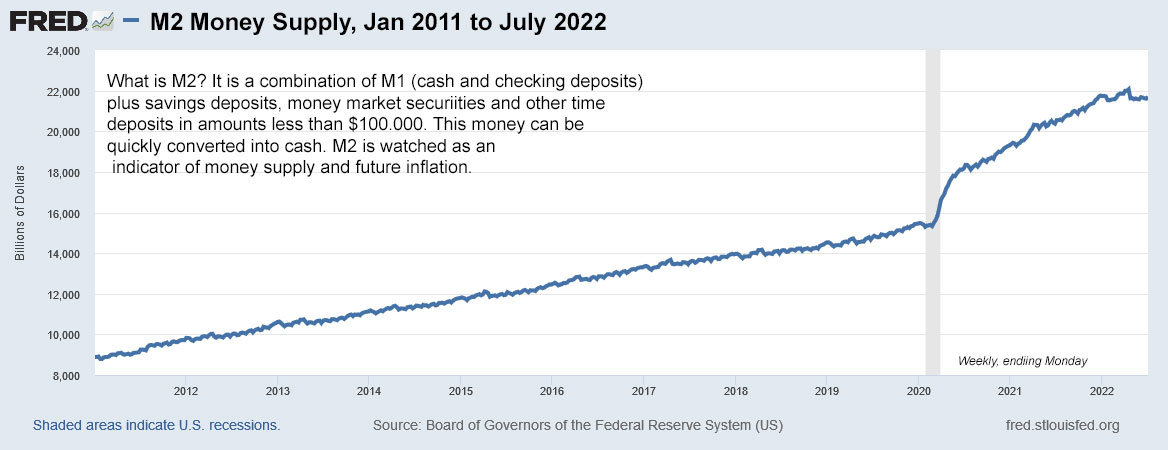
Over this same period, here is the trend in the U.S. money supply, as defined by M2:
And to complete the picture, here is the trend in the annual U.S. inflation rate, by month, over that same time period:
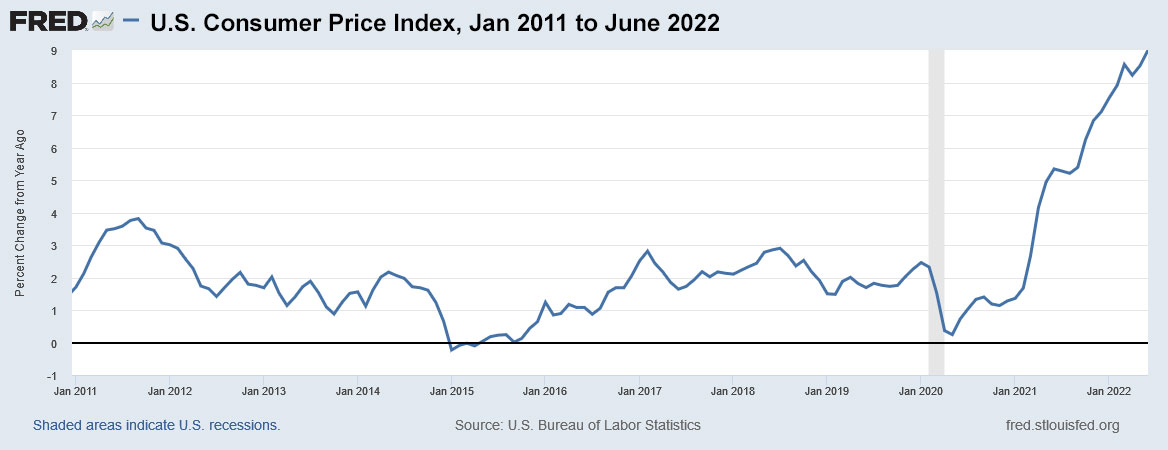
Logical conclusion: Increases in the Fed’s balance sheet, especially in the period after 2018 through the pandemic — and combined with aggressive direct-to-taxpayer stimulus from Congress — resulted in a strong surge higher in both money supply and U.S. inflation. To solve today’s dangerous inflation problem, the Fed will have to get serious about reducing its balance sheet, running the risk of weakening the U.S. economy.
But so far, the Fed hasn’t seriously addressed its balance sheet, which has probably resulted in a weird combination of effects: 1) allowing longer-term interest rates to drift lower, and 2) allowing the stock market to surge off its bear market lows.
Barron’s published a story yesterday with a great headline: “The Fed Is About to Ramp Up Balance-Sheet Shrinkage. It May Get Dicey.” The article makes the point that the Fed’s half-hearted balance sheet reduction so far is barely being noticed by the markets. From the article:
When the central bank began QT in June, it set out to partially unwind roughly $4.5 trillion in quantitative easing, or QE, that was conducted in response to the pandemic. The Fed started by letting up to $30 billion in Treasuries and $17.5 billion in mortgage-backed securities, or MBS, roll off its balance sheet, as opposed to reinvesting the proceeds. Starting next month, those caps will rise to $60 billion and $35 billion, respectively, meaning the pace of balance-sheet runoff is about to double. Fed Chairman Jerome Powell has suggested that QT would go on for two to 2½ years, implying that the Fed’s $9 trillion balance sheet would shrink by roughly $2.5 trillion.
Barron’s points out that the Fed has attempted quantitative tightening only once before, in the 2018-19 period, and even though that tightening wasn’t aggressive, it resulted in disruptions to the U.S. bond market. More from the article, with thoughts from Joseph Wang, former senior trader on the Fed’s open markets desk.:
September and beyond is when Wang warns something is apt to break, not unlike what happened the last time the Fed embarked on QT, and chaos in the repo market prompted an early end to the program. …
And from Solomon Tadesse, head of quantitative equities strategies North America at Société Générale:
… in order to bring inflation back to 2%, the Fed needs to shrink its balance sheet by about $3.9 trillion — significantly more than what investors expect, Tadesse says. By his calculations, QT alone would amount to about 4.5 percentage points in additional rate hikes.
“I don’t think there is appreciation for QT, by markets or the Fed,” Tadesse says. “In the end, if QE mattered, so will QT,” he says, referring to the big lift quantitative easing gave to risk assets. “It might not be totally symmetrical, but there will be a meaningful impact.”
The Barron’s article ends with this: “… investors should brace for added volatility. The Fed is entering the unknown, and so are markets.”
Some final thoughts
We have just ended a very strange month for the Treasury and TIPS markets, with uncertainty driving yields higher, lower, higher, lower — almost at random. Much of this volatility followed statements from Jerome Powell, chair of the Federal Reserve, and actions by the European Central Bank. While those statements seemed hawkish to me, the markets reacted with talk that the Fed would soon ease off and begin cutting interest rates again next year.
In his July 27 news conference, Powell said: “We are continuing the process of significantly reducing the size of our balance sheet.” But as the data show, that process has started slowly and has been an insignificant factor, so far, in bond markets. The 10-year Treasury note had a yield of 0.54% on July 1 and closed at 0.37% on Aug. 5.
This isn’t the way it was supposed to work, which forced San Francisco Fed President Mary Daly to step in Tuesday to declare that there is still “a long way to go” to bring inflation down from four-decade highs.
It seems clear to me that if the Fed ever wants to institute quantitative easing again in the future (and you know it will) it has to first drastically reduce its balance sheet, probably down to at least the September 2019 level of $3.8 trillion. That will take a lot of quantitative tightening, over a period of two years, or more.
Unfortunately, that sort of sustained tightening is not likely. And so … inflation will continue to be a problem. And inflation protection continues to make sense as part of your asset allocation.
* * *
Feel free to post comments or questions below. If it is your first-ever comment, it will have to wait for moderation. After that, your comments will automatically appear.
David Enna is a financial journalist, not a financial adviser. He is not selling or profiting from any investment discussed. The investments he discusses can be purchased through the Treasury or other providers without fees, commissions or carrying charges. Please do your own research before investing.






Re: can my spouse and I use the same ID.me Wallet or the same email address?I've been in touch with…