
Is inflation really slowing? And what does this mean for I Bonds, TIPS and the Social Security COLA?
By David Enna, Tipswatch.com
The July inflation report provides evidence that U.S. inflation is gradually slowing, which should be good news for financial markets and the Federal Reserve.
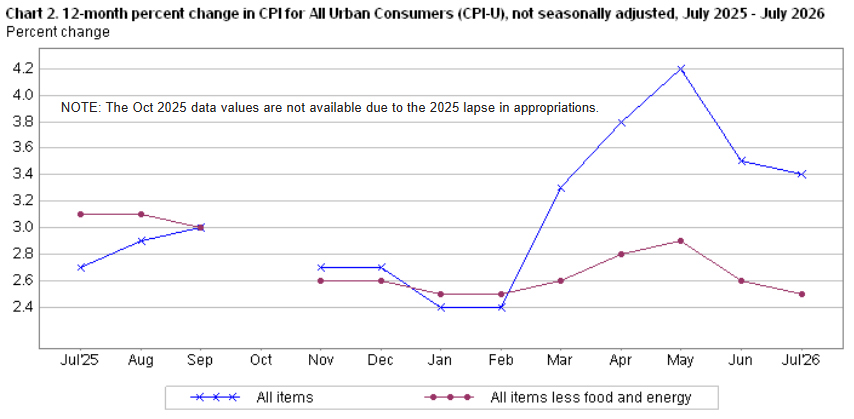
The Consumer Price Index for All Urban Consumers increased 0.1% on a seasonally adjusted basis in July after falling 0.4% in June, the Bureau of Labor Statistics reported. Over the last 12 months, the all-items index increased 3.4%, down from 3.5% in June.

Core inflation, which removes food and energy, ran at 0.2% for the month and 2.5% for the year, down from 2.6% from June. All of these numbers matched economist expectations.
While it might appear to most drivers that gasoline prices increased in July as the war in Iran escalated, the BLS reported that gas prices fell 2.9% for the month, after falling 9.5% in June. I’d expect this reflects averaging over the month, so the August report should show an increase.
Gas prices have increased 24.7% over the last year. Here are other items from the report:
- Food at home costs decreased 0.1% for the month are up 2.7% for the year.
- Egg prices fell 0.5% in July and are down 25.7% for the year.
- Lettuce prices fell 16.4% for the month, thanks to the cyclospora outbreak.
- Shelter costs increased 0.1% for month, which the BLS said accounted for about two-thirds of the all-items total.
- The overall energy index fell 1.5% for the month.
- Apparel prices increased 0.1% for the month and 3.9% for the year.
- Costs of medical care services increased 0.6% for the month and are up 2.7% for the year.
- Airline fares increased 2.2% for the month and are up 25.5% for the year.
- Prices for new vehicles rose 0.1% for the month and 0.5% for the year.
- Costs of used vehicles increased 0.4% for the month, but are down 1.9% for the year.
Overall, like in June, this is a tame inflation report. While the annual rates of increase remain too high, U.S. inflation appears to be trending lower. The big question: Can this continue through a summer of potential supply shocks from the Mideast? Here is the 12-month trend in all-items and core inflation:
What this means for TIPS and I Bonds
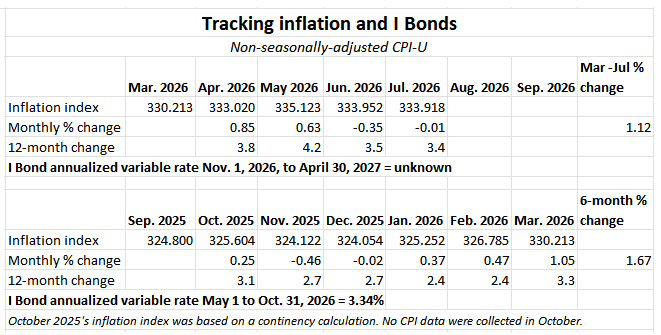
Investors in Treasury Inflation-Protected Securities and Series I Savings Bonds are also interested in non-seasonally adjusted inflation, which is used to adjust principal balances for TIPS and set future interest rates for I Bonds. For July, the BLS set the inflation index at 333.918, a decrease of 0.01% from June.
For TIPS. The July inflation report means that principal balances for TIPS will decline 0.01% in September after falling 0.35% in August. For the 12 months ending in September, principal balances will have increased 3.4%. Here are the new September inflation indexes for all TIPS.
For I Bonds. July marks the fourth month in a six-month string that will determine the I Bond’s new variable rate, to be reset November 1. So far, with two months remaining, inflation has increased 1.12%, which translates to a variable rate of 2.24%. Two months remain. I would guess we will end up with a variable rate of about 3%, down from the current 3.34%. Here are the data so far:
Social Security COLA
The Social Security cost-of-living adjustment is based on an unusual inflation index – CPI-W – and is determined by averaging the indexes for July, August, and September and comparing that number to the same average for the year before. For July, the BLS set the CPI-W index at 327.104, essentially no higher than the 327.075 recorded for June.
My projection for the 2027 COLA was 3.6%, lower than the number estimated by most other forecasters. We all might be too high, but 3.6% remains possible. Here are the data:

What this means for future interest rates
There seems to be growing support among Federal Reserve hawks for preemptive interest rate increases in coming months. I think the mild July inflation report should slow things down. It’s time to wait and watch: Is inflation truly declining? Is the U.S. labor market softening?
So I would think the Fed has a chance to stay on hold through early fall, at least.
In its morning report, Bloomberg called July inflation “subdued,” and noted:
“The big surprise with a report that had no surprises (all of the data came perfectly in line with the estimates) is that a situation where inflation isn’t reaccelerating, coupled with the most recent, weak jobs report gives the Fed more time to wait,” Chris Zaccarelli, the chief investment officer at Northlight Asset Management, said in a note. …
Also this, from Bloomberg economists Anna Wong and Troy Durie:
“July’s CPI report was modest enough to lower chances of a September rate hike, but not low enough to write it off completely. With core CPI matching its five-year low from February, and July payrolls declining, it’s hard to make an urgent case to hike.”
I would guess we will end up seeing at least a minor acceleration in inflation for August and September. But so far, the trend looks relatively mild. Core inflation at 2.5% remains too high, but it is starting to look “normal” in very un-normal times.
—————————

Donate? This site is free and I hope to keep it that way. Some readers have suggested having a way to contribute. I welcome donations, any amount. And FYI, ads on this site pay for about one visit to Costco.
—————————
Follow Tipswatch on X for updates on daily Treasury auctions and real yield trends (when I am not traveling).
Feel free to post comments or questions below. If it is your first-ever comment, it will have to wait for moderation. After that, your comments will automatically appear. Please stay on topic and avoid political tirades. NOTE: Comment threads can only be three responses deep. If you see that you cannot respond, create a new comment and reference the topic.
David Enna is a financial journalist, not a financial adviser. He is not selling or profiting from any investment discussed. I Bonds and TIPS are not “get rich” investments; they are best used for capital preservation and inflation protection. They can be purchased through the Treasury or other providers without fees, commissions or carrying charges. Please do your own research before investing.


Whoa y’all are getting paranoid. Don’t panic. ID.me works fine. Try it out. The advantage is having all of your government financial info in one place (SS, pensions, taxes, savings bonds)
What about the freedom to not have to use it?
why id me is the only private monopoly to get lucrative gov deals ?
who pays them ?
why us gov does not buy and own them?
Thank you for the thorough breakdown of the July inflation report.
I like how you translated the CPI data into actionable insights for investors holding TIPS and I Bonds.
It can be difficult to see how headlines like these impact individual portfolios, so your clear explanation of near-future adjustments is helpful.
Dear all:
I just received correspondence from TD that the log in process will change next month. I assume everyone else received the same notification? Logging in will now use the ID.me method for enhanced security. This is also the way you can check social security and pension benefits as well as tax information with IRS. I wonder if it’s a precursor to imminent additional changes in the savings bond program.
Got the email, too. I already have an ID.me account. I can’t remember if it was a huge hassle to get going. This could be a first step of upcoming changes?
I didn’t get the e-mail for some reason, but from the transcriptions I read it seems as if Treasury Direct is remaining for the time being and that ID me is an overlay for logging in. As it is for IRS and SSA. If there are bigger changes related to this it seems more right now to me to be for consolidating ID me as the USGs preferred log in platform.
But time will tell.
Well IRS exclusively. SSA still has login.gov as an option for now.
But IRS has other options for filing and SSA has id me or SSA TD is perhaps the first to mandate ID me?
This is really where you need the courts to block something. I hope someone does something.
This is actually a big deal, and seriously bad news in my opinion.
First of all, the timeline is very short. Secondly, ID.me is a third-party provider. I would encourage people to do their own DD on the company, and before giving them, or any third party, their biometric data. ID.me previously allowed applicants to schedule a ‘virtual interview’ if they didn’t want to provide biometric data due to backlash with privacy concerns. This of course was time consuming to schedule and complete the process. Not sure if it’s still available or the timeline to complete, especially if the system gets slammed.
It looked for awhile like the government was moving away from ID.me and would continue to allow Login.gov in the interim until another system was developed/chosen. I believe many TD users will simply sell their holdings rather than be forced into ID.me. What happens if you don’t sell before the deadline? What about tax statements etc., etc.?
Glad my Treasuries are all secondary market, but will need to make a decision regarding I-bonds.
My comment along your lines is awaiting moderation. They need to allow login.gov.
I, too, believe many users will sell rather than create an ID.me account, but the timeline is short and many, like me, can’t really fit it into this year’s tax situation. But I have already done the calculations and looked at fitting it into next year’s.
Biometric data/facial recognition/fingerprint ID, whatever, stored in corporate or government computers, gives me the creeps. An invasion of privacy, and my wife and I have studiously avoided it, and avoided doing business with any organization that doesn’t offer a less invasive and offensive alternative for purposes of account authentication. (The exceptions are whatever use is made of passport/driver licence photos, which are unavoidable.)
If this is the going to be the only way to do online business with TreasuryDirect, we’re going to have to reconsider whether to remain I Bond customers.
For anyone interested, there’s also a Bogleheads thread in progress about TreasuryDirect’s forthcoming and apparently mandatory transition to ID.me
https://www.bogleheads.org/forum/viewtopic.php?f=1&t=474308
Got it also. No login.gov, which is secure login run by the govt and allowed by most other government agencies?
ID.me is a private company, which has gone through various iterations, received venture funding, etc. They essentially are building financial dossiers on individuals using data from banks and others, including biometrics and facial recognition. There have been some issues before with ID.me.
From the wikipedia page:
In November 2021, the Internal Revenue Service announced plans to replace their current log-in systems with a third-party verification system, along with replacing their old log-in system with ID.me by mid-2022.[17] However, researchers raised concerns about lack of evidence of accuracy, false negatives which prevent dark-skinned or transgender people from accessing their own information, false positives which let third parties impersonate a taxpayer to access tax information, and citizens’ right to refuse to give their biometric information to the government and its contractors.[18] On January 28, 2022, the United States Department of the Treasury, the parent agency of the IRS, announced that it may consider alternatives due to privacy concerns.[19]
I have asked Treasury Direct how someone will be able to redeem their holdings and get 1099s etc in the absence of an ID.me account. I suspect the answer will be “you can’t.”
And here’s another potential problem: what about businesses (e.g. LLC’s) and trusts that hold bonds through TD??
And yet, there is no official press release about this change on the TD website:
https://www.treasurydirect.gov/news/
Elsewhere in these reader comments, I’ve noted, and provided a link to, an in-progress Bogleheads thread about the ID.me transition.
Someone in that thread provided this link:
https://www.treasurydirect.gov/savings-bonds/idme-one-month/
It doesn’t surprise me that such a change can’t be found in the “News” action of the TreasuryDirect site, because this isn’t the first time I’ve viewed TreasuryDirect’s public communication practices to as, uh, haphazard.
A few months ago I posted projected IRMAA brackets. Now that 11 of 12 months are known, I looked again, and the 2nd and 3rd tiers are slightly less than I projected earlier.
My initial projections was 112/142/177 for single, 224/284/354 for married filing jointly.
I now expect them to be 112/141/176 for single, 224/282/352 for married filing jointly. While anything is possible, it would require next month to have inflation of almost 1% to cause the 2nd and 3rd tiers to round up.
Those numbers apply to your 2025 tax return amounts to determine your 2027 Medicare premiums.
For planning purposes for 2026 income, a conservative estimate using a 2% inflation factor would be 228/288/360 (single is half that). And all this assumes I built my spreadsheet correctly!
PPI numbers hit today. I realize CPI numbers are what directly drive the instruments we can buy, but PPI also helps tell more of the story and would appreciate your thoughts on them as well.
PPI leveled off, but June numbers were revised from a 0.3% decline to a 0.1% decline. Still, it remains in the 4s.
To me this is more of a, “Huh. Is this how it’s going to be for a while?” That’s my take, in that the baseline expectation has clearly changed, and expecting numbers to start with a 3 or 4 is my outlook for the next few years. It could get worse, it could get better, but realistically it’s going to be in this range at a minimum.
My plans don’t change. I keep executing as I always have. My long term planning has always been extremely pessimistic, so if I stay the course I’ll be plenty fine. As much as I try to tweak my I-Bond rates, the reality is I’ve always focused maximizing the size of my shovel, which matters more than a few dozen basis points here and there.
I wonder if higher inflation is baked in for the long term. Climate change (insurance, construction, food, etc). Health care (aging population, covid long term impacts, old people illnesses now hitting youth, etc). Lack of immigration, aging out of work force, poor fertility, putting pressure on labor costs. Foreign suppliers slowly moving away from US market due to unstable policies putting upwards price pressure on the limited supply of US goods. How much inflation? For how long?
At the same time, I suspect we won’t have interest rate increases regardless. The admin doesn’t want them, the US budget won’t support them and the Fed chair is laying the groundwork for new math. Rate decreases may be in our future, regardless.
Markets can raise longer rates on their own, but short rates? Harder for them to move absent Fed increases, at least to my thinking. And even longer rates are theoretically built on the series of short rates for each year, so longer rates may be range bound in the absence of Fed increases.
I have always thought chances of a rate increase this year are low. You are right that a few basis points don’t matter. I try not to be off by a magnitude though.
I agree that there’s a reticent for rate increases because of the functional messaging it signals. There’s a measurable (but not large) global butterfly-effect as well, as it would be more acceptable for other nations to then follow suit.
You are right that a few basis points don’t matter. I try not to be off by a magnitude though.
Agreed. I’m fortunate that my standard of living hasn’t materially moved in 15+ years, and I don’t buy much anymore. So as the size of my shovel multiplied, I’m in a position where saving that much more (> 40% gross) has the much larger bearing on long-term success. Even a 2-3% difference in real return (enormous difference!) matters less when you’ve more than doubled the input.
I wonder if we should care more about a tree such as a month or a forest such as a year. I know we all tend to have recency bias because we had a flat PPI for the month but:
Headline PPI (YoY): Rose 4.7% vs. 4.9% expected
And we had modest Core PPI for the month but:
Core PPI (YoY): Up 4.2%, cooling down from June’s pace
YOY, these numbers are more than double the Fed target. The short-term cooling may simply be a pause, but there’s no doubt it is at the same time long-term hot.
And what has been actively done to cool inflation? Raise rates? No. Eliminate tariffs? No. Expand the labor market? No. Enhance the supply chain? No. Reign in corporate price gauging? No. Reduce our national debt? No. End the war? No.
I’m an optimistic person but the inaction and worse, actions that actively keep inflation at high levels, makes me pessimistic that inflation won’t be an ongoing problem.
My lazy brain wonders what the impacts of the tariff rebates might have been… The rebates were collected by sellers; did this impact the magnitude of the cost increases passed along to the consumers? Oh look, a squirrel!
The impact of the tariffs and the earlier corporate tax cuts are readily apparent in both the stock market performance and the affordability problem as neither will ever see the consumer pocketbook.
Sadly this is just as I expected. We should all know better than to trust these numbers going forward.
Mr. Enna: Thank you so much for everything you do to research, report and compile valuable financials information to keep us well informed (even while globe-trotting). I am “we are”very GRATEFUL.
Because millions of people, including journalists and media rely on your credible reporting, I wanted to bring to your attention this very small typo detail (I have your back):
Fourth paragraph: While it might appear to most drivers that gasoline prices increased in July as the war in Iran escalated, the BLS reported that gas prices fell 2.9% for month, (“the” is missing between 2.9% for “the” month).
With gratitude,
Mo
My readers are my editors! I appreciate the alert.
I wish I could believe these numbers aren’t “cooked”. I have come to trust very little that comes out of this administration or the administrative bureaucracy it has sought to mold into partisan compliance. My “lived experience” of inflation on the ground doesn’t corroborate these statistics at all.
When trust is broken, the entire system breaks down. And I have come to distrust our government mightily in the past couple of years.
Bingo. Always was somewhat suspect of the #s coming out of the agencies, given the political incentives to fudge. But this administration?
ZERO trust.
I agree, but with one caveat. The reduction in Federal Government services (mostly in healthcare) does not register as inflation even if it means higher costs to the public. Just one example, the enhanced subsidies for the ACA were eliminated. That drove up costs (doubled or tripled premiums) for 20+ million Americans yet it’s not reflected as a price increase attributable to inflation. So for those Americans, it feels like inflation is higher than it is because net costs have increased for those people.
Because other sources were quoting the same inflation rate, I think this July number is legit. But yes, trust becomes a huge problem when you lose it. Very hard to get it back. The U.S. has had the “gold standard” of economic reporting for decades. Now that is under question, and will continue to be questioned. It is sad.
Elevated inflation became more normal when Warsh said he looks at the number to the left of the decimal. That told me everything I needed to know about his leanings if I couldn’t already surmise it from other indicators.
After the spike of the first two months seemed to portend a big rate change, it looks like the next composite rate could end up right around where it is right now. Womp-Womp.
If the fixed rate increases from 0.9% as you’ve calculated is likely, the next I Bond is still the better long-term buy.
However, if it undershoots the anticipated 1.2% fixed rate by more than expected, the composite rate will end up lower than it is now (and lower than the nominal 5-year T-Note is now) and it becomes a more interesting decision whether to buy a 5-year T-Note (if holding for 5 years but without inflation protection) or the current I Bond in mid-October which is an unexpected outcome.
Is there an historical trend for summer CPI that might be instructive here?
Summer CPI is always volatile. As I noted in the Social Security COLA article, we’ve had at least one month of non-seasonally adjusted deflation during the third quarter in 2014, 2015, 2016, 2017, 2019, 2022 and now 2026. We “might” see some turnaround in August, at least.