
30 years is a difficult maturity for a small-scale investor.

NOTE TO READERS: The U.S. Treasury announced Wednesday (one day before the auction) that it is doubling its buy-backs of longer-term Treasurys. This continues the Treasury’s moves to focus on shorter-term T-bills, which have a much lower yield controlled by the Federal Reserve. The effect of this announcement was to push the 30-year real yield below 3% in trading Wednesday.
By David Enna, Tipswatch.com
The Treasury on Thursday will auction $8 billion of a reopened 30-year Treasury Inflation-Protected Security, CUSIP 912810US5. This will be a relatively historic event because the auction is very likely to generate the highest real yield for this term at auction since October 2001, nearly 25 years ago.
Of course, the Treasury stopped issuing the 30-year TIPS right after that 2001 auction, which generated a real yield to maturity of 3.465%. I guess long-term TIPS were getting too expensive for the Treasury? Issuance resumed in February 2010, nearly nine years later.
CUSIP 912810US5 had its originating auction on Feb. 19, 2026, when it generated a real yield to maturity of 2.473%. Its coupon rate was set at 2.375%. Thursday’s auction sets the term at 29 years, 6 months.
The auction looks likely to get a substantially higher real yield. CUSIP 912810US5 trades on the secondary market, where it closed Friday with a real yield of 3.02%. That is significant. If it carries through to Thursday’s auction, it would crash through the previous post-2010 high of 2.650%, set at last year’s August auction.
Definition: The “real yield to maturity” of a TIPS is its yield above future U.S. inflation, over the term of the TIPS. So a real yield of 3.02% means an investment in this TIPS would provide a return that exceeds official U.S. inflation by 3.02% for 29 years, 6 months.
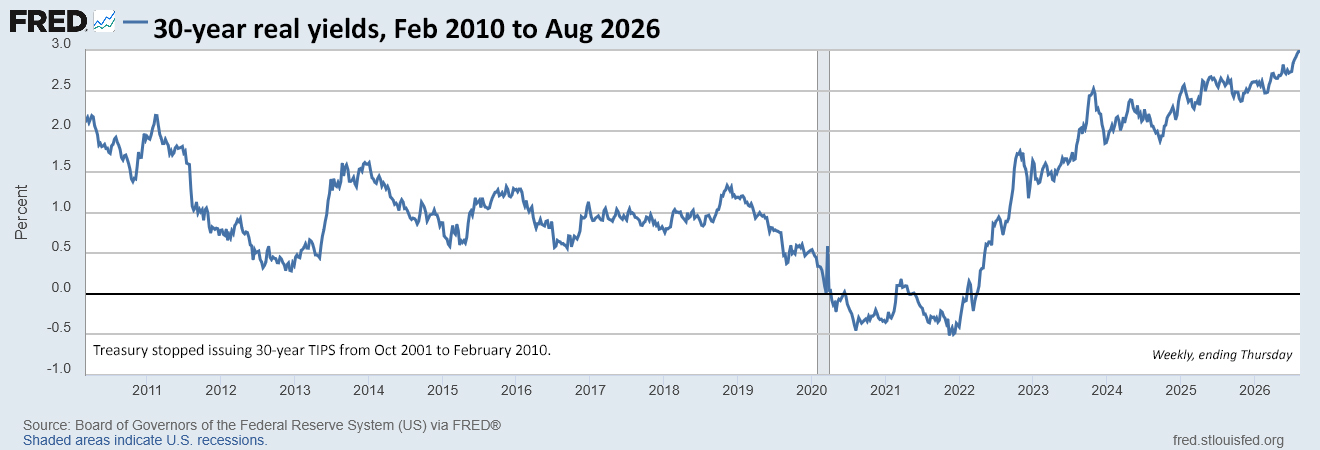
For years, TIPS investors have dreamed about getting a 3% real yield long term. Now that day has arrived. Here is the trend in the 30-year real yield over the last 16 years:
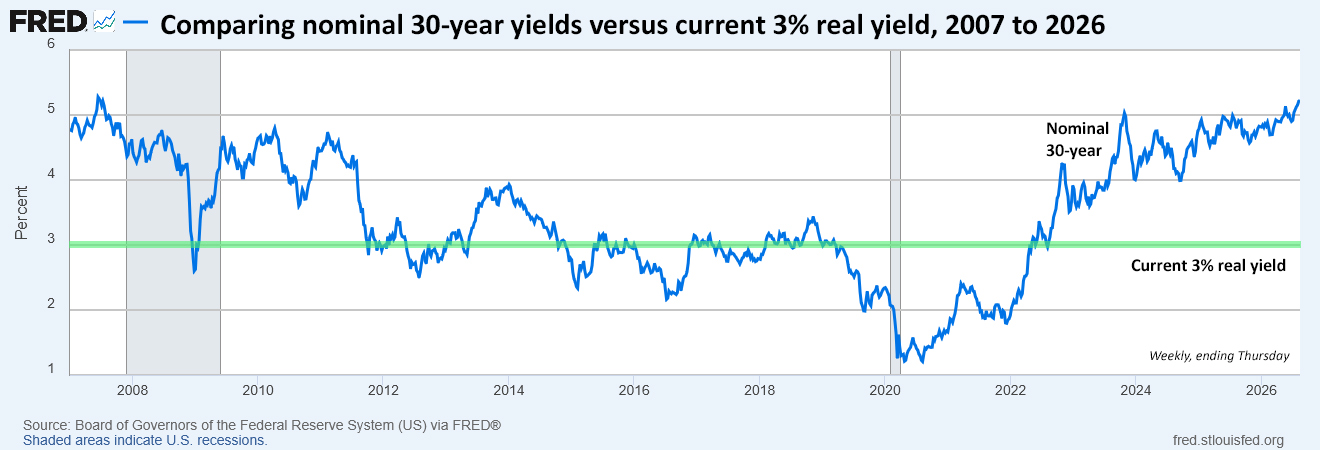
Here’s another chart, comparing historic 30-year nominal Treasury bond yields with the current 3% real yield of a 30-year TIPS. Note how frequently the nominal yield dipped below the current real yield of 3%. Again, this is significant. (Although I don’t foresee nominal 30-year yields dipping below 3% anytime soon.)
All of this reinforces the idea that Thursday’s 30-year reopening TIPS auction has great appeal. But …
The negatives
A 30-year bond of any type is going to be highly volatile. For example, CUSIP 912810US5 was issued in February with a coupon rate of 2.375%. Today, six months, later, it is trading with a price of about 87.41, meaning it has lost more than 12% of its value in six months.
Another example: A disastrous 30-year TIPS issued in February 2021 got a real yield of -0.04% and its coupon rate was set at 0.125%. Today, that TIPS along with its accrued inflation is trading with a price of about 49.65, meaning it has lost half its value if sold today.
If you are a TIPS trader, that volatility can work for you, or against you. Jumping into a 30-year bond is a gamble. If it ends up that 3% is the real-yield peak for this cycle, a trader could end up getting a nice profit. But we can’t predict the future. The current trend in yields is higher.
TIPS are best purchased, I believe, with a strong intention to hold to maturity. Also, for such a long maturity, a tax-deferred account is the best location for the investment, for most investors.
Pricing
As of Friday’s close, CUSIP 912810US5 was trading with a price of 87.41 and it will carry an inflation index of 1.03055 on the settlement date of August 31. With that information, we can estimate the cost of a $10,000 par value purchase:
- Par value: $10,000.
- Principal purchased on settlement date: $10,000 x 1.03055 = $10,305.50.
- Cost of investment: $10,305.50 x 0.8741 = $9,008.04.
- Plus accrued interest of about $10.64.
In summary, if Friday’s market conditions continue, an investor would pay $9,008.04 for $10,305.50 of principal on the settlement date. From then on, the investor would earn accruals matching future inflation, plus an annual coupon rate of 2.375% on adjusted principal for 29 years, 6 months. The accrued interest would be returned at the February 2027 coupon payment.
This is an estimate. Market conditions will change by Thursday.
Inflation breakeven rate
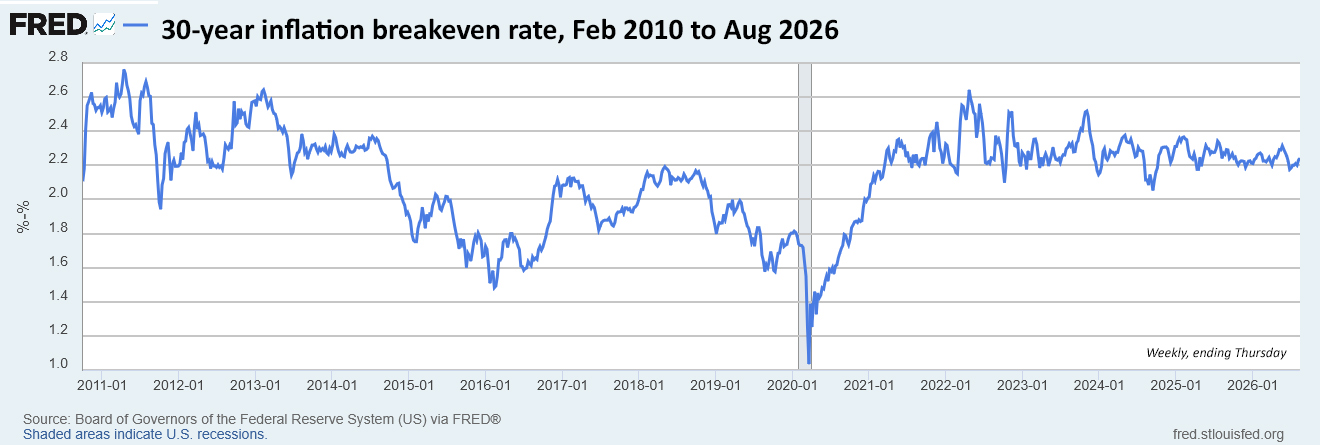
With the 30-year nominal Treasury closing Friday at 5.26%, this TIPS currently has an inflation breakeven rate of 2.24%, somewhat high historically but perfectly reasonable considering long-term inflationary trends. Over the last 30 years, ending in July, inflation has averaged 2.5%.
Here is the trend in the 30-year inflation breakeven rate over the last 16 years, showing the remarkably stable trend recently hovering around 2.2%:
Thoughts
CUSIP 912810US5 is a fascinating investment, and attractive by historical standards. But will we continue to see rising longer-term nominal and real yields? It’s possible — and that’s the risk for such a potentially volatile investment.
On the other hand, for a buy-and-hold investor looking to build a TIPS ladder out to 2056, getting close to a 3% real yield is extremely attractive.
CUSIP 912810US5 trades on the secondary market and can be purchased at any time in a brokerage account. There is no need to focus on Thursday’s auction if you see a real yield you like on the secondary market. I suspect, however, that 30-year TIPS are fairly lightly traded in small lots. Bid-ask spreads could be a problem.
The advantage of buying at auction, especially through TreasuryDirect, is that even small-lot purchases will get the auction’s high yield. The advantage of the secondary market is that you can see exactly the price and real yield you will be receiving.
I won’t be a buyer at this auction, since I will be “long gone” at maturity in 2056.
This TIPS auction closes Thursday at 1 p.m. ET. Non-competitive bids at TreasuryDirect must be placed by noon Thursday. If you are putting an order in through a brokerage, make sure to place your order Wednesday or very early Thursday, because brokers cut off auction orders before the noon deadline.
Note: On Thursday I will be driving into Tennessee to attend a memorial service. I expect I will be late posting the auction results, possibly very late. You can find the auction result announcement on this page after the 1 p.m. close.
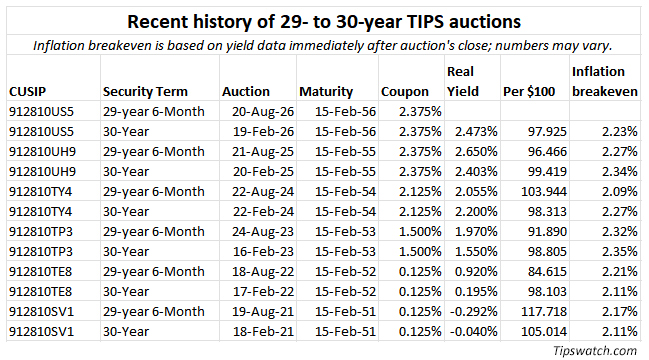
In the meantime, here is a history of auction results for this term over the last 5 years:
• Now is an ideal time to build a TIPS ladder
• Confused by TIPS? Read my Q&A on TIPS
• TIPS in depth: Understand the language
• TIPS on the secondary market: Things to consider
• TIPS investor: Don’t over-think the threat of deflation
• Upcoming schedule of TIPS auctions
—————————

Donate? This site is free and I hope to keep it that way. Some readers have suggested having a way to contribute. I welcome donations, any amount. And FYI, ads on this site pay for about one visit to Costco.
—————————
Follow Tipswatch on X for updates on daily Treasury auctions and real yield trends (when I am not traveling).
Feel free to post comments or questions below. If it is your first-ever comment, it will have to wait for moderation. After that, your comments will automatically appear. Please stay on topic and avoid political tirades. NOTE: Comment threads can only be three responses deep. If you see that you cannot respond, create a new comment and reference the topic.
David Enna is a financial journalist, not a financial adviser. He is not selling or profiting from any investment discussed. I Bonds and TIPS are not “get rich” investments; they are best used for capital preservation and inflation protection. They can be purchased through the Treasury or other providers without fees, commissions or carrying charges. Please do your own research before investing.


I read the WSJ article today “Bessent Moves on Treasurys”, and I have a question about the closing paragraph: “The one consolation for investors: They can earn 2.5% above inflation on Treasurys while they wait, in an asset that might even do better if AI turns out to be a bubble and pops—or really badly if Bessent loses control.” I assume the author was referring to TIPS, so the only way buying a TIPS would go “really badly” is if you sell it before maturity, right? Or am I misunderstanding something here?
Yes, I agree.
NOTE TO READERS: The U.S. Treasury announced Wednesday (one day before the auction) that it is doubling its buy-backs of longer-term Treasurys. This continues the Treasury’s moves to focus on shorter-term T-bills, which have a much lower yield controlled by the Federal Reserve. The effect of this announcement was to push the 30-year real yield below 3% in trading Wednesday.
How high did the 30 year t-bond yield get back when Paul Volker was fighting 1970’s stagflation? 15% or so? Long term bonds are extremely risky for the small investor.
Would have been a good buy in 1981!
Yes, long term bonds can be risky for any investor. However, there is a scenario where it may work. For example, I bought 20 year Treasury Bonds at auction, in our taxable account, last month on July 22nd at 5.16% YTM with a coupon at 5%. First, I got these bonds at a discount. Second, I bought them for income and it has more than solved our income needs.. I will reinvest the interest to make more than 5.16%. I will be 70 this year and my wife is 5 years younger. If I am not there she will be 85 to collect the principal. We most likely will have the optionality to sell these bonds with some capital gains ifin the next 20 years interest rates go down. We live in Massachusetts with 6.5% state tax and may move to CA with state tax over 10%.
If Volcker were in charge of the Fed, long-term bonds wouldn’t be very risky at any reasonable yield. Unfortunately, he is dead and if he left heirs they don’t seem interested in the family business.
Minor point (made more significant by recent events): there is no difference in yield between participating in the auction through TD and participating via a broker; both will make a “noncompetitive bid” on your behalf and you will receive the full number of bonds you bid for at the same rate everyone else gets. The only difference is that brokers usually offer them in the standard $1000 increment, but you can buy them through TD in $100 increments. That’s not important to me, certainly not worth the trouble, but some people might care. I don’t know if any brokers charge a fee or commission to participate; Fidelity does not.
As for this auction, I am going to participate because I have some 29-year TIPS in a taxable account and it would be a shame to let that capital loss go to waste when I can buy a nearly identical (but not legally so) issue instead. The only thing that makes me sad is that it’s a reopening so it will get the same relatively poor coupon that was set during the brief drop in yields in February. I do wish Treasury would either bring back the 20-year TIPS or do 2 new 30-year issues each year. For whatever reason we seem to keep getting stuck with low coupons in February. Of course, some people are indifferent or even prefer low-coupon bonds, but at 3% the coupon would be enough to play a meaningful role in a current income portfolio. That’s something we don’t often get with TIPS, and would offer a meaningful advantage over gold.
That statement about the 3% jumped out at me, too. I thought I might have missed something.
In terms of changing the CPI calculation, I would be interested in knowing if that would impact all longer term treasury investments (nominal bonds, TIPS, and I bonds) or just some, and how much the impact on each would differ and why.
So I jumped into TIPS recently with the 10-year as a reallocation of something like 20% of my BND holding. Given that the “total bond” fund doesn’t have any inflation-protected securities, I believe my decision added diversification, and hedged against elevated inflation, at a trivial cost, with no tax consequence in an IRA.
However, the 30 year duration is a tough one; yes, it does beat the 10 year by ~0.6%, but I think that actually understates the gap in risks related to the additional 20 years.
It’s almost existential. Ask anyone, “Where were you 30 years ago?” – and they’ll respond, “Wow, I can’t even remember.” One could consider the additional risks, and opportunities, that will come about over the next 30 years, but it’s impossible to know in advance.
If you ever logged into the Social Security web site, IRS.GOV, or EFTPS then you would likely already have an ID.ME account. It’s not a big deal.
Indeed. I’m actually looking forward to the change because, currently, TD (Treasury Direct) has a less convenient login system than virtually every other website I use. TD forces you to check your email for a one-time code that needs to be copy-pasted every time you want to log in, which no other website does.
I use login.gov for Social Security. I started setting up an ID.me for the IRS but I stopped when I realized what the process involved.
Here is a 35-minute WSJ podcast from today that discusses TIPS and I bonds. One of the more interesting things discussed is the possible impact of changes in how CPI is calculated. Readers of this blog may be interested: https://youtu.be/p8wLO3oa3-Q?is=Qo85UlWBaTt-Ozs-
Interesting bit about the historical precedent in changing CPI methodology, though the precedent was to create a commission. That takes time, more time than she implies – task force > commission > BLS changing methodology.
She goes on to say that she built a ladder of 1-6 year TIPS because you could get 3% real yields in that range of maturities. You cannot.
Kind of shot her credibility.
Warsh has been talking about using a different measure than core PCE for judging and setting interest rates, not directly talking about changing CPI-U, which the Fed doesn’t control. So really, no direct change. However, if the Fed eases, it could mean higher inflation and that does effect TIPS pricing.
The Bureau of Labor Statistics could be pushed by President Trump to alter CPI-U calculations, definitely. Minor adjustments go on all the time. Major changes? There’s the plot if you want to go the conspiracy route.
Wow, this is a tough choice for me.
I’m 46, live in California and have been buying I Bonds for my wife and myself steadily for the past few years, the goal being to slowly but surely replace 50% of the bond portion of our retirement portfolio with I Bonds.
I currently have $30k of dry powder marked for future I Bond purchases, but this TIPS is really attractive. Of course, the tough part is I’d need to leave it alone until I’m 76 to guarantee the benefits. Yikes.
There’s a chance I can hold this TIPS in my traditional 401k (currently moving my 401k from Ascensus to Fidelity) but I’d likely need to hold it in taxable account in order to buy at auction.
Has anyone here dealt with a TIPS vs. I Bonds issue like this before? I’d love to hear any thoughts the community has!
I look at real yield, and right now TIPS are much higher than I Bonds. I will keep my I Bonds, but don’t plan to buy more as I like the TIPS ladder for the higher real yield. Also, living in CA, I try to avoid holding any treasuries in a traditional IRA/401K, and instead use a taxable brokerage or Roth account to gain the benefit of no state taxes on the interest.
I prefer to hold my TIPS in a Roth IRA account, which does require a brokerage account because TD does not take on the role of custodian. A major advantage of the Roth is that it avoids tax on (and laborious tracking of) annual inflation accretions, known in tax speak as Original Issue Discount (OID, aka phantom taxable income).
Under federal law (31 U.S. Code, Section 3124) all interest on U.S. federal obligations is exempt from state and local income taxes, so there is no need to use either a traditional or Roth IRA account to avoid that tax.
Great points, Scott & Lou. Thank you!
I thought about using my Roth IRA for this TIPS purchase, but I don’t plan to retire for another 15 years or so and am weary about giving up the tax-free growth space, seems like a heavy opportunity cost?
I think it’s either $10k TIPS in my TBA or pass on the TIPS and continue buying I-Bonds for the flexibility instead.
Such a tough call…but a good problem to have.
Too old to invest in this term. Did you notice Treasury Direct will be using id.me? May involve change for some as it starts in mid September. I use it for other federal access.
Yes, I noticed the id.me email. It seems to have created a storm of controversy. I also have an account (plus login.gov, too). I have found the set-up to be miserably clunky and even logging in can be a pain. But the bigger issue is that it is a private corporation collecting personal data. A lot of my readers, and others, are furious. I will try to post thoughts on Tuesday morning after I can do some research.
Look forward to your report.
Out of curiosity, I went to id.me, which I’ve never used, and until now had never heard of, just to look at the company’s own site.
And at the top of the page is a pull-down menu titled “Save Money.”
I wondered what that was about, and it turns out that having an ID.me account also confers shopper discounts and deals at a bunch of other corporations. (“exclusive discounts from hundreds of stores without verifying again. Let our partners show their appreciation.”)
What on earth other kind of so-called “security” company–let alone one already being paid enormous amounts of tax dollars to be made the sole, though privatized, citizen access point to certain functions of the people’s government–does that?
https://id.me/member-discounts-overview
I have not received any communication from TreasuryDirect about id.me. Is this recent?
Some people have received the e-mail, some haven’t (yet?). My wife and I are among those who haven’t.
But here’s an announcement on the TreasuryDirect website:
https://www.treasurydirect.gov/savings-bonds/idme-one-month/
Unhelpfully, TreasuryDirect didn’t put that under its “News” pages. I found the link after someone posted it in this Bogleheads thread about the situation:
https://www.bogleheads.org/forum/viewtopic.php?f=1&t=474308
https://www.treasurydirect.gov/savings-bonds/idme-one-month/
Trying again to post a working link to what I already tried to post in my comment below.
Thank you for the link. It appears that after October 28, 2026 you MUST use id.me to login to TreasuryDirect.
It also appears that beginning September 13, 2026 you MAY use id.me.
I guess if you use TreasuryDirect and don’t have id.me, you will need to get verified by id.me.
https://treasurydirect.gov/savings-bonds/help-center/faqs/idme-faq/
Similar link and info here also