
David Enna, Tipswatch.com
On October 21, 2021, the Treasury offered $19 billion in a new 5-year Treasury Inflation-Protected Security, CUSIP 91282CDC2, generating the lowest real yield at auction in the 29-year history of this investment, -1.685%. These were very dark days for investors in TIPS.
In my recap of this auction, I wrote:
The auction result doesn’t mean that investors were accepting a negative nominal return, but they were willing to pay a 9% premium to par value to collect a 0.125% coupon rate plus five years of inflation accruals. To put this another way, official U.S. inflation will have to increase about 9% before investors reach a breakeven point on this investment.
That is actually scary. But you know what? CUSIP 91282CDC2 ended up being a decent investment, at least versus the nominal 5-year Treasury available in October 2021. Here is the final tally for this 5-year TIPS:

Note the nominal return in the final column: 2.375%. In October 2021, a 5-year Treasury note was yielding 1.20%. Over the ensuing 5 years, inflation ended up running at an annual rate of 4.1% (rounded) versus the auction’s inflation breakeven rate of 2.89%. The result is that the TIPS outperformed the Treasury note by a wide margin, as has been the case for all TIPS maturing in recent years.
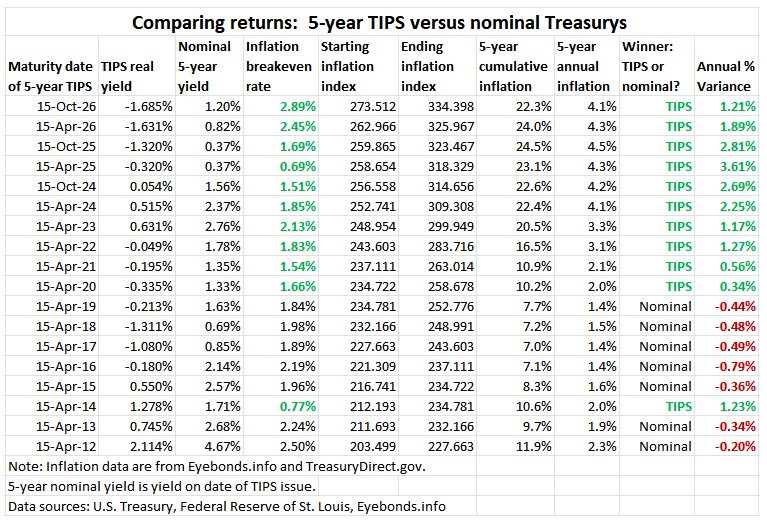
This reinforces a simple point: A TIPS will out-perform a nominal Treasury of the same term when inflation runs higher than expected. Inflation has been running much higher (4.1%) than expected over the last five years. Over the last decade, inflation-breakeven rates for TIPS have rarely exceeded 2.5%, and often were much lower.
This auction was unique because the real yield was deeply negative and the inflation breakeven rate was unusually high (2.89%), and the TIPS still outperformed.
I Bonds were the winner
In my preview of the 2021 auction, I noted that I Bonds (with a 0.0% fixed rate at the time) were a much more attractive investment. The math is simple: The I Bond would match official U.S. inflation while the TIPS would trail inflation by 1.685%. I wrote:
For a small-scale investor, in October 2021, an I Bond makes a heck of a lot more sense than a comparable TIPS.
The October 2021 I Bond — with a 0.0% fixed rate — has had about a 4.3% compounded rate of annual return over five years, much better than 2.375% for the TIPS and 1.20% for the Treasury note. (Source: Eyebonds.info)
What about bond funds?
- Vanguard’s Total Bond Fund (BND) has had a total annual return of -0.29% over the last five years. Ouch.
- The iShares TIPS ETF (TIP), which holds the full range of maturities, has had a total annual return of -0.05% over the last five years. Also ouch.
- Vanguard’s Short-Term TIPS ETF (VTIP), which holds TIPS with maturities less than five years, looks better with a total 5-year annual return of 2.93%, better than the October 2021 TIPS (2.375%) but worse than the I Bond at 4.3%.
Bond funds had been doing a bit better going into 2026, but the sharp rise in longer-term yields has hit full-maturity-spectrum funds hard.
Thoughts
Two very important takeaways: 1) An I Bond — even with a fixed rate of 0.0% — will be an attractive investment any time the Federal Reserve decides to repress interest rates through quantitative easing. And 2) Even a TIPS with a negative real yield can be “relatively” attractive if the inflation breakeven rate is lower than seems likely.
Notes and qualifications
My TIPS vs. Nominals chart is an estimate of performance.
Keep in mind that interest on a nominal Treasury and the TIPS coupon rate is paid out as current-year income and not reinvested. So in the case of a nominal Treasury, the interest earned could be reinvested elsewhere, which would potentially boost the gain. For certain, we don’t know what the investor could have earned precisely on an investment after re-investments.
In the case of a TIPS, the inflation adjustment compounds over time, and that will give TIPS a slight boost in return that isn’t reflected in the “average inflation” numbers presented in the chart.
• Confused by TIPS? Read my Q&A on TIPS
• TIPS in depth: Understand the language
• TIPS on the secondary market: Things to consider
• TIPS investor: Don’t over-think the threat of deflation
• Upcoming schedule of TIPS auctions
—————————

Donate? This site is free and I hope to keep it that way. Some readers have suggested having a way to contribute. I welcome donations, any amount. And FYI, ads on this site pay for about one visit to Costco.
—————————
Follow Tipswatch on X for updates on daily Treasury auctions and real yield trends (when I am not traveling).
Feel free to post comments or questions below. If it is your first-ever comment, it will have to wait for moderation. After that, your comments will automatically appear. Please stay on topic and avoid political tirades. NOTE: Comment threads can only be three responses deep. If you see that you cannot respond, create a new comment and reference the topic.
David Enna is a financial journalist, not a financial adviser. He is not selling or profiting from any investment discussed. I Bonds and TIPS are not “get rich” investments; they are best used for capital preservation and inflation protection. They can be purchased through the Treasury or other providers without fees, commissions or carrying charges. Please do your own research before investing.


Back when Peter Lynch was a media star (prior to the introduction of both TIPs and I-bonds) he wrote a couple of books in which he made the strong case for buying dividend paying stocks in lieu of bonds – for essentially the same purposes. Looking on the Vanguard site the annual return on VHYAX over the last 5 years is 11.61% . The chance of actually making money versus locking in a real loss seemed pretty compelling back in 2021. The current real rates and soon to be announced I-bond fixed rate are much more compelling now. A blend of both with Value and High Dividend Yield funds offer pretty robust inflation protection.
I heard Bob Pisani, former financial correspondent with CNBC say that he just bought 5 year TIPS, either for the first time or the first time in years.
Based on auction purchase price and taxes paid on phantom income (taxable account); did you actually lose money on this investment?
Because of the 0.125% coupon rate, this Oct 2021 TIPS would have been cash-flow negative the entire five years if held in a taxable account. Those were high years of inflation and 0.125% probably would not have covered the tax on inflation accruals. But at maturity the inflation-adjusted principal (not taxable at maturity) should have covered those outflows. (I am no tax expert.)
Thanks for evaluating the relative performance of TIPS and I Bonds over this period of time. But wouldn’t the best decision, both in hindsight and at the time, have been to hold off on multi-year investments in any of these options and instead bided your time until fixed income yield became attractive again? During that period of time, fixed yield was in scarce supply. It wasn’t a time to lock in. What were you recommending investors do at the time?
Recall that in Oct 2021 the 4-week T-bill was yielding 0.02% and the 13-week, 0.05%. Your money market account was essentially at zero. So there were no “safe” investment choices with any return. The I Bond was obviously the choice during the deepest, darkest days because it would at least track inflation every year without losing a cent. During that era I often called I Bonds the “no-brainer” investment. TIPS were horribly unattractive though a lot of this era, until 2018 when the Fed began raising interest rates and ceased bond-buying. (I bought some TIPS in 2018.) Then came COVID and even more severe financial repression, until the break in 2023, when TIPS again became highly attractive in the fall.
Exactly. It looked at the time like there might never be an opportunity to get a decent return on fixed income. It’s easy to look back in hindsight and say we should have waited.
Interesting to note that the market got it right in this case. Despite the seeming low yield the TIPS still outperformed nominals.
How does one know (at the time) what inflation will do over the next five years? Had it spiked again, the TIPS would have outperformed both nominal and biding your time (MM?).
Yes, holding off was wise. Locking in ultra low interest rates is almost never advisable.
My (imperfect) spreadsheet shows .5% yields on HYSA and a little over 1% on a reasonably safe alternative at the end of 2021. By the end of 2022, rates were 3.5%+ on the HYSAs and likely around that on MMFs.