
A tip of my hat to the U.S. Treasury. Exactly the correct decision.
By David Enna, Tipswatch.com
The U.S. Treasury followed a decade-long tradition and set the fixed rate of the Series I Savings Bond at 1.40% for purchases from November 2026 through April 2027. That creates a highly attractive annualized composite rate of 5.51%.
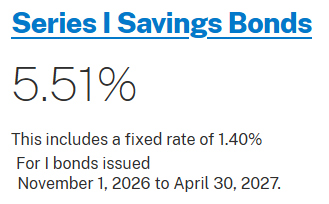
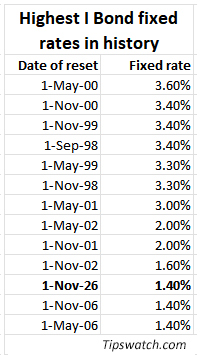
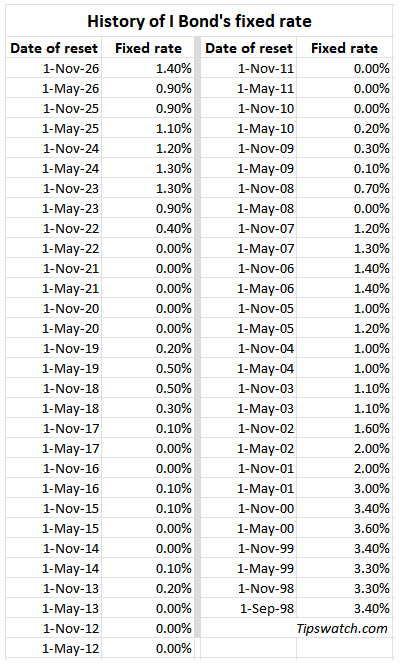
The fixed rate of 1.40% — which is equivalent to the I Bond’s real yield above inflation — is the highest for the investment since November 2006. The composite rate, up from 4.26%, will make this I Bond highly competitive with other very safe investments, such as the 1-year T-bill currently yielding 4.42.%
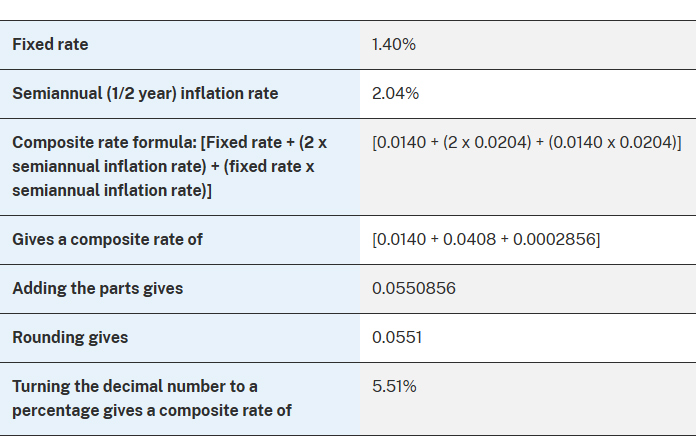
An I Bond pays interest based on a semi-annual inflation rate (in this case 2.04% from April to September 2026) and a fixed rate (now 1.40%). Here is how the Treasury combines the two rates to get a composite rate of 5.51%:
The variable rate
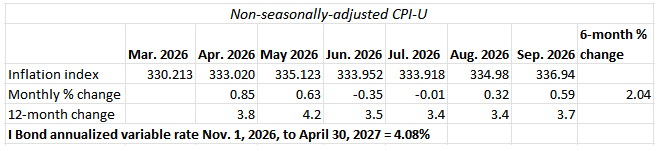
The inflation-adjusted rate (often called the I Bond’s variable rate) is now 4.08%. That rate will apply to all I Bonds ever issued, with the starting date depending on the original month of purchase. The variable rate of 4.08% means that even I Bonds from past years with fixed rates of 0.0% will earn 4.08% for six months, a yield a bit above high-quality money market funds.
Here are the inflation numbers used to determine the variable rate:
The fixed rate
Here is the formula I have been using to forecast the Treasury’s fixed-rate decision: Apply a ratio of 0.65 to the average real yield of the 5-year TIPS over the last six months. This formula has worked, without fail, for 16 fixed-rate resets since November 2017. it is reassuring to see past practices continued.
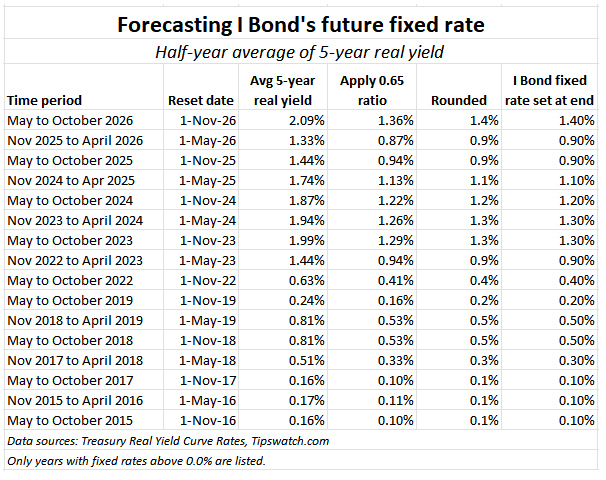
The 0.65 ratio formula was discovered by Boglehead geniuses — and it worked — but a debate remained about when the six-month rate-setting period begins. In my forecasts, I have been using yields starting on May 1 and November 1, but some analysts argued the period should start and end 5 days earlier. Today’s result gave us a clear answer: the Treasury started the count on May 1. (Going 5 days early would have resulted in a fixed rate of 1.30%.) More on that here.
The fixed rate is crucial for I Bond investors because it creates the real yield over inflation. A fixed rate of 1.40% means an I Bond will out-perform future inflation by 1.40%. This is a solid fixed rate and means your investment can continue to surpass official U.S. inflation for as long as you hold the I Bond, up to 30 years.
The composite rate
The fixed rate of 1.40% and the inflation-adjusted variable rate combine to create six-month composite rate of 5.51%, which is very attractive. Keep in mind, however, that an I Bond has to be held for 1 year and then any redemption before 5 years will lose the last three months of interest. This new I Bond will keep the fixed rate of 1.40% forever, but get a new composite rate beginning six months after purchase.
In my opinion, I Bond investors should be looking to hold for 5 years and then cash out when they need the money.
The Treasury held its purchase cap at $10,000 per person per year. If you have already bought your 2026 allocation (as I have) you can get the 1.40% fixed rate and 5.51% composite rate for any purchase from January to April 2027.
EE Bonds
The Treasury set the fixed rate for Series EE Bonds at 2.90% for purchases from November 2026 to April 2027. That is up from the past rate of 2.40%. After 20 years, EE Bonds automatically double the original purchase amount, which creates an effective return of 3.53% if held for 20 years. Treasury says:
For EE bonds you buy now, we guarantee that the bond will double in value in 20 years, even if we have to add money at 20 years to make that happen.
A fixed rate of 2.90% is an improvement but isn’t highly attractive, and 3.53% for a 20-year investment doesn’t compare well with the 20-year Treasury bond yielding 5.35%.
I Bonds are attractive
Yes, you can earn a real yield of about 2.31% on a 5-year Treasury Inflation-Protected Security, a bonus of about 91 basis points. That’s hard to ignore and the TIPS is a highly attractive alternative. If you use the 0.65 ratio as a “fair value” yield for the I Bond, you get a fixed rate of 1.50%. So the TIPS has an advantage, even at the discounted rate.
I Bonds, however, have other advantages: Tax-deferred interest, rock-solid deflation protection, a flexible maturity date and no market fluctuations. I Bonds are well suited for use as a secondary emergency fund, constantly outpacing inflation, to be held for 5 years and then redeemed when you need the cash.
Haven’t bought in 2026? You are a genius and now you can purchase this attractive I Bond in November or December and then potentially again in 2027. When you are placing an order at TreasuryDirect, remember to buy near the end of the month to earn a full month of interest. In November, the 25th looks like a good target date.
You could also consider redeeming any of your remaining 0.0% or 0.1% I Bonds to raise cash to purchase this higher rate. When you redeem, you should do that early in a month, because you will earn no interest for month you redeem. Also be aware that you will owe federal taxes on the interest earned.
Also, remember that even 0.0% I Bonds will be earning 4.08% for six months, a rate that I bet beats the current yield on your money-market account.
Already bought in 2026? Are you like me? I bought my full allocation in April, before the May reset. There are ways to get around the $10,000 limit, using purchases through the gift-box loophole, trusts, or business-owner strategies. The gift box only works for investors with a trusted partner.
I am souring on the gift box, so I will hold off until 2027 to buy into this new I Bond. In this case, it looks wise to hold off on purchases until mid-April, to get an idea of the upcoming variable and fixed rates heading toward us on May 1.
Final thought
I appreciate that the U.S. Treasury followed tradition and allowed I Bond investors to get an attractive real yield and composite rate. Well done.
• Confused by I Bonds? Read my Q&A on I Bonds
• Wise advice: ‘Don’t die with I Bonds’
• Let’s ‘try’ to clarify how an I Bond’s interest is calculated
• Inflation and I Bonds: Track the variable rate changes
• I Bonds: Here’s a simple way to track current value
• I Bond Manifesto: How this investment can work as an emergency fund
—————————

Donate? This site is free and I hope to keep it that way. Some readers have suggested having a way to contribute. I welcome donations, any amount. And FYI, ads on this site pay for about one visit to Costco.
—————————
Follow Tipswatch on X for updates on daily Treasury auctions and real yield trends (when I am not traveling).
Feel free to post comments or questions below. If it is your first-ever comment, it will have to wait for moderation. After that, your comments will automatically appear. Please stay on topic and avoid political tirades. NOTE: Comment threads can only be three responses deep. If you see that you cannot respond, create a new comment and reference the topic.
David Enna is a financial journalist, not a financial adviser. He is not selling or profiting from any investment discussed. I Bonds and TIPS are not “get rich” investments; they are best used for capital preservation and inflation protection. They can be purchased through the Treasury or other providers without fees, commissions or carrying charges. Please do your own research before investing.


Pingback: Treasury's I bonds issued through April 2027 pay a 5.51% composite rate, built from a 1.40% fixed rate that never changes and a 2.04% inflation rate that resets every six months - The Financial Wire
Pingback: I Bond Rate November 2026: Cash Out After One Year and 5.51% Shrinks to About 4.2% - Savings Roll
Pingback: I Bond Rates November 2026: 5.51%, 1.40% Fixed – Quiet Wealth
Pingback: Treasury guarantees that Series EE savings bonds bought from Nov. 1, 2026 through April 30, 2027 will double in value for buyers who hold them 20 years – Main Street Dollars
Pingback: I Bonds vs TIPS: Which Inflation Hedge Pays More Now?
I ran across a tongue-in-cheek post on the Bogleheads forum, suggesting the possibility that Treasury used to just “wing it” in setting the I Bond fixed rate, i.e., had no particular formula or plan at all, but then began to watch Bogleheads and Tipswatch predictions for advice on what to do at the next re-set.
Is it possible that this site has more influence than ever previously imagined, and that the “formula” which has worked so well for the past decade is actually “cause” rather than “effect”? 🙂
The answer, I am pretty sure, is “no.” That doesn’t mean Treasury officials don’t read my site; I think some do.
On the treasury direct website, is there a way to directly see (logged into my account) what the fixed rate is for bonds previously purchased, or does it always require cross checking with an outside resource?
I think TreasuryDirect simply shows the current composite rate and doesn’t separate out the fixed rate.
Its basic math of course, but it would be nice if they showed it up front
What are your thoughts regarding locking in multi year guaranteed annuities (MYGA’s) vs. iBonds? It might seem like apples to oranges at first blush but I think they have the tax timing benefit in common. I know of course with a MYGA, there’s no portion of that yield that’s guaranteed for 30 years like the 1.4% on the current, but it strikes me as a tough decision. I mean of course there’s additional risk (for the MYGA) but very little if you stick to A or A+ issuers for the MYGAs. (There is a state fund that supposedly makes you whole if they default, though I can’t speak to its record. General consensus is that it’s not quite FDIC). But it intrigues me that they share this “tax timing optionality” albeit with some difference, with iBonds. You can take the interest every year (some even let you take 10% of total each year), you can also 1035 exchange into another to delay the tax or even exchange into a lifetime DIA or SPIA annuity
I don’t know enough about MYGAs to have an opinion.
> General consensus is that it’s not quite FDIC
That’s the real risk. Looking at past failures…
* Baldwin-United Corporation: 4 years for holders to be made whole.
* Executive Life Insurance: 50 – 70% recovery for most.
* Guarantee Security Life Insurance: 14 years, no full recovery
* London Pacific Life & Annuity: 2 years, recovery capped
* PHL Variable: Ongoing 2+ years later. Recovery will be capped
You should expect in the event of failure of the annuity that any recovery will be capped (to at most $250,000), and haircuts are likely.
Low-cost deferred annuities are one of the few remaining additional “tax deferred” spaces available, yet folks are bigger on I-Bonds and TIPS Ladders for “self-funded annuities” as they should be lower risk.
If the US Government/Treasury isn’t paying up, you likely have other things you’re worrying about other than where you money is.
If I were to buy an annuity, I would only go with the really long established companies such as New York Life.
I also bought all of my I bonds for 2026 back in April, but I don’t feel too bad about it. At the time, I had the money available, and knowing I could get 4.03% for six months and 4.26% for another six months after that, I wasn’t sure there was anywhere else I’d rather keep the money for 6-7 months while waiting for the November reset. I also figured that if TIPS yields increased enough to result in a higher fixed rate for I bonds in November, I could just buy more TIPS — And I have. I purchased in the latest 5-year TIPS auction, and earlier in October I managed to buy CUSIP 91282CRE3 (maturing 7/15/2036) at a little over 2.9% real yield.
It is a little tempting to think about trying the gift box strategy to get some of the 1.4% fixed rate before the end of the year, but I have never used the gift box and I am reluctant to try it. I’ll probably be content to wait until 2027 for another I bond purchase.
The gift box is not risky. It’s easy. Here’s the definitive resource on how it works:
https://thefinancebuff.com/buy-i-bonds-as-gift.html
It seems the gift box is a way to get the current fixed rate and “gift” them in a year when the fixed (not necessarily composite) rate is lower if you have time on your side.
In past years, this was the practice. But then the loophole blew wide open when investors realized they could buy unlimited sets of gift-box pairs and then deliver them after waiting five days, with no penalty or limit on purchases in future years. This still seems to be true.
Pingback: I bonds bought from November 1 carry Treasury's best fixed rate since 2006, 1.40% - The Financial Wire
Random question that’s been on my mind as we are getting closer to the Fall of 2028. That’s when the first purchased i bonds will mature. How much roughly are those i bonds worth right now if you bought a $10k one back then?
Looks like $52-53k today, and probably close to $60k at maturity: https://eyebonds.info/ibonds/10000/ib_1998_09.html
Which when you look at it, is fantastic.
$10,000 in, in September 1998.
$56,528 if you cashed them November 1st.
Compared to $20,595.35 looking at CPI Inflation.
On $45,428 interest, after 22% fed taxes, $35,434 left.
So $10,000 -> $34,838 net of inflation and 22% taxes.
Utterly fantastic for “cash-equivalent.”
Comparing to S and P 500, a 10k investment then would be worth around 122k today with dividends reinvested.
But yes, there’s certainly a place for cash equivalents and the first 15 years of that S and P 500 investment would have been rough.
As others point out, there are several ways to determine this, including logging in to the Treasury direct web site and checking the current valuation.
And there’s the eyebonds site.
Moving forward, if you want something very easy, you can also use my free inventory tracker:
https://ibonds.pages.dev/
No login required, ads, or cloud storage of data. Your bond list is stored in browser storage.
This is great! Thank you for sharing.
Lovely to see your predictions hold. I have followed for a few years now and it has definitely helped me. Recently retired and IBonds are part of my spending floor in the near future after other cash runs out.
I am still debating on what to do with my first IBonds from Jan 2021 and Jan 2022 that are 0% fixed rate with the second one coming out of the 5 year penalty box in a few months. I have a severance dump currently sitting in VMFXX (technically other options are better but it is easy) that I am slowly draining first as, despite it being ‘chunky’, IBonds tend to beat it with the coming rate leapfrogging from the drag position the past few months.
An opinion would be nice if you have a second. Do I drain my VMFXX faster (over 3ish years instead of 6ish) by buying IBonds from there in the beginning of next year? Or do I cash in my oldest bond tranche from 0% to the new 1.4%? At my tax bracket, which is no tax at all basically, it is likely a wash, and VMFXX has historically lost to inflation with the past few years being an anomaly. Basically 6 years ‘cash’ and 6 years bonds vs 3 years ‘cash’ and 9 years bonds once it all settles out, leaning towards the second option.
Thanks! Look forward to seeing what the next batch brings. Happy early spooky day.
I am not a financial adviser, so I can just give personal thoughts. VMFXX is currently yielding 3.88%, but that could rise if the Fed raises interest rates in December. The 0% fixed rate I Bonds will yield 4.08% for six months beginning in January 2027 and that rate will run through July, when you will have $13,060 in value. If you redeem in April to buy the 1.40% fixed rate, the value of each $10,000 will be $12,928. So you will owe taxes on $2,928 for each I Bond (could this push you into a higher tax bracket?) You can only reinvest $10,000 in the 1.40% I Bond, per person. Is that VMFXX money serving as a “security blanket” for you in this transition? If so, it is a lot easier to access than new I Bonds with a 1-year clock for redemption and 5-year penalty period. And if that is true, roll over the 0.0% I Bonds.
Thanks for the reply! No worries about not being an advisor. I am basically at the point of a coin flip so just wanted to see if you had an idea on which way to lean.
The VMFXX average rate over the past six months is about halfway between where my oldest IBonds were last week compared to where they will be a week from now which is why I called the latter chunkier. Both are a bit above inflation right now but historically VMFXX had done poorly in that area so I don’t mind getting out of it a little quicker. The funds there are less of a security blanket and more just where I dumped my last few paychecks and severance since I already grabbed IBonds for the year and TIPS give me a headache even though I see they are doing well right now. The combo of IBonds and VMFXX is just a cash floor buffer I want (mostly) to exhaust by the time I am 59.5 while I work up my Roth ladder and won’t be touching the bonds for a few years no matter which way I go so half or all of them will basically be completely liquid once I start touching the to use.
The taxes for each run me about the same amount federally for this year with the payout from VMFXX realized already and IBonds taken when I cash them out. However, a tax free pension and a fairly small VTSAX draw means that I will be under the standard deduction both for federal and state (more room there with bonds but not a huge difference) no matter which way I go. Again, kind of a coin flip with current VMFXX rates and old 0% fixed rate IBonds.
No matter what I will be getting new IBonds and then cashing out the oldest ones once VMFXX runs out but the shell game for the next dozen years has a slightly different spin depending which way I go is all. It might come down to a few bucks a year so I won’t be stressing too much. The crossover point once I get to IBonds with actual fixed rates is the key so I might do a bit of a hybrid run. I’ll make my choice once I see how rates are in the beginning of the year and I am able to grab my next tranche.
Thanks for the input! There aren’t a lot of places with heavy IBond discussion out there despite how much some of us love them.
Is the ‘severance dump’ deferred compensation? Are withdrawals taxed as ordinary income? If that is your only taxable income it would seem to make sense to take withdrawals up to the top of the 0% bracket. It would be up to you where to put it next.
The severance dump padded with cashing out all of my banked leave actually hit all last year so I have no ‘income’ this year. Federally I just have: my savings interest, brokerage dividends, and a matured old bond. Even with a little bit of realized LTCG I will be below the standard deduction this year and about a dozen more. I will be using the combo of VMFXX and IBonds to control that space. That’s why I plan on Roth conversions for the remaining space, starting at 5k this year and adding more next year once I see the math proves out correct. Withdrawals right now would be subject to a 10% early penalty since I’m not 60 yet. Converting until I am while drawing down the cash and bonds means I might never pay taxes again unless it grows faster than expected which is fine by me.
The gift box discussion got me thinking about the first time TD sent out emails to deliver gift I Bonds ASAP:
https://tipswatch.com/2024/10/22/deciphering-treasurydirects-mysterious-gift-box-email/
That was TWO YEARS AGO!
At the time, we thought imminent changes were coming to TD that would affect the Gift Box, and while there have been some changes related to paper I Bonds, tax refund I Bond purchases, C of I, and login accounts, the Gift Box has been stuck in neutral for all this time with an interpretation that not only allows but encourages immediate delivery regardless of whether you’ve already reached the purchase limit for a given year.
So, what to make of this:
A. No changes are forthcoming and the emails were simply a PSA reminder not to forget to deliver gift I Bonds.
B. Changes are in the works but they are so understaffed the project has been put on the back burner or moving forward at a snail’s pace.
C. Changes are in the works but they’ve hit a technical or political snag of some kind that is taking a long time to circumvent.
D. Changes are imminent but when they are announced there will be a very short window for bond holder to adjust to it like there was with the ID.me transition.
E. Other
My hypothesis was always that TD was developing a new website from scratch which would require manual gift box migration “behind the scenes” so they wanted users to deliver them to simplify the process.
All we have is speculation at this point, but does anyone have any other thoughts?
I am in the camp of B and C. Something has been in the works for quite awhile, but Treasury can’t get the courage to launch.
“In past years, this was the practice. But then the loophole blew wide open when investors realized they could buy unlimited sets of gift-box pairs and then deliver them after waiting five days, with no penalty or limit on purchases in future years. This still seems to be true.”
In 2024 I was one of many(?) that delivered multiple years of gifts after the 5-day hold period. Due to anticipated lumpy income that hits in Q4 this year, I am tempted to do it again now that fixed real rates are at 1.40%.
Thank you so much for the information and education you give us! I have a question:
I’ve been investing in IBonds for years and I plan to buy I Bonds now and again in 2027. But my question is about TIPS which I am just starting out to build a ladder in my traditional IRA.
I purchased a 10-yr TIPS at auction this Fall. I will have enough funds to purchase a 5-yr TIPS at auction in November/December. If I purchase both 5 & 10 yr TIPS again in 2027, and each year following, in 5 years I would have a ladder with one maturing each year for the next 10 years. Is that a good plan?
Or would it be better to purchase 5 & 10 yr TIPS in 2027 and then fill in the rest of the rungs of ladder with iShares IBonds ETF funds that mature in single year of the ladder that I still need? I hope that makes sense…I’m just learning about TIPS.
I guess I’m wondering if it would be better to purchase now while rates are good versus the unknown later.
You could build the ladder now by purchasing TIPS on the seconday market. The bid/ask spread is pretty small so you’re not giving up much capital to do so. You are subject to the risk of deflation, but maybe that is true for iShares ETFs as well, I don’t know.
BTW, gauge the size of the the bid/ask spreads when the market is open. At least with my broker, the spreads are a lot larger when the market is closed.
Thank you! I was not aware that the bid/ask spreads were different when the market is open vs closed.
My feeling on building a TIPS ladder is to do it when real yields are attractive, across the board. Yields have been slipping in a “flight to safety” this week, but anytime you can nail down real yields of 2.3% to 3.0% you are doing great.
That makes good sense. I’m just not confident enough about what I’m doing yet to purchase on the secondary market. If I fill out my ladder with the iShares ETFs that mature in the single years that I need, would the real yields be close to what I could purchase on the secondary market?
I have learned so much from this site and you and am so grateful!!
For anyone reluctant to purchase TIPS on the secondary market, David has a great article (Tipswatch Feb 5, 2023) that compares TIPS offerings with an explanation of which ones are the better buy. After reading it (multiple times) I felt comfortable building my ladder. Thanks again for this exceptional site! Cheryl
Thank you Cheryl! I’ll find that and study up!
Debbie
Here is that article: https://tipswatch.com/2023/02/05/tips-on-the-secondary-market-things-to-consider/
I provide a link to that article at the bottom of every article I write on TIPS.
Thank you!!!
I understand your previous reluctance to rely on the gift box option since we don’t know how long it will remain available. However, I don’t understand why you would sour on it while it remains available. Could you explain?
It’s a personal finance thing for me: I have a good stash of I Bonds (even though I am starting to sell off my 2031 beauties). So I really don’t want to add more than $20,000 a year at this point. But I also just don’t like the gift-box loophole, which really should be altered or closed. (Combined with an increase in the annual purchase limit.)
David: You say you are selling some of your 2031 beauties, where are you putting the proceeds? My wife and I each bought the $30,000 annual maximum in 2028 through 2031, so we have a lot of interest coming in starting in two years.
I have looked at several options for accelerating some of that income, but any tax savings from lower brackets in earlier years seem to be largely offset by the loss of income (1) on the early payment of taxes which, of course, earns nothing, and (2) from reinvesting the after tax proceeds at the lower short term rates currently available instead of the 7.45% current average rate for the beauties (starting on Sunday), so we will be holding them maturity.
Hard decision. In your case, you could be looking at $360,000 in interest income spread across those three years? If you are on Medicare that could result in steep IRMAA surcharges for three years, some phase-outs of tax benefits, and higher marginal tax rates. I wish I could salvage my 2031 I Bonds until maturity, but I don’t want to face that tax hit at a time of RMDs for two people. So … gradually getting out of them. Some of the proceeds will go back into I Bonds, and other proceeds will be devoted to a large expense we face in 2029.
Thanks for the explanation.
It does sorta seem like the gift box option levies a tax on people who aren’t familiar with your work. Increasing the annual limit would make it much more equitable.
I’m also trying to understand why you’re souring on it, as I don’t want to miss something I should consider.
Are you just saying that the loophole is kind of bad and messy and you have feelings about that which deter you on principle? Because I can understand that but ultimately I’m looking at this unlimited gift boxing and thinking that financially it’s incredible for me to potentially buy my wife $1M and her buy me $1M of gift boxes and then immediately delivering them to one another. A lot of website clicking but the result is an amazing fixed income portfolio with stunning tax advantage of it being tax deferred (I’m a max rate payer).
It is a loophole that should be closed and the purchase limit should be increased, to allow everyone to participate. The potential to buy $2 million in I Bonds is only there because you have a trusted partner and this loophole exists. If you do this, and then deliver 5 business days later, get back to us on the process. I might even want to write an article on your experience (anonymous, of course). I have never heard of anyone using the gift box to this extent, so I have no anecdotal experiences.
Thanks David. So far what I have done is to reciprocally buy $60K of gift box between my wife and I. That took barely ten minutes of clicking around on TD within my account, and then within hers. The $60K quantities are now in the 5 business day wait period. Once that completes, I’ll attempt to deliver everything. I expect it will be fine and there’s not a lot to say about the process but I’m happy to share anything with you if it would help.
If it works, I’ll then need to decide how far to go with this. $2M total is probably more conservative than we’ll ultimately want to be but I’m at least contemplating another $200K.
I’m slightly nervous that although this has been working for people, and the loophole seems clearly confirmed, it’s not exactly a mainstream thing and likely relies upon an unintended consequence of the gift box set up. In practical terms I worry about somehow being penalized or at least forced to revert things, potentially years later.
But the attraction of the investment seems clear. I don’t know of a better fixed income choice that would have such inflation-beating guarantees, deferred taxation, etc.
I appreciate your articles on I-bonds even as I am running off my I-bond portfolio. “Don’t die with I-bonds”is some of the best advice you have given.
Pingback: I-Bonds Rate: 5.51% APY (Fixed 1.40%) - Doctor Of Credit
Congratulations on two fronts; The point Brian L. highlights on the five day question; and that CNBC quoted you in its prompt coverage of this morning’s decision. We all benefit from your insights.
Here is the link to the CNBC article by Kate Dore. I have worked with her many times in the past. https://www.cnbc.com/2026/10/30/treasury-i-bond-rate-through-april-2027.html
A question about the gift box strategy as it relates to this new fixed rate. If I purchase 2 years worth (or any amount) of ibonds as a gift for my wife, is the fixed rate the rate when I purchased the gift or when I gift them to her?
The gift-box purchase is like any other I Bond purchase. It gets the current fixed rate. The only difference is that it technically belongs to the trusted partner, even before you deliver it. It earns interest just like any other I Bond.
I purchase $833.33 at the first of each month (works with my household budget) and I was going to ask your opinion of this strategy but I think you already answered that in your piece. Should I change all future purchases to the 25th now? Thanks.
I’d say yes, because cash does earn a decent return these days.
David, your postings are always so helpful and informative. Thank you! I know that you are committed to staying in your lane, but I sure would love it if you could do a post on the topics of sovereign debt distress and data manipulation. I understand that these would require a bit of speculation on your part, so you could introduce the topic by saying that these are just your subjective reflections…it would still be very valuable. To be specific, do you think TIPS are the same today as they were 10 years ago, or do you think things are different now, with federal debt being so high and the threat of statistical shenanigans rearing its head for the first time? In deciding where to put one’s nest egg, must one now evaluate TIPS while weighing the possibility of Treasury default or failure to match true inflation? Or do you feel that those are merely theoretical concerns, such that solvency and fidelity can still be relied upon?
At this point, statistical manipulation remains “theoretical,” at least for inflation numbers. But the risk is there. For example, at one point President Trump was attempting to appoint a MAGA-oriented economist to head the Bureau of Labor Statistics. Republican senators shot that down. For now, I think the BLS is trying to do honest work, while being under-staffed and under some political pressure.
Many thanks. What are your thoughts on Treasury default? A vanishingly-small left-tail risk, or a consideration that now must be weighed?
It is a very slight risk. I can’t see a straight-out default happening, but some sort of manipulation of terms? Possible.
Nice work David and cheers on learning a bit more on the specific formula likely used. That little 5-day question seems to now be understood.
Seems I have some decisions to make regarding my iBond monthly ladder that began 4.5 years ago when the variable rate was juicy but the fixed was 0. Probably should redeem those and re-up, assuming that May 2027 reset is also a fixed rate above 0.
Again, nice work on your precise blog.
I am souring on the gift box, so I will hold off until 2027 to buy into this new I Bond. In this case, it looks wise to hold off on purchases until mid-April, to get an idea of the upcoming variable and fixed rates heading toward us on May 1.
I agree holding off until mid-April to decide when to purchase in 2027 makes sense, but why are you souring on the Gift Box as a strategy for accumulating more I Bonds? It works, it’s allowed, and TD even wants you to deliver them ASAP according to their own communications last year.
I have a strong bias against using the gift box, even though I used it twice when the fixed rate was 1.30%. It’s a loophole, but it is allowed and perfectly legit. In my case, I would rather preserve cash for use in 2027.
I am of the same mindset. Used the gift box in October 2024, but now prefer to just wait and see where rates go in the coming years. I plan to buy the 1.4% fixed rate in December, then reassess next spring. Who knows, maybe we’ll see an even higher rate six months from now. I’m convinced the fixed rate will eventually hit at least 1.5%.
I believe the Treasury has indicated that when they update the website, there could be problems if I-bonds are sitting in the gift box. They clearly stated they want gift boxes empty when the update occurs. The questions is, when will it occur? You can probably get away with using the gift box and delivering 5 or 6 days later, but the risk, I guess, is if the update occurs during this time.
If they want gift boxes empty, they’re going to have to disable gift box purchases otherwise gift boxes will remain an ongoing issue.
Excellent analysis all along the way leading to today’s announcement.
In the last sentence you wrote:
I Bonds are well suited for use as a secondary emergency fund, constantly outpacing deflation, to be held for 5 years and then redeemed when you need the cash.
I think you meant inflation.
Thanks Marce for the careful read. This is fixed.
👍
Tipswatch 1 Boglehead geniuses 0.
There’s a reason I come here for news and updates.
I look forward to making my annual purchase in ~3.5 weeks.
I finally get to fill in that box on my annual progress spreadsheet!
PPI numbers — particularly PPIcore — are what I’m looking at to get a better indication of what May’s reset might bring.
A tip of the hat to your prediction skills. Well done.