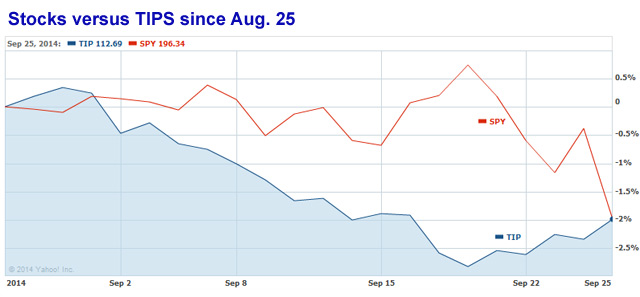
What exactly did the Federal Reserve say Wednesday to spook the bond market?

While we’re waiting for more data on today’s 10-year TIPS reopening, I thought I’d take a look at the minutes statement issued Wednesday by the Federal Reserve. It came on the same day as a weak inflation report, causing double tension in the Treasury markets.

Here is how the TIP ETF (which holds a broad range of TIPS through all maturities) reacted to the Fed minutes, which were released at 2 p.m.:

TIP Aug. 17

What did the Fed say that caused this reaction? You can read the minutes for yourself, but here is my summary:

  • Economy is improving, jobs are still a problem.  “(E)conomic activity is expanding at a moderate pace. On balance, labor market conditions improved somewhat further; however, the unemployment rate is little changed and a range of labor market indicators suggests that there remains significant underutilization of labor resources.”
  • Inflation isn’t high enough. “Inflation has been running below the Committee’s longer-run objective.”
  • Bond-buying stimulus is nearly complete. “Beginning in October, the Committee will add to its holdings of agency mortgage-backed securities at a pace of $5 billion per month rather than $10 billion per month, and will add to its holdings of longer-term Treasury securities at a pace of $10 billion per month rather than $15 billion per month.”
  • But the Fed is still influencing the bond market. “The Committee’s sizable and still-increasing holdings of longer-term securities should maintain downward pressure on longer-term interest rates …”
  • Short-term interest rates will remain near zero. “The Committee continues to anticipate, based on its assessment of these factors, that it likely will be appropriate to maintain the current target range for the federal funds rate for a considerable time after the asset purchase program ends, especially if projected inflation continues to run below the Committee’s 2 percent longer-run goal.”

The market reaction yesterday was pretty simple: Stocks up, bonds down. The Wall Street Journal noted that the stock market was rejoicing:

“The Fed cheered the market a little bit yesterday with keeping in the ‘considerable time’ language,” said Karyn Cavanaugh, senior market strategist at Voya Investment Management.

In the bigger picture, Ms. Cavanaugh said the improving economy, which could translate into higher corporate profits, and accommodative monetary policy in other regions should continue to lift stocks.

The bond market, though. found things to worry about, as noted in this separate Wall Street Journal report:

But what spooked bond investors was that Fed officials expect the official interest rate to end higher by the end of next year compared with their predictions in the June meeting. The median forecast from Fed officials sees the fed-funds rate at 1.375% by the end of 2015, compared with a 1.125% forecast in June.

The latest forecasts suggest “a faster pace of rate increases next year,” which sent bond yields higher, said Todd Hedtke, vice president of investment management for Allianz Investment Management, which manages more than $600 billion in assets globally.

Mr. Hedtke said the Fed’s message was “confusing” to bond investors, causing the gyrations in bond prices. He expects volatility in bond prices to rise as the Fed moves closer to raising interest rates.

Posted in Investing in TIPS | 4 Comments

U.S. inflation fell 0.2% in August, what does it mean for TIPS and I Bonds?

The Consumer Price Index for All Urban Consumers (CPI-U) decreased 0.2% in August on a seasonally adjusted basis, the U.S. Bureau of Labor Statistics reported today. Over the last 12 months, inflation has increased 1.7%.

This was the first decline in ‘headline’ inflation since April 2013. The August number fell well below the consensus prediction of 0.0%, primarily driven by by declines in energy indexes, especially gasoline. The energy index fell 2.6%, with the gasoline index declining 4.1% and the indexes for natural gas and fuel oil also decreasing.

Beyond energy, the CPI-U report showed modest increases in prices for food, shelter and new vehicles, all at 0.2%.

Holders of Treasury Inflation-Protected Securities and I Bonds are also interested in the non-seasonally-adjusted inflation number, which is used to adjust the principal of TIPS and set future interest rates for I Bonds. In August, non-seasonally-adjusted inflation also came in at -0.2%, and 1.7% for the last 12 months.

I have updated my ‘Tracking Inflation and I Bonds‘ page to reflect these new August numbers. The I Bond inflation-adjusted interest rate will re-set on Nov. 1, based on non-seasonally-adjusted CPI-U for March to September. Now, with one month to go, the potential annualized I Bond rate has dropped to 1.32%. September’s number is the one missing piece.

‘Core inflation’ – which strips out food an energy – was 0.0% in August and 1.7% over the last 12 months.

The weak inflation numbers could take pressure off the Federal Reserve, which is pondering when to begin raising its pivotal short-term rate. We’ll be hearing more today from the Fed after the close of its two-day meeting.

And the negative August number could weaken demand for Thursday’s reopening of a 10-year TIPS, CUSIP 912828WU0. I’ll be checking in on that Thursday morning and after the auction.

Here is the one-year trend in seasonally-adjusted CPI-U:

one-year inflation

Posted in Investing in TIPS | 7 Comments

Next up: 10-year TIPS reopens at auction Sept. 18

Hate to admit this auction announcement actually slipped past me (I’ve been out of town lately), but maybe it’s for the best because conditions in the TIPS market have been changing dramatically in the last two weeks. So, yeah, oops, the Treasury announced last Thursday that it will reopen CUSIP 912828WU0 on Sept. 18, creating a 9-year, 10-month TIPS with a coupon rate of 0.125%.

This will be a fascinating auction because CUSIP 912828WU0 was first auctioned July 24, 2014, with yield to maturity of 0.249% (plus inflation). Because that yield fell just below the 0.250% mark, the Treasury set the coupon rate one notch (1/8 percent) lower, to 0.125%, the lowest possible on any Treasury Inflation-Protected Security.

Now, add in the rising yields of the last two weeks, and you get a TIPS selling at a pretty nice discount, a rarity in TIPS auctions of the last three years. Here’s what we can say right now about CUSIP 912828WU0, after the close of market Monday:

  • Because this TIPS trades on the secondary market, you can track its real-time value at Bloomberg’s Current Yields page. Not always totally accurate midday, but at this moment it is showing a yield of 0.46% and a price of about $96.81 per $100 of value, a discount of more than 3%.
  • The Wall Street Journal’s Closing Prices page is showing a yield of 0.444% and a price right around $96.81 per $100 of value.
  • The Treasury’s Real Yields page is estimating a yield to maturity of 0.47% for a full-term 10-year TIPS. This is 20 basis points higher than the yield estimate for Sept. 2, just two weeks ago.

So in the two months since its original auction, CUSIP 912828WU0 has gone from ugly ducking to ‘sorta-homely-but-more-interesting.’ Keep in mind that six months ago, a similar 9-year, 10-month TIPS auctioned with a yield to maturity of 0.659%. That was in March 2014, before Treasury yields started another decline.

The very recent trend has been rising Treasury yields, and that could cause some uneasiness at Thursday’s auction. Could that mean an upside yield surprise? We’ll find out at 1 p.m. Thursday.

Also, watch for Wednesday’s report on the Consumer Price Index. The expectation is for continued mild inflation. A surprise in either direction could upset the TIPS market.

Inflation breakeven point. With a 10-year TIPS yielding 0.47% and the 10-year traditional Treasury yielding 2.60%, this sets up an inflation breakeven rate of 2.13%. If inflation averages more than 2.13% over the next 10 years, CUSIP 912828WU0 will outperform a traditional Treasury. This is on the lower end of the ‘moderate’ scale, meaning this TIPS is fairly cheap, at least versus a traditional Treasury.

For the record, here is a chart of all 9- to 10-year TIPS auctions since January 2008:

10- year tips auctions

Posted in Investing in TIPS | Tagged , , | 2 Comments

PenFed’s new 1-year CD shows the screwed-up state of interest rates

I am a customer of the Pentagon Federal Credit Union, also known as PenFed, and I jumped happily aboard when it offered an above-market 3% 5-year CD in December 2013 and January 2014. But since then its CD rates have dipped to U.S. market levels, which are very low.

Then I got this offer in an e-mail from PenFed yesterday:

PenFed 1-year CDPenFed’s offer requires just a $1,000 investment for a 1-year CD, paying 1.06%. Early withdrawal forfeits six months of interest payments. That’s good; but not wildly good.  The national average for a 1-year CD is 0.24%, but BankRate.com lists several institutions offering 1.10% today.

But here’s what’s intriguing about PenFed’s ‘promotional rate.’ That 1.06% offer is placed on every PenFed CD from 1 to 4 years, and bumps up to only 1.21% for 5- and 7-year. Here is rate information from its Website:

PenFed ratesMy conclusion is that PenFed expects to sell only one thing: 1-year CDs. There would be no reason for customers to accept that 1.05% rate on a 2-year, 3-year, 4-year CD, or just slightly higher on a 5-year or 7-year CD.

Consider this: A 5-year traditional Treasury is paying 1.79% today. That is 58 basis points higher than PenFed’s 5-year and 7-year CDs. It makes no sense; except to conclude that PenFed is pushing customers toward a 1-year CD.

Treasury yields are on the move

PenFed is demonstrating the ultimately flat yield curve, but in recent days yields across the Treasury market have been rising. This is a trend worth watching.

For example, the 5-year TIPS yield dropped to -0.28% on Aug. 15, but has since risen to 0.10%, based on the Treasury’s Real Yield Charts. This is the first time since April that the 5-year yield has moved into positive territory. Here’s a one-year chart, minus the last few days because the St. Louis Fed’s data has some lag time:

5-year TIPS yieldIn reaction to rising yields, the price of the TIP ETF has been declining — very conveniently (!) since I posted Why TIPS aren’t a good buy right now: A story in charts on Sept. 4. Here’s the 5-day chart since Sept. 4:

5-day TIPSLong way to go to $110, which is still my target/prediction for when TIPS become more appealing. We probably won’t be seeing that anytime soon, but we can hope. Because I want to be a net buyer of TIPS, I am cheering for higher yields.

Posted in Investing in TIPS | Tagged , | 3 Comments

Why TIPS aren’t a good buy right now: A story in charts

I am a choosy buyer of Treasury Inflation-Protected Securities, so choosy in fact that I’ve only pulled the trigger three times since July 2011. In that time, yields on TIPS have plummeted, while at the same time inflation has been very mild. TIPS haven’t been that attractive. These were my purchases:

  • May 2013: Bought a 9-year, 8-month TIPS with a yield of -0.225%. The current yield on that TIPS is 0.223%.
  • July 2013:  Bought a 10-year TIPS with a yield of 0.384%. The current yield on that TIPS is 0.192%.
  • August 2013: Bought a 4-year, 8-month TIPS with a yield of -0.127%. The current yield on that TIPS is -0.417%.

At the time, I thought these were attractive yields that fit my TIPS ladder and investing needs. For the 37 other TIPS auctions since July 2011, I haven’t found an attractive combination. So I have been sitting on the sidelines.

Am I a market timer? No. I buy-and-hold TIPS to maturity, so I am not a trader. I am just looking for the best opportunities for my limited investment cash.

And right now – in September 2014 – I am not finding attractive opportunities in TIPS. Yields have dropped sharply this year, meaning TIPS are much more expensive than they were in 2013. And they are more expensive against other bond investments, as this chart shows:

year to date

The TIP ETF has greatly outperformed Vanguard’s Total Bond Market ETF (BND) and the Intermediate Treasury ETF (IEI) in 2014. That indicates TIPS are getting more expensive versus the overall bond market. NOTE: The TIP ETF is more volatile because it has a duration of 7.78, versus 4.59 for IEI and 5.60 for BND.

This out-performance looks very much like the pattern in 2012, when TIPS yields were plummeting:

2012 TIPSAnd this out-performance led to a crushing fall in 2013, when yields in the TIPS market rose by more than 100 basis points, sending the TIP ETF plummeting, even against other bond investments:

2013 TIPSA lot of new TIPS investors who poured money into mutual funds and ETFs after July 2011 didn’t realize they were getting a possibly volatile investment. TIPS seem so conservative. After May 2013, they got the message loud and clear. And when the fall came, I was buying.

Just to drive this point home, here is a chart showing 2104 year-to-date yields for the 10-year TIPS, which I consider the benchmark. It has been a steady decline:

10-year yieldOn the other hand, it’s a positive for TIPS that the 10-year inflation breakeven point has been behaving very nicely, staying in a lowish pattern against the traditional 10-year Treasury.  This chart would indicate that TIPS aren’t a bad investment right now, at least versus traditional Treasurys, and also that TIPS were oversold in 2013:

Inflation breakevenA lower number is a good thing, indicating TIPS are less expensive versus traditional  Treasurys. In general, a number above 2.5% means TIPS are very expensive, and a number below 2.0% means they are very cheap. This chart shows a good trend for TIPS buyers.

Conclusion. I have a very rough guide: If the yield on a 10-year TIPS begins approaching 1%, I will be likely to buy. When it stays below 0.5%, I am very unlikely to buy, unless a certain investment meets my needs, such as filling a hole in my investment ladder.

Also, keep an eye on the price of the TIP ETF, which is currently $114.54. When it begins to approach $110, sellers will be panicking and buyers will need to be ready.

Market timing? No. Just a common sense approach to buy-and-hold investing.

Posted in Investing in TIPS | 11 Comments