5-year TIPS auctions with yield of – 0.281%

The Treasury Department sold $16 billion in 5-year Treasury inflation-protected securities Thursday at a yield of -0.281%.

That’s from Marketwatch … I am on the road.

Posted in Investing in TIPS | 1 Comment

Checking in on Thursday’s TIPS auction, plus words from the Fed

I will be traveling Thursday and so I won’t be able to post any before- or after-thoughts on Thursday’s reopening of CUSIP 912828C99, creating a 4-Year 8-Month Treasury Inflation-Protected Security with a coupon rate of 0.125%.

So let’s take a look at where we stand at 6:05 p.m. Wednesday:

  • This TIPS was trading today with a yield to maturity of -0.29%, according to Bloomberg’s Current Yields chart. This is up about 12 basis point from where it was last week.
  • The Wall Street Journal’s Closing Prices chart shows that this TIPS maturing April 2019 closed with a yield of -0.308% and a price of about $102 for $100 of value (because of the the coupon rate of 0.125%).
  • The Treasury’s Real Yield Curve chart estimates a full 5-year TIPS would yield -0.18%. This estimate isn’t directly comparable with the two quotes above, since a full-term TIPS would yield slightly more than a TIPS with 4-month-shorter term.

So, conditions have improved since I wrote about this auction last week. Last Thursday, the market was signaling a yield of about -0.41% and now -0.29% looks more likely.

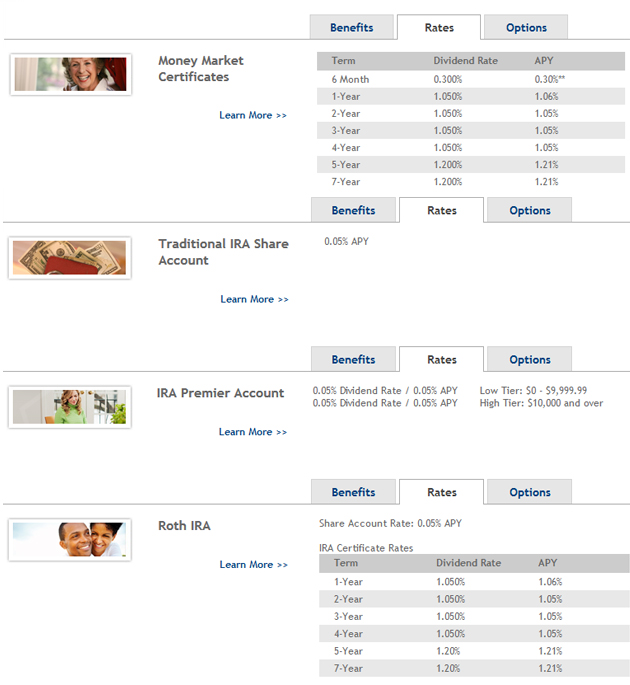
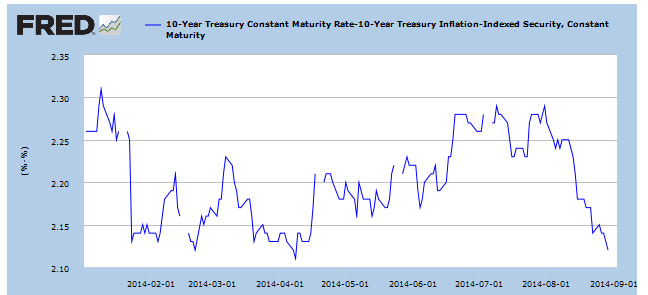
With the 5-year nominal Treasury trading today at 1.65%, you’re looking at an inflation breakeven rate of 1.94% for this TIPS. I’d probably take that bet if I were thinking about buying a 5-year Treasury, but maybe not against a 5-year bank CD paying 2.30%, which pushes the breakeven point up to 2.59%.

Honestly, I’m not in the market to buy any of these at the moment. I mean, could interest rates be rising next year? …

Did the Fed give a signal today?

The Wall Street Journal’s Website lead story right now has this headline: ‘Fed Minutes: Rate-Hike Debate Heating Up.’ An excerpt:

Federal Reserve officials debated at their July meeting whether to move sooner than expected to start raising interest rates in light of an improving job market and rising inflation, but decided they needed more evidence before concluding that was the right approach.

The minutes of the meeting, released Wednesday, provide fresh evidence of an intensifying debate inside the central bank about when to respond to a surprisingly swift descent in the unemployment rate and rising consumer prices.

You can read the Fed’s full minutes here. There’s a giant section with the heading: Monetary Policy Normalization, which I can assure you has not appeared in any Fed minutes over the last couple of years. It includes this paragraph:

Meeting participants continued their discussion of issues associated with the eventual normalization of the stance and conduct of monetary policy, consistent with the Committee’s intention to provide additional information to the public later this year, well before most participants anticipate the first steps in reducing policy accommodation to become appropriate.

In other words, the Fed is saying: ‘More to come. Just wait patiently.’ But in fact, the Federal Reserve just signaled that there is more to come, and a reason to wait patiently.

For the Fed, that is a pretty big step.

Posted in Investing in TIPS | 1 Comment

U.S. inflation rose a moderate 0.1% in July

The Consumer Price Index for All Urban Consumers (CPI-U) increased 0.1% in July on a seasonally adjusted basis, the U.S. Bureau of Labor Statistics reported today. Over the last 12 months, this ‘headline’ inflation rate increased 2.0%.

The 0.1% number matched the consensus estimate and broke a four-month string of 0.2%-or-higher monthly increases. Today’s inflation report was a mixed bag – food prices increased a sharp 0.4% in July, but where offset by a 0.3% decline in energy costs, including gasoline. New vehicle prices were up 0.3%, but used vehicle prices declined by the same amount.

Holders of Treasury Inflation-Protected Securities and I Bonds are also interested in the non-seasonally adjusted CPI-U, which is used to adjust the principal on TIPS and set the future inflation-adjusted interest rate on I Bonds. In July, the non-seasonally adjusted inflation index declined slightly to 238.250, down 0.04% from the June index.

I have updated my Tracking Inflation and I Bonds page to reflect the new July number. With two months of inflation numbers remaining, the I Bond inflation-adjusted interest rate would reset to an annualized 1.64% on Nov. 1. But remember, two months remain.

Here is the one-year trend in CPI-U, which still shows a bump in the inflation in recent months:

2014 inflation

Posted in I Bond, Inflation, Investing in TIPS | Leave a comment

Up next: 5-year TIPS will reopen at auction Aug. 21, 2014

The US Treasury just formally announced it will reopen CUSIP 912828C99 at auction next Thursday, creating a 4-Year 8-Month Treasury Inflation-Protected Security with a coupon rate of 0.125%.

This TIPS was originally auctioned on April 17, with a yield to maturity of -0.213%, plus inflation. Buyers at that auction paid about $101.87 for $100 of value because of the spread between the yield and the coupon rate.

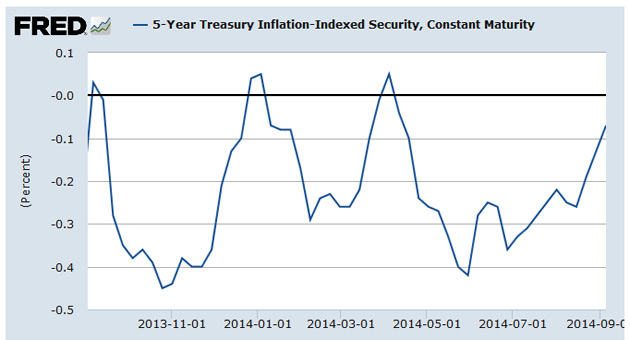
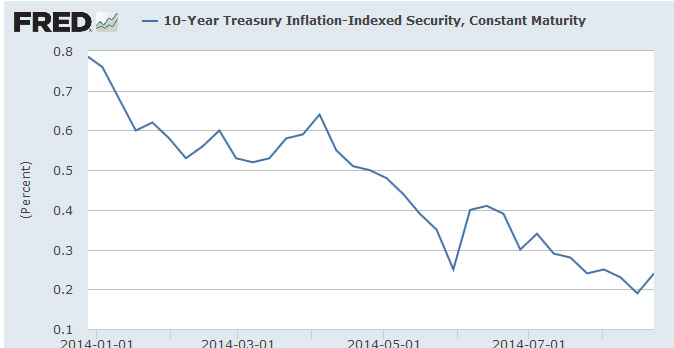
What can we expect? Since April, yields on TIPS have been sinking, dropping to a low for the year of -0.44% in late May. Recent strength in the overall bond market has again pushed TIPS yields to near their yearly lows.

  • Bloomberg’s Current Yields page shows a yield of -0.44% for CUSIP 912828C99 on today’s secondary market.
  • The Wall Street Journal’s Closing Prices page shows a closing yield of -0.418% for this TIPS on Wednesday.
  • The Treasury’s Real Yields page – which estimates the yield on a full-term 5-year TIPS – shows -0.29%, a fairly wide variance from the other two real-world measurements.

Let’s set aside the Treasury’s number and for now let’s estimate a yield of about -0.420% for next week’s auction. That would mean buyers will pay about $102.50 for $100 of value, plus chip in more than $1 for accrued inflation. That’s pretty pricey for a 0.125% coupon rate.

This chart tracks the longer-term trend for yields on 5-year TIPS, showing the wild swing of more than 500 basis points from the depth of the recession to Fed-induced ultra-low rates of 2012:

5-year yieldsIt’s impossible to figure what’s ‘normal’ from that chart, but certainly the peak and the nadir can be ruled abnormal. The pre-recession yields above 1% generate nostalgia, but that’s about it. Let’s work on getting above zero.

I personally won’t be participating in next week’s auction, unless yields climb dramatically in the next seven days.

Alternative? I repeat again that buying US Savings I Bonds up to the limit is a much better investment than a 5-year TIPS paying -0.41%. I Bonds currently pay 0.1% above inflation. That is 51 basis points better than a TIPS, and I Bonds are more flexible investments and the interest is tax deferred.

Here is a chart of 4- to 5-year TIPS auctions since 2007. Check it out and tell me if you can figure out what would pass for a ‘normal’ yield in 2014, minus Fed manipulation and simmering world turmoil:

TIPS auctions

Posted in Investing in TIPS | 3 Comments

2014: What a strange year for stocks, bonds

Here is the chart of the day, captured at 9:34 a.m. Eastern time:

TIP versus SPYLooking at net asset value, the TIP ETF, which holds a broad range of Treasury Inflation-Protected Securities, has performed almost exactly the same as the SPY ETF, which holds the Standard and Poors 500.

  • Net asset value for both funds is up about 5% year-to-date as of Aug. 11.
  • In addition, the TIP ETF has paid out $1.354 in dividends, an additional return of about 1.2%.
  • The SPY ETF has paid out $1.762 in dividends, an additional return of about 0.9%.

You won’t often see two remarkably different assets classes performing in lockstep for such a long period of time. I have said in a previous post that I don’t think this can continue. We should see returns breaking away, especially if stocks continue to rise.

The other possibility is that both assets classes will decline. I think the longer the trend continues upward for both, the more likely a fall for both follows.

Posted in Investing in TIPS | Leave a comment