Tempting short-term investment: TIPS maturing April 15, 2013

Reader Joe pointed out that current pricing on the TIPS maturing April 15, 2013, has moved to a positive yield, while almost the entire TIPS ladder is negative. At this point, it is substantially positive:

short

Tempting, isn’t it? This TIPS has a coupon rate of 0.625% and is selling at a discount, resulting in a yield of 0.739%. That’s attractive, but the TIPS will mature in 4 1/2 months, so it’s definitely a short-term investment.

There’s a thread discussing this issue in the Bogleheads forums, dating back to June but with posts continuing through this week. Experts there agree it is an intriguing investment in theory, but it reality will generate very little income in the short remaining time period, less than 0.2% on the money invested. Still, that is better than a six-month Treasury (0.13%) and even better than a one-year (0.18%).

Why the pricing anomaly? With oil and gas prices declining, we are currently in an inflation downswing, and the ‘fiscal cliff’ raises a specter of deflation. TIPS are inflation protection, and there is little chance of much inflation at all before April 2013. So there is no ‘inflation premium’ on this issue. In fact, a couple months of deflation could nearly wipe out its positive return.

There is little risk in this investment, though, so it could be interesting for someone parking short-term cash, which is going to earn near-zero anyway.

Posted in Investing in TIPS | 4 Comments

Surprise: A TIPS auction without a record-low yield

I was on vacation last week and away from computers and the Internet (mostly), so I didn’t get a chance to write about Wednesday’s reissue auction of CUSIP 912828TE0, effectively creating a 9-year 8-month TIPS.

Read the Treasury’s announcement.

Demand for this issue was relatively weak, resulting in a yield to maturity of -0.720%, just above the record low yield for a 10-year Treasury Inflation-Protected Security, which is -0.750%, set by this same TIPS was it was reissued in September. A week ago, it looked like this reissue would generate at yield of about -0.83%. Just before the auction, experts were predicted a yield of 0.746%.

That’s significant. We’ve been waiting to see the yield on TIPS, which has been plummeting for about 18 months, start to bottom, or even rise. There’s no reason to say we’ve hit bottom yet, but this auction wasn’t a record low and that is a milestone.

Since January 2011, there have been twelve 10-year TIPS issues and reissues, and the yield has declined in ten of those auctions. A chart:

10-year tips auctions


Posted in Investing in TIPS | 1 Comment

Next up: Reopening of a 10-year TIPS, auctioning on Nov. 21, 2012

Treasury announcementThe U.S. Treasury announced today it will reissue a 10-year Treasury Inflation-Protected Security, CUSIP 912828TE0, effectively creating a 9-year 8-month TIPS.

Read the announcement.

What we know: This TIPS has a coupon rate of 0.125%, the lowest the Treasury offers on a TIPS. It also has a record-setting history in the world of 10-year TIPS:

First auction: On July 21, 2012, with a record-low yield to maturity of -0.637%.

First reissue: On Sept. 20, 1212, with a record-low yield of -0.75%

And now we have the second reissue coming Nov. 21, and we can expect another record low yield. Since this security trades on the open market, we can check its current price.

At this point, a week away from the auction, it looks like the yield to maturity will set another record low, dipping to about -0.83%. That means buyers are willing to accept 0.83% less than the rate of inflation over the next 10 years. It also means this TIPS is pretty darn pricey.

Not too long ago (who remembers January 2011?) a 10-year TIPS auctioned with a yield of 1.17%. It’s been a long, steady decline since then, mostly caused by Federal Reserve manipulation of the Treasury market (QEs), but also fear of economic collapse in Europe and lingering fears of inflation in the United States (still dormant today.)

Here are recent 10-year TIPS auctions for some historical perspective:

10-year TIPS auctions

Because buyers at next Thursday’s auction will be getting a coupon yield that is a wild 0.956% above the actual yield to maturity, they will be paying big money for this issue — somewhere around $109 for every $100 of value. Ouch. You really have to fear future inflation to pay that price, in my opinion.

The breakeven rate. The national election Nov. 6 has set off fears of a financial crisis ahead (like we didn’t know the fiscal cliff was looming a month ago?). This has socked the U.S. stock market and strengthened U.S. Treasuries.

The yield on a traditional 10-year Treasury closed today at 1.58%, down from 1.78% on Election Day. When traditional Treasury rates fall, TIPS yields almost always follow. A buyer can look at the ‘breakeven inflation rate’ to see which is the better ‘bargain.’

Today, that 10-year breakeven rate is a rather high 2.41%. That means a buyer of this TIPS needs inflation to run at 2.41% over the next 10 years to beat an investment in a traditional Treasury. (The inflation rate over the last 12 months was 2.2%, by the way.)

This reissue will continue a nearly 18-month trend of declining TIPS yields. Until that trend breaks, TIPS are not an attractive investment for a small investor.

Posted in Investing in TIPS | Leave a comment

U.S. inflation ticked up just 0.1% in October

Rising food costs and higher rents offset a drop in gas prices last month, leaving consumer prices only slightly higher in October compared with the previous month. From the Associated Press report:

The consumer price index rose a seasonally adjusted 0.1 percent in October, down from sharp gains of 0.6 percent in the previous two months, the Labor Department said. In the past year, prices increased 2.2 percent. That’s just above the Federal Reserve’s inflation target of 2 percent.

This ‘headline’ number is the one that matters for holders of TIPS and I Bonds, because it determines the principal adjustment on TIPS and contributes to the future interest rate on I Bonds. The Fed, though, more closely watched core inflation, which rose 0.2% in October.

Here is the full Labor Department report.

Posted in Investing in TIPS | 3 Comments

Vanguard’s new short-term TIPS funds: Better than cash?

Vanguard this month launched a family of mutual funds investing in short-term Treasury Inflation-Protected Securities. While investors could duplicate this strategy by simply buying and holding 5-year TIPS to maturity (at zero cost with Treasury Direct), these low-fee funds are intriguing as a possible substitute for cash in your portfolio.

Here are the three share classes, with identical investing philosophies but differing fee structures:

  • Short-Term Inflation-Protected Securities Fund Investor Shares (VTIPX), a traditional mutual fund with a 0.25% purchase fee and an expense ratio of 0.20%. Minimum investment: $3,000.
  • Short-Term Inflation-Protected Securities Index Fund Admiral Shares (VTAPX), a traditional mutual fund with a 0.25% purchase fee and an expense ratio of 0.10%. Minimum investment: $10,000.
  • Short-Term Inflation-Protected Securities ETF (VTIP), an ETF with no purchase fee and an expense ratio of 0.10%. No minimum investment, but brokerage fees might apply.

The purchase fee on the two mutual funds doesn’t apply to reinvested dividends and capital gains. While this fee benefits current shareholders, and is designed to discourage short-term trading, I think the ETF should be the way to go with this investment, especially in a brokerage (like Vanguard) with no commissions and automatic reinvestment of dividends.

However … as Vanguard notes: “The market price of Vanguard ETF Shares may be more or less than net asset value.” This is the case as of Friday, with the market price of the ETF closing at $49.88, and the NAV ending at $49.75. For this reason, the Admiral shares also have appeal, with dividends reinvested.

This is going to be a moderately-traded ETF, with average volume likely to be about 30,000 shares a day, compared to 900,000+ a day for the TIP ETF. Therefore, buyers and sellers should set limit orders, not market orders. Here is how the ETF performed versus Admiral shares in the last five days:

Short-term TIPS

While the ETF and the Admiral shares should have identical performance, the ETF has outperformed in recent days, putting its price above net-asset-value. For this reason, some investors might prefer the more-accurate Admiral shares, despite the 0.25% purchase fee.

Goals of these funds. Vanguard lays out three simple investing goals:

  1. Invests primarily in U.S. Treasury Inflation-Protected Securities with remaining maturities of less than five years.
  2. Seeks inflation protection and income consistent with short-term U.S. Treasury Inflation-Protected Securities.
  3. Principal and interest adjusted for inflation.

Consider N0. 2, income consistent with short-term U.S. Treasury Inflation-Protected Securities. Because TIPS yields have plummeted since mid 2011, short-term TIPS provide income well below the rate of inflation. There are only 14 TIPS with maturities of less than six years, and these have a typical yield of -1.35%. So if inflation averages 2.5% in the next few years, these issues will provide a yield of about 1.15%, which is less than you can get on a 5-year bank CD.

Consider No. 3, principal and interest adjusted for inflation. Well, not quite. Keep in mind that because of No. 2, principal and interest will currently lag inflation by about 1.35%.

Short-term TIPS versus cash. Cash in a money market account or bank savings account, earning maybe 0.04% today (I”m being generous), is going to lag inflation by an even wider margin. That is why I think these short-term TIPS funds could work as slightly more risky substitute for cash.

These TIPS funds aren’t money market accounts and their net asset value will vary. Although there is zero credit risk, there is interest-rate risk and you could lose money.

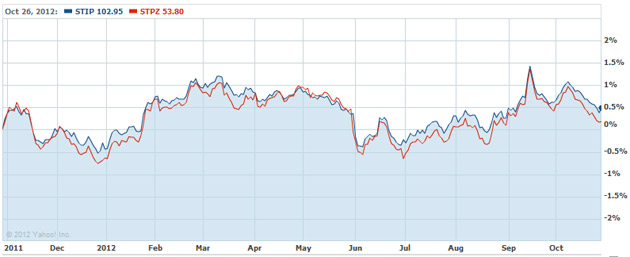
There are two other ETFs that track short-term TIPS — iShares Barclays 0-5 Year TIPS Bond (STIP) and PIMCO 1-5 Year US TIPS Index ETF (STPZ) — and here is how they performed over the last year:

Short-term TIPS funds

Although the price fluctuations aren’t Halloween scary, short-term TIPS funds will see a rise and fall in net asset value.

At this point, Vanguard isn’t listing duration or yield for these brand-new funds, but from the Pimco and iShares funds you can predict a duration of about 2.5%, meaning that net asset value will fall about 2.5% for every 1% rise in yield. If short-term TIPS returned to a more ‘normal’ yield of 0.5% above inflation, investors could see a 4.5% drop in net asset value. So the risk is not extreme, but it is there.

On yield, buyers can expect about 1% in the near term. That’s not great, but it is better than cash.

Other alternatives. If you haven’t invested in US Savings I Bonds this year, you can still buy $10,000 per person before Oct. 31 and get a six-month interest rate of 2.2% and then 1.76% for the next six months, resulting in a combined annual yield of 1.98% in the next year. That’s definitely better than cash, and you avoid any current tax liability.

Another strategy, as I noted above, would be to buy and hold to maturity every new issue and reissue of 5-year TIPS on Treasury Direct. This produces zero cost and zero risk. The next 5-year offering is a reissue on Thursday, Dec. 20, 2012.

Conclusion. I view the Vanguard short-term TIPS funds as a low-risk and low-return investment. Because of the built-in protection against unexpected inflation, these funds are a good alternative to cash, if you can tolerate the small additional risk.

Posted in I Bond, Investing in TIPS | 6 Comments