U.S. debt downgrade: Tough talk from China

This was inevitable, wasn’t it? China is the world’s largest holder of U.S. debt, and now it is holding downgraded debt.  China is not happy, as you can see in this report on Marketwatch.com:

“The U.S. government has to come to terms with the painful fact that the good old days when it could just borrow its way out of messes of its own making are finally gone,” China’s state-run Xinhua News Agency said Saturday, in Beijing’s first official response to the S&P action, according to wire service reports.

“China, the largest creditor of the world’s sole superpower, has every right now to demand the United States to address its structural debt problems and ensure the safety of China’s dollar assets,” it said.

I love the simplicity of that language: “the good old days when it could just borrow its way out of messes of its own making are finally gone.” There is so much truth to that statement that I think we should borrow 50 or so Chinese Communists to serve in the U.S. House and Senate. That is how bad things look in U.S. politics.

But China lecturing the United States on its fiscal policy – no matter how deserved – probably won’t help. Will we see a backlash response from the U.S.? Probably not, since China sits in front of a big pile of money in this poker game. In fact, the U.S. and China are economic partners, sort of an ‘arranged’ marriage.

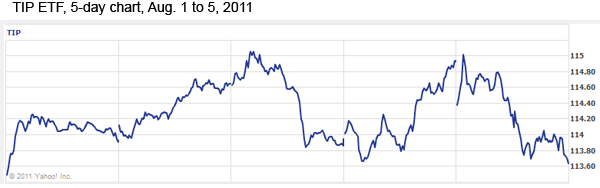
What about TIPS? Treasury Inflation-Protected Securities, as measured by the TIP ETF, had a wild 5 days last week but ended just about where they started, and still near all-time highs:
But that price swing was relatively minor in last week’s wild market:
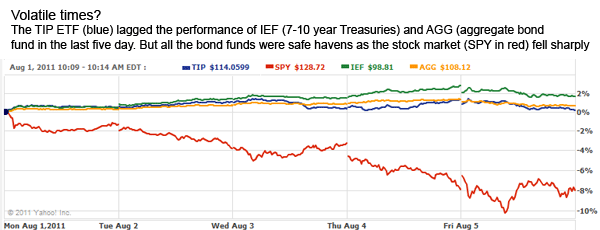
Next week, despite the S&P downgrade, TIPS could stay relatively stable if the stock market continues its sharp decline. If stocks rebound, as they did Friday, TIPS yields could begin rising, because the ‘safe haven’ attraction is dimmed. Even if the S&P downgrade resulted in a 50 basis point increase in TIPS yields, that would just bring the yields back to April levels.

For holders of the TIP ETF (I don’t own it), a 50 basis point increase in TIPS yield would result in about a 2% drop in NAV, hardly a disaster.

Eventually, TIPS are going to have to reflect the new reality: The economy is possibly heading toward another recession, and inflation may not be a threat in the short term.

Or … will the Fed step in with QE3 if the economy tanks (giving TIPS a boost)?

Upcoming auction. The uncertainty makes the Aug. 18 reissue of a 5-year TIPS especially unattractive, in my opinion. The likely real yield has been wavering well below  the all-time low of negative 0.55% in October 2010, right before the launch of QE2.

Friday’s yield, after TIPS took a hit, was negative 0.676% for the 5-year TIPS maturing July 15, 2016.

The auction announcement will come Aug. 11.
Posted in Investing in TIPS | Leave a comment

Bill Gross: U.S. economy is at ‘tipping point’ of recession

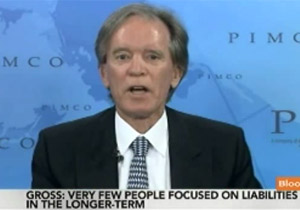
Bill Gross, who runs the world’s biggest bond fund at Pimco, says in an interview with Bloomberg that the U.S. economy is stalling and a recession is a real possibility.

In another Bloomberg interview, Harvard University economics professor Martin Feldstein said he thought “there’s now a 50% chance that we could slide into a new recession.”

For investors in TIPS, talk of recession is significant, because along with its many damages a recession brings the threat of deflation.

“We’re not looking at a recession yet, but we’re at a tipping point,” Gross told Bloomberg TV. “We’re at what we call a stall speed in which corporate profits don’t grow, jobs aren’t created.”

The Fed may arrange a third round of quantitative easing, known as QE3, Gross said. That would be significant for investors in Treasury Inflation-Protected Securities, because a third round of quantitative easing would inflame inflation fears.

But Gross repeats his oft-stated criticism of U.S. Treasuries, which he calls a ‘dirty shirt’ of investments, and notes there are ‘cleaner shirts out there.’

Watch the video

More pessimism … The Associated Press hit a home run with this lead-in today on its story about the worsening economy:

Shoppers won’t shop. Companies won’t hire. The government won’t spend on economic stimulus; it’s cutting instead. And the Federal Reserve is reluctant to do anything more.

Without much to invigorate growth, the economy may be in danger of slipping into a stupor like the one Japan has failed to shake off for more than a decade. And Wall Street is spooked.

Posted in Investing in TIPS | Leave a comment

Next auction: Reissue of a 5-year TIPS, Aug. 18, 2011

Update: Buy this issue? I say, no.

The U.S. Treasury will auction a reissue of a 5-year Treasury Inflation-Protected Security on Aug. 18, 2011. It will be interesting to see how much buyer interest this auction can raise. My point of view: It looks like a dreadful offering. Things can change, but I will almost certainly pass this one up.

Announcement: Thursday, Aug. 11
Auction: Thursday, Aug. 18
Settlement: Wednesday, Aug. 31

I was a buyer of the last 5-year TIPS, CUSIP 912828QD5, which auctioned April 21 with base yield of negative 0.18%. Before that decision, I remember wondering, quite sensibly: ‘Why would anyone buy a TIPS with a negative real interest rate?’

Here’s why. Well, first of all, the principal gets adjusted for inflation, and at the time, that made a 5-year TIPS preferable to other super-safe investments, like a 5-year CD. And at the time inflation appeared to be looming just around the corner.

And … It’s only five years.

This time it’s different. The market rate for a 5-year TIPS is currently running about -0.862% (updated for Monday’s rate), before the inflation adjustment. That means buyers are willing to accept a return .862% below the inflation rate for the next five years.

At the same time, the economy is wilting and inflation in the near term is looking less and less like a risk. (Unless you see QE3 coming in the next year.)

And what about 5-year bank CDs? You can get a 5-year CD at a rate around 2.32%.  So, to make this 5-year TIPS attractive, inflation would have to average around 3.1% over the next five years. That certainly could happen. Or maybe inflation would average around 2.3%, which could also happen. In that case:

  • With a bank CD you’d get 2.32%
  • With this 5-year TIPS would would get about 1.5%

TIPS have been in a mini-bubble the last few weeks, and are still rising sharply. The TIP ETF hit another all-time high today, at $113.50, and at one point was at $114.26. It was at $107.82 on April 21, the day the last 5-year TIPS was auctioned.

That’s a capital gain of 5.2% in 100 days. How much gain is left in this TIPS tank?

OK, let’s recap. In April, you could have bought a new issue 5-year TIPS in a somewhat shaky environment (and as I noted, I did buy it):

April 2011
– 5-year TIPS auctions with a real yield of negative 0.18%
– 5-year bank CD with a fixed interest rate of 2.43%
– 5-year TIPS vs. bank CD, breakeven inflation rate: 2.61%

And how things have changed in August 2011:

August 2011
– 5-year TIPS could auction with a real yield of negative 0.862%
– 5-year bank CD pays a fixed interest rate of 2.32%
– 5-year TIPS vs. bank CD, breakeven inflation rate: 3.182%

Alternatives. There are 10-year and 30-year reissues still coming up this year, so I am taking the month of August off. I am not buying this 5-year reissue.

And remember … The first $5,000 or $10,000 you invest this year in inflation-protected bonds should be in US Savings I Bonds. They fully protect you against inflation and cannot carry an interest rate below 0.0%, so you are protected against deflation, too.

You can own them one year and sell them, and you won’t earn less than 2.3%.

Posted in I Bond, Inflation, Investing in TIPS, Savings Bond | Leave a comment

Amid crisis, TIP ETF hits an all-time high

While a close-to-the-brink financial and political crisis rages, the TIP ETF today hit an all-time high, reaching $113.55 in midday trading, up about 0.6% from the previous day’s close.

This is impressive, when you consider:

  • The financial crisis, in theory, involves the U.S. Treasury’s ability to pay interest and principal on Treasury Inflation-Protected Securities. Obviously, buyers of TIPS do not see this as a real threat.

Associated Press: The economy expanded at meager 1.3 percent annual rate in the spring after scarcely growing at all in the first three months of the year, the Commerce Department said Friday. The combined growth for the first six months of the year was the weakest since the recession ended two years ago.

  • In this environment, a double-dip recession seems more likely than a spike in inflation. Fear of inflation is generally considered the driving force behind demand for TIPS. But right now, investors are looking for safety first, and the fact that TIPS provide inflation protection is a nice plus.

CNN Money: Economists say the debt ceiling debate has already damaged the U.S. economy, and many worry that a deadlock could send the country hurtling into a double-dip recession.

Posted in Investing in TIPS | 1 Comment

Despite threat of default, TIPS are holding up well

With a threat of default looming over U.S. Treasuries in just a few days, you might think that Treasuries would be swooning. Amazingly, they aren’t. Either investors don’t believe the threat of default is real, or they just don’t care.

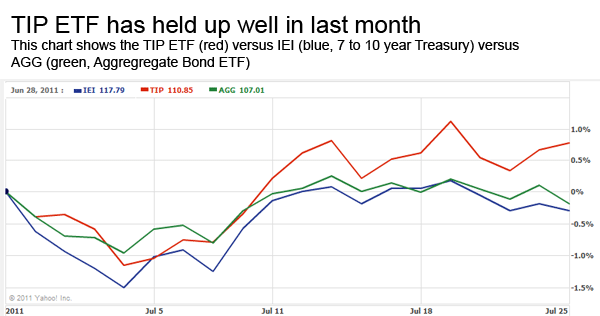
To gauge how TIPS are performing, I like comparing the TIP ETF, which holds U.S. Treasury Inflation-Protected Treasuries, with two other ETFs: IEI (which holds 7-10 year traditional Treasuries) and AGG (an aggregate corporate/Treasury bond fund that is basically a ‘total bond fund’).

This is a good comparison because they all perform as ‘intermediate’ bond funds. Here are the duration numbers:

  • TIP = 4.63
  • IEI = 4.40
  • AGG = 4.56

Here is a chart of the three over the last month.

Of the three, the TIP ETF has performed the best, with a positive gain of about .75%. The other two funds are slightly negative over the past month. As the fear of default has increased in the last two weeks, the TIP ETF has performed much better.

I don’t have a conclusion about why. But it appears are investors are seeing TIPS as a safe harbor through this crisis — certainly the view is not negative. If default actually happened, or if the U.S. lost its AAA credit rating, I’d expect these results:

  • Interest rates would increase, for Treasuries, corporates, everything
  • Investors would demand a higher coupon rate for TIPS
  • The stock market would take a major hit
  • Economic growth would take a major hit
  • Deflation, not inflation, would be a threat (unless the U.S. Treasury could get approval to inflate the money supply)

Jamie Dimon, CEO of JPMorgan Chase, gave the Chamber of Commerce this opinion of the dangers of default, back in March:

If the United States actually defaults on our debt it would be catastrophic … Companies like us, every single company with Treasuries, every insurance fund, every requirement, it will start snowballing. … All short-term financing would disappear.

This wouldn’t be a positive for TIPS, or just about any other traditional U.S. investment. In fact, while TIPS mutual funds might take a hit, they would hardly be the worst of investments.

At this moment, investors don’t seem to believe any of that is likely. Hope they are right.

What I have found troubling in the last two weeks is this: Just about everyone in the government – Republicans and Democrats – agrees that the U.S. budget deficit is a serious problem. We must begin on the path to a solution. And yet our government cannot find the will to find to act. We are witnessing politics, not leadership, by both sides.

I am not sure any investment is ‘safe’ in this environment.

Posted in Investing in TIPS | 1 Comment