An incredible site for TIPS data …

Bob Hinkley is known as ‘#cruncher’ on the Bogleheads forums, and rightly so. He has created and updates an incredible site with a massive amount of useful data guiding us through the history of Treasury Inflation-Protected Securities. Here’s a glimpse of part of the opening page:
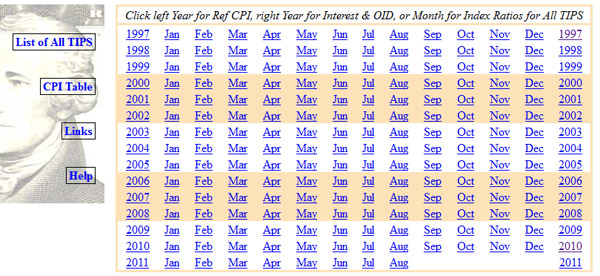
All this data is a bit daunting, so I asked Bob to give me a summary of how to use the site. Here is what he wrote:

I should explain what may be the most useful part of my web site for TIPS owners who want to confirm the OID reported by TreasuryDirect or their brokers.

The Interest and OID page (e.g., TIPS INTEREST & OID FOR 2010) becomes available in November with the release of the October CPI. It can be used by those who’ve held TIPS

  • For the entire year or
  • From the beginning of the year until maturity or
  • From the initial auction until the end of the year

For example, someone who bought the Feb 2040 at the initial auction on 2/26/2010 earned $12.59 for each $1,000 of face value for 2010.

For those who don’t meet any of the above conditions the OID can be looked up in one of the “After Market” pages. For example, assume one bought the Feb 2040 at the second auction on Aug 31, 2010. By scrolling down to the row for August 31 on 2.125% 30-YEAR TIPS DUE FEBRUARY 15, 2040 Interest and OID per $1,000 Face Value for 2010, one sees that $3.42 of OID is reportable for 2010.

The Help page (Interest & OID on After Market Purchase or Sale) explains what to do if you buy and sell a TIPS within the same year.

The site also has a page that show the monthly CPI-U going back to 1961. On the right side I’ve added 5 columns that show the annualized increase for 1, 2, 5, 10, and 30 year periods. This view of past inflation can help a TIPS investor get a feel for what the future might hold. One can change the terminal month for the annual increases by clicking on the month name at the top or bottom of the chart.

For example, I own the 10-year TIPS that matures 07/15/17. I can look down the chart, and click on the coupon rate, which is 2.625 (good old days) and find a history of interest payments and principal adjustments.

Want to look at all 10-year TIPS ever issued?

How about all the 30-years?

There is a ton of data here. Explore.
Posted in Investing in TIPS | Leave a comment

10-year TIPS auctions at a surprising 0.639%

Today’s 10-year auction of a new-issue Treasury Inflation-Protected Security was met with tepid demand, resulting in a surprising coupon rate of 0.625% and a real yield to maturity of 0.639%.

Just two days ago, the market rate for a 10-year TIPS was inching below 0.5%.

On the other hand, 0.639% was the 2nd lowest 10-year TIPS auction in history, above only the 0.409% of  November 2010. The 10-year TIPS auctioned in May went at a yield of 0.887%.

I say tepid, but Dow Jones says the auction was well-received by institutional direct bidders, who probably saw the higher rate coming. MarketWatch says:

Direct bidders, a group that includes domestic money managers, purchased another 13.7%, the highest since at least 2002 and well above the average of 4.8%.

View the auction results for Cusip 912828QV5.

Treasuries have been under pressure this week, according to Bloomberg, because of reports that European leaders may accept a temporary Greek default and ease the terms on bailouts to cash-strapped nations, damping U.S. bonds’ refuge appeal.

In addition, the threat of a possible U.S. default is looming in just 11 days, which creates uncertainty in the market. It was also the first TIPS auction since the end of QE2, which helped bolster demand for Treasuries.

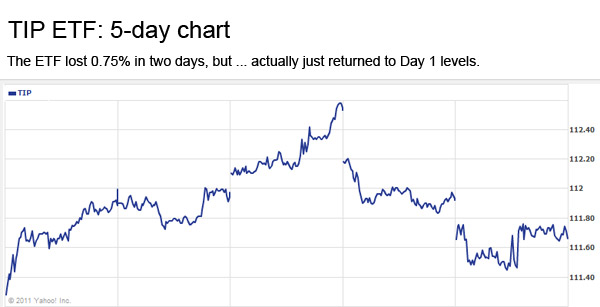
TIP ETF, 5-day chart

Posted in Investing in TIPS | 1 Comment

Yes or no on the 10-year TIPS auction of July 21?

The U.S. Treasury, at 1 p.m. Thursday, will auction $13 billion in a new-issue 10-year Treasury Inflation-Protected Security, Cusip 912820YP6.

Buy it: Yes or no? I say no. Here is Tuesday’s quote for the 10-year TIPS that will mature in January 2021, six months before this new issue will mature:

Maturity Coupon Bid Asked Yield to maturity
2021 Jan 15 1.125 105.27 105.32 0.479

0.479%, not good enough. Does this real yield, 0.479% above the rate of inflation, look appealing? It does not.

The yield has fallen dramatically in recent weeks. The 10-year TIPS auctioned in May went at a yield of 0.887%, hardly wonderful, but much better than 0.479%. On June 29, three weeks ago, the market yield was at 0.676%. Amazing.

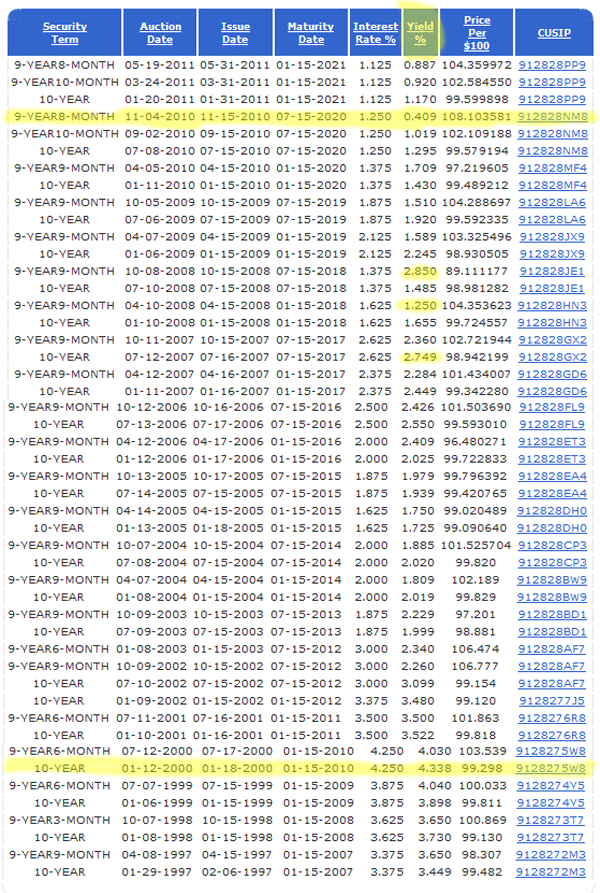
This auction could threaten a record-low yield for a 10-year TIPS.  Here are the auction yields for every 10-year TIPS ever issued or reissued:

10-year TIPS, all auctions

I highlighted the record low yield, 0.409% in November 2010, and the record high yield, 4.25% in January 2000. It’s worth noting that only three auctions, all recent, have ever gone under 1%.

Of course, we don’t know what kind of appeal Thursday’s issue will have. But I can’t imagine high demand at a time when the Treasury is facing a threat of default (unlikely, I hope) in 12 days. In addition, this is the first recent TIPS auction without the artificial demand of QE2. Maybe the yield will end up substantially higher. But as I have said before … don’t fool yourself into thinking you can predict a TIPS auction.

Still wavering? Thursday morning, recheck that Jan 2021 yield on the Barron’s chart.  TIPS had a crummy day Wednesday, with the TIP ETF falling 0.57%. The 10-year yield likely rose nicely. Make the call after seeing the closest market yield.

Update: Wednesday’s yield to maturity for the Jan 2021 TIPS closed at 0.550%, up substantially. This could be an very interesting auction today. The coupon rate would likely be 0.5% and the TIPS could go at a slight discount to par.

This is the last new issue of the year, but you will get several more chances to buy reissues; in fact, there is an auction every month of this year. Ten-year reissues will come up in September and November.

And, of course, your first $5,000 (or $10,000 or $20,000, depending on if you mix paper and electronic purchases) should be in I Bonds, anyway, if you haven’t invested in them this year.

Would this 10-year TIPS be a horrible investment? No, it would be fine. Here’s the thing: Do your thinking about TIPS before you buy. After you buy, forget it. If you are holding to maturity, you will do fine. Buy it and forget it.

Posted in Investing in TIPS | 2 Comments

Auction coming July 21: 10-year Treasury Inflation-Protected Security

Update: Yes or no on this 10-year TIPS auction?

The U.S. Treasury announced today that it will auction $13 billion in a new-issue 10-year TIPS, Cusip 912820YP6. The Treasury announcement does not say what the ‘coupon rate’ will be on this issue (it will be set at the auction, very close to the real yield). The coupon rate is what the TIPS actually pays for 10 years, in addition to adjustment of principal to match the inflation rate.

The issue date is July 29, 2011. The TIPS mature July 15, 2021.

The real ‘yield to maturity’ will be determined at the auction July 21, at 1 p.m. The yield to maturity is set by the market … buyers pay more, or less, than the par value to buy a TIPS at auction. That sets your real yield. But in this auction the two rates (coupon and real) will be very close.

Right now, it looks like the yield to maturity will be about 0.527%, which was Friday’s market rate for a 10-year TIPS maturing Jan. 15, 2021. This one should be close to that.

Buy it, or not? I’ll try to examine this more closely later this week, but right now my feeling is to skip this TIPS issue. There is way too much going on the in the markets right now (threat of a U.S. defaut, crisis in Europe, weak economy, etc.) to be enthusiastic about a 10-year TIPS that might pay just 0.5% above the rate of inflation.

This is the last new issue of the year, but you will get several more chances to buy reissues; in fact, there is an auction every month of this year. Ten-year reissues will come up in September and November.

And, of course, your first $5,000 (or $10,000 or $20,000, depending on if you mix paper and electronic purchases) should be in I Bonds, anyway, if you haven’t invested in them this year.

Posted in Investing in TIPS | Leave a comment

Would U.S. default create a ‘perfect storm’ for TIPS?

Update: How are TIPS holding up through this debt crisis?

Update 18 months later: The TIPS earthquake: When did it happen, and why?

Two years ago, Richard Ferri laid out the worst-case scenario for Treasury Inflation-Protected Securities in an article titled, ‘The Dark Side Of TIPS.’ The Forbes.com article is getting more attention right now as the U.S. grinds toward a potential default on its debt obligations. If that happened,  it could mean a ‘perfect storm’ for TIPS … higher interest rates combined with stable or even declining inflation.

Ferri, founder and director of research at Portfolio Solutions, wrote this in April 2009, well before the talk of default, but he makes many points that apply to this looming issue:

I would not argue with those who say that most long-term investors should have at least some of their retirement money in inflation-indexed bonds. However, there is another side to this story that is rarely discussed. There is a dark side to inflation indexed bonds. …

Overrated risk of inflation?

Let me first say the financial markets have a way of doing things that we least expect. When everyone expects something to happen, it usually doesn’t. Today, a majority of people expect inflation to be a problem in the future because the Fed has increased the money supply significantly …

Currently, monetary policy has placed interest rates near zero percent. The Fed cannot be any more accommodative unless they pay banks to borrow money. The only place interest rates can go is up–and higher interest rates will likely squeeze any inflation out of the system rather quickly as loan demand will drop as soon as rates increase. Consequently, inflation is probably not the big threat that investors think.

Loss of confidence in U.S. debt?

The risk is a loss of confidence by our trading partners who hold trillions of dollars in U.S. Treasury bonds. … Selling may beget selling as one country tries to dump ahead of others. The only way to make U.S. debt attractive again is for real interest rates to go up substantially to match the level of perceived risk in U.S. obligation. That is the big risk for TIPS investors.

That last quote sums up the current risk: If the U.S. defaults on its debt in August, or the rating agencies downgrade U.S. debt before then, would the immediate effect be higher interest rates on U.S. debt? (And, ironically, even higher U.S. debt?)

What this means for TIPS. If you are holding TIPS to maturity, and you have laddered them over many maturity dates and base interest rates, you wouldn’t see much of an effect with a short-term default. Since TIPS just paid semiannual interest July 15, you aren’t likely to miss an interest payment.

Your current, more recent holdings might pay a lower interest rate than new issues, if the higher interest rates continued. But that is the whole idea of laddering. Buy the new issues, get a higher rate.

TIPS mutual funds, though, could take an immediate hit if the base interest rate on TIPS rises. The duration of the TIP ETF is 4.01, so a 2-percentage-point increase in the base rate — which is not out of the question — could cost you 8% or so of your principal. But even that is hardly a ‘perfect storm.’

This scenario would set up a buying opportunity in TIPS mutual funds, in my opinion. (I don’t own any TIPS mutual funds at the moment, so this would be something to watch.)

Will the U.S. default? I hope not. That would be a true disaster, in my opinion. On the other hand, the bond market does not seem worried. Here is a seven-month chart of the TIP ETF:

7 month chart of TIP ETF

Does this look like a bond market that is worried about a U.S. default, two weeks from now?

Ferri posted a note today in the Bogleheads forum referencing his April 2009 article and gave this updated opinion:

I don’t believe there is a high probability of the dark side scenario. More likely, Treasury will print as much money as we need to pay our debts, thereby creating an inflationary scenario. This scenario would make TIPS attractive.

Posted in Investing in TIPS | Leave a comment