5-year TIPS reopening auction gets a real yield of 2.050%

By David Enna, Tipswatch.com

The Treasury’s offering of $21 billion in a reopened 5-year Treasury Inflation-Protected Security — CUSIP 91282CKL4 — generated a real yield to maturity of 2.050%, slightly lower than expected.

The auction appears to have been met with decent demand. The “when-issued” prediction used by bond traders was set at 2.070% right before the auction’s close. In addition, the bid-to-cover ratio of 2.52 was in the solid range.

The yield came in below the April 18 originating auction‘s real yield of 2.242%, which set the coupon rate for this TIPS at 2.125%. However, this was only the third TIPS auction of this term to get a real yield higher than 2.0% since October 2008. There have been 50 auctions of 4- to 5-year TIPS since October 2008, so today’s result is significant.

This TIPS trades on the secondary market and earlier Thursday morning it was trading with a real yield of 2.08%. The auction result of 2.050% indicates demand was strong. Apparently, inflation protection still has some appeal.

Here is the trend in the 5-year real yield over the last four years:

Click on image for larger version

Pricing

Because the real yield came in below the existing coupon rate of 2.125%, today’s investors had to pay a small premium at this auction. The unadjusted price was 100.338480. In addition, CUSIP 91282CKL4 will have an inflation index of 1.01332 on the settlement date of June 28.

This is how the pricing works out for a $10,000 par investment at today’s auction:

  • Par value: $10,000
  • Principal on settlement date: $10,000 x 1.01332 = $10,133.20
  • Cost of investment: $10,133.20 x 1.00338480 = $10,167.50
  • + $43.54 of accrued interest, which will be returned at the first coupon payment.

In summary, an investor purchasing $10,000 par at this auction paid $10,167.50 for $10,133.20 of principal, and will now receive accruals matching inflation plus a coupon rate of 2.125% until maturity on April 15, 2029.

Inflation breakeven rate

In my preview article for this auction, I noted that the market was setting a 5-year inflation breakeven rate of 2.12%, which seems low given current inflation trends. But this auction narrowed the gap, a bit. With a 5-year nominal Treasury trading at 4.28% at the auction’s close, this TIPS gets an inflation breakeven rate of 2.23%.

That means it will outperform the nominal Treasury if inflation averages more than 2.23% over the next 4 years, 10 months. Seems like a reasonable bet.

Here is the trend in the 5-year inflation breakeven rate in the last four years:

Click on image for larger version.

Thoughts

There was nothing really out-of-the ordinary about this auction. The 5-year real yield closed Tuesday at 2.07%, pretty close to the result. A real yield of more than 2.0% is a solid investment, in my opinion. If you were a buyer, this looks good.

How good? Here is a history of TIPS auctions of this 4- to 5-year term, highlighting the lowest real yield in history, -1.685%, in an auction in October 2021. Since then, in less than three years, real yields have risen 373 basis points.

Now is an ideal time to build a TIPS ladder

Confused by TIPS? Read my Q&A on TIPS

TIPS in depth: Understand the language

TIPS on the secondary market: Things to consider

Upcoming schedule of TIPS auctions

* * *

Follow Tipswatch on X (Twitter) for updates on daily Treasury auctions and real yield trends (when I am not traveling).

Feel free to post comments or questions below. If it is your first-ever comment, it will have to wait for moderation. After that, your comments will automatically appear.Please stay on topic and avoid political tirades.

David Enna is a financial journalist, not a financial adviser. He is not selling or profiting from any investment discussed. I Bonds and TIPS are not “get rich” investments; they are best used for capital preservation and inflation protection. They can be purchased through the Treasury or other providers without fees, commissions or carrying charges. Please do your own research before investing.
Posted in Inflation, Investing in TIPS | Tagged , , , , , , , | 9 Comments

Inflation breakeven rate makes 5-year TIPS auction look attractive

Do you believe inflation will average more than 2.12% over the next 5 years?

By David Enna, Tipswatch.com

The U.S. Treasury on Thursday will offer $21 billion in a reopened 5-year Treasury Inflation-Protected Security, CUSIP 91282CKL4.

The result will be a 4-year, 10-month TIPS with a coupon rate of 2.125%, which was set by the originating auction on April 18, 2024. The auction size of $21 billion is the largest for any 5-year TIPS reopening in history, up from $20 billion in December 2023 and $19 billion a year ago in June 2023.

I was a buyer at that originating auction, which generated a real yield to maturity of 2.242%, the 2nd highest at auction in 15 years for any 4- to 5-year TIPS. As of Friday, CUSIP 91282CKL4 was trading on the secondary market with a slightly lower real yield of 2.12%.

What makes this auction interesting is the sudden shakeup of both real and nominal yields, triggered by a soft inflation report released Wednesday. That report caused speculation the Federal Reserve would cut interest rates several times in 2024, but then the Fed tamped down the euphoria with a prediction of “one … or maybe two” rate cuts this year, depending on the data it sees. This set off a shakeup in bond yields:

  • Nominal. On Monday, the 5-year nominal Treasury note closed with a yield of 4.48%, which fell to 4.22% by Friday, a drop of 20 basis points.
  • Real. The 5-year TIPS real yield closed Monday at 2.21% and fell to 2.11% at Friday’s close, a drop of only 10 basis points.

The difference means the 5-year inflation breakeven rate — a measure of future inflation expectations — fell by 10 basis points in a week. And in fact, the breakeven rate of 2.11% hit a low for 2024. I heard a commentator on Bloomberg this week mention the “collapse in breakevens” as a significant event. I wrote about this wild yield trend back on June 9: Read that here.

A lower inflation breakeven rate indicates a TIPS is “cheaper” as an investment versus the nominal Treasury of the same term. Here is the trend in the 5-year inflation breakeven rate so far in 2024:

Rate estimates are for full-term TIPS.

In just two months, expectations for inflation over the next five years have fallen 41 basis points. That is a remarkable move lower, and potentially makes the 5-year TIPS an attractive investment when measured against a nominal Treasury.

Here is a 20-year look at the 5-year inflation breakeven rate, showing that 2.12% is in a historically high range, but well below recent trends. In my opinion, the risk of under-performance for this 5-year TIPS (versus a nominal Treasury) is small.

The real yield

CUSIP 91282CKL4 trades on the secondary market, and you can track its real yield on Bloomberg’s Current Yields page, which updates in real time. It closed Friday at 2.12%, just slightly below the coupon rate of 2.125%. Here is the trend in 5-year real yields over the last 20 years:

A lot can change this week, especially with the high volatility we’ve seen in the last month. Just based on reasonable inflation expectations, it seems like the yield should be more in the range of 1.95% to 2.00%. That’s not a prediction, just an observation.

Pricing

Bloomberg shows a price very close to par value, 100.02, given that the current real yield is close to the coupon rate of 2.125%. This TIPS will have an inflation index of 1.01332 on the settlement date of June 28. So that leads to this estimate of the potential cost of $10,000 par at auction:

  • Par value: $10,000
  • Principal purchased: $10,000 x 1.01332 = $10,133.20
  • Cost of investment = $10,133.20 x 1.0002 = $10,135,23
  • + about $43.54 of accrued interest.

This calculation is an estimate and is highly likely to change in the next week.

Thoughts

It will be interesting to see if the real yield of this TIPS holds above 2.0% over the next week. It could be that bond-market turmoil left real yields a bit out of sorts on Friday. Or … investors really have decided that inflation could average less than 2.12% over the next 4 years, 10 months. If yields hold, this TIPS is attractive versus the nominal Treasury.

Last week, you could find best-in-nation 5-year bank CDs yielding 4.50%, which moves the inflation breakeven rate up to 2.38%, a more reasonable number. But we could see those bank CD rates fall if the downward Treasury yield trend continues.

I won’t be a buyer because I already own this TIPS and the 2029 rung of my TIPS ladder is fully stocked. If you are considering a purchase, watch Bloomberg’s Current Yields page during the week. The 5-year quote there is for CUSIP 91282CKL4. (And of course you can buy this TIPS at any time on the secondary market.)

This TIPS auction closes Thursday at 1 p.m. EDT. Non-competitive bids at TreasuryDirect must be placed by noon Thursday. If you are putting an order in through a brokerage, make sure to place your order Wednesday or very early Thursday, because brokers cut off auction orders before the noon deadline.

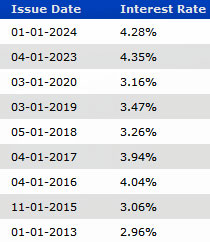
I will be posting the auction results soon after the close on Thursday. Here is a history of auction results for this term over the last 7 years:

Now is an ideal time to build a TIPS ladder

Confused by TIPS? Read my Q&A on TIPS

TIPS in depth: Understand the language

TIPS on the secondary market: Things to consider

Upcoming schedule of TIPS auctions

* * *

Follow Tipswatch on X (Twitter) for updates on daily Treasury auctions and real yield trends (when I am not traveling).

Feel free to post comments or questions below. If it is your first-ever comment, it will have to wait for moderation. After that, your comments will automatically appear.Please stay on topic and avoid political tirades.

David Enna is a financial journalist, not a financial adviser. He is not selling or profiting from any investment discussed. I Bonds and TIPS are not “get rich” investments; they are best used for capital preservation and inflation protection. They can be purchased through the Treasury or other providers without fees, commissions or carrying charges. Please do your own research before investing.
Posted in Bank CDs, Federal Reserve, Inflation, Investing in TIPS, TreasuryDirect | Tagged , , , , , , | 31 Comments

May’s inflation report gives the Fed breathing room

Both all-items and core inflation came in below expectations.

By David Enna, Tipswatch.com

The Federal Reserve, which is set to provide future rate predictions this afternoon, got a bit of good news this morning from the May inflation report. Inflation came in below expectations, across the board.

The Consumer Price Index for All Urban Consumers was unchanged in May on a seasonally adjusted basis, the U.S. Bureau of Labor Statistics reported. Over the last 12 months, the all-items index increased 3.3%. Both of these numbers came in lower than the expectations for 0.1% monthly and 3.4% annual.

Core inflation, which removes food and energy, also fell below expectations, rising 0.2% for the month and 3.4% year-over-year. Annual core inflation, while still too high, has now fallen from 5.3% in May 2023 to 3.4% in May 2024, a very encouraging trend.

The BLS pointed to two key factors in the May report: Gasoline prices fell 3.6% for the month and are now up 2.2% year-over-year. That was offset by a continuing increase in shelter costs, up 0.4% for the month and 5.4% year-over-year. More data from the report:

  • The costs of food at home were unchanged in May and are up only 1.0% for the year.
  • The medical care index rose 0.5% in May after rising 0.4% in April.
  • Costs of prescription drugs rose 2.1% for the month.
  • Airline fares fell 3.6% in May and are down 5.9% for the year.
  • Costs for used cars and trucks rose 0.6% but are down 9.3% year over year.
  • Costs for new vehicles fell 0.5% and are down 0.8% for the year.
  • Apparel costs fell 0.3% for the month.
  • Costs of motor vehicle insurance fell a meager 0.1% for the month, but are up 20.3% for the year.

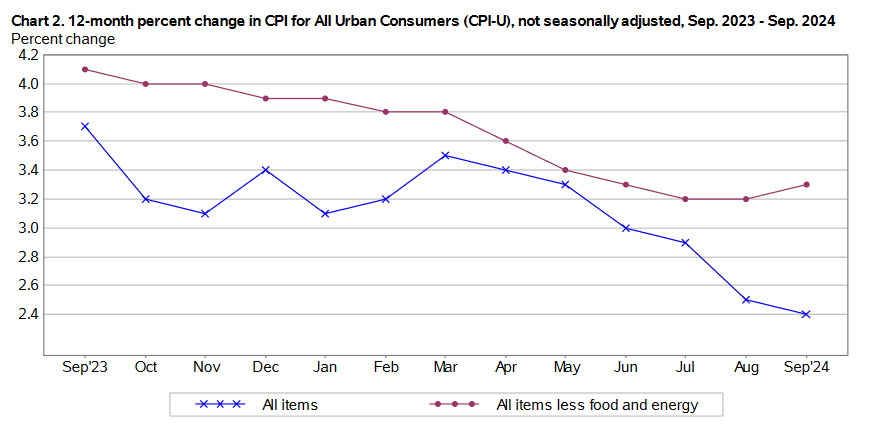
Here is the one-year trend for annual all-items and core inflation, showing how core inflation has finally begun falling from levels near 4.0%:

What this means for TIPS and I Bonds

Investors in Treasury Inflation-Protected Securities and U.S. Series I Savings Bonds are also interested in non-seasonally adjusted inflation, which is used to adjust principal balances on TIPS and set future interest rates for I Bonds. For May, the BLS set the inflation index at 314.069, an increase of 0.17% over the April number.

For TIPS. The May CPI index will reset principal balances for all TIPS higher by 0.17% in July, after rising 0.39% in June. Keep in mind that non-seasonal inflation tends to run higher than headline CPI from January to June, and then lower at the end of the year. Eventually, over a year, the numbers balance out.

Here are the new July Inflation Indexes for all TIPS.

For I Bonds. The May report is the second in a six-month string that will set the I Bond’s new inflation-adjusted variable rate, which will be reset on November 1 and eventually roll into effect for all I Bonds. At this point, after two months, inflation has increased 0.56%. It is too early to draw any conclusions, but note that in 2023 March to May inflation increased 0.76%.

Here are the relevant data:

Track historical data on my Inflation and I Bonds page.

What this means for future interest rates

Obviously, the Federal Reserve can breathe a sigh of relief, with inflation coming in below market expectations and annual core inflation falling 20 basis points. This is good news in the battle against U.S. inflation.

Does this mean we will get a rate cut this afternoon? That is highly unlikely, but here is Bloomberg’s headline this morning: “US CPI Report Opens Door to Multiple 2024 Fed Rate Cuts“. Selected quotes from the article:

The good news on inflation extended to the so-called “supercore” measure of core services less housing. On a monthly basis, the measure was negative (-0.04%) for the first time since late 2021.

The expectation at this point in markets will be that the Fed later today projects two rate cuts for 2024. If we only get one, that could see a negative reaction in Treasuries and stocks.

“A 0.2% monthly core CPI reading should be the base case for the balance of the year, especially as it looks more and more like the long-awaited slowdown in shelter costs will hit as soon as the next report.” (quote from Omair Sharif of Inflation Insights)

We are seeing an immediate effect on the markets, with the S&P 500 trading up about 1% this morning in the premarket, just minutes from the opening. Real yields have taken a sharp dip lower, with the 5-year falling from 2.16% at yesterday’s close to 2.08% this morning. The 10-year is at 2.05%, down from yesterday’s 2.12%.

Of course, we have seen a lot of head-fakes on U.S. inflation over the last four years. This time, the trend does look positive, but the Fed knows the battle must continue. Expect rate cuts to come at a measured, cautious pace.

* * *

Follow Tipswatch on X (Twitter) for updates on daily Treasury auctions and real yield trends (when I am not traveling).

Feel free to post comments or questions below. If it is your first-ever comment, it will have to wait for moderation. After that, your comments will automatically appear.Please stay on topic and avoid political tirades.

David Enna is a financial journalist, not a financial adviser. He is not selling or profiting from any investment discussed. I Bonds and TIPS are not “get rich” investments; they are best used for capital preservation and inflation protection. They can be purchased through the Treasury or other providers without fees, commissions or carrying charges. Please do your own research before investing.

Posted in Federal Reserve, Inflation, Investing in TIPS, Savings Bond | Tagged , , , , , , | 13 Comments

Real yields continue their wild ride

By David Enna, Tipswatch.com

If you follow me on Twitter (yes, I still call it Twitter), you might have seen a very recent (June 5) post observing that real yields appeared to be heading back below 2.0%, breaking a two-month trend.

Meaningful shift? I was wrong. That was just two market days ago, but things reversed rather dramatically in reaction to the May jobs report released Friday morning. The report was much more positive than expected, raising concerns that the Federal Reserve will now put off any rate cuts until 2025. From the UPI report:

Hiring accelerated in May as employers added a robust 272,000 jobs … Economists had estimated that 185,000 jobs were added last month, according to a Bloomberg survey. Average hourly pay rose 14 cents to $34.91, pushing up the yearly increase to 4.1%.

“These data are in no way supportive of an imminent move by the Fed to lower rates,” economist Rubeela Farooqi of High Frequency Economics wrote in a note to clients.

This report hit the bond market hard, with the the total bond market (BND ETF) falling 0.80% in one day. The TIP ETF, which holds the full range of maturities of Treasury Inflation-Protected Securities, fared even worse, down 0.82%. The Treasury’s estimate of the 10-year real yield rose 13 basis points in one day, to close Friday at 2.13%.

It’s been a crazy year so far for real yields, as summarized in this chart:

A year ago, on June 8, 2023, the 10-year real yield stood at 1.53%, a whopping 60 basis points lower than today’s 2.13%. At that time, the Fed was still one month away from its final rate increase. On July 26, 2023, it raised its federal funds rate target to 5.25% to 5.50%, where it remains today.

The 10-year real yield reached its 2023 high on Oct. 25 at 2.53% before gradually sliding to 1.74% to begin 2024. The market still hasn’t matched that high in 2024. Could it? A week ago, I had my doubts, but the apparently robust U.S. economy opens the door to higher yields.

At the same time, inflation seems to be weakening. The Cleveland Fed’s Inflation Nowcasting site is predicting CPI inflation of just 0.08% for May and 0.14% for June. U.S. gas prices have fallen nearly 7% since early April. The U.S. dollar strengthened Friday in reaction to the jobs report, plus rate cuts this week by the both European and Canadian central banks. A stronger dollar tends to hold down inflation.

Weaker inflation could give the Fed the opening it needs to cut interest rates later this summer, but then the fall national election begins looming. The Fed seems comfortable with holding rates at these levels for many months.

What does this mean?

This week’s boost in real yields opens another buying opportunity for people looking to build a ladder of TIPS to hold to maturity. Real yields are again solidly above 2.0%, a historically attractive level. And they could go higher. Who knows?

Here is a year-to-date chart of the net asset value of the TIP ETF, which holds the full range of maturities.

Net asset value does not include distributions. TIP has had a total return of 0.05% year-to-date.

This chart could be painful for investors looking for capital gains on their TIPS holdings. But for investors holding individual TIPS to maturity, market swings don’t matter. An investor in an individual TIPS today can earn 2.0%+ above inflation for the length of the term. Here is a look at assorted secondary-market offerings I found Saturday on Vanguard’s platform:

I set the search for maturities from 2029 to 2043 and there are a lot of interesting offerings — 19 in total –some with high coupons (and premium prices), some with low coupons (and discounted prices). All 19 have real yields above 2.0%.

Despite the yield swings, TIPS remain an attractive investment.

Now is an ideal time to build a TIPS ladder

Confused by TIPS? Read my Q&A on TIPS

TIPS in depth: Understand the language

TIPS on the secondary market: Things to consider

Upcoming schedule of TIPS auctions

* * *

Feel free to post comments or questions below. If it is your first-ever comment, it will have to wait for moderation. After that, your comments will automatically appear.Please stay on topic and avoid political tirades.

David Enna is a financial journalist, not a financial adviser. He is not selling or profiting from any investment discussed. I Bonds and TIPS are not “get rich” investments; they are best used for capital preservation and inflation protection. They can be purchased through the Treasury or other providers without fees, commissions or carrying charges. Please do your own research before investing.
Posted in Federal Reserve, Inflation, Investing in TIPS | Tagged , , , , , | 23 Comments

AllianceBernstein suggests a 60/30/10 portfolio to protect against inflation

Investment firm sees ‘higher and spikier’ inflation looming.

By David Enna, Tipswatch.com

AllianceBernstein, a global investment firm with about $725 billion in assets under management, is now advising its clients to replace the traditional 60% stocks / 40% bonds portfolio with a 60/30/10 model, with the 10% being allocated to inflation protection.

AllianceBernstein has its headquarters in Nashville and offices in 26 countries.

The strategy grew out of an April 2 report by two senior bond experts at the firm — Serena Zhou and AJ Rivers — who made the case that inflation protection in the form of Treasury Inflation-Protected Securities is now a “unique opportunity.”

As inflation recedes from recent cyclical highs, many investors are selling their holdings of inflation-protected securities. The result? Explicit inflation protection has become unusually cheap. Investors needing to boost their strategic allocations to inflation strategies may wish to take advantage of this opportunity—securing inexpensive “flood” insurance ahead of higher structural inflation over the coming decade.

The authors theorize that global economies are moving toward an era of “higher and spikier” inflation, triggered by three powerful forces:

  • Deglobalization, which leads to potential labor shortages, higher labor costs, and potential supply shortages.
  • Aging demographics, which also shrinks the labor pool.
  • Climate change, which could drive energy, transportation, insurance, food and other costs higher in the future.

The authors point out that in the last three years, U.S. consumers lost 16% of their purchasing power. While inflation seems to be easing in 2024, the dangers remain:

(W)e think it’s more likely that 2% becomes a lower bound for inflation, rather than a central-bank target. Indeed, it’s highly likely we’ve already entered this new regime … Yet even marginally higher inflation represents a key risk. For example, if inflation persists at just 2.8%, an unprotected investor will have lost 35% of purchasing power 15 years from today.

The authors note: “That’s why, in our view, the wisest defense against unexpected inflation is to maintain a strategic allocation to an active inflation strategy that includes explicit inflation protection in the form of TIPS.”

The price of protection

In the 27-year history of TIPS, the authors note, these securities have yielded an average of 90 basis points below GDP growth. Today, with real yields well above 2% across the TIPS maturity spectrum, TIPS have yields close to or above GDP growth predictions for the next decade.

In other words, TIPS are abnormally cheap today relative to long-term averages; they’re also cheap if inflation surprises to the upside in the near future; and they’re cheap given our expectations for higher long-term inflation over the next decade.

Click on image for larger version

The investment strategy

The authors suggest that investors should increase allocations to inflation protection.

In our analysis, a 10% allocation to inflation protection—for example, shifting from a typical 60/40 portfolio to a 60/30/10 allocation—may meaningfully improve risk-adjusted potential return under the new inflation regime.

Will that shift reduce investment returns? The authors theorize that it won’t and in fact could enhance returns. They suggest concentrating on shorter average duration to reduce interest-rate risk while retaining inflation protection. They conclude:

In our view, the right active inflation strategy should help investors beat inflation without sacrificing return. Between the low price of getting inflation protection today and the high cost of not having such insurance tomorrow, we believe the time is right to beat the inflationary tide.

The authors, unfortunately, then revert to “global investment firm” advice by suggesting backing up the TIPS holdings with high-yield bonds and emerging market debt. I am not a fan of that advice. Keep your bond allocation in safe investments and take risk elsewhere.

Thoughts

The AllianceBernstein authors raised an interesting point about real yields currently matching or potentially exceeding future GDP growth, which makes TIPS look like an under-priced investment. At the same time, investor interest is waning.

“Investors have been selling inflation protection in the mistaken belief that it’s no longer needed,” Rivers and Zhou wrote. Total net assets in this category have declined in each quarter from mid-2022 through March. In an interview with Barrons, Rivers noted that investors shouldn’t try to time inflation protection. From that article:

By buying TIPS “you’re getting a real yield of 2% plus any inflation accretion,” says Serena Zhou, portfolio manager for Fixed Income US Multi-Sector at AllianceBernstein. “If there are any unexpected inflation hikes, you are immunized from those spikes.”

Although my personal portfolio has only a 35% allocation to stocks, I have tried to achieve a 15% asset allocation in inflation protection. So my target would be more like 35% in stocks, 50% in bonds, CDs & cash, and 15% in I Bonds and individual TIPS held to maturity.

Over most of the past 13 years, attempting to build an inflation-protected allocation has been frustrating, with real yields often well below zero. That made I Bonds look super attractive with a fixed rate of only 0.0%. Today, the situation is reversed. Real yields are attractive. They could go higher, but today’s real yields are historically attractive.

My allocation is an outlier. For most people approaching or in retirement, this 60 / 30 / 10 recommendation from AllianceBernstein passes the “common sense” test. Placing 10% of your portfolio in TIPS and I Bonds is a quality recommendation for the cautious investor.

Now is an ideal time to build a TIPS ladder

Confused by TIPS? Read my Q&A on TIPS

TIPS in depth: Understand the language

TIPS on the secondary market: Things to consider

Upcoming schedule of TIPS auctions

* * *

Feel free to post comments or questions below. If it is your first-ever comment, it will have to wait for moderation. After that, your comments will automatically appear.Please stay on topic and avoid political tirades.

David Enna is a financial journalist, not a financial adviser. He is not selling or profiting from any investment discussed. I Bonds and TIPS are not “get rich” investments; they are best used for capital preservation and inflation protection. They can be purchased through the Treasury or other providers without fees, commissions or carrying charges. Please do your own research before investing.
Posted in Cash alternatives, Investing in TIPS, Retirement | Tagged , , , , , | 42 Comments