
By David Enna, Tipswatch.com
Too often, the bond market tricks you. It happened again Thursday in the wake of Wednesday’s “sort-of surprise” action by the Federal Reserve to cut short-term interest rates by 50 basis points.
The initial (and expected) reaction after the Fed announcement was that real yields for 5- and 10-year Treasury Inflation-Protected Securities dropped by about 5 to 7 basis points. The stock market moved higher. And then … things turned around, with stock prices dipping and Treasury yields rising.
All that led into today’s $17 billion reopening auction of CUSIP 91282CLE9, creating a 9-year, 10-month TIPS. This TIPS trades on the secondary market, and at one point on Wednesday afternoon its real yield dipped to about 1.53%, before rising back to about 1.58% at the market close.
Thursday’s auction, which closed at 1 p.m. EDT, resulted in a real yield to maturity of 1.592%, which should look acceptable to investors. The “when-issued” prediction was 1.59%. The bid-to-cover ratio was a solid 2.44. By any measure, this auction went off without a hitch.
Of course, real yields have declined mightily in 2024 as the Fed began signaling its intention to cut interest rates. As recently as May 23, 2024, a similar 10-year TIPS auction generated a real yield of 2.184%, the highest since 2009. Yields have fallen 59 basis points since then.
Here is the trend in the 10-year real yield since January 2023, with today’s result falling close to the middle of the yield range:

For now, the days of 2.0% real yields are over, even for very long-term TIPS. The 30-year TIPS is trading today at 1.92%.
Pricing

CUSIP 91282CLE9 has a coupon rate of 1.875%, which was set by the originating auction on July 18. Because the auctioned real yield was well below the coupon rate, investors had to pay a premium price for this TIPS. The unadjusted price was 102.554561. In addition, it will carry an inflation index ratio of 1.00237 on the settlement date of September 30:
With that information, we can look at the actual investment cost of a purchase of $10,000 par value at this auction:
- Par value: $10,000.
- Principal purchased as of Sept. 30: $10,000 x 1.00237 = $10,023.70.
- Cost of investment: $10,023.70 x 1.02554561 = $10,279.76.
- + Accrued interest of about $39.33.
In summary, an investor purchasing $10,000 par at this auction paid $10,279.76 for $10,023.70 of principal and will now earn inflation accruals plus an annual coupon of 1.875% on accrued principal.
Inflation breakeven rate
With a 10-year nominal Treasury trading at 3.75% at the auction’s close, this TIPS gets an inflation breakeven rate of 2.16%, well below recent trends. In fact, this is the lowest breakeven rate for an auction of this term since January 2021. It indicates that this TIPS will outperform a nominal 10-year Treasury if inflation averages more than 2.16% over the next 9 years, 10 months.
Here is the trend in the 10-year inflation breakeven rate since January 2023, showing the sharply downward trend since May 2024:
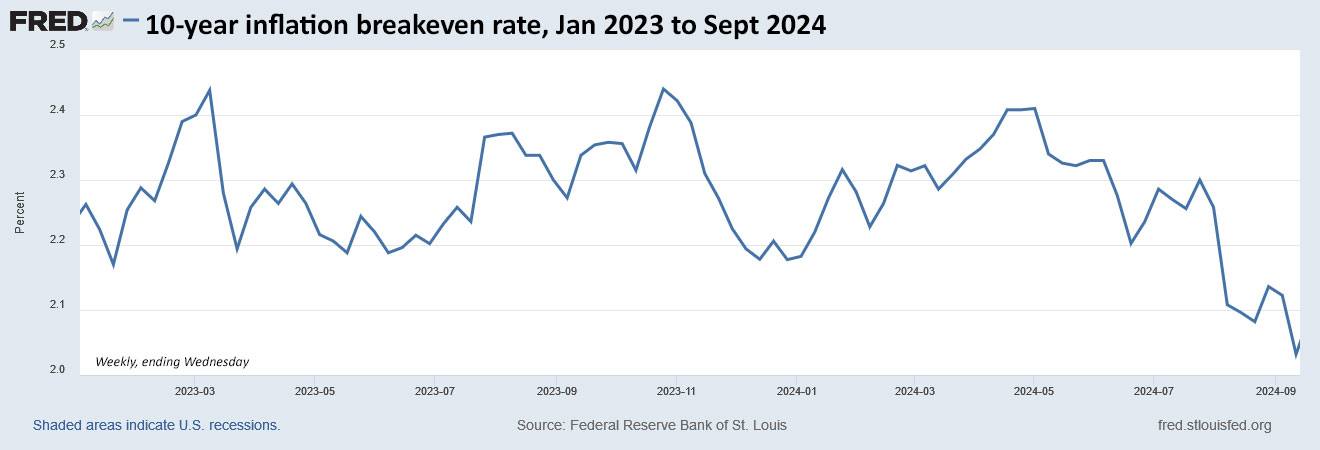
I think it would be logical that the Fed’s dovish cut of 50 basis points would increase fears of potential inflation, since the Fed now seems to be focusing its attention on labor markets versus U.S. inflation. And the result? This rate of 2.16% is slightly higher than the breakeven at Tuesday’s market close, 2.12%.
Reaction to the auction
As I noted, this auction result looks right on target with expectations. Both the Treasury and investors can be pleased with the result. Demand was reasonably strong and the real yield was reasonably high.
CUSIP 91282CLE9 will have one more reopening auction on November 21, 2024, two weeks after 1) the U.S. presidential election on Nov. 5, and 2) another rate-cutting decision by the Federal Reserve on Nov. 6. A whole lot could change by then.
Here is the history of 9- to 10-year TIPS auctions going back to January 2021:

—————————-
• Confused by TIPS? Read my Q&A on TIPS
• TIPS in depth: Understand the language
• TIPS on the secondary market: Things to consider
• TIPS investor: Don’t over-think the threat of deflation
• Upcoming schedule of TIPS auctions
* * *
Follow Tipswatch on X (Twitter) for updates on daily Treasury auctions and real yield trends (when I am not traveling).
Feel free to post comments or questions below. If it is your first-ever comment, it will have to wait for moderation. After that, your comments will automatically appear. Please stay on topic and avoid political tirades. NOTE: Comment threads can only be three responses deep. If you see that you cannot respond, create a new comment and reference the topic.
David Enna is a financial journalist, not a financial adviser. He is not selling or profiting from any investment discussed. I Bonds and TIPS are not “get rich” investments; they are best used for capital preservation and inflation protection. They can be purchased through the Treasury or other providers without fees, commissions or carrying charges. Please do your own research before investing.







Fred, did you see my reply to you in the Pandora's Box article? Worth a look. While I am not…