Highlights from Eastern Europe: Freedom, history, beauty … and inflation

I’ve been gone three weeks. Did anything happen?

By David Enna, Tipswatch.com

Yes, I am now back home after a three-week adventure in Eastern Europe — Czech Republic, Slovakia, Hungary and Romania. In all, adding in a recent trip to southern Italy and Sicily, I have been in Europe for six of the last 10 weeks. It seems like a lot has happened in those three months, right?

One thing that didn’t happen: No one in my small traveling groups — 12 in Italy and 6 in Eastern Europe (down to 4 in Romania for an optional extension) — contracted Covid, which was a huge relief. You have to take a Covid test 24 hours before flying to the United States. We all got to go home, but we heard of many travelers forced to extend their vacations by at least five days in isolation.

Bran Castle in Bran, Romania. Home of Vlad the Impaler, inspiration for Count Dracula.

Some impressions of these formerly Soviet-dominated lands in Eastern Europe:

  • In Italy, which learned some harsh Covid lessons in 2020, nearly everyone wore face masks indoors — churches, museums, even restaurants until seated. A few weeks later in Eastern Europe, we saw close to zero face masks anywhere, even in Vlad the Impaler’s very crowded castle in Transylvania, attacked by hordes of school children. (Our group did wear face masks in crowded indoor places, but we didn’t see many others.)
  • These Eastern European countries are all members of NATO and the European Union. The atmosphere and spirit is totally Western. People are heading to prosperity, loving newfound freedoms, wearing colorful and fashionable clothes, driving on traffic-filled streets. Always very friendly. Russia is almost universally considered the enemy. English is every young person’s second language.
  • Nearly everyone in all the countries complained of corrupt governments, a legacy of the restrictive communist systems. “It’s going to take us another 30 years to develop a rule of law,” one young women told me in Brasov, Romania. “It will take Russia at least another 100 years, or more.”
  • Hungary, a country I’ve visited twice before, is bucking against the European Union’s actions against Russia, mainly to get concessions on gas and oil shipments. Hungary’s nationalistic government has some grievances against Ukraine and Romania, and that is troubling. (Hungarian-speaking communities survive in both countries, and Hungary still complains about its borders.)
  • Press freedoms are also under attack in Hungary, a troubling trend. Many of the dissident news outlets have shut down, not by direct action by the government, but from lack of funds.
  • When the topic turned back to the United States, almost everyone asked us: “Why are there so many guns in your country?”
  • These should all be tourist meccas, with magnificent UNESCO-protected towns dotting the landscape. but the combination of lingering Covid and the war in Ukraine is scaring tourists off. Our guide in Romania told us that Overseas Adventure Travel (our trip company) had planned for 40 tours this summer. Only two are now scheduled, and our group had only four people.
  • Tourists should not fear. These are safe places full of friendly people who appreciate American travelers. The Ukraine war is on people’s minds, but is not any kind of threat right now.

However … Inflation is a huge problem in these countries, which are suffering from soaring gas, food and housing prices. Grocery stores, however, are well stocked and life is going on. Here are some recent inflation numbers, much worse that the U.S. rate of 8.3%:

  • Czech Republic, annual inflation of 14.2% (as of April)
  • Slovakia, annual inflation of 11.8% (April), an all-time high
  • Hungary, annual inflation of 10.7% (May)
  • Romania, annual inflation of 13.7% (April), highest since Feb. 2004

The war in Ukraine has accelerated these inflationary trends, but inflation is clearly a global problem that is going to be difficult to get under control.

Since I’ve been gone …

I left for Prague on Tuesday, May 17, and it seemed from a distance like financial markets started falling apart immediately. But I really wasn’t paying attention, other than to write my report on the April inflation numbers. In actuality, not much to to see here. The S&P 500 started that period at 4,088 and closed Tuesday at 4,156. All good. Here’s what happened to real yields in those three weeks:

  • The 5-year real yield started at -0.12% and closed Tuesday at -0.04%
  • The 10-year real yield started at 0.27% and ended at 0.25%.
  • The 30-year real yield started at 0.65% and ended at 0.58%.

So, the yield curve flattened, and that is a sign that recession fears are increasing and also should mean that inflation fears are subsiding, a bit. The 10-year inflation breakeven rate now stands at about 2.76%, very close to where it was on May 17.

Nominal Treasurys are starting to get interesting, with the 13-week Treasury now yielding 1.26% and the 1-year at 2.26%. Is your bank paying 2.26% for a 1 year CD? Probably not. Treasurys are the way to go right now for short-term savings. The 5-year Treasury note slipped above 3% on Monday. It could be worth a look, too.

Coming up …

From Econoday.com

The May inflation report will be released Friday at 8:30 a.m. EST. The consensus estimate is for monthly inflation to run at 0.7% and year-over-year at 8.2%. These numbers — influenced heavily by rising energy costs — remain stubbornly and dangerously high.

I’ll be posting my inflation analysis, and its effect on TIPS and I Bonds, on Friday morning.

Also, a 5-year TIPS reopening auction is coming up on June 23. That auction could be attractive, and I will be posting a preview article on Sunday, June, 19.

So, yes, I am back.

* * *

Feel free to post comments or questions below. If it is your first-ever comment, it will have to wait for moderation. After that, your comments will automatically appear.

David Enna is a financial journalist, not a financial adviser. He is not selling or profiting from any investment discussed. The investments he discusses can purchased through the Treasury or other providers without fees, commissions or carrying charges. Please do your own research before investing.

Posted in Bank CDs, Inflation | 9 Comments

10-year TIPS reopening auction gets a real yield of 0.232%, a strong result for investors

For the first time in 2 years, a 10-year TIPS auctioned with a real yield positive to inflation and a price discounted to par value.

By David Enna, Tipswatch.com

Here I am, vacationing in the beautiful city of Prague, and the financial world is seemingly falling apart. Earlier this morning it appeared stocks were plunging again, and my soon-to-be-completed investment in a 10-year TIPS reopening looked pretty punk.

The Treasury auctioned $14 billion in CUSIP 91282CDX6 today, creating a 9-year, 8 month Treasury Inflation-Protected Security.

All morning, according to the Bloomberg Current Yields page, CUSIP 91282CDX6 was trading with a real yield to maturity of 0.09%, about 16 basis points lower than looked likely on Tuesday. It wasn’t even hanging above the coupon rate of 0.125%, which would have meant it would auction at a discount to par.

So I went to dinner with friends (an excellent roast duck with red and white sauerkraut and dumplings … and pilsner beer, of course) and figured this wasn’t going to be pretty, with demand seemingly soaring for TIPS as stocks plummeted. When I got back to my hotel room in central Prague, I found a surprise …

The auction, which closed at 1 p.m. EDT, got a real yield to maturity of 0.232%, a very high result based on where this same TIPS was trading just a hour before the auction closed. The bid-to-cover ratio was 2.24, a very low number that indicates investor demand was weak. Conclusion: We have entered a new era for Treasury auctions, with the Federal Reserve no longer bolstering demand (and lowering yields) by aggressively buying up supply.

This was the first TIPS auction of this term to get a positive real yield in more than two years. And it was also the first 9- to 10-year TIPS auction to sell at a discount to par value in two years. I was hoping to see that result (since I was a buyer at this auction) and … whew … it happened.

Investors paid an unadjusted price of about $98.98 for $100 of par value. Because of accrued inflation, the adjusted price was higher, about $102.62 for $103.67 of value, after accrued inflation is added in. This TIPS will have an inflation index of 1.03672 on the settlement date of May 31.

It’s not spectacular, but very welcome news for TIPS investors. Keep in mind that this TIPS, with a real yield of 0.232%, could out-perform the highly coveted U.S. Series I Bond, with a real yield of 0.0%. (Because of the I Bond’s better deflation protection, though, the I Bond will still probably end up with a slight edge.)

Inflation breakeven rate

I’m going to have to “ballpark” this one, since I was eating roast duck when this auction was closing. When I returned around 8 p.m., the 10-year nominal Treasury was yielding 2.84%, creating an inflation breakeven rate of 2.61% for this reopened TIPS. While this number is fairly high, it is 32 basis points lower than the number generated when this same TIPS was reopened in March.

That means this TIPS will out-perform a nominal Treasury if inflation averages more than 2.61% over the next 9 years, 8 months. Looks good to me.

Reaction to the auction

One-day trading chart for TIP ETF

As I would expect, the auction result caused TIPS yields to rise, and that caused the price of the TIP ETF to move lower immediately after the auction close, but not dramatically. The TIP ETF has lost about a half-percentage-point of value on the day, so far. But it still has a positive 5-day trend, in reaction to overall market volatility.

It looks like the market is OK with this auction result, even though it continues a six-month trend of TIPS auctions coming in with higher-than-market real yields.

I am pleased to see this result because TIPS investors deserve yields that are positive to the rate of official U.S. inflation. Investors who have flooded into I Bonds now have a legitimate option after reaching the $10,000 per-person cap on I Bond purchases. TIPS are a little more complicated, but a high-quality, safe investment if held to maturity.

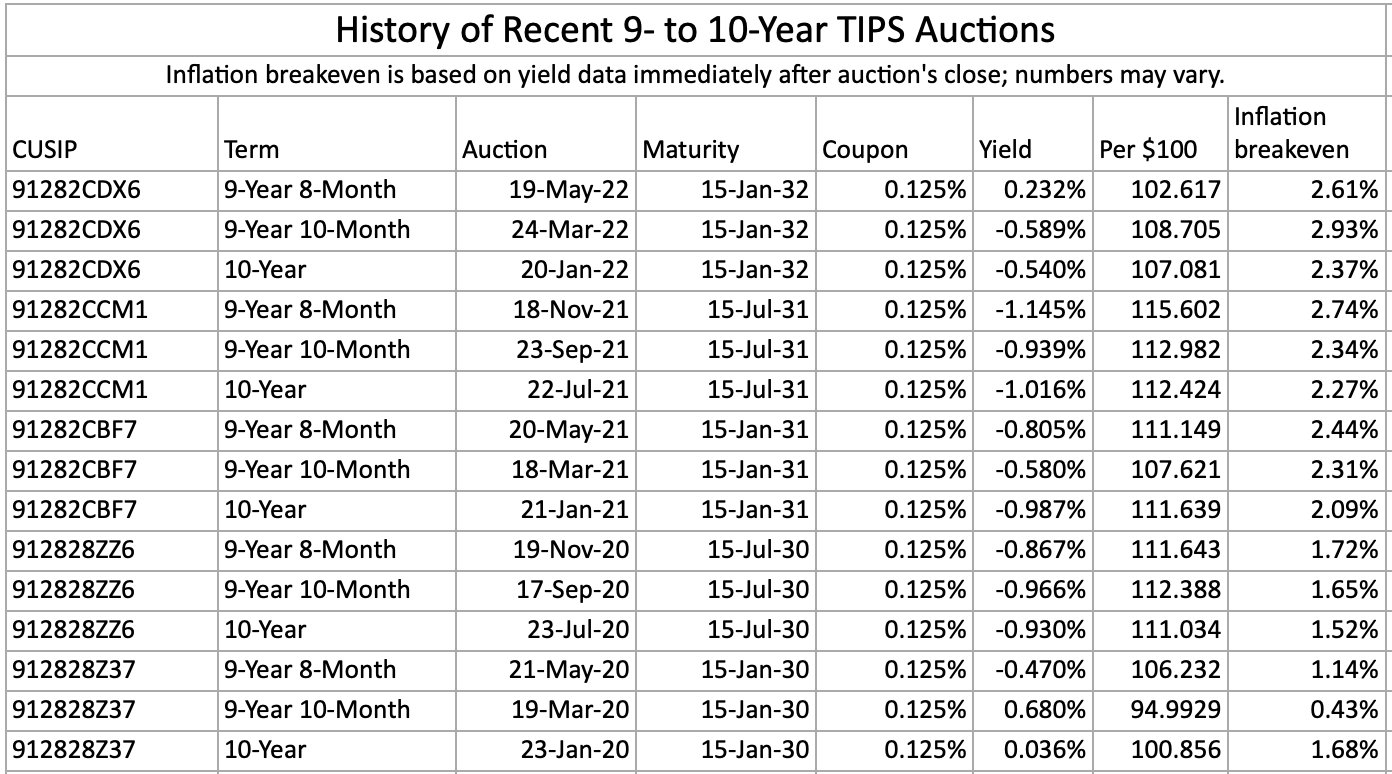
This auction closes the books on CUSIP 91282CDX6. The Treasury will auction a new 10-year TIPS on July 21. Here’s a chart of recent 9- to 10-year TIPS auctions, showing how today’s result broke a 12-auction string with below-inflation yields:

* * *

Feel free to post comments or questions below. If it is your first-ever comment, it will have to wait for moderation. After that, your comments will automatically appear.

David Enna is a financial journalist, not a financial adviser. He is not selling or profiting from any investment discussed. The investments he discusses can purchased through the Treasury or other providers without fees, commissions or carrying charges. Please do your own research before investing.
Posted in Investing in TIPS | 18 Comments

This week’s 10-year TIPS reopening should get a positive real yield (finally!)

If the real yield holds above zero, this will be the most attractive TIPS auction in more than 2 years.

By David Enna, Tipswatch.com

Something great and unfortunately rarely seen could happen this Thursday, when the Treasury holds a $14 billion auction reopening CUSIP 91282CDX6, creating a 9-year, 8-month Treasury Inflation-Protected Security.

This reopened TIPS could 1) get a real yield positive to inflation, and 2) an auction price at a discount to par value. We haven’t seen either of these things for the last 12 TIPS auctions of this term, dating back to the wildly chaotic auction on March 19, 2020, when the financial markets were roiled by the pandemic outbreak.

CUSIP 91282CDX6 trades on the secondary market, and you can track its real yield to maturity and price on Bloomberg’s Current Yields page. As of Friday’s market close, it had a real yield of 0.18% and a price of $99.45 for $100 of par value. This TIPS is trading at a discount because its real yield now surpasses the coupon rate of 0.125%.

The price investors actually pay at Thursday’s auction will look a little different, however. This TIPS will carry an inflation index of 1.03672 on the settlement date of May 31. That means an investor will pay roughly $103.10 for $103.67 of value, after accrued inflation is added in. In other words, you’ll pay more, but get a matching amount of additional principal.

Side note 1: Note the significance of that 1.03672 inflation index. It means that non-seasonally adjusted inflation will have increased 3.67% in just four and a half months, ending on May 31. That’s amazing.

Side note 2: Ponder just how fast real yields have increased as the Fed began reversing its aggressive quantitative easing of the last two years. On November 18, 2021, a reopened 10-year TIPS auctioned with a real yield to maturity of -.1.145%, the lowest in history for this term. Thursday’s auction looks likely to be about 135 basis points higher … in just six months.

Definition: The “real yield” of a TIPS is its yield above or below official U.S. inflation, over the term of the TIPS. So a real yield of 0.20% means an investment in this TIPS will exceed U.S. inflation by 0.20% for 9 years, 8 months.

Of course, we can’t know what Thursday’s auction price and real yield will be. The Treasury market is experiencing strong volatility. But the trend is definitely higher for real yields, as shown in these Treasury estimates for a full-term 10-year TIPS:

  • March 1, 2022: -0.90%
  • April 1, 2022: -0.41%
  • April 18, 2022: -0.07%
  • May 2, 2022: 0.18%
  • May 13, 2022: 0.24%

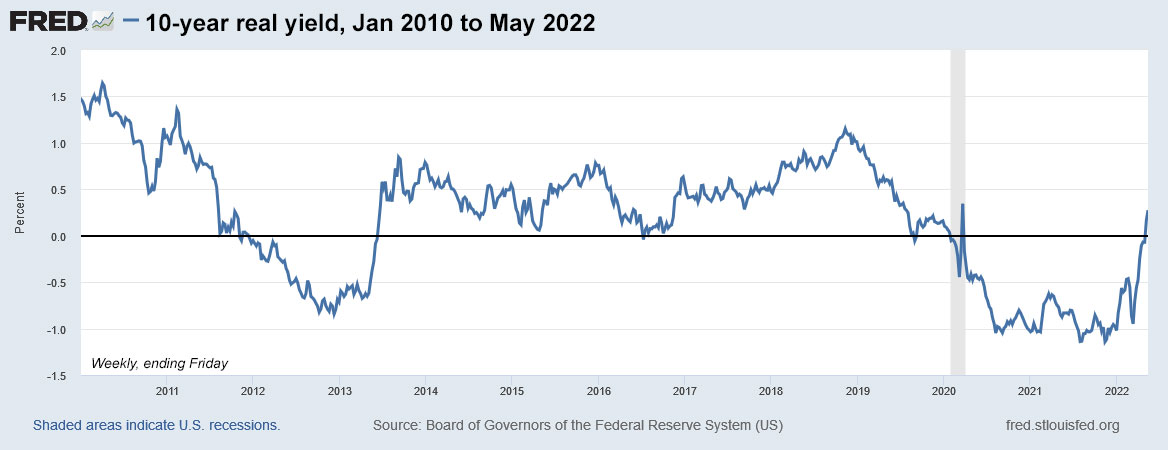
Now let’s take a look at the big picture, with this chart of 10-year real yields over the last 12 years:

This chart shows two full Fed easing cycles: 2011 to 2014 and then 2019 to 2022. The middle section, where real yields are positive, shows what happens when the Fed sustains tightening. In the last tightening cycle beginning in 2014, the Fed gradually increased short-term interest rates and then later began reducing its balance sheet of Treasurys, but even then only made half-hearted reductions.

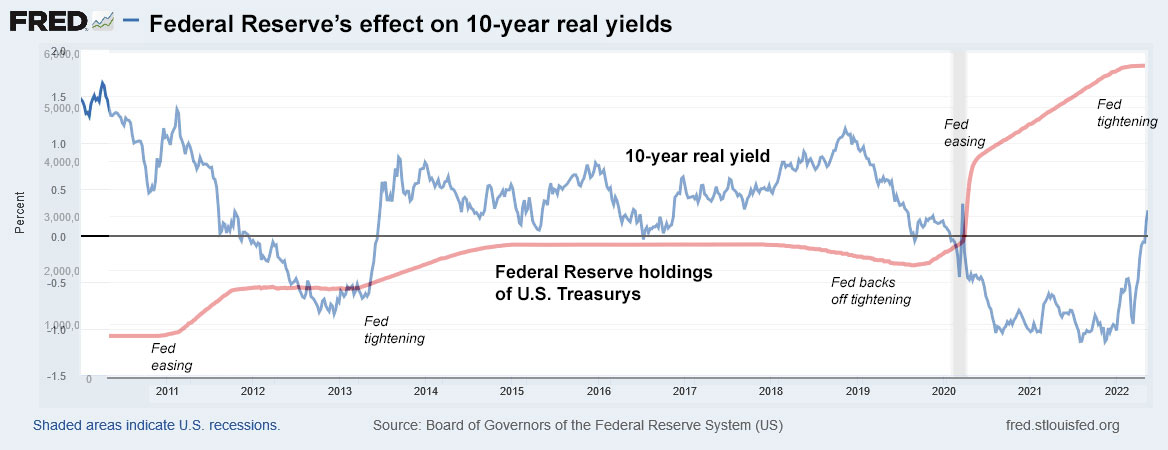
Here is that same chart with the Federal Reserve’s balance sheet of Treasurys overlaid on the 10-year real yield. Notice that when the Fed increases its balance sheet, it does so aggressively. When it reduces it, as in 2019, it does it very gradually (at least in the past):

Click on image for a larger version.

When the Fed eases — lowering short-term rates and adding to its Treasury holdings — real yields dip well below zero. When the Fed backs off, real yields normalize, above zero. That is where we are today. Except the huge difference in 2022 is that U.S. inflation is running at 8.3% and the Fed knows it has to act aggressively to raise rates and lower its balance sheet. We are only a small step along that process, in my opinion, but the bond market is already pricing in some of the future Fed actions.

Inflation breakeven rate

With a nominal 10-year Treasury trading Friday with a yield of 2.92%, CUSIP 91282CDX6 currently has an inflation breakeven rate of 2.74%, an entirely reasonable number with U.S. inflation running at 8.3%. But as I noted, the bond market has been pricing in future Fed actions, and the market believes inflation can be held in check. In normal times, I’d consider 2.74% a high breakeven rate, but these aren’t normal times.

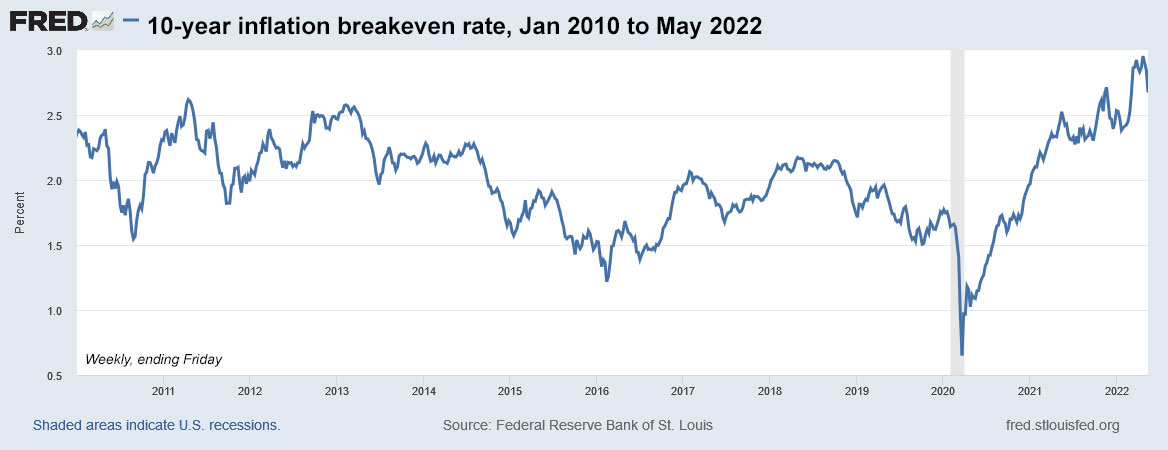
Here is the trend in the 10-year inflation breakeven rate over the last 12 years, showing that by historical standards, these breakeven rates have tended to top off around 2.6%:

Some thoughts on the auction

If the real yield can hold above zero, CUSIP 91282CDX6 would mark a milestone for TIPS investors, with the first positive real yield after 12 consecutive 10-year auction offerings yielding negative to inflation. I’m calling this attractive. Better yields could be coming, but this one is worth a look.

TIPS vs I Bonds. With a real yield of 0.20%, is a 10-year TIPS more appealing than an I Bond with a real yield of 0.0%, based on the current fixed rate? I’d say no, but things are getting close. The I Bond has advantages because of its flexible maturity date, better deflation protection and built-in deferred federal taxes. The TIPS can be traded on the secondary market, which can be a positive or a negative. I’d still prefer I Bonds for my first $10,000 a year in inflation protection. But this 10-year TIPS looks like a good alternative, if the yield can sustain above zero.

Another advantage for TIPS is that investors can use retirement account money to buy a TIPS in an IRA brokerage account. That means there is no consequence in raising money for the purchase. Sell something, buy something, all in the same account. I Bonds can’t be held in an IRA account, so investors can face tax consequences in raising cash for an investment.

Reader alert: I will be traveling again

I’ll be a buyer of this TIPS, adding to my recent “nibble” purchases as real yields have been rising. This should be the most attractive auction in more than two years.

This auction closes for non-competitive bids at TreasuryDirect at noon EDT on Thursday. If you are buying through a brokerage account, you should make your purchase either Wednesday evening or early Thursday, because auction orders close early at brokerages.

I will attempt to post the auction result soon after it closes at 1 p.m. EDT Thursday. However, I will be out of the country (again), and I can’t be certain of my schedule Thursday. Where am I going? The photo at the right provides a hint.

Until then, here is a history of recent 9- to 10-year TIPS auctions, going back five years. It’s hard to remember, but as recently as November 2018, a 10-year TIPS auctioned with a real yield of 1.109%. Soon after, the stock market tanked and the Fed backed off. A year later, the global pandemic hit. Such interesting times:

* * *

Feel free to post comments or questions below. If it is your first-ever comment, it will have to wait for moderation. After that, your comments will automatically appear.

David Enna is a financial journalist, not a financial adviser. He is not selling or profiting from any investment discussed. The investments he discusses can purchased through the Treasury or other providers without fees, commissions or carrying charges. Please do your own research before investing.
Posted in I Bond, Investing in TIPS | 18 Comments

Podcast: ‘Inflation Guy’ explains peak inflation

Are we there yet? Probably. Are our troubles over? No.

By David Enna, Tipswatch.com

If you’ve been reading coverage of Wednesday’s April inflation report, you might have noticed two strains of news spin: 1) “Inflation is coming down,” or 2) “Inflation is stubbornly high.”

Both takes are true, and sometimes politics may flavor how the media look at current U.S. inflation, which I might mention (totally apolitically) remains at a 40-year high.

I applaud the New York Times for this straightforward take: “Consumer Prices Are Still Climbing Rapidly” and the Wall Street Journal did well with: “Inflation Slipped in April, but Upward Pressures Remain.” And I like how the Washington Post covered all the bases with: “Pace of inflation eases slightly in April but still at 40-year high.”

Less impressive, from MSNBC: “Steve Rattner: U.S. inflation may have peaked” or this, from CNN: “US inflation slowed last month for the first time since August.” Fox Business spun in the opposite direction: “Inflation soars 8.3% in April, hovering near 40-year high.”

OK. In other words, the correct answer is that annual inflation did decline slightly in April, but the U.S. remains in a deep, deep inflationary mess.

Have we hit ‘peak inflation’?

For the answer, let’s turn to Michael Ashton, an inflation guru who explains his thoughts just about weekly in his “Cents and Sensibility” podcast. In this week’s episode, he analyzes the April inflation report, and explains that while inflation may have “peaked” in March, prices are likely to continue climbing, briskly higher, well into 2023.

His take on “peak inflation”:

Peak inflation means different things to different people. … I think some of our leaders are making a big mistake trumpeting peak inflation, which to an economist means that the rate of change is going to decline. … But the consumer, who is not an economist, hears the promise that, hey, we are past the worst inflation and they hear prices are going to go down now. … When we say peak inflation, we mean the rate of change is going to slow, but prices are going to keep going up.

Here is his podcast intro: Have we peaked? Well, arguably the Inflation Guy peaked in his 20s but we are talking about inflation here. While CPI has nominally peaked in terms of its year over year rate of change, that doesn’t mean prices are going to go ‘back to normal.’ Even more important: it doesn’t mean that we have reached peak inflation pressure. Listen while the Inflation Guy explains.

Take a listen:

Direct link to podcast

Who is Michael Ashton?

His audiences know him as the “Inflation Guy.” He is a pioneer in the U.S. inflation derivatives market. Before founding his company, Enduring Investments, Ashton worked in research, sales and trading for several large investment banks including Bankers Trust, Barclays Capital, and J.P. Morgan.

Since 2003, when he traded the first interbank U.S. CPI swaps, and 2004 when he was the lead market maker for the CME’s CPI Futures contract, he has played an integral role in developing new instruments and methods for accessing and hedging various inflation exposures. In 2016, Mr. Ashton published What’s Wrong With Money? The Biggest Bubble of All. He is a graduate of Trinity University and lives in Morristown, New Jersey.

Have a question? Get the Inflation Guy app in the Apple App Store or Google Play, or email InflationGuy@enduringinvestments.com.

* * *

Feel free to post comments or questions below. If it is your first-ever comment, it will have to wait for moderation. After that, your comments will automatically appear.

David Enna is a financial journalist, not a financial adviser. He is not selling or profiting from any investment discussed. The investments he discusses can purchased through the Treasury or other providers without fees, commissions or carrying charges. Please do your own research before investing.
Posted in Inflation | 6 Comments

U.S. inflation rose 0.3% in April, again exceeding expectations

While annual inflation dipped slightly, inflation continues to run hot — too hot for complacency by the Federal Reserve.

By David Enna, Tipswatch.com

When is a surprise not a surprise? When it comes to economists trying to predict U.S. inflation.

All-items U.S. inflation rose 0.3% in April, exceeding economist predictions of 0.2% for the month and continuing a string of monthly upside surprises. The year-over-year number was 8.3%, also exceeding expectations of 8.1%. Core inflation looked even worse, coming in at 0.6% for the month (beating expectations of 0.4%) and 6.2% for the year (versus 6.0%).

The stock market’s instant reaction was negative. Just minutes before the Bureau of Labor Statistics released the report at 8:30 a.m., S&P 500 stock market futures were trading at 3996. Minutes after the report, futures were down to 3969.

In April, U.S. inflation rose 0.3% even though the price of gasoline — a major factor in the monthly all-items report — actually declined 6.1%, but remained 43.6% higher year over year. Already, this trend has reversed, with gas prices rising to record highs in May.

The BLS noted that increases in the indexes for shelter, food, airline fares, and new vehicles were the largest contributors to the seasonally adjusted all-items increase. Some highlights:

  • The food at home index rose 1.0% in April, the fourth month in a row with price increases higher than 1%. Year over year, food at home prices were up a painful 10.8%.
  • Food prices have increased 17 months in a row. The BLS noted that the index for dairy and related products rose 2.5%, its largest monthly increase since July 2007. The index for eggs increased 10.3% in April.
  • Shelter costs increased 0.5% for the month and are now up 5.1% year over year. Shelter costs are a lagging indicator and should be a factor in higher inflation in coming months.
  • The cost of used cars and trucks fell 0.4% in April, but are still 22.7% higher year over year. The index for new vehicles was up 1.1% for the month.
  • Apparel prices also fell 0.8% in the month.
  • The index for airline fares increased a mammoth 18.6% in April, the largest one-month increase since the inception of the CPI-U series in 1963.
  • Costs of medical care increased 0.5% in April and are up 3.5% year over year.

Here is the trend in all-items and core inflation over the last year, showing that annual inflation did peak in March, but remained at a very high level in April:

Source: Bureau of Labor Statistics

A side note: The separate inflation index — CPI-W — used to determine Social Security’s annual cost of living increase has increased 8.9% over the last 12 months, a bit higher than overall U.S. inflation. But the Social Security increase for 2023 will be determined by the average of inflation from July to September. It’s too early to draw any conclusions.

What this means for TIPS and I Bonds

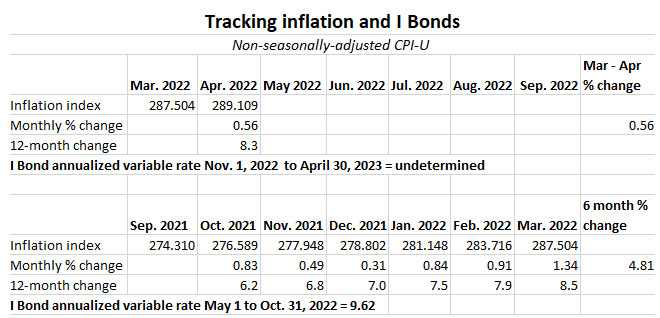
Investors in Treasury Inflation-Protected Securities and U.S. Series I Savings Bonds are also interested in non-seasonally adjusted inflation, which is used to adjust principal balances for TIPS and set future interest rates for I Bonds. For April, the BLS set the inflation index at 289.109, an increase of 0.56% over the March number.

Keep in mind that since non-seasonally adjusted inflation was running higher than the seasonally adjusted number in April, this will eventually reverse in coming months. The two numbers merge after 12 months.

For TIPS. The April inflation number means that principal balances for all TIPS will rise 0.56% in June, after rising 0.91% in April and 1.34% in May. Here are the new June Inflation Indexes for all TIPS.

For I Bonds. The April inflation index is the first of a six-months string — from April to September — that will determine the I Bond’s new inflation-adjusted variable rate, which will be reset on November 1. So far, that 0.56% number would translate to a variable rate of 1.12%, but it’s way too early to draw any conclusions from just one month. Inflation can be highly volatile in summer months.

Here are the data I’m tracking:

What this means for future interest rates

While annual inflation slipped slightly lower in April, the upside surprises for both all-items and core inflation indicate that the Federal Reserve has to stay the course with balance-sheet reductions and routine increases of 50 basis points in short-term interest rates.

I think the bond market has already priced in this trend, with the 5-year nominal Treasury rising above 3% earlier this week. The real yield of a 5-year TIPS is inching ever closer to zero and should quickly rise to positive, if the Fed stays the course and attempts to hold down inflation expectations.

I don’t expect annual U.S. inflation to continue above 8% for long. It should begin gradually slipping lower in coming months, possibly ending the year in the 4% to 5% range. This is what the market expects, but a lot will depend on if the U.S. economy can remain reasonably strong at a time of soaring energy prices and rising interest rates.

Next week’s reopening auction of a 10-year TIPS should be interesting. That TIPS is currently trading on the secondary market with a real yield of 0.32% and a price discounted to par. We haven’t seen that in a long time. I will be writing a preview article on that auction this weekend.

* * *

Feel free to post comments or questions below. If it is your first-ever comment, it will have to wait for moderation. After that, your comments will automatically appear.

David Enna is a financial journalist, not a financial adviser. He is not selling or profiting from any investment discussed. The investments he discusses can purchased through the Treasury or other providers without fees, commissions or carrying charges. Please do your own research before investing.

Posted in I Bond, Inflation, Investing in TIPS | 6 Comments