
 The US Treasury just announced that the fixed rate on Series I Savings Bonds will remain at 0.0% from May to October, meaning I Bonds purchased in this period will earn a composite rate of 0.0% for six months. In addition, the Treasury raised the EE Bond fixed rate to 0.3% and left intact the guarantee that EE Bonds will double in value if held for 20 years.
The earnings rate for Series I Savings Bonds is a combination of a fixed rate, which applies for the 30-year life of the bond, and the semiannual inflation rate, also called the variable rate.
The new I Bond variable rate of -1.60% (annualized) was set in stone when the Bureau of Labor Statistics released the March inflation number. This May 1 adjustment is determined by non-seasonally adjusted CPI-U for September to March. Here are the numbers, from my Tracking Inflation and I Bonds page:
 The composite I Bond rate is determined by adding the variable rate (-1.60%) to the fixed rate (depends on when the I Bond was issued). Any I Bond with a fixed rate of 1.60% or less – and that is every I Bond issued in the past 13 years – will get a composite rate of 0.0% for six months. This is because I Bonds cannot pay negative interest; the lowest they can go is 0.0%. The starting date of that 0.0% period depends on which month you purchased the I Bond, but they will all get six months of it.
One point to consider: Since inflation fell at an annual rate of 1.60% over the last six months, your I Bond paying 0.0% is beating inflation by 1.60%. This is one of the benefits of I Bonds: They lose no value in times of deflation, which isn’t true of the principal balance of TIPS, which declines with each deflationary month.
Should you dump your I Bonds paying 0.0%? One word answer: No. Since you are limited to I Bond purchases of $10,000 a year per person (plus $5,000 as a tax refund), I don’t think selling your I Bonds is a good idea. Unless: 1) you need the money today to meet current expenses, or 2) the I Bond has reached its 30-year maturity (none have as of yet, of course). The idea in I Bond investing is to build as large a cache of inflation-protected money as possible, to use as a resource in the future. Selling out of I Bonds will keep you from reaching that goal. Just be patient; wait out the six lousy months.
Should you buy I Bonds paying 0.0%? One word answer: No. It makes no sense to buy I Bonds in this May to October period. Instead, wait until the November 1 adjustment, which could bring a positive variable rate and the possibility of a fixed rate higher than 0.0%. You’d still have two months to buy your 2015 allocation. Inflation has already started ticking up, rising 0.6% in March on a non-seasonally adjusted basis. There is a good chance I Bonds will be paying a decent variable rate starting November 1.
What about EE Bonds? The Treasury’s decision to pump the fixed rate from 0.1% to 0.3% was a nice gesture, but in effect it is meaningless. The key to EE Bonds is this clause:
All Series EE bonds issued since May 2005 earn a fixed rate in the first 20 years after issue. At 20 years, the bonds will be worth at least two times their purchase price.
The Treasury kept intact the 20-year doubling of value, which in effect creates a 20-year, tax-deferred Treasury bond paying 3.5%. This is an outstanding value, given that a 30-year traditional Treasury is currently paying 2.75%, and a 20-year is paying 2.49%, more than 100 basis points lower. That is a huge difference in a 20-year investment.
EE Bonds are the investment of choice in mid-2015, if … and only if … you can afford to hold them for the full 20 years.
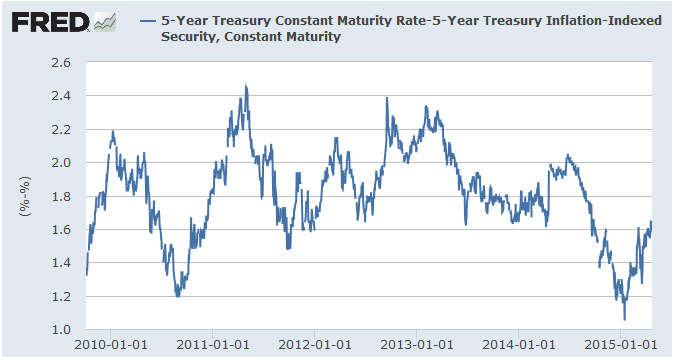


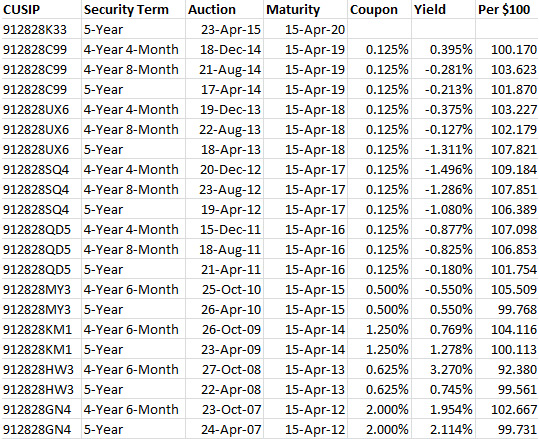


This is certainly true for individual TIPS (no TIPS in history has ever matured with an inflation index at less…