Tracking inflation and I Bonds: A new data page

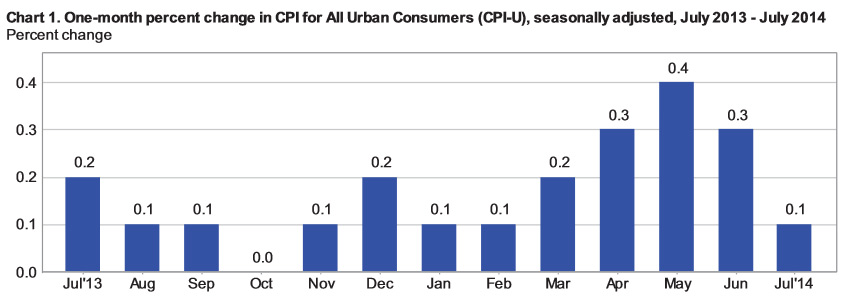
I have added a new data page to this site’s top navigation: Tracking Inflation and I Bonds that I will be updating each month when new inflation numbers are released. I have been having a hard time finding this information, so I figured I should compile it myself. Here is the chart that I’ll be updating:

Tracking inflation and I Bonds

Posted in I Bond, Inflation | 4 Comments

I Bond scenarios: Counting down to May 1, 2014

If you haven’t bought US Savings I Bonds up to the limit in 2014, you face an interesting decision: Buy right now, or wait until May 1, when the Treasury will reset the variable interest rate for all I Bonds and determine the fixed rate for bonds sold between May 1 and Oct. 31.

I Bonds pay a combination of two interest rates:

1. The inflation-adjusted rate, also called the variable rate, changes each six months to reflect the running rate of inflation. That rate is currently set at 1.18% annualized. It will adjust again on May 1, 2014, for all I Bonds. The starting date of the new interest rate depends on the month you bough the I Bond. Learn more here.

The Treasury uses the non-seasonally adjusted Consumer Price Index (CPI-U) to set this variable rate. The March inflation number was the last piece of data we needed to know the next variable rate. The inflation index at the end of March was 236.293, a 0.9156% increase over the 234.149 recorded at the end of September 2013. This will mean the new I Bond inflation-adjusted rate will go to an annual rate of 1.83% (or possibly 1.84%, depending on how the Treasury rounds the numbers) for six months beginning May 1.

2. The fixed rate, currently 0.2% for as long as you hold the I Bond, up to 30 years – will never change. So if you bought an I Bond in 2013 with a zero fixed rate, it will continue to have a zero fixed rate. Purchases through April 30, 2014, have a fixed rate of 0.20%.

The Treasury will re-set the fixed rate on May 1 and there is no way to know for sure what it will be, except it won’t be less than 0.0%. When the Treasury set the 0.2% fixed rate on Nov. 1, 2013, it broke a three-year string of 0.0% fixed rates. That was a surprise.

On Nov. 1, 2013, a 10-year TIPS was yielding 0.50%. Today, it is yielding 0.52%, an increase of 2 basis points. That seems like a pretty strong argument for leaving the fixed rate where it is, at 0.20%. But the Treasury is mysterious. Here’s my wild guess:

Fixed Rate on May 1 Percentage chance
0.00% 15.0%
0.10% 15.0%
0.20% 69.9%
Higher than 0.20% 0.1%

I have wondered if the Treasury set the 0.20% fixed rate in November to offset the low inflation-adjusted rate, which was stuck at 1.18% annualized for 12 months. That rate will now be rising to 1.83%; does that eliminate the need to keep the fixed rate at 0.2%?

Because the fixed rate stays with an I Bond through its entire life, up to 30 years, it is a very desirable thing. So let’s get to the scenarios.

Purchase I Bonds before May 1

I am in this group because I bought my I Bond allocation in February ($10,000 per person per year, at Treasury Direct). Buyers can also get $5,000 in paper I Bonds in lieu of a tax refund, but I don’t use this strategy.

  • Fixed rate 0.20%
  • Variable rate 1.18% for six months, 1.83% for six months
  • Combined rate of 1.38% for six months, 2.03% for six months
  • Effective rate of 1.705% for 12 months

Purchase I Bonds between May 1 and Oct. 31

  • Fixed rate unknown
  • Variable rate of 1.83% for six months, unknown for six months
  • Combined rate unknown
  • Effective rate unknown

At lot isn’t known, because to look out a year for an I Bond purchased in May requires a second inflation adjustment on the variable rate, and that number won’t be known until mid-October. If you think inflation will be rising this year, you may want to wait.

If the fixed rate stays at 0.20%, waiting will look like a smart move. You’d get a combined interest rate of 2.03% for six months and bypass the six months at 1.38%. November’s new variable rate is not known, but that’s the same for all I Bond holders.

If the fixed rate drops to 0.0%, you’d still do OK in the first year, with the combined rate of 1.83% for six months. Even if the variable rate dropped to zero in November, you’d get a combined rate of 0.92% for 12 months.

If you plan to sell the I Bond after a year, no big deal. (You’d lose three months of interest, however.) But if you are holding the I Bond for 20 or 30 years, you want the highest possible fixed rate.

Purchase I Bonds between Nov. 1 and Dec. 31

  • Fixed rate unknown
  • Variable rate unknown
  • Combined rate unknown
  • Effective rate unknown

Why would you wait until Nov. 1 and face all these unknowns? You would if you believe interest rates and inflation will be rising in 2014. If that happens, you might get a higher fixed rate and higher variable rate than you could get in April or May.

The rates set in November will be in effect in January, when the I Bond purchase-limit  clock will reset. I will probably be buying again at the beginning of 2015, up to the limit. If rates rise this year, a savvy buyer could double up on the November to April I Bonds by purchasing them in December and then again in January.

Posted in I Bond, Inflation | 8 Comments

5-year TIPS auctions with a yield of -0.213%

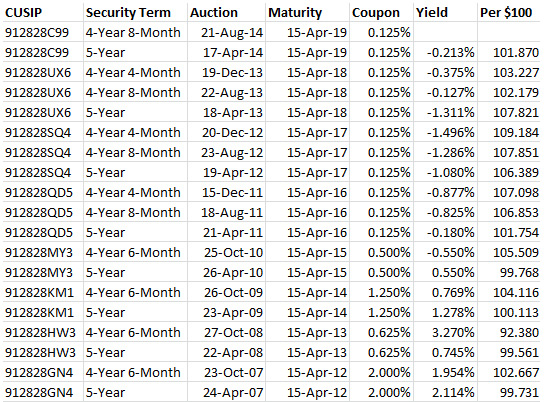
The Treasury just announced that a new 5-year TIPS, CUSIP 912828C99, auctioned with a yield to maturity of -0.213% and a coupon rate of 0.125%. The combination of negative yield and positive coupon rate means that buyers paid an adjusted price of $101.87 for $100 of value, which includes about 5 cents of inflation adjustment through April 30.

Read the announcement.

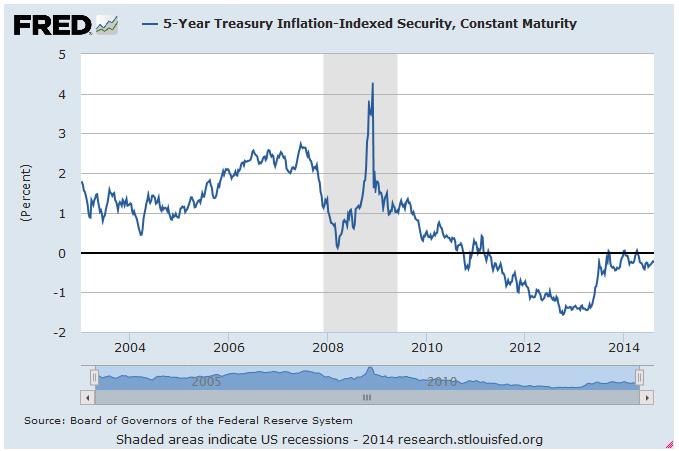
The yield of -0.213% continued a string of 11 consecutive 4- to 5-year TIPS auctions that produced a yield negative to inflation. Because the principal balance of a TIPS grows with inflation, buyers today accepted a return 0.123% less than inflation over the next five years.

When you look at the 5-year inflation breakeven rate, you can see why some buyers would find this issue attractive. A 5-year nominal Treasury is trading right now at 1.70%,  setting up an inflation breakeven rate of 1.91%, meaning that this TIPS will outperform a traditional Treasury if inflation averages more than 1.91% over five years.

Even if this 5-year TIPS under-performs, it probably won’t be by much, so TIPS buyers aren’t giving up much yield to get the inflation protection.

TIP ETFTwo weeks ago, this TIPS looked likely to carry a positive yield, but Treasurys  strengthened as the stock market weakened and turmoil rose again in Ukraine. The TIP ETF was up strongly in the minutes after the auction closed, indicating a positive reaction to the auction.

At 11:14 a.m., before the auction closed, Bloomberg forecast a yield of -01.62%, based on a survey of primary dealers.

So it looks like the Treasury is the winner in today’s auction.

Reaction to the auction

The Wall Street Journal’s Cynthia Lin noted ‘a strong turnout’ for this auction, noting that the yield of 0.213% was less than the market rate at the time of the sale,  “reflecting strong demand.”

Bloomberg’s Cordell Eddings noted strong demand from overseas buyers, which include central banks.

The bid-to-cover ratio, which gauges demand by comparing the amount bid with the amount offered, was 2.7, matching the highest level since December 2012. “The stats were off the charts,” said Stanley Sun, a New York-based strategist at Nomura Holdings Inc., a primary dealer.


Posted in Investing in TIPS | 3 Comments

Checking in on today’s 5-year TIPS auction — note earlier bid times

The U.S. Treasury will announce results of its auction of a new 5-year Treasury Inflation-Protected Security, CUSIP 912828C99, just after 11:30 a.m. Non-competitive bids have to be placed by 11 a.m., if you are buying at TreasuryDirect. The times are earlier for this auction because of the Easter weekend.

What to expect. This TIPS has been a hard one to call, with possible yields falling all over the place. A few weeks ago, it looked like this TIPS would generate a positive yield to maturity (plus inflation), but that looks unlikely now. The coupon rate will almost certainly be 0.125%, the same rate for the last nine 4-to 5-year TIPS auctions, because that is the lowest coupon rate the Treasury allows on TIPS.

Combine a negative yield at auction with a coupon rate of 0.125% and you get an above-par price for buyers at today’s auction, possibly $102 or more for $100 of value.

  • The Treasury’s chart of Daily Treasury Real Yield Curve Rates is currently showing a 5-year TIPS yielding -0.06%. This is usually my preferred source for new issues, but the number looks a little suspect because …
  • Bloomberg’s Current Yields chart this morning is showing a yield of -0.50% for the newest 5-year TIPS currently trading. But this TIPS was issued a year ago, so it is actually a 4-year TIPS and that skews the number. You’d expect a shorter-maturity TIPS to yield less, especially in a time of very low inflation.
  • The Wall Street Journal’s closing prices chart shows TIPS bracketing the maturity date of this new TIPS yielding -0.401% and -0.365%, and you have to go out to a maturity of July 2020 to find a yield of -0.118%

So, at this point, the Treasury seems to be predicting one number (-0.06%) and the market points to another (maybe around -0.385%). That’s a 32-basis point swing – an unusual amount of uncertainty.

The 5-year nominal Treasury closed Wednesday at 1.67%, setting up a 5-year inflation breakeven point of 1.73% (if you trust Treasury’s low prediction) or 2.05% (if you trust the market numbers).

If this TIPS goes off with a yield of -0.06%, it will be a pretty good bargain for buyers. We’ll see what happens at 11:30 a.m.

Posted in Investing in TIPS | 2 Comments

U.S. inflation rose 0.2% in March, what does this mean for I Bonds?

The Consumer Price Index for All Urban Consumers (CPI-U) increased 0.2% in March on a seasonally adjusted basis, the U.S. Bureau of Labor Statistics reported this morning. This was slightly higher than the expected rate of 0.1%, and resulted in an inflation rate of 1.5% over the last 12 months.

Increases in the shelter and food indexes accounted for most of the increase. The food index increased 0.4% in March, with several major grocery. The energy index, in contrast, declined slightly in March, with gasoline down 1.7% and fuel oil down 2.9%. Utility gas service was up a strong 7.5%.

Excluding the volatile food and energy categories, core prices increased 0.2& in March and 1.7% in the past year.

Holders of TIPS and I Bonds are also interested in the non-seasonally adjusted CPI-U, which is used to determine the inflation adjustment on TIPS and the future inflation-adjusted interest rate on I Bonds. This number was up 0.6% in March, but the number for the last 12 months remains at 1.5%.

What this means for I Bonds. The March inflation number was the last piece needed to determine the inflation-adjusted variable rate for I Bonds that will begin May 1.

The inflation index at the end of March was 236.293, a 0.9156% increase over the 234.149 recorded at the end of September 2013. This should mean that the new I Bond inflation-adjusted rate will go to an annual rate of 1.83% or 1.84% for six months beginning May 1.

The annualized rate is currently 1.18%, plus a fixed rate of 0.2% that lasts as long as you hold the I Bond. We don’t know if the Treasury on May 1 will keep the fixed rate at 0.2%, drop it, or raise it. The Treasury does not provide a formula on how it makes this decision.

Posted in I Bond, Inflation, Investing in TIPS | Leave a comment