
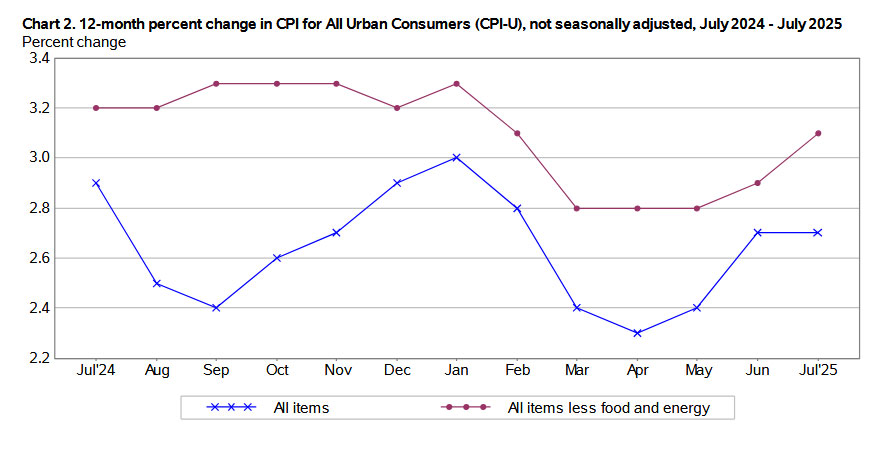
Core inflation, however, rose to 3.1% annually despite moderating shelter costs.
By David Enna, Tipswatch.com
The July inflation report offered a mixed bag of results.
Seasonally adjusted all-items inflation increased 0.2% for the month, as expected, and held steady at 2.7% year over year, less than expected. But core inflation, which removes food and energy, rose 0.3% for the month and 3.1% year over year, higher than expectations.

Core inflation rose above 3.0% for the first time since March 2025 and remains well above the Federal Reserve’s overall target of 2.0% (for a different index).
The Bureau of Labor Statistics noted that shelter costs rose 0.2% in July and were a primary factor in the overall increase in core inflation. A 0.2% increase is moderate and probably acceptable, but shelter costs over the last year were up 3.7%.
In addition, declining gasoline prices have been a huge factor in holding down all-items inflation. The gas index fell 2.2% in July and is now down 9.5% year over year. (Without seasonal adjustment, gas prices were down 0.5% in July). More from the July report:
- Food at home costs declined 0.1% and are up only 2.2% over the last year.
- The meats, poultry, fish, and eggs index rose 0.2% for the month and 5.2% over the last 12 months. The eggs index has increased 16.4% year over year.
- Costs of new vehicles were flat for the month and up only 0.4% year over year.
- Used car and truck prices, however, were up 0.5% for the month (after falling 0.7% in June) and are now up 4.8% for the year.
- Apparel costs were up only 0.1% in July and fell 0.2% year over year.
- Costs of medical care services rose a strong 0.8% for the month and 4.3% for the year.
- The index for dental services increased 2.6% for the month.
- Airline fares increased 4.0% in July but are up only 0.7% year over year.
- Furniture and bedding prices rose 0.9% but prices for appliances fell 0.9%.
From this report, it’s hard to pinpoint much effect from U.S. tariffs, which should eventually cause an uptick in prices for items like new cars, apparel, fruits and vegetables, electronics and home furnishings. The Federal Reserve is going to have some interesting discussions next month.
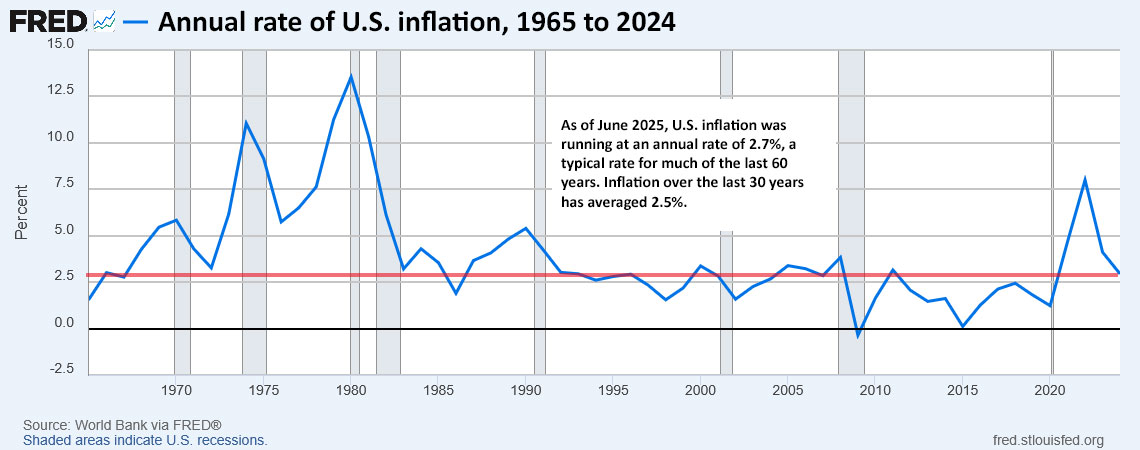
Here is the annual trend for all-items and core inflation, showing the upward glide of core inflation. Does this present a picture of “inflation under control”? Not quite.
What this means for TIPS and I Bonds
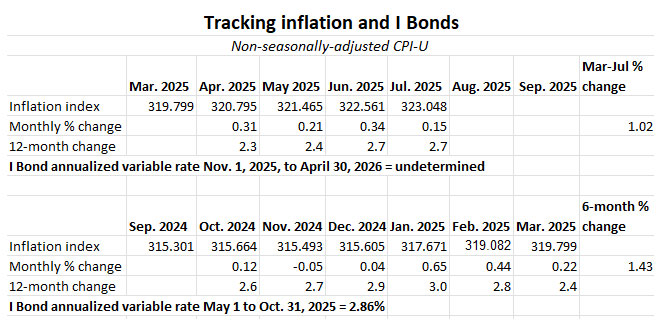
Investors in Treasury Inflation-Protected Securities and U.S. Series I Savings Bonds are also interested in non-seasonally-adjusted inflation, which is used to adjust principal balances on TIPS and set future interest rates for I Bonds. For July, the BLS set the inflation index at 323.048, an increase of 0.15% over the June number.
For TIPS. The July inflation report means that principal balances for all TIPS will increase 0.15% in September, after a 0.34% increase in August. Here are the new September inflation indexes for all TIPS.
For I Bonds. The July report is the fourth of a six-month string that will determine the I Bond’s new inflation-adjusted variable rate, to be reset November 1. At this point, through four months, inflation has increased 1.02%, which translates to a variable rate of 2.04%. I’d expect the next two months to bring that number up to about 2.8%, or possibly higher. Here are the data so far:
What this means for the Social Security COLA
The Social Security cost-of-living adjustment is based on an unusual inflation index – CPI-W – and is determined by averaging the indexes for July, August and September and comparing that number to the same average for the year before. For July, the BLS set the CPI-W index at 316.349, an increase of 0.13% over the June number.
With one month complete, here is where we are:

I had been projecting an increase of 2.8% for the 2026 COLA, which isn’t looking very good right now. I was expecting July CPI-W to be a bit higher.
What this means for future interest rates
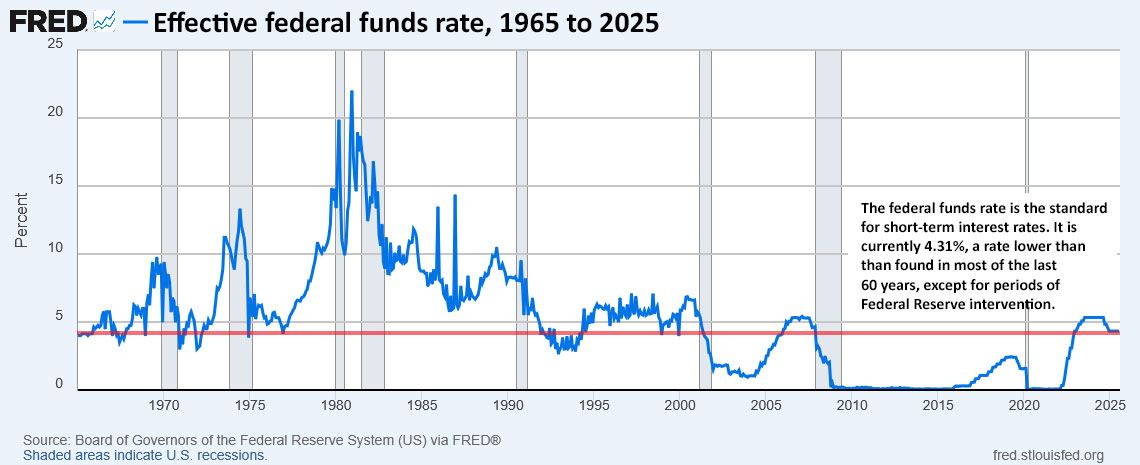
Most likely, the mixed bag of the July inflation report should allow the Federal Reserve’s Open Market Committee to move forward with a 25-basis-point cut in short-term interest rates at its September meeting. More jobs and inflation data will be coming before that meeting, however.
From today’s live report from Bloomberg:
“Inflation was broadly in line with expectations as tariffs continue to be largely absorbed within profit margins. This gives the Fed the room to respond to the weaker jobs backdrop and cuts interest rates from September.” — James Knightley, chief international economist at ING. …
A 25 basis point cut in September seems to be the base case now. Can the Fed cut rates when inflation is going up? Yes, it can, as long as the tariff inflation is seen as a one-off price adjustment.
Fed officials will have plenty of time to knock down this rate-cut speculation if it isn’t accurate. Most likely they will not, which will indicate a rate-cut is coming.
An interesting side note
The BLS said: “With this release, BLS has replaced survey data collected for the CPI’s wireless telephone services index with secondary source data and non-traditional index methods.” This probably makes sense in a time of budget and staff cuts. More on this topic.
FYI, the cost index for wireless telephone services was flat for July, after a 0.4% decline in June and 0.2% decline in May.
—————————

Donate? This site is free and I plan to keep it that way. Some readers have suggested having a way to contribute. I would welcome donations. Any amount, or skip it, your choice. This is completely optional.
—————————
Follow Tipswatch on X for updates on daily Treasury auctions and real yield trends (when I am not traveling).
Feel free to post comments or questions below. If it is your first-ever comment, it will have to wait for moderation. After that, your comments will automatically appear. Please stay on topic and avoid political tirades. NOTE: Comment threads can only be three responses deep. If you see that you cannot respond, create a new comment and reference the topic.
David Enna is a financial journalist, not a financial adviser. He is not selling or profiting from any investment discussed. I Bonds and TIPS are not “get rich” investments; they are best used for capital preservation and inflation protection. They can be purchased through the Treasury or other providers without fees, commissions or carrying charges. Please do your own research before investing.






Do they both have ads on their websites? The idea of ID.me trying to get you to buy something after…