
By David Enna, Tipswatch.com
The Treasury’s auction of $20 billion in a new 10-year Treasury Inflation-Protected Security — CUSIP 91282CML2 — generated a real yield to maturity of 2.243%, the highest for this term at auction since January 2009.
The auction appeared to generate “okay” demand, with a bid-to-cover ratio of 2.48, fairly standard for this term of TIPS. The “when-issued” auction prediction was for a real yield of 2.232%, so the result of 2.243% indicated less-than-stellar demand.
Nevertheless, this is a very good auction result for investors. The real yield to maturity was the highest for this term since a new 10-year TIPS was auctioned in January 2009 with a real yield of 2.245%. Just like that 2009 auction, CUSIP 91282CML2 gets a coupon rate of 2.125%, also the highest in 16 years.
Definition: The “real yield” of a TIPS is its yield above official future U.S. inflation, over the term of the TIPS. So a real yield of 2.243% means an investment in this TIPS would provide a return that exceeds U.S. inflation by 2.243% for 10 years.
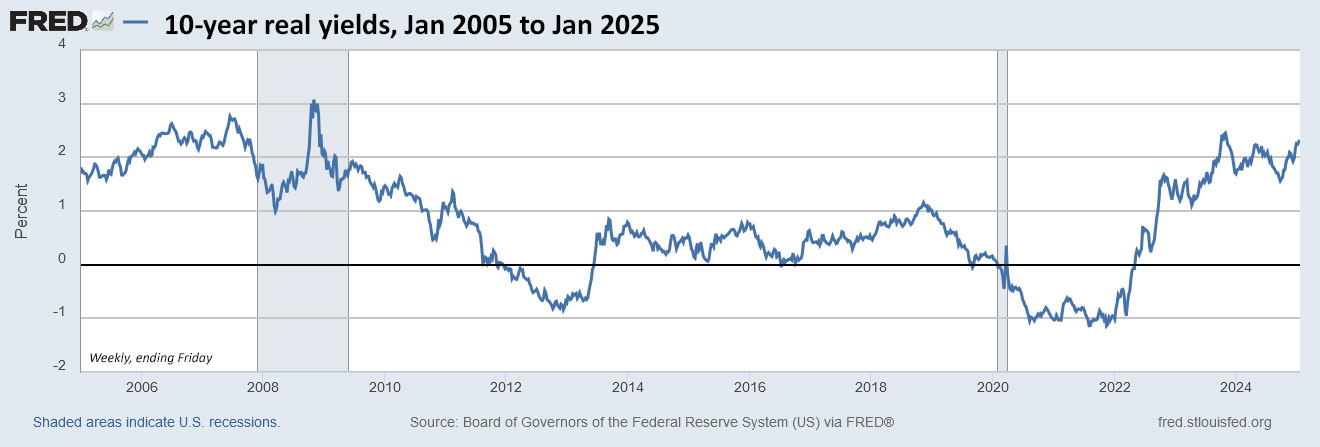
Here is the trend in the 10-year real yield over the last five years, showing that today’s real yield is approaching secondary-market highs of October 2023:

Obviously, real yields have moved dramatically higher since the Federal Reserve’s aggressive pandemic-era quantitative easing programs ended in early 2022. Today’s 10-year real yield is again historically attractive.
Pricing

Because the coupon rate was set at 2.125%, below the auctioned real yield, investors got CUSIP 91282CML2 at a discounted unadjusted price of 98.951405. On the settlement date of Jan. 31, it will carry an inflation index of 0.99972. With that information, we can calculate the investment cost of $10,000 par at today’s auction.
- Par value: $10,000.
- Actual principal purchased: $10,000 x 0.99972 = $9,997.20
- Cost of investment: $9,997.20 x 0.98951405 = $9,892.37
- + Accrued interest of $9.39
In summary, an investor at today’s auction is paying $9,892.37 for $9,997.20 of principal on the settlement date of Jan. 31. After that, the investor will receive inflation accruals plus an annual coupon rate of 2.125% until maturity. The accrued interest of $9.39 will be returned at the first coupon payment in July.
Interesting side note: The coupon rate of this inflation-adjusted TIPS, at 2.125%, is higher than the 10-year Treasury note’s nominal yield of less than 2.0% from August 2019 to March 2022. Things have changed.
Inflation breakeven rate
With the nominal 10-year Treasury note trading with a yield of 4.64% at the auction’s close, CUSIP 91282CML2 gets an inflation breakeven rate of 2.40%, a bit higher than recent results for this term. It means the TIPS will outperform a nominal Treasury if inflation averages more than 2.4% over the next 10 years.
That breakeven rate is high enough to make the nominal 10-year Treasury attractive, but I’d still prefer the inflation protection the TIPS provides. Here is the trend in the 10-year inflation breakeven rate over the last 5 years, showing the fairly stable pattern in the 2.0% to 2.5% range:

Reaction
As I have been noting for months, I was a buyer at this auction because CUSIP 91282CML2 is the first TIPS in history to mature in 2035, and I wanted to fill that spot on my TIPS ladder. The real yield of 2.243% was a bit of surprise, about 4 basis points higher than I thought looked likely earlier in the morning.
Also, as I predicted (this one was obvious), the TIPS auctioned with an investment cost below par value. This isn’t a huge deal, but a plus. I am pleased. Obviously, real yields could continue to climb higher, but this was a historically attractive mark.
There will be 5 more 10-year TIPS auctions in 2025. CUSIP 91282CML2 will be reopened at auction on March 20, and then again in May. Another new 10-year TIPS will be auctioned in July and then reopened in September and November.
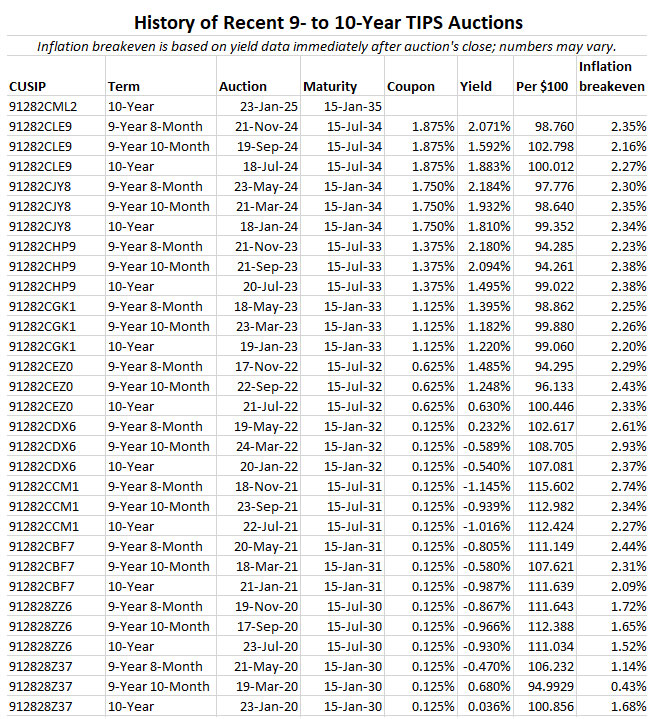
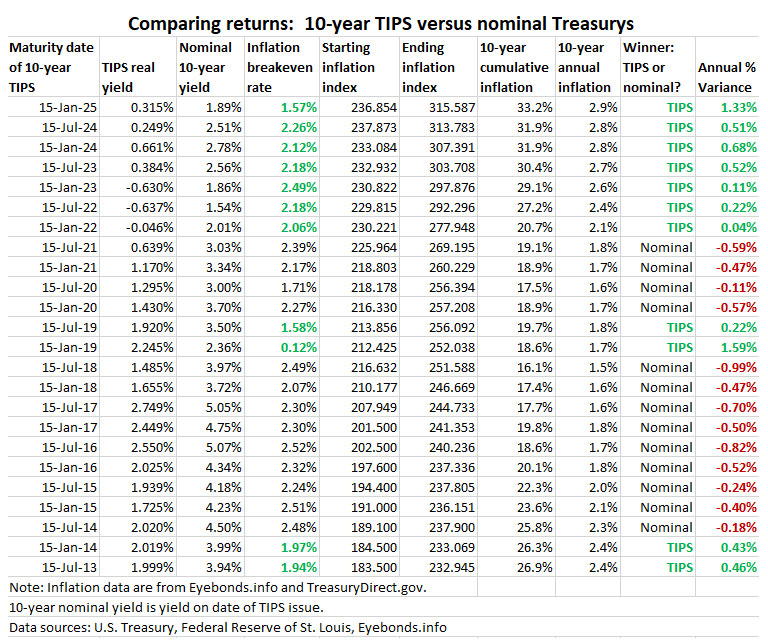
Here is a recent history of TIPS auctions of this term, showing that as recently as three years ago, 10-year TIPS were auctioning with negative real yields:

• Now is an ideal time to build a TIPS ladder
• Confused by TIPS? Read my Q&A on TIPS
• TIPS in depth: Understand the language
• TIPS on the secondary market: Things to consider
• TIPS investor: Don’t over-think the threat of deflation
• Upcoming schedule of TIPS auctions
* * *
Follow Tipswatch on X (Twitter) for updates on daily Treasury auctions and real yield trends (when I am not traveling).
Feel free to post comments or questions below. If it is your first-ever comment, it will have to wait for moderation. After that, your comments will automatically appear. Please stay on topic and avoid political tirades. NOTE: Comment threads can only be three responses deep. If you see that you cannot respond, create a new comment and reference the topic.
David Enna is a financial journalist, not a financial adviser. He is not selling or profiting from any investment discussed. I Bonds and TIPS are not “get rich” investments; they are best used for capital preservation and inflation protection. They can be purchased through the Treasury or other providers without fees, commissions or carrying charges. Please do your own research before investing.







TLDR every single comment. However, no where did I see anyone discuss the TD beneficiary limitations. Specifically, unlike 'normal' financial…