The Treasury’s auction of a new 30-year Treasury Inflation-Protected Security — CUSIP 912810TY4 — generated a real yield to maturity of 2.20%, the highest for this term at auction since February 2010. The coupon rate for this TIPS was set at 2.125%, matching a 14-year high.
I consider this a solid result. Just before the auction close, a similar TIPS was trading on the secondary market with a real yield of 2.19%, so the auction result was very close to market. The bid-to-cover ratio was a solid 2.48.
When looking at this result in historical terms, it is worth noting that the Treasury stopped issuing 30-year TIPS from October 2001 to February 2010. So today’s result matches the highest yield and coupon rate in the era since February 2010.
Pricing
Because the coupon rate was set slightly lower than the auctioned real yield to maturity, investors got this TIPS at a slight discount, with an unadjusted price of 98.359923. In addition, the TIPS will have an index ratio of 0.99952 on the settlement date of February 29. So this is how a $10,000 investment in this TIPS would be priced:
Par value: $10,0000
Adjusted principal ($10,000 x 0.99952) = $9995.20
Cost of investment ($9,995.20 x 0.98359923) = $9,831.27
+ Accrued interest = $8.17
This is a pretty simple auction result to understand. The investor got $10,000 in par value, but paid $9,831.27 for $9,995.20 in principal as of Feb. 29. The accrued interest will be returned at the first coupon payment on August 15.
Inflation breakeven rate
With the nominal 30-year Treasury bond trading at 4.47% just before the auction result, this TIPS gets an inflation breakeven rate of 2.27%, which looks fine. This means the TIPS will outperform the nominal Treasury if inflation averages more than 2.27% over the next 30 years.
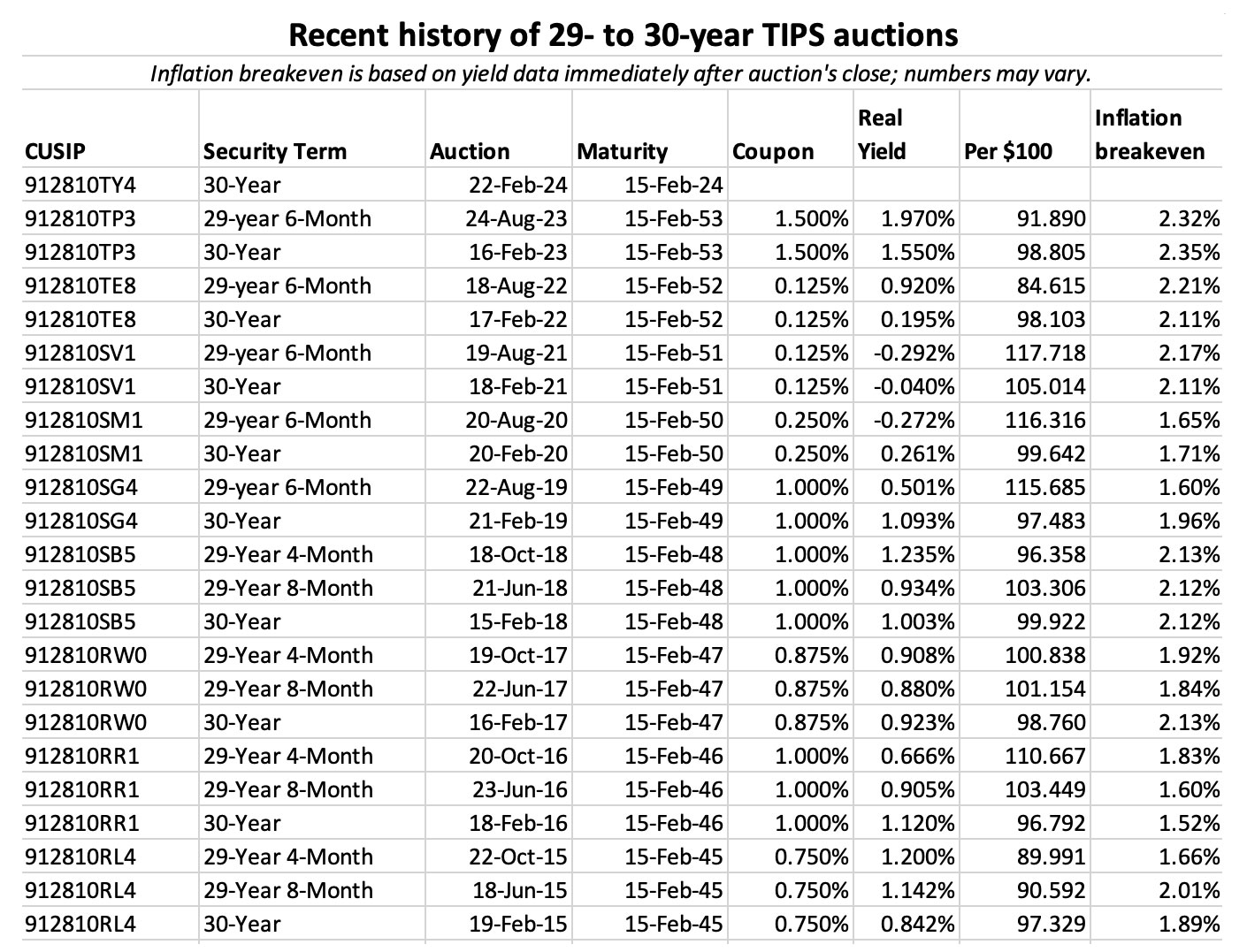
Here is a history of recent TIPS auctions of this term:
Feel free to post comments or questions below. If it is your first-ever comment, it will have to wait for moderation. After that, your comments will automatically appear.Please stay on topic and avoid political tirades.
David Enna is a financial journalist, not a financial adviser. He is not selling or profiting from any investment discussed. I Bonds and TIPS are not “get rich” investments; they are best used for capital preservation and inflation protection. They can be purchased through the Treasury or other providers without fees, commissions or carrying charges. Please do your own research before investing.
Caution: Consider carefully the long term and high volatility.
By David Enna, Tipswatch.com
The U.S. Treasury on Thursday will offer at auction $9 billion in a new 30-year Treasury Inflation-Protected Security. For an investor who can handle the long term and high volatility of a 30-year TIPS, this auction deserves a careful look.
The Treasury’s real yield estimate for a 30-year TIPS closed Friday at 2.17%, up 26 basis points since February 1. That’s a strong move higher, triggered by elevated inflation fears in the wake of the higher-than-expected January inflation report.
If the yield holds at 2.17% at Thursday’s auction, it would be the highest auctioned real yield for any 29- to 30-year TIPS since February 2011.
A yield that high would set its coupon rate at 2.125%, matching the highest coupon rate for any TIPS auction of this term since February 2010.
Definition: A TIPS is an investment that pays a coupon rate well below that of other Treasury investments of the same term. But with a TIPS, the principal balance adjusts each month (usually up, but sometimes down) to match the current U.S. inflation rate. So, the “real yield to maturity” of a TIPS indicates how much an investor will earn above inflation each year until maturity.
So in this case, a real yield to maturity of 2.17% means this TIPS would out-perform U.S. inflation by 2.17% over the next 30 years. That is historically attractive. Getting a coupon rate of over 2.0% is also attractive, in my opinion. It offers a buffer of protection during deflationary periods, plus generates current income that should easily cover the “phantom tax” problem for TIPS in a taxable account.
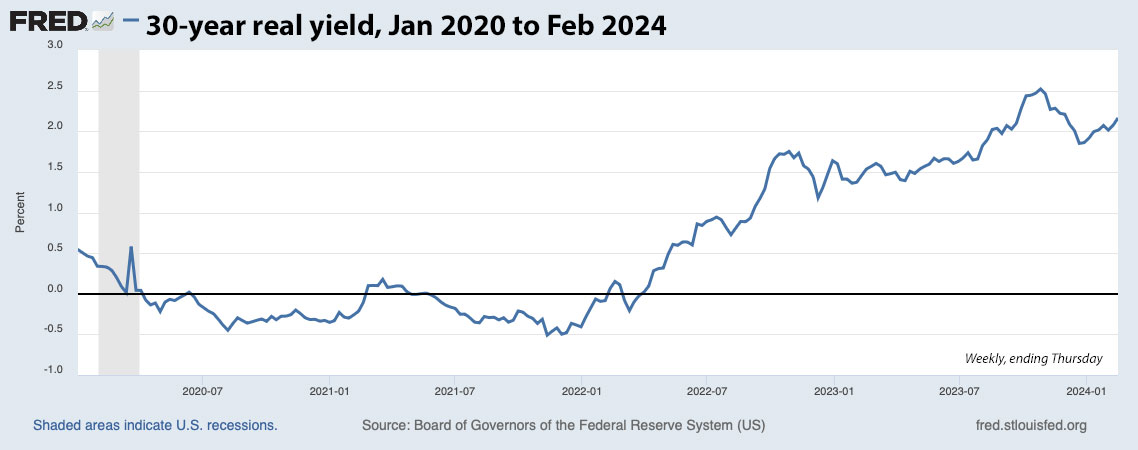
Here is the trend in the 30-year real yield over the last four years, showing real yields have backed off the highs of late October 2023, but remain historically strong. Obviously, yields could continue rising. Impossible to predict.
Click on image for larger version.
There are dangers
There are only two types of investors who should seriously consider buying this TIPS: 1) An investor who is committed to holding to maturity, no matter the ups or downs of market pricing, as part of a structured 30-year plan to set aside inflation-protected cash for the future, and 2) A speculator who believes this TIPS can be sold at a profit in the near- to mid-term future.
A 30-year TIPS is highly volatile. In 2023, the February 30-year TIPS auction generated a real yield of 1.55%, the highest in 12 years. The coupon rate was set at 1.50%, also a 12-year high. It was an attractive result, at that moment. But … with the 30-year real yield currently at 2.17%, that TIPS (CUSIP 912810TP3) is now trading with a price of 85.96, meaning it has lost about 14% of its value in one year.
The investor in that TIPS who intends to hold to maturity will do fine collecting 1.55% above inflation over 30 years. But an investor who can’t stomach that sort of volatility probably isn’t happy. It takes an iron will to invest in a 30-year TIPS and then hold to maturity.
Pricing
This TIPS will carry an inflation index of 0.99952 on the settlement date of February 29. That means any investment at this auction should result in a cost close to the par value. In other words, an investor placing an order for $10,000 in par value should end up paying slightly less than $10,000. But a small amount of accrued interest will raise the cost slightly.
The par value of a TIPS — $10,000 in the example above — is guaranteed to be returned at maturity if severe deflation sets in. For a 30-year TIPS, this really isn’t an issue. But buying a new TIPS at par value is still “nice,” in my opinion.
Inflation breakeven rate
With the nominal 30-year bond closing Friday at 4.45%, this new TIPS currently would get an inflation breakeven rate of about 2.28%, slightly below the rates of the last two auctions of this term. This number seems reasonable. Inflation over the last 30-years, ending in January, has averaged 2.5%.
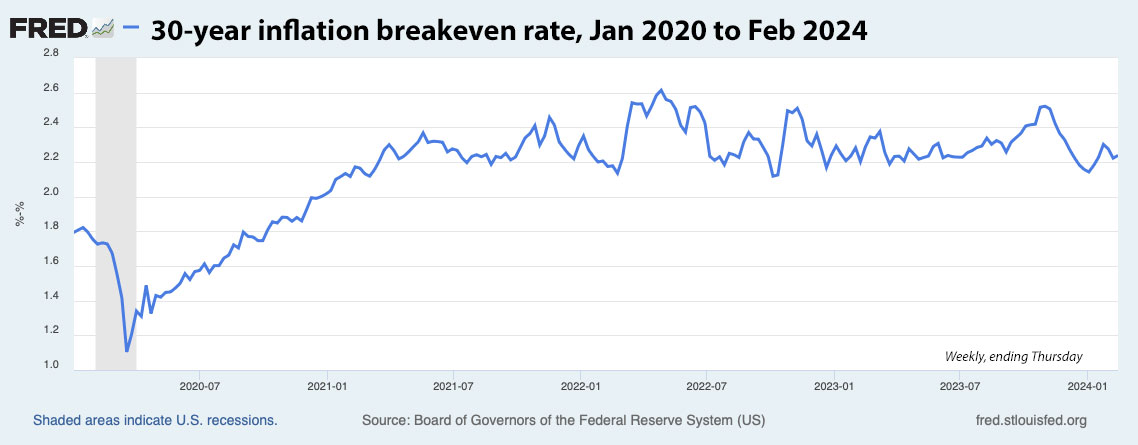
Here is the trend in the 30-year inflation breakeven rate over the last four years, showing the current rate is close to the typical rate seen since July 2022:
Final thoughts
I won’t be a buyer of this TIPS because its 30-year maturity doesn’t match my probable lifespan for holding to maturity. (My TIPS ladder extends to 2043, when I will be 90. Hope I make it.)
But the auction is intriguing because the real yield is attractive. For an investor who can conceivably hold this TIPS for 30 years, and can tolerate its high volatility, CUSIP 912810TY4 deserves a strong look.
This TIPS auction closes Thursday at 1 p.m. EST. Non-competitive bids at TreasuryDirect must be placed by noon Thursday. If you are putting an order in through a brokerage, make sure to place your order Wednesday or very early Thursday, because brokers cut off auction orders before the noon deadline.
I am writing this from Wellington, New Zealand, where I am 18 hours ahead of Eastern Standard Time. I plan on writing on the auction result after it closes on Thursday, but I can’t say when. The auction closes just at the start of a busy travel day, 7 am on Friday for me. Be patient, but you can check this page for the auction result after 1 p.m EST.
Meanwhile, here are auction results for the 29- to 30-year term over the last eight years:
Feel free to post comments or questions below. If it is your first-ever comment, it will have to wait for moderation. After that, your comments will automatically appear.Please stay on topic and avoid political tirades.
David Enna is a financial journalist, not a financial adviser. He is not selling or profiting from any investment discussed. I Bonds and TIPS are not “get rich” investments; they are best used for capital preservation and inflation protection. They can be purchased through the Treasury or other providers without fees, commissions or carrying charges. Please do your own research before investing.
I am traveling today so this will be a brief post.
So … it looks like the Federal Reserve’s wariness on inflation has been justified, at least based on data from the January inflation report.
The Consumer Price Index for All Urban Consumers increased 0.3% in January on a seasonally adjusted basis, the U.S. Bureau of Labor Statistics reported today. Over the last 12 months, the all items index increased 3.1%.
Both the monthly and annual numbers came in higher than expectations, and I had even heard discussions on CNBC of a possible “2-handle” for annual inflation coming out of this report. It didn’t happen. Core inflation also was higher than expectations, coming in a 0.4% for the month and 3.9% for the year.
Once again, the BLS pointed to shelter as a major driver of overall inflation, with shelter costs rising 0.6% in January and 6.0% for the year. Food-at-home prices also perked up at 0.4% for the month, after running at 0.2% for two consecutive months. Gasoline prices were down 3.3% in the month and 6.4% for the year.
The annual trend in U.S. inflation shows that core inflation seems to have stabilized at an annual rate right around 4.0%:
What this means for TIPS and I Bonds
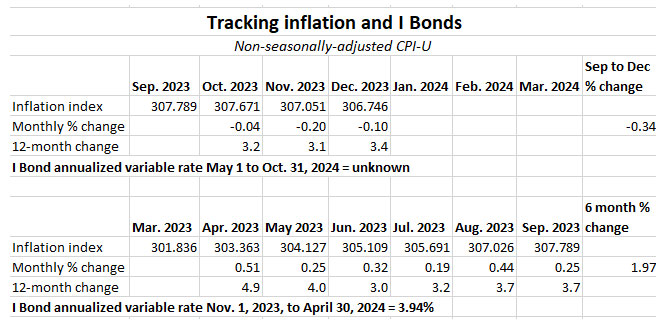
Investors in Treasury Inflation-Protected Securities and U.S. Series I Savings Bonds are also interested in non-seasonally adjusted inflation, which is used to adjust principal balances for TIPS and set future interest rates for I Bonds. For January, the BLS set the inflation index at 308.417, an increase of 0.54% over the December number.
For TIPS. The January report means that principal balances for all TIPS will rise 0.54% in March, after falling 0.20% in January and 0.10% in February. The Treasury hasn’t posted the new March inflation indexes for all TIPS as of yet. When it does, this link should work.
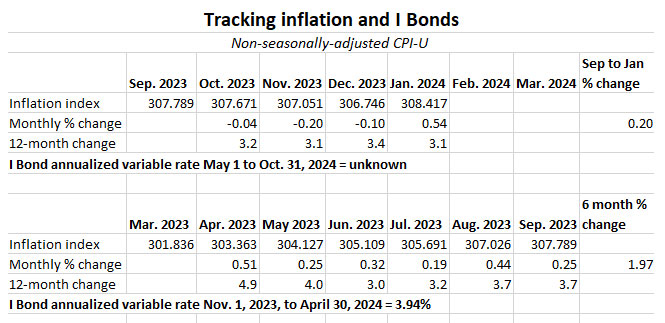
For I Bonds. The January inflation report is the fourth of a six-month string that will determine the I Bond’s new inflation-adjusted variable rate, to be reset on May 1 and eventually roll into effect for all I Bonds. In the October to January period, inflation has increased just 0.20%, which would translate — for now — to a variable rate of 0.40%, much lower than the current 3.94%. The next two months are likely to increase that number; I’d say 2.0% certainly looks possible.
Here are the data so far:
This is all the time I have this morning. I am off!
* * *
Feel free to post comments or questions below. If it is your first-ever comment, it will have to wait for moderation. After that, your comments will automatically appear.Please stay on topic and avoid political tirades.
David Enna is a financial journalist, not a financial adviser. He is not selling or profiting from any investment discussed. I Bonds and TIPS are not “get rich” investments; they are best used for capital preservation and inflation protection. They can be purchased through the Treasury or other providers without fees, commissions or carrying charges. Please do your own research before investing.
If you have been reading this site for a long time, you know what this headline means: I will soon be traveling to some distant place with confusing timezone differences and potentially weak-to-zero internet.
It is so far, in fact, that I will depart on Day One and arrive on Day Three after crossing the international dateline. I will entirely miss Valentine’s Day. And I expect the jet lag to be severe. The trip will last more than three weeks and I won’t have a lot of time to follow financial news.
So expect some lag time, especially in approving comments or responding to questions. But I will try to post news when I can, including a preview of this month’s 30-year TIPS auction.
Tuesday, Feb. 13. The January inflation report will be issued at 8:30 am EST. Originally, this wasn’t going to be a schedule problem for me because my departing flight was leaving Tuesday afternoon. Things got shifted around and now I am leaving in the morning, so I won’t be able to post any news or analysis until a layover in Houston.
The forecast for January inflation is 0.2%, according to Barron’s. That is the seasonally adjusted number for all-items inflation, and — if accurate — looks tame enough to keep both the stock and bond markets happy.
I’d expect the non-seasonally adjusted number to come in higher. Last year, for example, official January 2023 inflation was 0.5%, while non-seasonally adjusted rose 0.8%. In January 2022, official inflation rose 0.6%, while non-seasonal was up 0.84%.
Why is this important? Because non-seasonally adjusted inflation will be used to set the new inflation-adjusted variable rate on U.S. Series I Savings Bonds. So far, three months into the 6-month rate-setting period, inflation has been negative, at -0.34%. So January non-seasonal inflation will need to come in at 0.34%, at least, just to get the number to zero.
All of this makes it highly likely that the I Bond in May will get a lower variable rate than the current 3.94%. Possibly much lower. But things can change.
Sunday, Feb. 18. In the morning, I will post a preview article on the 30-year TIPS auction set for Feb. 22. Although I won’t be a buyer (the term is too long for me) this could end up being attractive for the investor who can handle the long maturity date and high volatility.
As of Friday’s market close, the 30-year real yield stood at 2.13%, which I consider attractive. For perspective, here is the trend in the 30-year real yield over the last 14 years. Despite speculation that Treasury yields would plummet in 2024 as the Fed inched toward easing, long-term real yields have remained relatively high.
Click on image for larger version.
This chart is a reminder that the “window” for building a comprehensive TIPS ladder is still open. Real yields remain attractive across the maturity spectrum. Could they go higher? Sure. But I’d expect some “token” rate cuts coming from the Fed sometime this year, especially if inflation remains tame.
Thursday, Feb. 22. The 30-year TIPS auction will close at 1 p.m. EDT, which is 7 a.m. Friday in New Zealand. I’ll probably be at breakfast in Auckland and then embark on the day’s activities. I’ll get something posted, eventually. Don’t expect too much.
After that? Something crazy always happens when I travel, so sorry if I cause an international financial crisis. I might not even be aware it is happening. I’ll be back to the U.S. in time for the February inflation report, to be issued March 12.
* * *
Feel free to post comments or questions below. If it is your first-ever comment, it will have to wait for moderation. After that, your comments will automatically appear.Please stay on topic and avoid political tirades.
David Enna is a financial journalist, not a financial adviser. He is not selling or profiting from any investment discussed. I Bonds and TIPS are not “get rich” investments; they are best used for capital preservation and inflation protection. They can be purchased through the Treasury or other providers without fees, commissions or carrying charges. Please do your own research before investing.
U.S. Series I Savings Bonds are a unique investment because all interest is rolled into principal until redemption, and in most cases, all the compounded earnings are tax deferred until the I Bond is redeemed or matures.
This is good.
And no I Bond has ever matured. I Bonds were first issued in September 1998, so history’s first I Bond maturity will come in September 2028. These early-issue I Bonds from years 1998 to 2001 had incredible fixed rates of 3.0%+, meaning they have generated fantastic returns over the years, in the range of 6.0% to 6.25% annual interest, compounded.
This is good.
What isn’t good?
A rather large tax bill is coming for investors in these early-year I Bonds. When the I Bonds are redeemed or mature, the entire amount of interest will be subject to federal income taxes in that year. (I Bond interest is not taxed at the state level.) Some people might say, “Nice problem to have,” but break-through amounts of income can trigger a series of harsh tax consequences: higher marginal brackets, Medicare surcharges, phase-out of some deductions, and the 3.8% Net Investment Income Tax.
The amounts can be seriously hefty: When I Bonds were first created in the fall of 1998, the purchase limit was $30,000 per person per year, and the Treasury even allowed credit cards to be used for purchases with no fees. (Air miles!) This means couples could buy $60,000 in I Bonds each year in those early years.
This chart shows how a $10,000 investment has grown for each of these early I Bond issues, from September 1998 to November 2002. Investors who purchased $20,000 in a year would need to double these amounts; if the purchase was $60,000 for a couple, multiply the amounts by 6.
Couples who bought $60,000 in I Bonds in November 1999 have already earned $193,896 in interest and that amount could easily grow by another 30% at maturity in November 2029, figuring annual interest of around 6%. That brings the total interest to $252,065 in 2029. Ouch.
This is an extreme example, but I have heard from many readers who did indeed buy $60,000 a year of I Bonds in the early years. That has been a great investment, but the coming tax bill causes worries.
My own example: 2031 is a problem
Many readers have been encouraging me to write on this tax issue, but I’ll admit I have been ignoring it. I figured the problem was years away, and my wife and I could handle the influx of taxable interest by adjusting other income sources in the years of maturity. I had no intention of redeeming my high-fixed-rate I Bonds … until maturity.
But then I took a closer look.
I knew we had $40,000 in early-year I Bonds with high fixed rates, but I didn’t realize that all of our purchases were in the single year of 2001, meaning they would all mature in 2031. Hmmm … problem.
Let’s look ahead to 2031. Both my wife and I will be collecting Social Security, a pension, possibly an annuity, and drawing RMDs from traditional IRA accounts. This $144,700 of extra income would very probably push us into a higher tax bracket, high Medicare surcharges and trigger the 3.5% Net Investment Income Tax. Plus, it is possible that tax rates will be higher in 2031.
What’s the plan?
Reluctantly, I am going to give up the idea of holding these high-fixed-rate I Bonds until maturity. Now my plan is to redeem one-fifth of the total each year from 2027 to 2031, bringing the interest income to maybe $28,000 a year, an amount we can deal with by adjusting other sources of income (such as IRA withdrawals).
In our case, these are still paper I Bonds, stored in a bank’s safety deposit box. I looked into the box recently and double-checked. There are 40 $1,000 I Bonds, all issued in 2001. Because the denominations are each $1,000 original value, it will be simple to redeem eight a year for five years, 2027 to 2031.
The denomination is important because paper I Bonds have to be redeemed in whole, unlike electronic I Bonds, which can be redeemed in $25 increments. TreasuryDirect says: “You cannot cash part of a paper savings bond. A paper savings bond must be cashed for its entire value.”
My bank (Wells Fargo in Charlotte) still redeems paper savings bonds, but some banks no longer offer that service. TreasuryDirect says, “Banks vary in how much they will cash at one time – or if they cash savings bonds at all.” From a recent New York Times article:
Hoping to cash in a paper savings bond that’s been lying around for a few decades? Set aside a lot of time for disappointment. …
The process is only getting harder. In May, the nation’s largest bank, JPMorgan Chase, began imposing a $500 limit on each savings bond cashed for longtime depositors — that’s total redemption value, so including any interest owed. Wells Fargo and Citi place a $1,000 limit on new customers. U.S. Bank has a five-year waiting period before it will cash a bond for a new customer.
Converting paper to electronic
Because banks are balking at redeeming savings bonds, especially in large dollar amounts, another option would be to act now to convert these paper I Bonds into electronic form. This isn’t simple, of course. My wife recently converted a batch for her mother, and the process was tedious and time-consuming. But it worked.
To do this, you must have a TreasuryDirect account (if you are reading this I am sure you do), and then you will have to create a Conversion Linked Account where the converted I Bonds will reside. This page on TreasuryDirect has answers to a lot of questions on this procedure.
Harry Sit of TheFinanceBuff.com wrote an excellent guide to conversions, which you can read here. He notes:
In the usual government fashion, they don’t make it easy. Treat it as a test for how well you’re able to follow instructions.
Once converted, you can go into TreasuryDirect and adjust the ownership registration, if needed.
It is not a fun process and that is why I am hoping my wife will do it for us: She has experience!
Do TIPS face this same tax problem?
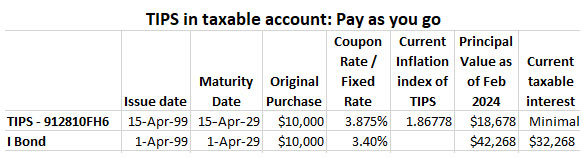
Absolutely not. For example, in April 1999 I bought $10,000 par of a 30-year Treasury Inflation-Protected Security in a taxable account at TreasuryDirect. Let’s look at how it now compares with an I Bond purchased in the same month:
This one chart dramatically shows the difference between investing in a TIPS, which pays out the coupon rate biannually, versus the I Bond, which continuously rolls interest payments into principal all they way to maturity. So even though the TIPS has a higher fixed rate of 3.875%, its current value reflects only inflation of 86.7% over the last 25 years. All the earlier coupon payments — the real yield over inflation — have already been paid out.
Plus, because of the way TIPS are taxed, with inflation accruals getting taxed in the current year, when this TIPS matures on April 15, 2029, there will be only a small amount of tax due — on 3 1/2 months of inflation accruals and the final coupon payment of 1.9375%.
A TIPS held in a taxable account does not create a “tax time bomb.” You pay the taxes as you go. At maturity, taxes are pretty much a non-event.
One more point: The chart demonstrates the benefits of compounded, tax-deferred interest when an I Bond has a very high fixed rate. That April 1999 I Bond is still earning 3.4% above inflation on compounded principal of $42,268. There is no way a TIPS investor could have earned that yield by reinvesting coupon payments in an equally safe investment from 1999 to 2024. For most of that period, real yields have been below 2.25%.
Click on image for larger version.
Final thoughts
If you were one of the fortunate investors to have invested in I Bonds in the early era of 1998 to 2001, congratulations. Now you should take a careful look at your investments and the potential tax consequences of holding to maturity. You will be paying taxes, of course, but you may be able to manage the redemptions to minimize effects on your tax bracket, potential Medicare surcharges and the looming Net Investment Income Tax.
You have time to create a plan because the first-ever I Bond maturity won’t occur until September 2028.
Feel free to post comments or questions below. If it is your first-ever comment, it will have to wait for moderation. After that, your comments will automatically appear.Please stay on topic and avoid political tirades.
David Enna is a financial journalist, not a financial adviser. He is not selling or profiting from any investment discussed. I Bonds and TIPS are not “get rich” investments; they are best used for capital preservation and inflation protection. They can be purchased through the Treasury or other providers without fees, commissions or carrying charges. Please do your own research before investing.









 Treasury Inflation-Protected Securities
I made a small addition to my TIPS at auction, and the real yield works for me. I didn’t watch…