
Will the Federal Reserve take this as a signal to begin slowing interest rate increases?
By David Enna, Tipswatch.com
The stock and bond markets finally got a positive surprise today with the release of the October inflation report, with monthly and annual numbers coming in well below expectations.

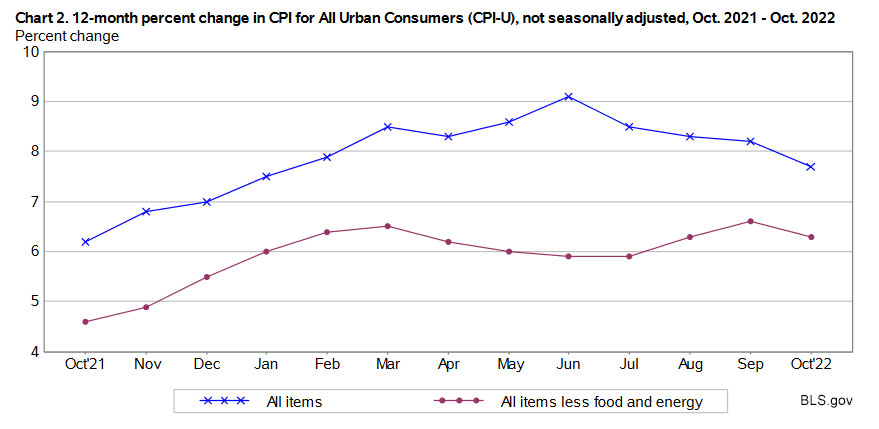
The Consumer Price Index for All Urban Consumers (CPI-U) rose 0.4% in October on a seasonally adjusted basis, the U.S. Bureau of Labor Statistics reported. Over the last 12 months, the all-items index increased 7.7%. Core inflation, which removes food and energy, rose 0.3% for the month and 6.3% year over year. All of these numbers were below expectations, as shown in the chart.
The BLS noted that the 7.7% increase in all-items inflation was the smallest 12-month increase since the period ending January 2022. This was the second month in a row that U.S. inflation ran at 0.4%, which sets an annual pace of 4.8%, well below the 2022 high of 9.1% set in June. Realistically, even 4.8% remains unacceptably high, but inflation watchers can take some comfort that the U.S. inflation appears to be trending down.
The October “cool-down” came despite a 4.0% monthly increase in the price of gasoline, breaking three consecutive months of steep declines. Gasoline prices remain 17.5% higher year over year. Also, shelter costs rose 0.8% and are now up 6.9% year over year. The BLS said shelter costs accounted for more than half of the increase in October inflation. The shelter increase was the highest for the category since August 1990. More from the report:
- The costs of food at home increased 0.4% for the month, down a bit from recent trends and the smallest monthly increase since December 2021. But food at home prices are still up 12.4% year over year.
- The index for meats, poultry, fish, and eggs rose 0.6% over the month. In contrast, the index for fruits and vegetables fell 0.9% in October.
- The rent index rose 0.7% over the month.
- The costs of medical care services fell 0.6% in October and were up 5.4% year over year.
- Apparel costs also fell, down 0.7% for the month.
- The costs of used cars and trucks fell 2.4% for the month and are up only 2% over the last year, following a strong surge higher in 2021. The costs of new vehicles were up 0.4% for the month and 8.4% year over year.
- The index for airline fares fell 1.1% in October.
The BLS noted that the October report was a “mix of increases and declines,” and the overall result was an inflation rate below economist expectations. Here is the 12-month trend in all-items and core inflation, clearly showing the gradual trend downward in all-items inflation since early summer.
What this means for TIPS and I Bonds
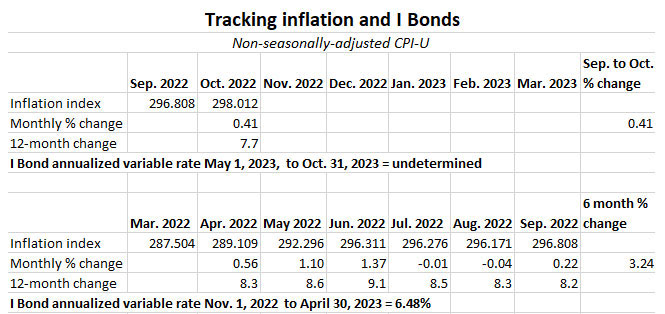
Investors in Treasury Inflation-Protected Securities and U.S. Series I Savings Bonds are also interested in non-seasonally adjusted inflation, which is used to adjust principal balances on TIPS and set future interest rates for I Bonds. For October, the BLS set the inflation index at 298.012, an increase of 0.41% over the September number. The annual increase was 7.7%.
For TIPS. The October inflation number means that principal balances for all TIPS will increase 0.41% in December, after a 0.22% increase in November. For the year ending in December, TIPS principal balances will have increased 7.7%. Here are the new December Inflation Indexes for all TIPS.
For I Bonds. The October report is the first in a series of six — from October to March — that will determine the I Bond’s new inflation-adjusted variable rate, which will be reset May 1. So far, that increase is 0.41%, but just one month of data is meaningless. Here are the numbers:
What this means for future interest rates
Clearly, the softening of the inflation trend in October could give the Federal Reserve reason to opt for a 50-basis-point increase in the federal funds rate in December, instead of 75 basis points. In fact, I’d say that is likely if prices continue to stabilize, and the Fed could potentially pause its rate increases in spring to summer 2023. But inflation doesn’t follow predictable patterns.
Core inflation at 6.3% remains much too high. The Fed knows this. The markets know this. Rate increases are likely to continue, but possibly the pace of increases will be slowing. Inflation tracker Michael Ashton posted this today on his E-piphany site:
The Fed … will take the peak in Core as a reason to step down to 50bps at the next meeting, then probably 25bps, and ending at around 5%. If rates are at 5% and median inflation is around the same level late next year, it isn’t clear that much higher rates would be called for especially in a recession. But neither will much lower rates. So I think overnight rates get to 5% and then stay stuck there for a while.
The immediate result of today’s inflation report was a sizable drop in real and nominal yields, with the 10-year Treasury note dropping from 4.12% to about 3.92% and the 10-year TIPS real yield falling from about 1.70% to about 1.54%. But we have learned to expect volatility in the bond market, one of the hallmarks of 2022.
The result, however, could be a lower real yield on the 10-year TIPS to be reopened at auction on November 17. I will be posting a preview of that auction over the weekend.
* * *
Feel free to post comments or questions below. If it is your first-ever comment, it will have to wait for moderation. After that, your comments will automatically appear. Please stay on topic and avoid political tirades.
David Enna is a financial journalist, not a financial adviser. He is not selling or profiting from any investment discussed. The investments he discusses can be purchased through the Treasury or other providers without fees, commissions or carrying charges. Please do your own research before investing.



After reading all your comments, another step you can take is to write your senators and representatives demanding that they…