30-year TIPS auction could break through negative real-yield barrier

The Treasury will offer $9 billion in a new 30-year TIPS at auction Thursday. Here’s what to expect.

By David Enna, Tipswatch.com

It’s been two years since we’ve seen any TIPS auction, of any term, generate a real yield to maturity higher than zero. But that could change Thursday, when the Treasury auctions $9 billion in a new 30-year Treasury Inflation-Protected Security, CUSIP 912810TE8.

The coupon rate and real yield to maturity will be set by the auction, which closes at 1 p.m. EST Thursday. But we can get a pretty good idea where this auction is heading: The coupon rate will almost certainly be set at 0.125%, the lowest the Treasury will go for any TIPS. And the real yield to maturity has a decent chance of rising above zero, making this the first TIPS auction since February 2020 to get a positive real yield.

A TIPS is an investment that pays a coupon rate well below that of other Treasury investments of the same term. But with a TIPS, the principal balance adjusts each month (usually up, but sometimes down) to match the current U.S. inflation rate. So the “real yield to maturity” of a TIPS indicates how much an investor will earn above inflation.

The U.S. Treasury issues an estimate of the real yield of a full-term 30-year TIPS each day after the market closes. On Friday, this estimate was 0.09%, up 45 basis points since the beginning of the year. A lot could change over the next week (for example, in the Ukraine), but for now, it looks like this auction has a good chance of generating a positive real yield, meaning a yield that will exceed official U.S. inflation over the next 30 years.

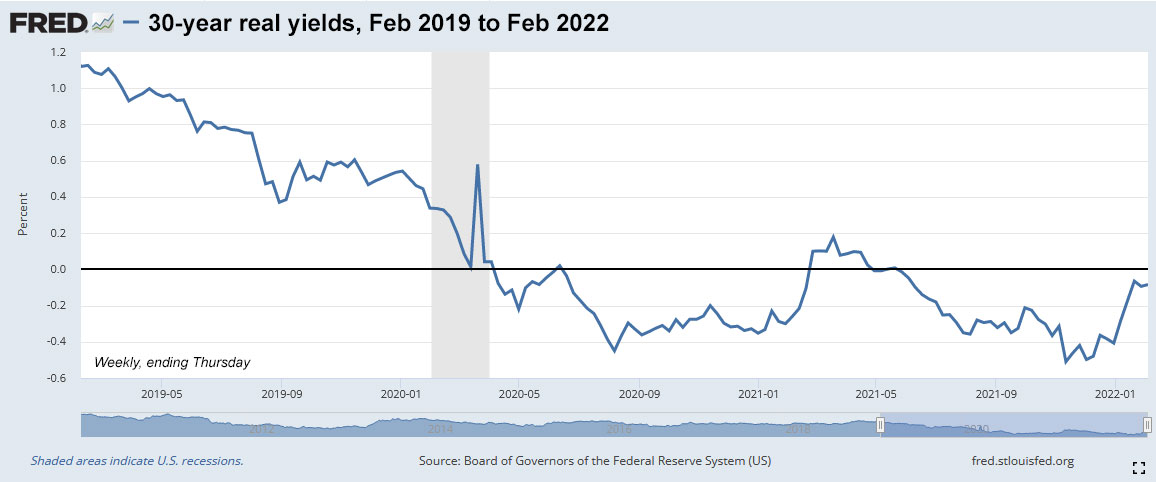
Here is the trend in the 30-year real yield over the last two years, a period that began before the pandemic-caused market panic of March 2020 and continued through two years of aggressive economic stimulus by both Congress and the Federal Reserve:
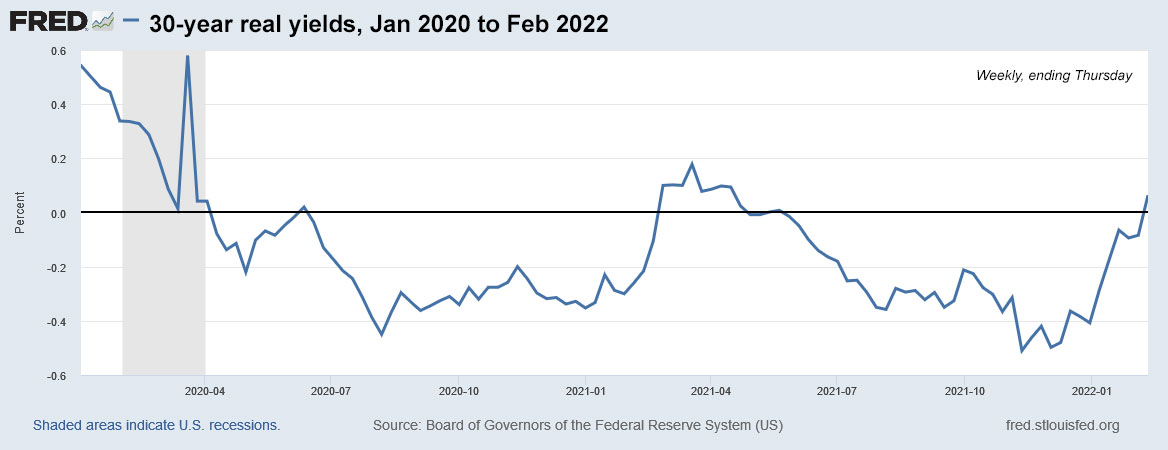
In recent months, as the Federal Reserve has indicated it will end its bond-buying quantitative easing in March, 30-year real yields have been rising steadily, but still remain below pre-pandemic levels. My opinion is that a “normalized” 30-year real yield would be in the range of 1.0% to 1.5%, and even that is low by historical standards. So these long-term real yields have room to rise, if the economy remains strong and the Federal Reserve begins reducing its massive balance sheet of Treasurys.

However, if the U.S. economy shows any sign of weakness, I’d expect long-term real yields to be depressed by a flattening yield curve. But they should still be positive, offering a return above inflation.

Even if it gets a yield positive to inflation, CUSIP 912810TE8 could still end up auctioning with a slight premium price, because the real yield will still be below the coupon rate of 0.125%. Most likely, that premium will be about 1% above par, if the real yield holds at 0.09%. However, this TIPS will carry an inflation index of 1.00142 on the settlement date of Feb. 28. This means investors could end up paying about $101.14 for about $100.14 of value, after accrued inflation is added in. That’s a rough estimate!

Inflation breakeven rate

With a 30-year Treasury bond trading at 2.24% at the market close Friday, a new 30-year TIPS would have an inflation breakeven rate of 2.15%, which seems reasonable. That means this TIPS would outperform a nominal 30-year Treasury if inflation averages more than 2.15% over the next 30 years.

An inflation breakeven rate of 2.15% is in line with 30-year TIPS auctions back in 2017 and 2018, when U.S. inflation was running at about 2.0%. Now that number is a much-more threatening 7.5%. But the financial markets don’t seem worried, and don’t this trend continuing over 30 years. In fact, markets are predicting inflation at a very moderate rate. We’ll see.

Here is the trend in the 30-year inflation breakeven rate over the last 2 years, showing that long-term inflation expectations have stabilized and even declined slightly over the last year:

Thoughts on this auction

I’ve made it clear for years that I am not a fan of 30-year TIPS with real yields this low. This is a highly volatile investment, and a move of 50+ basis points higher, as we have seen in just the last three months, can reduce the market value of a 30-year TIPS by 15%. For example, a 30-year TIPS reopening auction last August had a premium price of about 12.8% above par value, or $112.84 for $100 of value. Today that same TIPS has a market value of $101.50, meaning it has lost more than 10% of its value in just six months.

Of course, volatility can work both ways, and if you are interested in trading TIPS as a speculative investment, a 30-year TIPS can be attractive. Otherwise, the very long term and high volatility make it unattractive for me. Just my opinion.

30-year TIPS versus a 30-year I Bond

So, if this new 30-year TIPS gets a real yield to maturity slightly higher than zero, does it become more attractive than a U.S. Series I Bond, with a fixed rate of 0.0%? I’d say no. I Bonds have several key advantages over a TIPS:

  • The holding term of an I Bond is flexible, anywhere from 1 year (with a three-month interest penalty), to 5-plus years with no penalty, all the way to 30 years when they reach final maturity.
  • An I Bond will never go down in value during a time of deflation, while a TIPS will lose accrued principal during deflationary times.
  • Interest earned on an I Bond can be deferred until it is sold or matures. For TIPS, both the coupon payment and inflation accruals are taxable in the current year. This “phantom income” makes a 30-year TIPS very unattractive for holding in a taxable account.
  • I Bonds have an advantage in the way their interest is compounded, since it all gets compounded. With a TIPS, the coupon rate is paid out as current income and is therefore not compounded (but could be reinvested elsewhere).

My feeling is that I Bonds — at this point — remain more attractive than any TIPS of any maturity. My view would change if we see real yields on 5- and 10-year TIPS climb well above zero. But at this point, I Bonds up to the purchase limit of $10,000 per person per year should be your first money invested in inflation protection.

Auction details

Thursday’s auction will close to non-competitive bids — like those made at TreasuryDirect — at noon EST and then finalize at 1 p.m. EST. If you are purchasing this TIPS in a brokerage account, be aware than auction purchases might be closed by 10 a.m. the day of the auction, or even earlier.

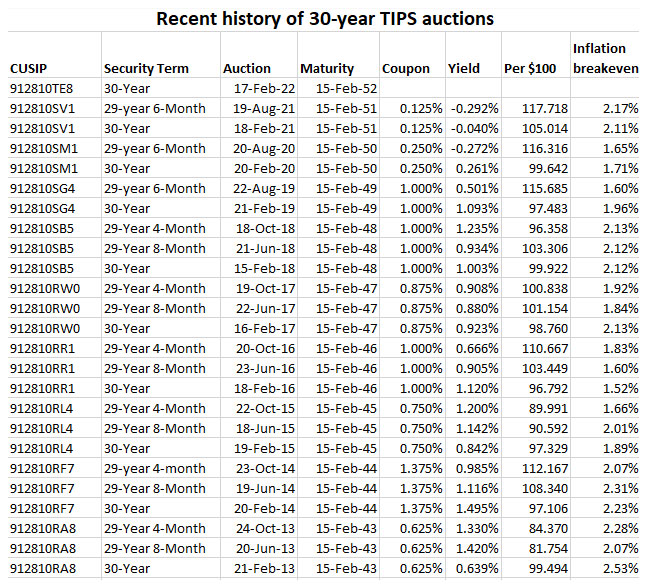
I will be reporting the auction results soon after the close. Here’s a listing of recent 29- to 30-year TIPS auctions, showing that the string of three consecutive negative yields is actually an aberration for this term, even during earlier times of Federal Reserve quantitative easing:
* * *

Feel free to post comments or questions below. If it is your first-ever comment, it will have to wait for moderation. After that, your comments will automatically appear.

David Enna is a financial journalist, not a financial adviser. He is not selling or profiting from any investment discussed. The investments he discusses can purchased through the Treasury or other providers without fees, commissions or carrying charges. Please do your own research before investing.

Posted in I Bond, Investing in TIPS | 2 Comments

Podcast: ‘The Inflation Guy’ analyzes the January inflation report

‘Too much money chasing too few goods.’ Economists don’t like it, it’s too simple, but it’s still the best explanation out there.

Tipswatch.com

Another month, another inflation shocker. What does it all mean?

Let’s get some answers from inflation guru Michael Ashton and his “Cents and Sensibility” podcast. I am a fan of this podcast and Ashton’s work because he has deep knowledge of how inflation works, but can explain complex issues in an entertaining way.

Ashton points out in January there were 10 price categories that inflated at an annualized monthly pace of at least 10%. So why are we still having a debate about “ongoing inflation” — the permanence, causes and symptoms of the nation’s surging prices?

His podcast intro: “Core CPI above 6%; headline at 7.5%. 40-year high after 40-year high. What is the ‘ongoing inflation debate’? The answers here are pretty simple. If you want fewer birds in your backyard, quit throwing birdseed out there.

Have a listen:

You can subscribe to this podcast in all the traditional ways, or find it here.

Follow Ashton on Twitter at: https://twitter.com/inflation_guy

Who is Michael Ashton?

His audiences know him as the “Inflation Guy.” He is a pioneer in the U.S. inflation derivatives market. Before founding his company, Enduring Investments, Ashton worked in research, sales and trading for several large investment banks including Bankers Trust, Barclays Capital, and J.P. Morgan.

Since 2003, when he traded the first interbank U.S. CPI swaps, and 2004 when he was the lead market maker for the CME’s CPI Futures contract, he has played an integral role in developing new instruments and methods for accessing and hedging various inflation exposures. In 2016, Mr. Ashton published What’s Wrong With Money? The Biggest Bubble of All. He is a graduate of Trinity University and lives in Morristown, New Jersey.

Have a question? Get the Inflation Guy app in the Apple App Store or Google Play, or email InflationGuy@enduringinvestments.com.

* * *

Feel free to post comments or questions below. If it is your first-ever comment, it will have to wait for moderation. After that, your comments will automatically appear.

David Enna is a financial journalist, not a financial adviser. He is not selling or profiting from any investment discussed. The investments he discusses can purchased through the Treasury or other providers without fees, commissions or carrying charges. Please do your own research before investing.
Posted in Inflation | 5 Comments

U.S. inflation surged 0.6% in January, again higher than expectations

Inflation is running at a 40-year high. What does it mean for I Bonds, TIPS and future interest rates?

By David Enna, Tipswatch.com

Once again, U.S. inflation is running higher than expectations, a trend that will probably continue through the early months of 2022.

The Consumer Price Index for All Urban Consumers (CPI-U) increased 0.6% in January on a seasonally adjusted basis, the U.S. Bureau of Labor Statistics reported today. Over the last 12 months, the all-items index increased 7.5%, the largest 12-month increase in 40 years, since the period ending February 1982.

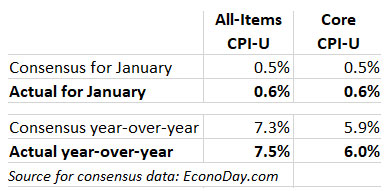
Both the monthly and year-over-year increases exceeded economist expectations of 0.5% for the month and 7.3% for the year. Core inflation, which removes food and energy, also exceeded expectations, running at 0.6% in January (versus expectations of 0.5%) and 6.0% for the year (versus 5.9%). The year-over-year number for core was the largest 12-month change since the period ending August 1982.

And this jump higher in inflation came despite the fact that gasoline prices actually fell in January, a trend that is likely to reverse in coming months. The BLS noted that a wide range of price increases contributed to January’s surge in inflation. Some highlights:

  • Food-at-home prices increased a troubling 1% in the month, and are now up 7.4% over the last year.
  • Gasoline prices fell 0.8% for the month, but are up 40% over the last year. This decline is highly likely to reverse in future months, as the price of WTI Crude has increased about 35% in the last two months.
  • Shelter costs rose 0.3% for the month, and are up 4.4% over the last year. This is another category where higher prices can be expected into the future.
  • Costs of electricity surged 4.2% in the month and are up 10.7% year-over-year.
  • Apparel prices, once a sleepy sector in the CPI report, were up 1.1% in January.
  • Prices for used cars and trucks continued surging higher, up 1.5% in the month and 40.5% for the year.
  • New car prices held stable, but are up 12.2% for the year.
  • The medical care index rose 0.7% for the month.

To wrap things up, the BLS said this: “The increase is broad-based, with virtually all component indexes showing increases over the past 12 months.”

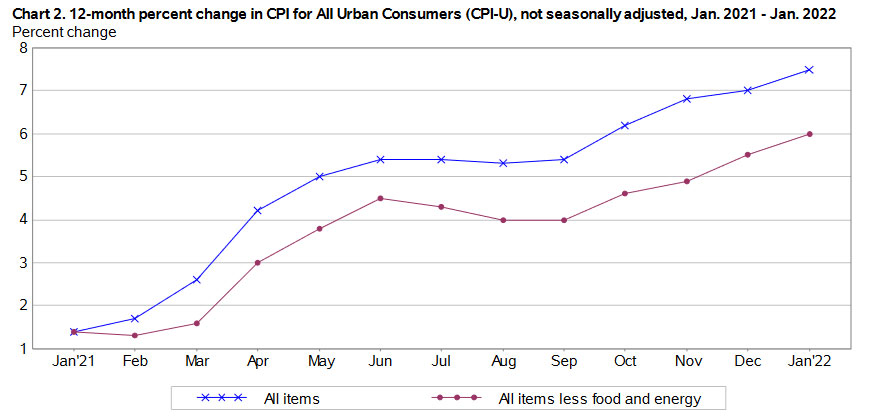
Here is the one-year trend for all-items and core inflation, showing the remarkable climb higher from very low levels of inflation in January 2021:

What this means for TIPS and I Bonds

Investors in Treasury Inflation-Protected Securities and U.S. Series I Savings Bonds are also interested in non-seasonally adjusted inflation, which is used to adjust principal balances on TIPS and set future interest rates for I Bonds. For January, the BLS set the inflation index at 281.148, an increase of 0.84% over the December number.

For TIPS. The January inflation report means that principal balances for all TIPS will increase 0.84% in March, following an increase of 0.31% in February. For the year ending in March, TIPS principal balances will have increased 7.5%. Here are the March inflation indexes for all TIPS.

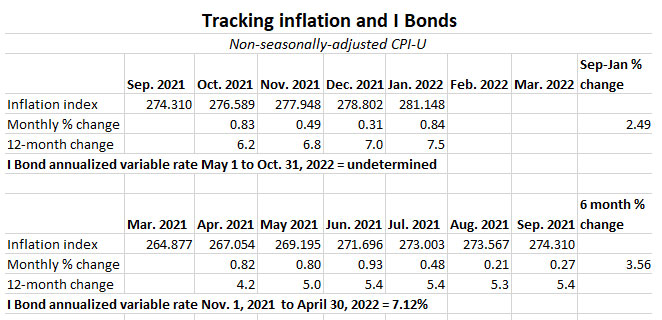
For I Bonds. The January inflation report is the fourth in a six-month series that will determine the I Bond’s new inflation-adjusted variable rate, to be reset on May 1 based on non-seasonally adjusted inflation from September 2021 to March 2022. So far, with two months remaining, inflation has increased 2.49%, which would translate to an I Bond variable rate of 4.98%. Two months remain, and that rate is likely to climb higher. Here are the data so far:

What this means for future interest rates

Clearly, interest rates are heading higher. This inflation report continues a string of higher-than-consensus numbers, even though the consensus forecasts have been rising. Already this morning the 10-year Treasury note is trading with a yield of 1.98%, very close to breaking through the 2% barrier, a level we haven’t seen since July 2019. And stock market futures are falling, indicating the markets are again adjusting to a future with higher interest rates.

From this morning’s Wall Street Journal report:

High inflation is the dark side of the unusually strong economy, posing a challenge to the Federal Reserve as it tries to quell rising prices without damping growth.

“This is not encouraging news for the Fed in its battle to get inflation heading back towards the 2% target,” said James Knightley, chief international economist at ING. “Rate hikes will do nothing to resolve supply chain strains and worker shortages, but they can contribute to taking some of the steam out of the economy and allow demand and supply to start moving towards a better balance, at the expense of weaker growth.”

I’m sure the Federal Reserve has a very good idea where prices are heading, and the current trend of 40-year inflationary highs must be addressed. An easy prediction: Expect the Fed to begin raising short-term interest rates in March, and continue raising them through 2022.

What will happen to longer-term rates? That will depend on the economy and the stock market’s reaction to Fed actions. In the next few months, longer-term rates should climb higher, but possibly stabilize if the economy begins sinking or the stock market plummets.

* * *

Feel free to post comments or questions below. If it is your first-ever comment, it will have to wait for moderation. After that, your comments will automatically appear.

David Enna is a financial journalist, not a financial adviser. He is not selling or profiting from any investment discussed. The investments he discusses can purchased through the Treasury or other providers without fees, commissions or carrying charges. Please do your own research before investing.
Posted in I Bond, Inflation, Investing in TIPS | 14 Comments

30-year real yield cracks through a milestone, rising above zero

Real yields are rising. Noticed that your TIPS fund or ETF has taken a hit?

By David Enna, Tipswatch.com

Maybe it’s not really an Earth-shattering event, but something significant happened Friday: The real yield on a 30-year Treasury Inflation-Protected Security rose above zero for the first time since May 21, 2021.

At Friday’s market close, the U.S. Treasury estimated the real yield of a full-term 30-year TIPS at 0.06%, up 39 basis points since the beginning of the year. This happened the day after the Treasury revamped the presentation of its Yields Curve site, which sent my head spinning. But Bloomberg’s Current Yields site showed that a 29-year, 6-month TIPS closed Friday with a real yield to maturity of 0.04%, so there you go … confirmation that the entire TIPS yield curve is no longer negative to inflation.

Bloomberg took note of this in a story posted Friday morning, noting the surge in yields after an important jobs report surprised to the upside earlier Friday:

It’s already been a tough start to a year for Treasury investors. U.S. government bonds lost about 2.1% this year through Thursday, according to the Bloomberg U.S. Treasury Total Return Index. The loss is already approaching the full-year decline of 2.3% last year, which was the first annual decline since 2013.

“We have to price in more risk that the Fed goes really aggressively, so we’re seeing most of the pressure on the front end of the curve,” said Michael Cloherty, head of U.S. rates strategy at UBS Securities. “As central banks get tighter that should push up real rates.”

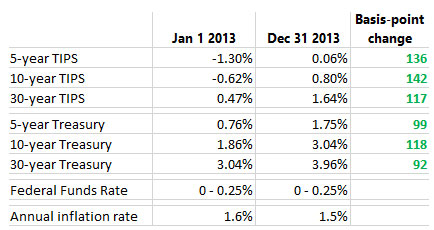
I have been speculating that both real and nominal yields could quickly surge higher as the Federal Reserve approaches actions to raise short-term interest rates and eventually to pare back its massive balance sheet of Treasurys and mortgage-backed securities. It turns out that 2022 is starting to look a lot like 2013, when real and nominal yields burst higher in anticipation of Fed actions:

Note in this chart that annual inflation was running at a muted 1.5% through 2013, which allowed the Federal Reserve to delay tightening. This year, with inflation running at 7.0%, the Fed can’t put off decisive actions, and the market is adjusting quickly to that reality.

Here is the trend in the 30-year real yield over the last three years:

These three years have been a remarkable era for Fed policy, beginning in 2019 with the tail end of a period of tightening, through a period of moderate interest rate cuts in 2019, to all-out massive stimulus in 2020 and 2021 to calm the market shock that resulted from the pandemic surge in March 2020.

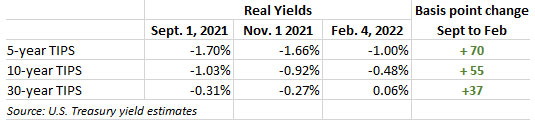
Now we are entering the “next era,” with inflation surging and the Federal Reserve almost certainly ready to raise short-term interest rates multiple times in 2022. Here is how real yields have increased over the last five months:

It’s no surprise that short-term real yields are rising faster than the longer-term yields. Fed actions to raise short-term nominal interest rates will have the greatest effect on the 5-year TIPS because it is the shortest maturity. Eventually, as short-term rates rise, longer-term yields may ease off, flattening or even inverting the yield curve. This happened in late 2018, setting off stock market panic and forcing the Fed to back off on tightening in 2019.

What’s happening to TIPS funds?

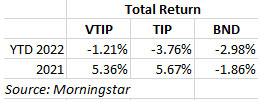
When real yields rise, the value of a TIPS falls. So, obviously, TIPS mutual funds and ETFs have hit a difficult stretch in recent months, but returns have been aided by high inflation accruals over the last year. This is why it is important to analyze TIPS funds based on total return, not net asset value.

The chart compares total returns for Vanguard’s Short-Term TIPS ETF (VTIP), the iShares TIPS ETF (TIP) and Vanguard’s Total Bond Market ETF (BND). Even though shorter-term real yields have been rising faster than longer-term yields, VTIP has outperformed the overall TIPS market and the overall bond market. TIPS funds have the advantage of inflation accruals, and as long as inflation continues running hot, these funds can balance off some of their net-asset-value losses caused by rising interest rates.

But I would still expect TIPS mutual funds and ETFs to have a difficult year in 2022, as interest rates rise. VTIP, with its shorter duration, should perform the best in this scenario, but it could still end up with a negative return for the year. Taking a longer view, higher real and nominal interest rates will be a positive for investors looking to add new money in inflation-protected investments.

Is the I Bond’s fixed rate affected at all?

The U.S. Treasury will reset the fixed rate of the U.S. Series I Savings Bond on May 2. The rate is currently 0.0%, and in my opinion looks very likely to remain at 0.0% through the May reset. The 10-year real yield is currently -0.48% and would need to rise at least 75 basis points in the next three months to make a higher fixed rate at all likely. I don’t see that happening, but you never know.

If real yields surge higher through 2022, it’s possible the fixed rate could rise in November. Still, the current annualized variable rate of 7.12% on I Bonds is too attractive to pass up. I think an investment before May 1 is the wisest course. The next variable rate, also to be reset on May 2, should be at least 4.5%, maybe much higher. Can’t pass up 12 months of very strong returns for the outside chance for a higher fixed rate in the future.

Look back at the Fed’s last tightening cycle

Back in July I did a series of articles looking at how real and nominal yields reacted when the Fed first began discussing tightening in 2013, stopped bond buying in 2014, and eventually began raising interest rates in late 2015. Through most of this period, surprisingly, the stock market did very well. Bond markets took some hits, but eventually recovered.

2013: A year of surging real and nominal yields
2014: The deck was stacked against TIPS funds
2015: The Fed actually did something!
2016: Inflation rises; TIPS out-perform the overall bond market
2017: ‘The calm before the storm’
2018: Did the Federal Reserve go too far?
2019: The Fed cries ‘uncle’; bond investors celebrate
2020: Chaotic year of pandemic fears, stunning stimulus
2021 and beyond: What’s ahead for U.S. financial markets?

* * *

Feel free to post comments or questions below. If it is your first-ever comment, it will have to wait for moderation. After that, your comments will automatically appear.

David Enna is a financial journalist, not a financial adviser. He is not selling or profiting from any investment discussed. The investments he discusses can purchased through the Treasury or other providers without fees, commissions or carrying charges. Please do your own research before investing.
Posted in I Bond, Investing in TIPS | 13 Comments

New 10-year TIPS auctions with a real yield of -0.540%

The auctioned real yield came in higher than current market pricing, indicating fairly weak demand for this offering.

By David Enna, Tipswatch.com

The Treasury’s offering of $16 billion in a new 10-year Treasury Inflation-Protected Security — CUSIP 91282CDX6 — generated a real yield to maturity of -0.540%, above current market yields for TIPS of this term. The issue got a coupon rate of 0.125%, the lowest the Treasury will go for any TIPS.

At the market close yesterday, the U.S. Treasury was estimating the 10-year real yield at -0.57%, a bit lower than today’s result. In addition, a 9-year, 6-month TIPS was trading this morning on the secondary market with a real yield of -0.65%, well below the auction result.

So it looks like this auction was met with lukewarm demand and the Treasury was forced to give this TIPS a slightly higher real yield than predicted. The question: Are investors sitting on the sidelines, waiting to see how interest rates will trend in coming months?

Today’s investors paid an adjusted price of about $107.08 for about $100.25 of value, after accrued inflation is added in. This TIPS will have an inflation index of 1.00253 on the settlement date of Jan. 31. Investors had to pay a premium price because the real yield of -0.540% is well below the coupon rate of 0.125%.

So, it looks like investors got a bit of a bargain at today’s auction. The real yield of -0.540% was the highest recorded for any 9- to 10-year TIPS auction since May 2020.

Real yields have been climbing in recent weeks, following signals that the Federal Reserve intends to stop bond-buying stimulus in March, and then begin raising short-term interest rates. Here is the trend in 10-year real yields over the last year, showing how yields have climbed since deep lows in August and November 2021:

Inflation breakeven rate

With a 10-year Treasury note trading with a nominal yield of 1.83% at the auction’s close, this new TIPS gets an inflation breakeven rate of 2.37%, which seems attractive. The rate means this TIPS will out-perform a nominal 10-year Treasury if inflation averages more than 2.37% over the next 10 years.

Inflation expectations have been falling since late 2021, triggered by investor belief that the Federal Reserve will take needed actions to tamp down soaring inflation. Here is the trend in the 10-year inflation breakeven rate over the last year.

Reaction to the auction

The TIP ETF — which holds the full range of maturities — had been trading higher all morning, indicating lower yields. But after the auction’s close at 1 p.m. EST, the ETF slipped lower. This is an indication of lukewarm support for the auction. In addition, the bid-to-cover ratio was 2.30, the lowest for any TIPS auction of this term in more than a year.

The Treasury might be disappointed — it had to pay a slightly higher yield than expected — but investors at today’s auction should be pleased. The real yield of -0.54% was 60 basis points higher than the most recent auction of this term. That auction, in November 2021, resulted in a record-low real yield of -1.145%.

Personal note: I considered making a small investment in this TIPS in my Vanguard brokerage account , but I didn’t realize that Vanguard closes off auction orders at 10 a.m. on the morning of the auction. I swear it was 9:55 a.m. when I looked to make an order, but I got cut off. Lesson learned. I don’t know if this is true at other brokerages.

Anyway, this TIPS will get reopening auctions in March and May. Maybe we will see even better yields by then. Here’s a history of recent auctions, showing the string of 11 auctions of this term with negative real yields.

* * *

Feel free to post comments or questions below. If it is your first-ever comment, it will have to wait for moderation. After that, your comments will automatically appear.

David Enna is a financial journalist, not a financial adviser. He is not selling or profiting from any investment discussed. The investments he discusses can purchased through the Treasury or other providers without fees, commissions or carrying charges. Please do your own research before investing.
Posted in Investing in TIPS | 7 Comments