I am writing this posting after just arriving in Zadar, Croatia. My time is short, so I will need to be brief this month.
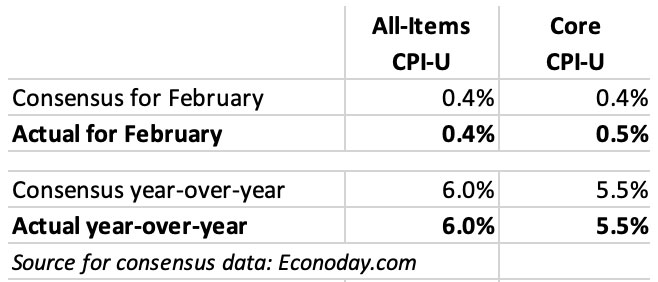
The Consumer Price Index for All Urban Consumers rose 0.4% in February on a seasonally adjusted basis, the U.S. Bureau of Labor Statistics reported today. Over the last 12 months, the all-items index increased 6.0%. Those numbers matched consensus estimates, but core inflation ran slightly higher than expected, at 0.5% for the month, versus the estimate of 0.4%.
The index for shelter was the largest contributor to the monthly all items increase, accounting for over 70% of the increase, the BLS said, with the indexes for food, recreation, and household furnishings and operations also contributing.
This report ended up close to expectations. The shelter index continues to run hot (up 8% for the month and 8.1% for the year), but this is a lagging indicator and should begin sliding lower in future months. The annual increase in the all-items index of 6.0% was the lowest 12-month increase since the period ending September 2021. The core increase of 5.5% was the smallest since December 2021.
Gasoline prices were up 1% for the month, but have fallen 2.0% over the last 12 months. Food prices were up 0.4% for the month and 9.5% for the year.
Here is a one-year look at trends for all-items and core inflation, showing the gradual decline in core inflation versus a steeper decline for all-items:
What this means for TIPS and I Bonds
Investors in Treasury Inflation-Protected Securities and U.S. Series I Savings Bonds are also interested in non-seasonally adjusted inflation, which is used to adjust principal balances on TIPS and set future interest rates for I Bonds.
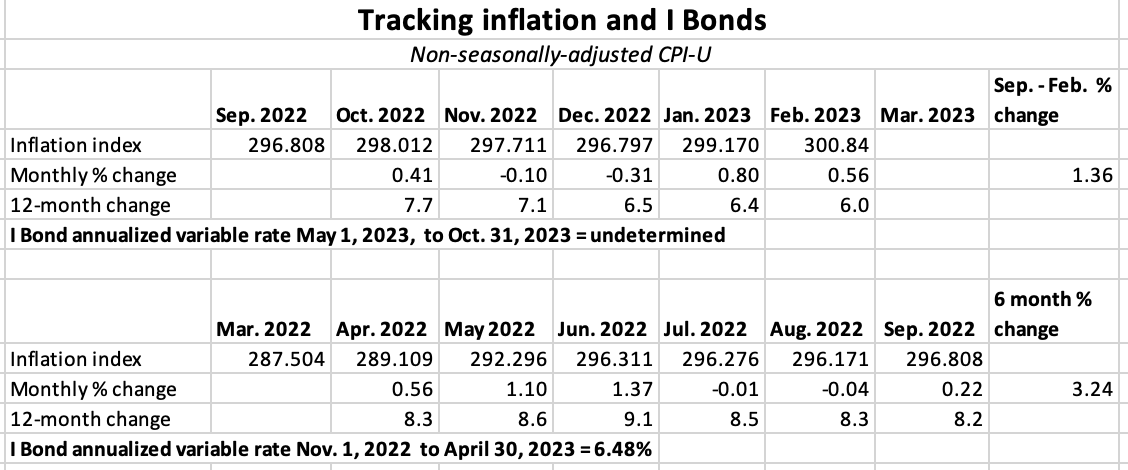
For February, the BLS set the inflation index at 300.840, an increase of 0.56% over the January number and 6.0% year-over-year.
For TIPS. The February inflation report means that principal balances for TIPS will increase 0.56% in April, after rising 0.80% in March. Here are the new April Inflation Indexes for all TIPS.
For I Bonds. February is the fifth month of a six-month string that will determine the I Bond’s new inflation-adjusted variable rate. Through the five months, inflation has run at 1.36%, which would translate to a variable rate of 2.72%. One month remains, so it looks like the new variable rate should fall into a range of about 3.2% to 3.5%, down substantially from the current 6.48%. The I Bond’s fixed rate will also be reset May 1, but the outlook for that reset is highly uncertain, given the volatility of real yields over the last week.
Sorry, but this is all I have time for on this busy travel day. I hope to post more later this week.
* * *
Feel free to post comments or questions below. If it is your first-ever comment, it will have to wait for moderation. After that, your comments will automatically appear.Please stay on topic and avoid political tirades.
David Enna is a financial journalist, not a financial adviser. He is not selling or profiting from any investment discussed. I Bonds and TIPS are not “get rich” investments; they are best used for capital preservation and inflation protection. They can be purchased through the Treasury or other providers without fees, commissions or carrying charges. Please do your own research before investing.
I am traveling for the next 2 1/2 weeks in a far-off land with a Mediterranean climate (I hope this applies to March), a beautiful coastline, amazing historical sites and hearty foods like Čobanac.
Its flag is one of my favorites in the world. Want to guess the country?
Of course, the trip means my internet access is going to be iffy for much of this time, and my schedule is going to be crowded through late March. So I won’t be able to update this site as frequently or as thoroughly as usual. I will try to check in to answer questions when I can, but that could also be iffy.
To add to the confusion, daylight savings time begins today (March 12) in the United States, but not until March 26 in the Central European Time zone. Oh, and by March 26 I will be in the Eastern European Time zone, doubling my dizziness.
But … the news never stops
March 14, 8:30 a.m. ET. The Bureau of Labor Statistics will release the February inflation report. This will be a crucial report. It will help set the course for future Federal Reserve actions on inflation, and also be the fifth of six monthly reports that will determine the I Bond’s new variable rate.
The Cleveland Fed is nowcasting a monthly inflation rate of 0.54% for February and annual inflation of 6.21%. Its core forecast is 0.45% for the month and 5.54% for the year. These Cleveland Fed numbers haven’t been highly accurate recently, and I haven’t yet seen other consensus estimates.
Most likely, when the inflation report is released Tuesday, I will be hiking in a nature preserve or sitting on a bus, heading for the coast. I will try to post the news and analysis as soon as I can, in whatever form I can.
March 19, 8 a.m. ET. At this time, I am planning to post my preview article on the 10-year TIPS reopening auction scheduled for Thursday, March 23. This one has been looking promising, after the originating auction on Jan. 19 got a “disappointing” real yield of 1.22%. The March 23 auction should get a better result, but real yields have been declining in recent days.
March 23, 1 p.m. ET. I’ll try to post the 10-year TIPS auction results as soon as I can. At that time (7 p.m. CET) I might be in the middle of a hearty dinner or finishing a fourth glass of wine. So take note: accuracy could be an issue.
Last week’s banking news
I have been out of the country during several economic collapses, so I get touchy when I see headlines like “Why Silicon Valley Bank’s crisis is rattling America’s biggest banks.” It reminds me of the hundreds of times I have heard CNBC commentators say the Federal Reserve would keep raising rates until “something breaks.”
Did something just break?
An interesting side to this story is the fact that banks were loading up on ultra-safe U.S. Treasurys during the era of near-zero interest rates. Now that the free-money era has ended, those Treasurys have declined sharply in value. But, as the Wall Street Journal reports:
Banks don’t incur losses on their bond portfolios if they are able to hold on to them until maturity. But if they suddenly have to sell the bonds at a loss to raise cash, that is when accounting rules require them to show the realized losses in their earnings. Those rules let companies exclude losses on their bonds from earnings if they classify the investments as “available for sale” or “held to maturity.” …
“This is the first sign there might be some kind of crack in the financial system,” said Bill Smead, chairman and chief investment officer of Smead Capital Management, a $5.5 billion firm that counts Bank of America Corp. and JPMorgan among its holdings. “People are waking up to the gravity that this was one of the biggest financial euphoria episodes.” …
The Federal Deposit Insurance Corp. in February reported that U.S. banks’ unrealized losses on available-for-sale and held-to-maturity securities totaled $620 billion as of Dec. 31, up from $8 billion a year earlier before the Fed’s rate push began.
This adds some perspective to the Federal Reserve’s somewhat controversial plan to reexamine banks’ capital reserves, a topic Fed Chairman Jay Powell got hammered on in last week’s congressional testimony. Powell absolutely could not say “there is a problem.” I just hope there isn’t a problem.
I am also hoping (as always) that we won’t see financial chaos while I am trying to enjoy my Mediterranean adventure. I’ll just close with a picture I took in 2018 in another country I am visiting on this trip:
* * *
Feel free to post comments or questions below. If it is your first-ever comment, it will have to wait for moderation. After that, your comments will automatically appear.Please stay on topic and avoid political tirades.
David Enna is a financial journalist, not a financial adviser. He is not selling or profiting from any investment discussed. I Bonds and TIPS are not “get rich” investments; they are best used for capital preservation and inflation protection. They can be purchased through the Treasury or other providers without fees, commissions or carrying charges. Please do your own research before investing.
Note, March 13: It has been 5 days since I wrote this article, and while I think it presents a reasonable theoretical way to look at the I Bond’s fixed rate, these predictions are totally shot, at least for now.The 10-year real yield is currently trading around 1.22%, down about44 basis points in the last 5 days. So … in this troubling environment of bank bailouts, the Fed and markets are likely to change course. Yields leading up to the May 1 decision are likely to be very volatile.(But I think this all still makes a strong case for investing in inflation protection.)
Read this article knowing that it is almost impossible to predict what the I Bond’s fixed rate reset will be on May 1. There are simply too many unpredictable factors.
And now, the original article:
I’ve been getting a lot of questions from readers asking: “Do you think the Treasury will raise the I Bond’s fixed rate on May 1? And what should we do about it?”
It’s still too early to speculate (a lot happens in the bond market every week), but I do think the fixed rate is probably going up on May 1. But by how much? No one can say. The Treasury has no announced formula for setting the I Bond’s rate. It seems to be set based on “whim.” But maybe not totally whim.
First, here are some details about the U.S. Series I Savings Bond, a security that earns interest based on combining a fixed rate and an inflation rate.
The fixed rate will never change. Purchases through April 30, 2023, will have a fixed rate of 0.4%. The fixed rate is essentially the “real yield” of an I Bond, the amount its return will exceed future inflation.
The inflation-adjusted rate (often called the variable rate) changes each six months to reflect the running rate of inflation. That rate is currently set at 6.48% annualized. It will adjust again on May 1, 2023, for all I Bonds, no matter when they were purchased. The starting month of the new rate depends on the month you purchased an I Bond.
The combination of these two rates creates the I Bond’s six-month composite rate, which is currently 6.89% annualized for I Bonds purchased through April 30.
The fixed rate is extremely important for an I Bond investor, especially a long-term investor, because it stays with the I Bond for 30 years, or until the I Bond is redeemed. A higher fixed rate is very desirable.
But even if the fixed rate rises on May 1, if the increase is small — say from 0.4% to 0.6% — an investor still might want to buy in April to lock in the 6.89% interest rate for a full six months. On a $10,000 investment, that equals $344.50 in interest. A 0.2% increase in the fixed rate only adds $20 a year.
It looks likely that the I Bond’s variable rate will fall on May 1. This is uncertain, with two months of inflation unreported, but the variable rate could fall to something like 3.50%. If the fixed rate rises to 0.6%, the new composite rate would be around 4.12%.
So the investment equation is: 6.89% before May 1 and something like 4.12% after May 1. For a short-term investor, buying before May 1 will make more sense. For the long-term holder of I Bonds, buying after May 1 may be wiser. But of course if you wait, you won’t know if the fixed rate is actually going higher. It’s a risk. Or … it could rise somewhere much higher, like 0.8% or 1.0% and you’d be very happy.
Alternatives. Buy half your $10,000 I Bond allocation in April and the other half in May. Or, some investors — those with spouses and two separate TreasuryDirect accounts — could use the “gift box” strategy. Buy your full allocation in April and then, if the fixed rate rises dramatically, use the gift box in May to invest another $10,000 each.
Handicapping the fixed rate
Although the Treasury has no public formula for setting the I Bond’s fixed rate, I have long speculated that the fixed rate will tend to track (although lower) with the real yield of a 10-year Treasury Inflation-Protected Security. Last October, I suggested that the fixed rate was likely to rise to a range of 0.3% to 0.5%, even though a higher fixed rate was justified. The Treasury settled on 0.4%. I got lucky on that prediction.
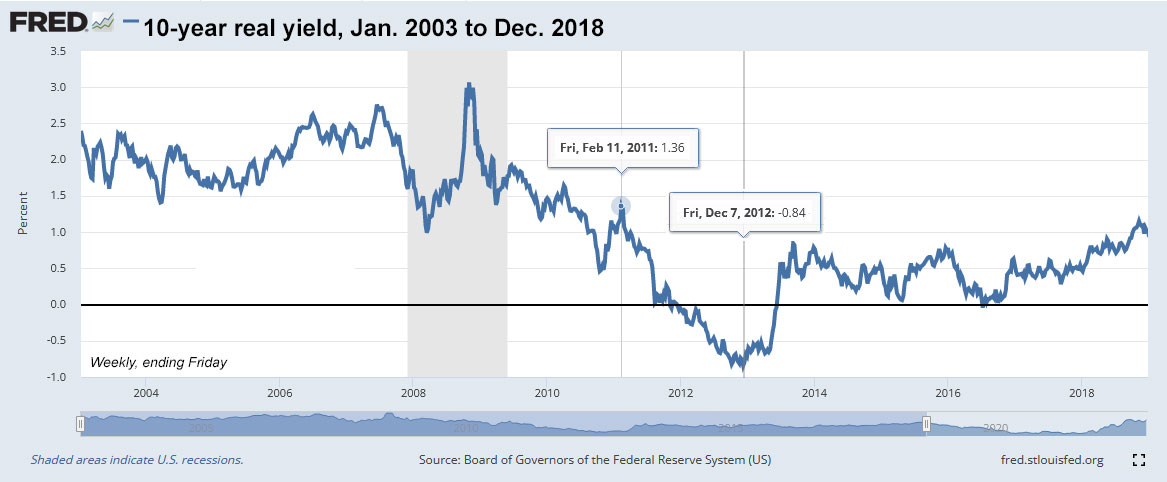
On October 31, 2022, the 10-year TIPS was yielding 1.58%. The I Bond’s fixed rate generally lags 50 to 75 basis points lower than the 10-year real yield, so a higher fixed rate was justified, in my opinion. But real yields at that point had just recently surged higher. It was hard to forecast a longer-term trend.
Several readers have suggested that the Treasury may take an average of the 10-year real yield over the previous six months and then apply a ratio to that yield to set the I Bond’s fixed rate. I liked that idea, at least in theory. So I took a look at recent rate-setting periods where the fixed rate was set higher than 0.0% to compare the six-month-average theory against the most-recent-yield theory:
OK, to be honest, neither theory works well enough to be relied on as a predictor and that puts us back to the “whim of the Treasury” theory for setting the I Bond’s fixed rate. It says so right in the Federal Register:
The Secretary of the Treasury determines the fixed rate of return. The fixed rate is established for the life of the bond. This amendment clarifies that the fixed rate of return will always be greater than or equal to 0%.
Still, I think market real yields do play a role in this rate-setting exercise.
Half-year average theory. To apply this theory, I determined the average 10-year real yield over the rate-setting periods — May to October and November to April for each period the fixed rate was set above 0.0%. Then I calculated the ratio of the new fixed rate to the six-month average.
In the most recent rate reset in November 2022, the fixed rate of 0.40% was 56% of the 0.72% six-month average for the 10-year real yield. If you applied that ratio to current 10-year real yield average of 1.41%, you get a fixed rate of 0.80%, rounded to the tenth decimal point. (Fixed rates are always set to the tenth decimal point, such as 0.40% currently.)
But … this history of rate resets is highly inconsistent, with the ratio averaging just 34%. If you apply that to the current average of 1.41%, you get a fixed rate of 0.50% (rounded), still higher than the current 0.40%.
The more-recent ratios have tended to fall around 60%, which would give you a fixed rate of 0.80%.
Most recent real yield theory. This theory — which looks at the yield spread between the I Bond’s new fixed rate and the most recent 10-year TIPS yield — is also hugely inconsistent, but it generally does a good job of predicting when the fixed rate is likely to rise or fall.
The fixed rate of 0.4% in November resulted in a yield spread of 118 basis points, the highest margin going back 13 years. It’s possible the Treasury saw the then-recent surge in real yields as temporary, so it held the fixed rate lower than it might have otherwise.
If you apply a spread of 50 to 75 basis points (the average is 67 bps) you get a fixed rate of 0.90% to 1.20%, based on the current real yield of 1.66%.
Conclusion
I think the fixed rate is heading higher, possibly to around 0.6% on the low end and 1.0% on the high end. Let’s just say –er, guess — 0.8%. Feel free to crowdsource your own ideas and theories in the comments sections below.
Plus, remember that a lot can change before May 1, and the Treasury can do anything on a “whim.”
I’ll be taking another look at this issue — and potential I Bond investing strategies — after we learn the new variable rate, which will be set by the March inflation report released on April 12, 2023.
Feel free to post comments or questions below. If it is your first-ever comment, it will have to wait for moderation. After that, your comments will automatically appear.Please stay on topic and avoid political tirades.
David Enna is a financial journalist, not a financial adviser. He is not selling or profiting from any investment discussed. I Bonds and TIPS are not “get rich” investments; they are best used for capital preservation and inflation protection. They can be purchased through the Treasury or other providers without fees, commissions or carrying charges. Please do your own research before investing.
The 2011 crisis led to an S&P downgrade of U.S. debt. This year could be worse.
By David Enna, Tipswatch.com
When I launched this website back in April 2011, I figured I had chosen one of the most placid and unexciting corners of the investing world: inflation-protected investments. Boring. Staid.
In the days leading up to my first post — on April 10, 2011 — real yields on a 5-year TIPS had started to slip below zero. That was a milestone, and a bit of a shock. But the 10-year TIPS was still yielding a solid 0.96% above inflation.
All of that was about to change. By the end of 2011, the 5-year real yield had plummeted to -0.76% and the 10-year also broke into the negative, at -0.07%. This chart shows the amazing drop in TIPS yields over the course of 2011 and through the entire year of 2012:
Click on image for a larger version.
In the middle of 2011, something shifted, but why?
Debt-limit crisis of 2011: A monumental event
Back in late 2011, I was quick to blame Federal Reserve manipulation of the Treasury market for the pathetically low yields on TIPS. One of the episodes of quantitative easing had to be behind this sudden shift, right? Wrong.
QE1 began in November 2008
A second phase of QE1 began in March 2009
QE2 began in November 2010
So in the years leading up to 2011-2012, real yields were declining but gradually. Something else happened exactly in late July to early August 2011: A crisis over increasing the U.S. government’s debt limit, the exact crisis we are rolling toward in 2023. A government in crisis; Congressional negotiations heading nowhere. Here are some headlines from that time, which we could see repeated this summer:
Yes, on Aug. 6, 2011, for the first time in history, Standard and Poors lowered its rating on U.S. debt from AAA to AA+, with a negative outlook.
Market reaction
Global stock markets declined on August 8, 2011, following the S&P announcement. All three major U.S. stock indexes declined 5% to 7% percent in one day. However, U.S. Treasurys, which had been the subject of the downgrade, actually rose in price and the dollar gained in value. The flight to safety was on.
This chart compares the performance of the TIP ETF, the long-term Treasury ETF (TLT) and the S&P 500 (SPY). It shows how the market earthquake struck precisely in mid 2011 and hit Treasuries (positively) and stocks (negatively):
Click on the image for a larger version.
Fear was the trigger: The stock market dropped and Treasurys soared. The Federal Reserved stepped in – one month later – to begin Operation Twist, selling short-term debt and using the money to buy longer-term debt. The intent was to flatten the yield curve (a problem that does not need fixing in 2023).
One last chart shows the massive moves in Treasurys and the stock market in a single month, August 2011:
Click on image for a larger version.
What is truly remarkable is that Treasury investments thrived amid this debt crisis and the downgrade from Standard and Poors. Fear was the driving force, and U.S. Treasurys were again shown to be the world’s premier “safety-first” investment.
2023: ‘This time is different’
Here we are, in March 2023, rolling toward the exact crisis we saw in 2011. Just like then, we have a Democratic president and a divided Congress (in 2011, by the way, Vice President Joe Biden was serving as the Senate President). But this isn’t a deja vu event. Things are quite different:
A divided Republican party. I am trying to avoid making this about politics, but it’s clear that about 20 House Republicans will attempt to block any attempt to raise the debt ceiling, right to the brink of disaster.
A no-compromise Democratic Party. Democratic leaders are strongly opposed to cuts in spending for social programs, including Social Security and Medicare. Most Democrats are refusing to even discuss spending cuts. A compromise will be very difficult to achieve in 2023.
Where’s the middle ground? It’s going to take middle-of-the-road Republicans and Democrats to break from party pressure to reach a debt-limit agreement. In 2011, a lot of people were talking compromise. In 2023, you can hear crickets.
A hamstrung Federal Reserve. U.S. inflation is likely to continue running well above the Fed’s target of 2% all summer. The Fed has limited ability to step in to support the bond or stock markets, even if disaster looms.
A volatile Treasury market. In June 2011, the 10-year note was yielding 2.96%, very close to what it was a year earlier, 3.29%. Today, the 10-year is at 3.97%, up 211 basis points from one year earlier. This market is now more unpredictable and less steady than it was in 2011.
A weakening economy. As interest rates continue to climb, many economists have been sounding the alarm about a looming recession. In 2011, the U.S. stock market was able to recover fairly quickly from the debt crisis, with the S&P 500 posting a total return of 16% in 2012 and 32% in 2013. There’s a lot more risk in 2023 with stocks still at fairly high valuations and the economy on a tightrope.
On the positive side, Biden has skills at negotiating a Congressional compromise. Eventually, both sides will probably have to “give” — a little.
Also interesting: Current Fed President Jay Powell played a key role is settling the 2011 debt crisis. At the time, Powell was a former Treasury official who was working for $1 a year as a visiting scholar at the Bipartisan Policy Center. Powell used his influence to help settle the issue, as CNN note in a recent article.
NPR’s Planet Money did a podcast recently on Powell’s role in 2011. Give it a listen:
Before he was Fed chair, Jay Powell spent the 2011 summer trying to avoid a global economic catastrophe.
Republicans didn’t trust the deadline Treasury was saying the debt limit needed to be altered by.
A lot of readers have been asking me what will happen if the debt-ceiling negotiations fail and the U.S. government goes into debt-lock. My answer is: I don’t know. Will I Bonds continue to be issued? Will the United States continue paying interest on its debt? Will the U.S. pay out maturing Treasurys? Will Social Security payments get slashed? I don’t know.
The most probable outcome, in my opinion, is that we will come to the brink of debt disaster — and maybe even take a quick leap off the cliff — before Congress settles the issue by kicking the can down the road. Maybe Democrats will need to bend on some future spending cuts. Maybe Republicans will have to silence the ultra-hawks.
“Once again, the debt ceiling is in the news and a cause for concern. If the debt ceiling binds, and the U.S. Treasury does not have the ability to pay its obligations, the negative economic effects would quickly mount and risk triggering a deep recession.”
In speculating on how a debt-lock could be handled, the authors note that the U.S. government created a contingency plan in 2011 at the height of the crisis:
“Under the plan, there would be no default on Treasury securities. Treasury would continue to pay interest on those Treasury securities as it comes due. And, as securities mature, Treasury would pay that principal by auctioning new securities for the same amount (and thus not increasing the overall stock of debt held by the public). Treasury would delay payments for all other obligations until it had at least enough cash to pay a full day’s obligations. In other words, it will delay payments to agencies, contractors, Social Security beneficiaries, and Medicare providers rather than attempting to pick and choose which payments to make that are due on a given day.”
The Brookings paper also speculates on the level of non-interest spending cuts needed if the government goes into debt-lock:
“If the debt limit binds, and the Treasury were to make interest payments, then other outlays will have to be cut in an average month by about 20%.”
And it continues with this grim scenario:
“If the impasse were to drag on, market conditions would likely worsen with each passing day. Concerns about a default would grow with mounting legal and political pressures as Treasury security holders were prioritized above others to whom the federal government had obligations.
“In a worst-case scenario, at some point Treasury would be forced to delay a payment of interest or principal on U.S. debt. Such an outright default on Treasury securities would very likely result in severe disruption to the Treasury securities market with acute spillovers to other financial markets and to the cost and availability of credit to households and businesses. Those developments could undermine the reputation of the Treasury market as the safest and most liquid in the world. “
This Brookings scenario seems to indicate that Treasurys (and savings bonds) would continue to pay interest and continue to be issued in at least scaled-back form. All other government spending would be at risk. It’s highly likely we would see severe disruptions in the stock and bond markets.
Final thoughts
I am going to move forward trusting that a solution (although a temporary one) will be found for 2023’s version of the debt-ceiling crisis. But this is going to get ugly. Fasten your seat belts.
Note: Comments are welcome, but keep them constructive. No political flame-throwing will be allowed. However, politics is the issue today; so just keep comments on the topic and focused on solutions.
* * *
Feel free to post comments or questions below. If it is your first-ever comment, it will have to wait for moderation. After that, your comments will automatically appear.Please stay on topic and avoid political tirades.
David Enna is a financial journalist, not a financial adviser. He is not selling or profiting from any investment discussed. I Bonds and TIPS are not “get rich” investments; they are best used for capital preservation and inflation protection. They can be purchased through the Treasury or other providers without fees, commissions or carrying charges. Please do your own research before investing.
Do AI innovations signal the end to human journalism? Let’s take a look.
And now, for something completely different on a Saturday morning, I asked Bing.com’s new ChatGPT-powered software to write an article on January inflation, in the style of Tipswatch.com. I gave it no more information. The top headline was written by Bing; the links you see in the article were created by Bing. And here we go:
By Bing
The latest inflation report for January showed that consumer prices rose 6.4% from a year ago, slightly higher than economists’ expectations. This was mainly driven by increases in food, energy and housing costs. The core inflation rate, which excludes food and energy, was 6% (wrong; it was 5.6%), also above forecasts.
These numbers indicate that inflation remains elevated and persistent, despite some signs of moderation in recent months. The Federal Reserve has acknowledged this challenge and has signaled its intention to raise interest rates several times this year to combat inflationary pressures. However, some Fed officials have also expressed caution about tightening monetary policy too quickly or too much, given the uncertainty about the pandemic and its impact on economic activity.
So what does this mean for your savings? If you are holding cash or low-yielding fixed-income investments, you are losing purchasing power every month as inflation erodes your real returns. To protect your savings from inflation, you may want to consider investing in Treasury Inflation-Protected Securities (TIPS), which adjust their principal and interest payments based on changes in the Consumer Price Index (CPI).
TIPS are currently offering attractive real yields across all maturities, ranging from 1.60% to 1.80% (wrong; current range is 1.45% to 1.55%). This means that you can lock in a positive return above inflation for up to 30 years with TIPS. Moreover, TIPS also offer tax advantages if you hold them in tax-deferred accounts such as IRAs or 401(k)s.
Another option to hedge against inflation is to buy Series I Savings Bonds (I Bonds), which also pay interest based on changes in CPI but have some additional features that make them more flexible than TIPS. For example, I Bonds have no maturity date (wrong; it is 30 years) and can be redeemed anytime after one year without penalty (except for three months’ interest if redeemed within five years). They also have a maximum purchase limit of $10,000 per person per year and are exempt from state and local income taxes.
The current composite rate for I Bonds issued from November 2022 to April 2023 is an impressive 9.6% (wrong;it is 6.89%), which consists of a fixed rate of 0% (wrong;it is 0.4%) plus a variable rate of 9.54% (wrong; it is 6.48%) based on CPI data from September 2022. However, this rate will change every six months depending on new CPI data released by the Bureau of Labor Statistics. Based on current projections, the variable rate for I Bonds issued from May 2023 to October 2023 could drop significantly to around 3.5%.
Therefore, if you are interested in buying I Bonds at their current high rate, you may want to act soon before they reset in May. You can buy I Bonds online through TreasuryDirect.gov or through payroll deduction plans offered by some employers.
In summary, January inflation was higher than expected and poses a risk to your savings if you don’t take steps to protect them from losing value over time. TIPS and I Bonds are two options that can help you preserve your purchasing power and earn positive real returns amid high inflation.
— End of Bing article —
Reaction
If you want to compare, you can go back and look at my original article on January inflation, from which Bing “borrowed” information without linking to the actual article. (It did link to my Inflation and I Bonds page, however.) My article includes helpful charts, something Bing lacks at this point.
Bing’s writing style is crisp and clear, with no spelling errors — certainly in the style of Tipswatch.com! I like that it expanded the topic from January inflation to focus on its effect on your savings and then suggest I Bonds and TIPS as a possible solution.
Bing made some puzzling errors. Where did it get a core inflation rate of 6.0% instead of the actual 5.6%? And it ran into serious problems when it tried to explain the current variable rate and fixed rate of I Bonds issued through the end of April. The answer was right there on the page it was referencing:
I Bonds purchased from November 2022 through April 2023 will pay an inflation-adjusted annual rate of 6.48%, and when combined with a fixed rate of 0.4%, creates an annualized composite rate of 6.89% for six months.
Overall, this attempt was a fail. However, it probably would have gotten a B in a college freshman econ class. Think the professor would have caught those mistakes?
Crosschecking with Google search
Was Bing’s incorrect information too difficult to find? Let’s see how Google search does with these specific questions:
What was the January core inflation rate?
Answer: 5.6%. Correct.
What is the maturity date of an I Bond?
Answer: 30 years. Correct.
What is the current real yield of a 30-year TIPS?
Answer: 1.63%. That was correct on Thursday, but Friday’s close was 1.49%, based on Treasury estimates.
What is the current I Bond composite rate?
Answer: 6.89%. Correct.
What is the current I Bond fixed rate?
Answer: Nothing specific, but does link to correct page on TreasuryDirect.
What is the current I Bond variable rate:
Answer: Nothing specific, same link as above.
What is Bing Chat?
Bing is Microsoft’s search engine and it has gotten a lot of attention in recent weeks as it began rolling out its artificial intelligence chat feature, which can answer questions in expanded (and possibly thoughtful) discussions.
Microsoft calls this “your AI-powered copilot for the web.” It says these features are all powered by an upgraded version of GPT 3.5, the OpenAI language model that powers ChatGPT.
I asked Bing how it is powered and it responded:
Bing chat is powered by a combination of natural language processing, machine learning and artificial intelligence technologies. These technologies enable me to understand your messages, generate relevant responses and learn from your feedback. I’m always trying to improve my skills and knowledge.
Microsoft calls its version of the AI software the “Prometheus model,” apparently named after the Greek god who gave humans fire (and thus, technology). Of course, a quick search with Bing would show that Prometheus is also a 2012 film, the fifth installment in the Alien franchise. It’s a horror film about an android with a high level of artificial intelligence.
My feedback is that Bing wrote a convincingly authentic article with several major errors. It still needs work, but … whether we like it or not … it marks a step toward a complex and possibly confusing future.
* * *
Feel free to post comments or questions below. If it is your first-ever comment, it will have to wait for moderation. After that, your comments will automatically appear.Please stay on topic and avoid political tirades.
David Enna is a financial journalist, not a financial adviser. He is not selling or profiting from any investment discussed. I Bonds and TIPS are not “get rich” investments; they are best used for capital preservation and inflation protection. They can be purchased through the Treasury or other providers without fees, commissions or carrying charges. Please do your own research before investing.







One has to have a reason to put money in harms way when you don't have to. I got my…