Social Security COLA: An increase of 6% looks likely for 2022

(And here’s the esoteric and confusing way that is calculated)

By David Enna, Tipswatch.com

August 11, 2021 update: The July inflation report keeps the COLA on track for an increase of about 6%

Inflation trends through June 2021 make it look likely that next year’s cost-of-living adjustment for Social Security beneficiaries could fall into a range of 5.8% to 6.2% for 2022, the highest increase since a 7.4% bump in 1982. But if inflation continues at its current torrid pace, the COLA could be even higher.

The Social Security Administration’s COLA formula is ridiculously complex and little understood. Is it related to U.S. inflation? Yes, but not the inflation index you hear about each month. Does it reflect 12 months of U.S. inflation? Not really. Does it underestimate actual U.S. inflation? Most years, yes.

U.S. inflation (measured by CPI-U) is running at 5.4% as of June, but the Social Security Administration doesn’t use CPI-U. Instead, it uses the Consumer Price Index for Urban Wage Earners and Clerical Workers (CPI-W). For that index, the June annual increase was actually higher, at 6.1%.

You are going to see that number — 6.1% — used often as the projection for the Social Security COLA in 2022. It is the current estimate of the Senior Citizen’s League, a credible advocacy group. It looks to me to be a reasonable projection, but at this point, the COLA’s complex formula makes things iffy. Let’s take a look at how the COLA comes together …

The Index

CPI-W includes data only from households with at least 50% of income coming from clerical or wage-paying jobs. I’ve noted in the past that CPI-W generally lags slightly behind CPI-U, which means the Social Security COLA also generally lags behind the standard measure of U.S. inflation. This year, at least through June, it is running higher than official inflation.

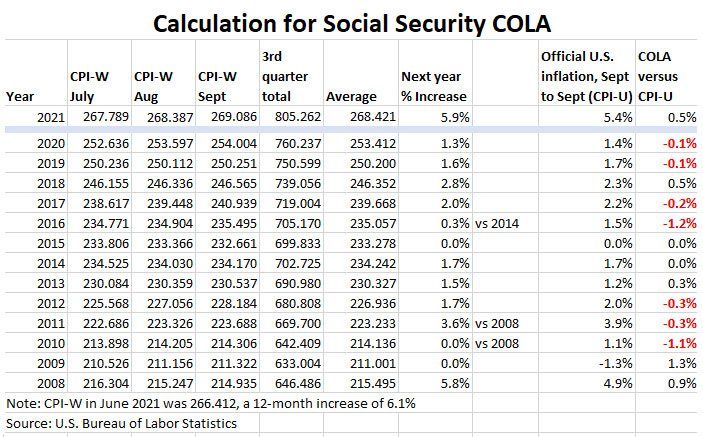
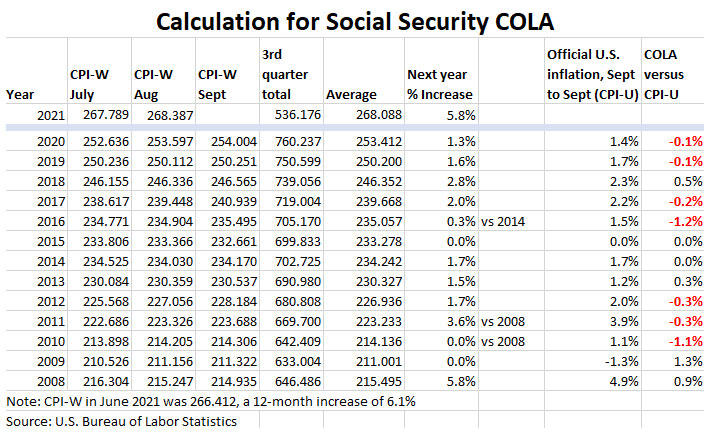
CPI-W isn’t widely tracked or reported, but the Bureau of Labor Statistics updates the index each month in its overall inflation report. Right now, you could say, “Well, CPI-W is running at an annual rate of 6.1%, so that will likely be the COLA increase for 2020.” But that’s not true. In fact, the June number isn’t necessarily an accurate indicator, as shown in this chart:

June sets the baseline for the COLA increase, but then we come to …

The Formula

The SSA doesn’t look at a full year’s data to determine the COLA. Instead it uses the average CPI-W index for the third quarter — July, August and September. Here is the language from the SSA site:

A COLA effective for December of the current year is equal to the percentage increase (if any) in the average CPI-W for the third quarter of the current year over the average for the third quarter of the last year in which a COLA became effective. If there is an increase, it must be rounded to the nearest tenth of one percent. If there is no increase, or if the rounded increase is zero, there is no COLA.

This wording means that the SSA eliminates years where inflation was zero or negative, and so there isn’t a “bounce-up” effect on benefits after a year of deflation. Instead, it goes back to the last year where there was an increase in benefits. But that won’t matter in this 2022 calculation, because the COLA rose 1.3% last year.

So, although 12-month CPI-W was up 6.1% in June, that number is only the baseline for the 2022 COLA increase. The only inflation numbers that will matter are for the third quarter: July, August and September. Last year, the CPI-W index averaged 253.412 in the third quarter. The June 2021 index was set at 266.412, or 5.1% higher than that average. So if we have zero inflation in the third quarter of 2021, the Social Security COLA be set at 5.1%.

U.S. inflation can be stubbornly finicky in the summer months, so predicting inflation from July to September is an impossible task. Hurricanes, gas shortages, food crop failures, stock market plunges, supply shortages, pandemic resurgence, etc., etc. It’s a guessing game, and nearly every summer brings some surprises.

Projecting the 2022 COLA

At this point, CPI-W is running at 6.1% over the last year, so you’d expect a continued inflationary trend of about 0.5% a month in July, August or September. But what if inflation dips after the multi-month surge so far in 2021? Could it run at 0.0% for three months? Doesn’t seem likely. But what about 0.4% a month? That seems possible.

Let’s take a look at how differences in 3rd-quarter inflation would alter the 2022 COLA:

My thinking is that after months of red-hot U.S. inflation, we could see things cool off a bit this summer. Used car prices aren’t likely to continue surging at a 45% annual pace, for example. Even air fares and hotel costs could slip if pandemic fears keep brewing. But other effects — gasoline and food costs, for example, and a possible spending surge caused by the new child care tax credit — could keep inflation rising a brisk pace.

Another factor is that CPI-W had a mild surge last summer, rising 0.6% in July and then 0.4% in August and 0.2% in September. That will make those numbers a bit harder to top than the June 2020 index, which was up 6.1% in June 2021.

So, if you think that CPI-W inflation will rise on average 0.3% a month in the 3rd quarter, you’d end up with a 5.8% COLA increase in 2022. If the average rises to 0.4%, the COLA would be 6.0% and if it rises to 0.5%, 6.2%. I think those are the most likely results, as I have shown in the chart.

That leads me to project that the 2022 Social Security COLA will fall into a range of 5.8% to 6.2%, and so let’s just go with 6.0% as most likely number.

Where can this go wrong? The stock market was taking a pummeling today, and two things also happened: Crude oil prices dipped sharply (down more than 7% today) and the U.S. dollar is getting stronger (up about 1.2% in the last month). Lower oil prices and a stronger dollar could dampen inflation over the next few months. Summer = market volatility.

What this means for Social Security recipients

The Social Security Administration currently estimates that the average retired beneficiary receives $1,555.25 a month, so a 6% increase would boost that monthly payment to about $1,648.56, an increase of $93.31 a month. If you are in the Social Security “limbo” period — older than 62 but not yet taking benefits — your future benefits would also climb by this percentage.

However, recipients can also expect that Medicare Part B costs will rise in 2022, which will subtract — at least partly — from the higher benefits. The base premium is now $148.50 a month. I could see that rising to $158 a month, cutting the effect of the COLA increase by $9.50 a month. But this is just speculation.

We won’t know the actual COLA number until 8:30 a.m. EDT on October 13, 2021, when the Bureau of Labor Statistics releases the September inflation report and completes the data needed for the 3rd quarter average of CPI-W. I will be tracking these numbers for July, August and September as each inflation report is issued.

I keep a running total of the CPI-W changes on my Social Security COLA page.

One more thing. One interesting side issue is that a 6% increase in benefits in 2022 could speed up Social Security’s path toward depleting its “trust fund” of accumulated payroll taxes. Once that happens, possibly in the early 2030s, Social Security will need to rely on incoming payroll taxes, which could cover only about 75% of projected benefits. Congress could — and should — address this issue quickly by gradually raising the full retirement age, or raising the income cap on payroll taxes, or taxing 100% — instead of 85% — of Social Security benefits for wealthy beneficiaries. Or some combination. We’ll see.

* * *

David Enna is a financial journalist, not a financial adviser. He is not selling or profiting from any investment discussed. The investments he discusses can purchased through the Treasury or other providers without fees, commissions or carrying charges. Please do your own research before investing.

Posted in Retirement, Social Security | 8 Comments

A new 10-year TIPS will be auctioned Thursday. Anyone interested?

Hint: It won’t be a thing of beauty. But investors may snatch it up.

By David Enna, Tipswatch.com

The U.S. Treasury on Thursday will offer $16 billion in a new 10-year Treasury Inflation-Protected Security, CUSIP 91282CCM1. The coupon rate and real yield to maturity will be determined by the auction result.

A TIPS is an investment that pays a coupon rate well below that of other Treasury investments of the same term. But with a TIPS, the principal balance adjusts each month (usually up, but sometimes down) to match the current U.S. inflation rate. So the “real yield to maturity” of a TIPS indicates how much an investor will earn above (or in this case, below) inflation.

This is a new TIPS, and auction results for new issues can be a little more complicated to predict. After all, there will be $16 billion in new supply entering the market. And these TIPS auction amounts have been inching higher as the Treasury requires more borrowing to finance ever-larger U.S. deficits. Here are auction amounts for recent new 10-year issues:

  • July 22, 2021: $16 billion
  • Jan. 21, 2021: $15 billion
  • July 23, 2020: $14 billion
  • Jan. 23, 2020: $14 billion
  • July 18, 2019: $14 billion
  • Jan. 17, 2019: $13 billion

In less than three years, the 10-year auction amounts have increased 23%. At some point, will the offering size grow too large for demand? That’s not likely for now, as the Federal Reserve continues aggressively buying TIPS and other U.S. Treasurys, keeping yields under control.

One thing about Thursday’s auction is certain: The Treasury will set the coupon rate for this TIPS at 0.125%, the lowest it will go for any TIPS.

As of Friday’s market close, the Treasury, on its Real Yields Curve page, was estimating that a full-term 10-year TIPS would have a real yield of -1.02%. That estimate has dropped 15 basis points since July 1. So the yield trend is working against potential investors in this TIPS. And that deeply negative yield — much lower than the coupon rate of 0.125% — will make this TIPS pricey. The adjusted auction price will probably be about $112 for about $100.39 of value, after accrued inflation is added in.

This TIPS will have an inflation index of 1.00387 on the settlement date of July 30. That number, by the way, is a reflection of the extraordinarily high non-seasonally adjusted inflation of 0.80% in May 2021. One month later, in August, the principal balance of this TIPS will adjust 0.93% higher, matching non-seasonally adjusted inflation in June. This two-month inflation trend definitely adds to the appeal of this TIPS.

If CUSIP 91282CCM1 does auction with a real yield to maturity of -1.02%, it will be the lowest yield ever for any 9- to 10-year TIPS auction. The current record low of -0.987% was set in a January 2021 auction.

Here is the trend in 10-year real yields over the last five years, showing the deep decline in the period after March 2020, when the COVID-19 pandemic began exploding across the United States. In mid-March, the Federal Reserve began an aggressive program of bond-buying, which has kept both real and nominal yields at extremely low levels.

Inflation breakeven rate

The Treasury is currently estimating the nominal yield of a full-term 10-year Treasury note at 1.31%, which means that if CUSIP 91282CCM1 auctions with a yield of -1.02%, it will get an inflation breakeven rate of 2.33%. That is well off recent highs for this metric, which hit a one-year high of 2.54% on May 17.

A lower inflation breakeven rate makes this TIPS more attractive versus its nominal alternative, and that should increase investor demand for this offering. It’s just a mathematical calculation. At current yields, this TIPS would greatly outperform a nominal Treasury if official U.S. inflation continues at 3% or higher. Here are the numbers:

Of course, this TIPS would also be a loser if inflation doesn’t maintain at an average of 2.33% for 10 years. Over the last 10 years, inflation has averaged 1.9%, so the market is pricing in higher-than-usual inflation over the next 10 years. My conclusion: I am not at all interested in a nominal 10-year Treasury yielding 1.31%. This new TIPS is at least a bit more intriguing, even if it gets a record low real yield.

Here is the trend in the 10-year inflation breakeven rate over the last five years, showing the lofty surge higher after March 2020, when both the Federal Reserve and Congress launched aggressive economic stimulus programs:

I Bonds remain the better alternative

I always feel the need to mention that U.S. Series I Savings Bonds, which currently can be bought with a permanent fixed rate of 0.0%, are a much better investment than a 10-year TIPS with a real yield of -1.02%. The I Bond has a 102-basis-point yield advantage, earns tax-deferred interest and has much better protection against deflation.

I Bonds have a purchase limit of $10,000 per person per calendar year. So if you are interested in inflation protection, I recommend purchasing I Bonds first, up to the limit, and then consider an investment in a Treasury Inflation-Protected Security.

For investors with a longer investment horizon, EE Bonds are also very attractive in our low-rate environment. They have a fixed rate of 0.1%, but will double in value if held for 20 years, giving them a return of 3.5%. But they have to be held 20 years. If that is reasonable for you, they are a strong investment today. A 20-year nominal Treasury is yielding 1.86%, so the EE Bond has a yield advantage of 164 basis points. EE Bonds also have a separate purchase cap of $10,000 per person per calendar year.

Conclusion

I probably won’t be an investor in this new 10-year TIPS, but I will be watching the Treasury’s Real Yields Curve page to see if yields are surging higher. I can see the appeal for an investor who believes real and nominal yields aren’t likely to rise dramtically in the mid-term future. In fact, if you believe real yields are heading even lower, this TIPS is an attractive investment.

I will be reporting the results soon after the auction closes at 1 p.m. Thursday. Non-competitive bids have to be made before noon.

Here is a history of recent TIPS auctions of this term:

* * *

David Enna is a financial journalist, not a financial adviser. He is not selling or profiting from any investment discussed. The investments he discusses can purchased through the Treasury or other providers without fees, commissions or carrying charges. Please do your own research before investing.

Posted in I Bond, Investing in TIPS, Savings Bond | 9 Comments

2021 and beyond: What’s ahead for U.S. financial markets?

You don’t seriously think I have answers, right? Just some ideas.

By David Enna, Tipswatch.com

What the heck was I thinking? A couple weeks ago, I started on a trek to review Federal Reserve actions and bond market reactions for the period of 2013 to 2021. My theory was that in July 2021, we are sitting on the edge of change, just as we were in June 2013, when the Federal Reserve “announced” it was “planning” to cut back on quantitative easing, its aggressive bond buying program.

Back in mid-June I created this chart for a similar article looking toward future Fed actions. I think it is remarkable how close real yields were in December 2012 to those of mid-June 2021. The surge higher in 2013, which was very strong, only took about 10 months, and it made the 2013 the worst year for bond funds in the last 10 years.

I thought it would be worth taking a year-by-year look at how my three favorite bond ETFs — Vanguard Short-Term Inflation Protected (VTIP), Schwab U.S. TIPS (SCHP) and Vanguard’s Total Bond (BND) — performed during this time of financial change. These are three conservative, liquid, mainstream bond funds with very low expense ratios. Here’s a recap of their basic statistics and performance.

Shifting focus back to 2013, it’s important to stress that the Federal Reserve didn’t actually do anything in that year. Because of ensuing market turmoil, the Fed delayed tapering of bond buying until January 2014. Nevertheless, 2013 was a disastrous year for the bond market, with a “taper tantrum” causing both real and nominal yields to soar 100 basis points or more. Is that where we are heading in 2021, now that the Federal Reserve has announced it is “talking about talking about” tapering its current bond-buying stimulus?

So far, at least, the financial markets don’t think so.

2021: So far, so good

In the first half of 2021, as the COVID-19 pandemic slowly wound down, financial markets took a breather. Bond yields were up, but not dramatically. The stock market was up — strongly — with the S&P 500 registering a total return of 17.8% in 2021, through June 30. Inflation is also surging, hitting an annual rate of 5.4% in June, the highest rate in 13 years.

The one nagging point came June 14, when Federal Reserve Chairman Jerome Powell said this at a news conference:

“But you can think of this meeting that we had as the talking about talking about meeting, if you like. And I now suggest that we retire that term, which has served its purpose well, I think.”

Powell said, in essence, that the Fed is now willing to talk about future tapering of its aggressive program of buying U.S. Treasurys and mortgage-based securities in support of the U.S. economy. We don’t know when the bond buying will end, or how quickly it will end, but it is now on the table. In addition, increases in short term interest rates could begin in late 2022 or 2023, a year earlier than had been expected.

That one statement should have been enough to set off at least a mini “taper tantrum,” but after a day or two of market unrest, the financial markets continued in happy bliss, with the yield on a 10-year nominal Treasury dipping 9 basis points in the month after Powell’s statement.

It is clear that the markets don’t believe any tapering of the Fed’s bond buying is likely in the near future, and that any increases in short-term interest rates are at least 18 months away. And the markets are probably right. Powell’s statement on June 14 was the first step in a months-long campaign to prepare the markets for the eventual tapering and then end to the bond-buying program.

One thing I have learned in this nine-article review of Fed history is that the Fed is very slow to reverse “easing” financial actions, and very quick in reversing “tightening.” So in 2021 we have entered at holding pattern, with inflation and the stock market surging, and the bond markets remaining relatively calm, so far. Here is a snapshot of the bond market in 2021:

Notice that real yields have been rising at a slower pace than nominal yields, which indicates the market is pricing in higher inflation expectations. Rightly so, since annual U.S. inflation has surged from 1.4% in January to 5.4% in June. In this scenario, you can expect TIPS funds to outperform nominal funds of similar duration.

Here is how our three bond ETFs performed in the first half of 2021, with the chart showing net asset value and not including distributions:

Vanguard’s VTIP fund, with its lower duration and gains from the inflationary surge, has been the top performer, despite the higher real yields. Schwab’s U.S. TIPS ETF has also performed well, aided by inflation accruals. The total bond market, BND, has lagged because its underlying nominal rates can’t overcome the effects of higher nominal rates.

All in all, though, 2021 has been a ho-hum year in the U.S. bond market. Will that continue? Well ….

Beyond 2021: Where are we heading?

OK, now we begin the pure speculation portion of this article. I can only describe my “gut feelings,” which tend to be right about as often as they are wrong. What is ahead? This speculation is based on the pandemic fading away and the U.S. economy avoiding any serious financial shocks.

  • The Fed will begin tapering its bond buying. If inflation continues to surge higher, remaining well above 5%, I’d guess this could happen in 2021, but more likely it will be early 2022. If the economy remains stable, bond-buying should end six months later. But the Fed will continue to hold a huge supply of U.S. Treasurys and mortgage-backed securities.

Here is a look at how the Federal Reserve has increased its total assets from 2013 to June 2021, showing how dramatically larger the 2020 bond-buying program has been versus the pre-2013 purchases, which continued through December 2014:

Investors should recognize, and the Fed would readily admit, that the Federal Reserve is manipulating the U.S. Treasury market. For example, examine the New York Fed’s purchase plans for the period of June 14 to July 14, 2021. In that time, the Fed planned to purchase $2.4 billion of 7.5- to 30-year TIPS and $2.0 billion of 1- to 7.5-year TIPS. That’s a total of $4.4 billion for the month, equal to about one-quarter of the value of the reopened 5-year TIPS auctioned in June. This happens month after month, and may actually under-estimate the Fed’s holdings because of reinvestments.

Tapering of Federal Reserve bond purchases is a huge deal.

  • The Fed won’t raise short-term interest rates until late 2023. In 2014, the Federal Reserve officially started tapering its bond-buying stimulus in January and ended the bond buying in October 2014. It didn’t raise short-term interest rates above zero until December 2015, 15 months later. So if this pattern continues, rate increases won’t follow quickly after the end of bond-buying stimulus. Expect the Fed to send mixed signals the whole way, but as the rate increase cycle nears, the Fed will give clear signals it is coming.
  • The yield curve will flatten once short-term rates begin rising. This is sort of a self-fulfilling prophecy. The end of quantitative easing should cause longer-term yields to rise, expanding the yield curve. But when short-term rates begin rising, the market can lose confidence in economic conditions. So, short-term rates (controlled by the Fed) will begin rising and longer-term rates (controlled by the markets) will begin falling. This ends up supporting the bond market through the early rate hikes.
  • Inflation will run higher than 2.5% a year in the mid-term future. The Fed will be highly unlikely to take any tightening action if inflation cannot sustain above 2.5%. So, expect inflation to sustain at that level.
  • Eventually, the 10-year real yield should “normalize” to a range of about 0.75% and the 10-year nominal yield could climb to 3% or higher. Maybe this is wishful thinking. But I do think we will again see these yields in the mid-term future. Less than three years ago, in November 2018, a 10-year TIPS reopening auction got a real yield to maturity of 1.109%. Around the same time, the 10-year nominal Treasury was yielding 3.01%.
  • The stock market will take a hit along the way. But it won’t necessarily be a disaster. The Federal Reserve has a history of backing up the stock market, acting quickly to intervene at times when stock prices are plummeting. That isn’t going to change. However, the highest-flying, speculative stocks could take a beating if the 10-year nominal Treasury reaches 3% or higher. That opens the door to the “risk off” trade and could bleed money out of the stock market.

However, the market in recent weeks has shown that it does not have any belief that the Federal Reserve will carry through with an end to the bond-buying, forcing the 10-year Treasury yield down to 1.25% recently. From a Market Watch report:

“Traders don’t see the Fed repeating the 2015-2018 hiking cycle, which brought the policy rate band to 2.25%-2.50% in December 2018, and a peak 10 year rate of 3.2% in November 2018, said the strategists. …

“Bank of America doesn’t see a sharp rise in rates such as was seen in the first quarter — driven by positive vaccine surprises and fiscal stimulus — but they see scope for modestly higher rates in the next six to 12 months. “We have not changed our forecast for 10y rates at 1.9% by year-end, but downside risks to our forecast have increased,” (BofA’s Ralph Axel) said.

Selecting the right bond ETF? Don’t even try.

The one thing the 2013 to 2021 era has proven is that there isn’t one “correct answer” when choosing a bond fund. My personal preference is intermediate-term TIPS, combined with Treasury or Treasury-dominated funds with very low expense ratios. Here is a recap of how our three bond ETFs performed through those years, with the addition of the S&P 500 ETF (SPY) and notes on Federal Reserve actions in each of those years:

First of all, please take note of the stock market’s performance during this time of financial turmoil — up 32% in total return in 2013, up 21% in 2017, up 31% in 2019, up 18% in 2020 and up 17% for the first half of 2021. There was only one year — 2018 — when the stock market had a negative total return, and that was only -4.56%. The Federal Reserve’s policies during this period were “very kind” to the stock market, even during periods of tightening. A future period of rising interest rates shouldn’t send the stock market crashing down. (However, high valuations are another matter … )

For the bond funds, I’ve noted the top performer of the three ETFs for each year. VTIP was at the top 3 years, SCHP two years and BND four years. I’d suggest investing in a combination of the three funds: VTIP for the combination of shorter duration and inflation protection, SCHP for longer duration and inflation protection, and BND as an attractive “core” nominal bond fund with very low expenses and an intermediate duration.

Another alternative: Get your inflation protection by buying individual TIPS and U.S. Series I Bonds, and then use BND for your nominal bond allocation. By buying TIPS and holding them to maturity, you can ignore the market swings up and down. But you also lose the chance for a capital gain if real yields decline.

One final conclusion

I am the founder of a website devoted to inflation and inflation protection, and so I definitely have a bias. I am a believer in devoting a portion of your asset allocation to inflation protection. Over the last 10 years, than has been a “losing” philosophy, with inflation lagging well below expectations during that decade. Today, inflation is much higher than expectations.

I don’t know where inflation is heading. I don’t think the Federal Reserve can say where it is heading with much confidence, either. For people in retirement, inflation can be devastating. TIPS and I Bonds provide some reassurance, even if their performance can be underwhelming.

Inflation protection helps me sleep at night. But that’s just me, and this ends my “speculation” on the future.

Coming soon: I’ll take a stab at projecting the Social Security COLA for 2022

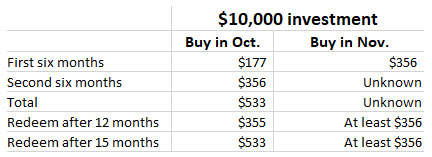
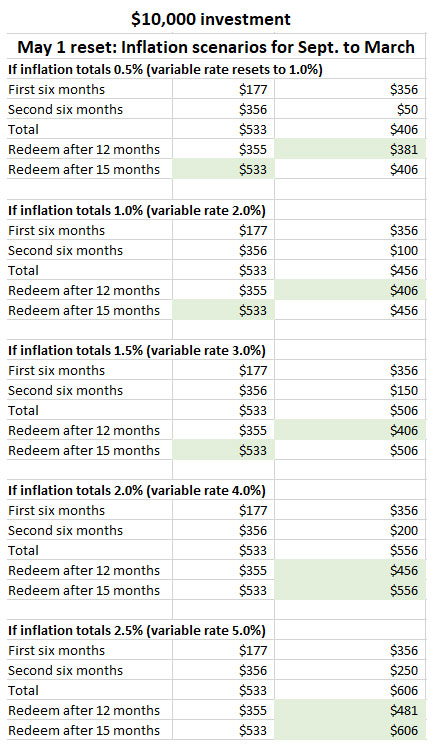
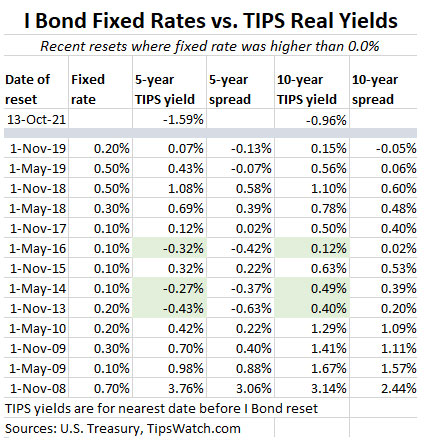
Coming soon: Is the Treasury likely to raise the I Bond’s fixed rate in November?

This full 9-article series:

* * *

David Enna is a financial journalist, not a financial adviser. He is not selling or profiting from any investment discussed. The investments he discusses can purchased through the Treasury or other providers without fees, commissions or carrying charges. Please do your own research before investing.
Posted in Investing in TIPS | 1 Comment

2020: Pandemic, then massive stimulus. TIPS funds thrive.

By David Enna, Tipswatch.com

This article is the eighth in a series looking at how my three favorite bond funds — Vanguard Short-Term Inflation Protected (VTIP), Schwab U.S. TIPS (SCHP) and Vanguard’s Total Bond (BND) — performed after 2013, when the Fed signaled it would back off on bond purchases and eventually raise short-term interest rates.

Why do this? Because we may be heading into a similar scenario in 2022 and beyond, with the Fed tapering bond purchases and eventually (and gradually) raising short-term interest rates. The performance after 2013 could tell us a lot about what’s ahead.

To recap, here are the three bond funds I am tracking; they are three conservative, liquid, mainstream bond funds with very low expense ratios. Here’s a summary of their basic statistics and performance:

2020: A chaotic year of pandemic fears, stunning stimulus

Let’s recall that 2020 started off with U.S. investors fearing a coming recession. In 2019, the Federal Reserve had already cut its key short-term interest rate three times. The yield curve had flattened, and TIPS with terms up to 10 years already had real yields close to zero. On Jan. 24, 2020, a 10-year TIPS auctioned with a real yield of 0.03%, the lowest in seven years.

So the financial markets were already facing low-level chaos. It was about to get a lot worse. Global awareness of the COVID-19 pandemic began rising in January, but gradually. Between January 21 and February 23, 2020, 14 coronavirus cases were reported by U.S. health agencies. The first non-travel case was confirmed in California on Feb. 26, and the first U.S. death was reported on Feb. 29. By March 15, two weeks later, the U.S. had reported 3,485 cases and 65 deaths. One week later, on March 22, the case total rose to 34,000 and deaths reached 413.

The escalating pandemic caused full-out panic in the financial markets. The S&P 500 stock index fell about 25% in the three weeks from March 1 to March 20, plummeting into a bear market. Bond markets were roiled, with yields rising and falling in seemingly random patterns. The financial system was in severe stress.

The Federal Reserve stepped in quickly to calm the markets and Congress soon followed along with a series of historically massive stimulus packages, many of which remain in effect today. Here is a rough timeline of the stimulus pouring into the U.S. economy:

  • March 3, 2020: The Federal Reserve cut its federal funds rate by 25 basis points, to a range of 1.00 – 1.25%.
  • March 15: Federal Reserve met on Sunday to cut short-term interest rates 100 basis points (effectively to zero) and launched another round of “quantitative easing,” a $700 billion program of bond buying. “There’s no monthly cap, no weekly cap,” Fed Chair Jerome Powell said. “We’re going to go in strong starting tomorrow.”
  • March 17: Federal Reserve created a Commercial Paper Funding Facility to protect short-term corporate debt.
  • March 18: Federal Reserve created a Money Market Mutual Fund Liquidity Facility to protect funds investing in corporate debt.
  • March 20: The Fed opened its money market program to include high-quality municipal debt.
  • March 23: The Fed expanded its quantitative easing bond-buying to include mortgage-backed securities.
  • March 23: The Fed created the Primary Market Corporate Credit Facility to buy corporate bonds.
  • March 26: The New York Fed announced plans to buy corporate bonds and bond exchange-traded funds on the secondary market.
  • March 27: President Trump signed into law the $2.3 billion CARES Act, providing a direct cash payment of $1,200 per person, plus $500 per child. It also provided an additional $600 unemployment benefit per week. The CARES Act also created a moratorium on evictions.
  • April 6: The Fed announced the Main Street Business Lending Program, that would purchase $600 billion of debt from companies employing up to 10,000 workers or with revenues of less than $2.5 billion.
  • April 6: The Fed announced a a new emergency lending facility, the Municipal Liquidity Facility, that would purchase $500 billion of debt from states and cities.
  • April 24: Congress passed a $484 billion supplementary stimulus package, mostly to support the Payment Protection Program.
  • Aug. 10: Trump, by executive order, extended a $400-per-week payment to those currently receiving unemployment payments.
  • Dec. 27: Trump signed a $900 billion stimulus and relief bill that included direct payments of $600 per person, with some income limits. It also continued expanded unemployment benefits.
  • March 11, 2021: President Biden signed the American Rescue Plan Act of 2021, a $1.9 trillion package that included direct cash payments of up to $1,400 for individuals earning less than $75,000 a year, plus $1,400 per dependent.

Stimulus. It works.

My focus in these articles is to track how our three bond ETFs — VTIP, SCHP and BND — performed in the period from 2013 to 2021, a time when at first the Federal Reserve was unwinding quantitative easing and ultra-low interest rates, and then a few years later, launching even bigger quantitative easing and returning to ultra-low interest rates.

But I can’t ignore noting that the S&P 500 had a total return of 18.22% in 2020, after falling deep into bear market territory in March.

For the bond market, the Fed actions (along with general market chaos) resulted in a deep decline in both real and nominal interest rates. Real yields took a deeper fall, as investors began realizing all this stimulus raised the specter of rising inflation:

All of this was “very good news” for the bond market (and especially TIPS) in a very bad year of locked-down life in the United States. Here is how our three funds performed, with the chart showing net asset value, excluding distributions:

Just like the stock market, the bond market took a beating in March 2020 as financial chaos set it. This is why the Federal Reserve stepped in (on March 15, a Sunday) to slash short-term interest rates to near zero. Four days later, the Treasury staged a reopening auction of a 10-year TIPS, CUSIP 912828Z37, that resulted in an inflation breakeven rate of 0.43%. That’s right, in mid-March 2020, investors expected inflation to run at 0.43% over the next 10 years. The real yield at that auction came in at 0.68%.

But things turned around quickly as stimulus poured into the system. By May 22, CUSIP 912828Z37 had another reopening auction and got a real yield of -0.47%, a drop of 115 basis points in 2 months. Its inflation breakeven rate was 1.14%. Things were clearly settling down as the Federal Reserve began aggressively buying bonds at a rate of $120 billion a month.

Inflation dipped in 2020 to an annual rate of 1.4%, which dampened the return of the TIPS funds, but rising inflation expectations gave those funds a boost in net asset value. Schwab’s U.S. TIPS ETF, SCHP, was easily the top performer of the year for this group, but both BND and the shorter-term and less-risky VTIP also had very good years.

Conclusion

Although 2020 ended up being an excellent year for both bond and stock investors, let’s hope we never have to relive a year like that. The Federal Reserve and Congress acted to stave off financial disaster, and we are living with the result of those actions today as U.S. inflation soars to 5.4%, a 12-year high.

The events of March 2020 stunned me. When the Federal Reserve announced a new wave of quantitative easing on March 15, my immediate reaction was that real yields for TIPS would be heading lower — probably deeply negative to inflation. And yet, four days later, a 10-year TIPS got an auctioned real yield of 0.68%, about 65 basis points higher than expected. This was financial panic in action. The Federal Reserve’s actions halted that panic and then my logic held true: a 10-year TIPS is now yielding -0.94%.

Coming tomorrow: A look at 2021 and beyond

* * *

David Enna is a financial journalist, not a financial adviser. He is not selling or profiting from any investment discussed. The investments he discusses can purchased through the Treasury or other providers without fees, commissions or carrying charges. Please do your own research before investing.
Posted in Investing in TIPS | Leave a comment

U.S. inflation surges 0.9% in June, nearly double expectations

By David Enna, Tipswatch.com

U.S. inflation surged 0.9% in June, much higher than expectations. It was the fifth month in a row that actual inflation far exceeded consensus estimates.

My conclusion: Economists really have no idea where inflation is heading.

What happened? The Consumer Price Index for All Urban Consumers increased 0.9% in June on a seasonally adjusted basis, the U.S. Bureau of Labor Statistics reported today. This was the largest 1-month change since June 2008 when the index rose 1.0%. Over the last 12 months, the all-items index increased 5.4%, the largest 12-month increase since a 5.4% increase for the period ending August 2008.

This was the fifth month in a row that inflation has exceeded consensus estimates, and follows monthly increases of 0.6% in May (consensus was 0.4%), 0.8% in April (consensus was 0.2%), and 0.6% in March (consensus was 0.5%).

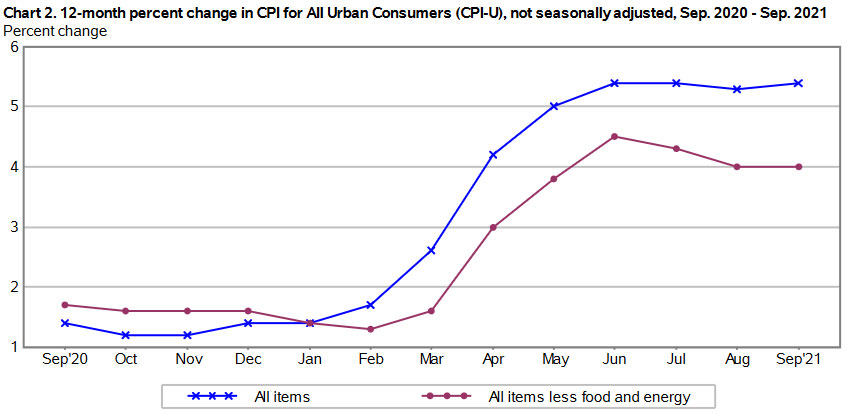
Core inflation, which omits food and energy, also surged 0.9% in June and has increased 4.5% over the last 12 months, the BLS said. Both of those numbers came in much higher than expectations.

Part of the “theory” of the higher inflation numbers for February to May 2021 was the very low baseline comparisons for the same months of 2020, when inflation sank to near zero during the rise of the pandemic. But that’s not the case for June, because inflation increased 0.6% in June 2020, certainly not a “depressed” number.

So, essentially, economists cannot predict with any certainty where inflation is headed in 2021 and beyond. The Federal Reserve — which has started “talking about talking about” scaling back monetary stimulus — may have a better idea, but we can expect easy monetary policy to continue for many more months, well into 2022.

In today’s report, the BLS noted that the index for used cars and trucks surged 10.5% in June and is up a remarkable 45.2% over the last year. This one price index accounted for more than one-third of the overall all-items increase, the BLS said. That’s a trend that will not continue, obviously. But …

  • Food prices rose a lofty 0.8% in June and are up 2.4% year over year.
  • The beef index rose 4.5% in June, its largest increase since June 2020.
  • The cost of new vehicles rose 2.0% in the month and 5.3% for the year.
  • Gasoline prices rose 2.5% for the month and 45.1% for the year.
  • The index for natural gas increased 1.7% in June, as it did in May.
  • Shelter costs rose 0.5% for the month and 2.6% for the year.
  • The costs of apparel rose 0.7% for the month and are up 4.9% for the year.

The overall picture is clear: Inflation is surging across the U.S. economy. How long will that continue? No one knows, including economists, obviously.

Here is the 12-month trend for both all-items and core inflation:

What this means for TIPS and I Bonds

Investors in Treasury Inflation-Protected Securities and U.S. Series I Savings Bonds are also interested in non-seasonally adjusted inflation, which is used to adjust principal balances on TIPS and set future interest rates for I Bonds. For June, the BLS set the inflation index at 271.696, an increase of 0.93% over the May number.

For TIPS. Today’s inflation report means that principal balances for all TIPS will increase 0.93% in August, following increases of 0.80% in July, 0.82% in June, 0.71% in May, and 0.55% in April. That’s a remarkable increase of 3.8% in just five months. Here are the new August Inflation Indexes for all TIPS.

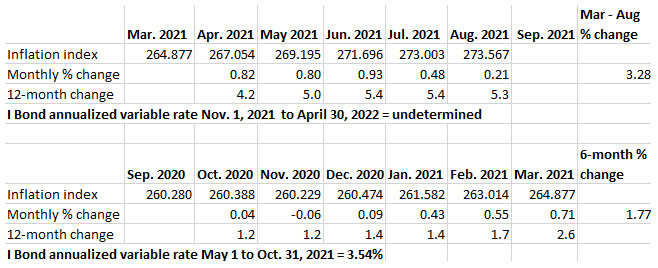
For I Bonds. The June inflation number is the third in a six-month series that will determine the I Bond’s semi-annual inflation rate for the months of April through September. So far, three months in, inflation has been running at 2.57%, which will translate to an annualized variable rate of 5.14% for the November 1 reset, much higher than the current (and still very attractive) rate of 3.54%. All I Bonds will eventually get November’s new annualized rate. But keep in mind that three months remain, and inflation in summer months can be quite volatile.

Here are the numbers so far:

What this means for the Social Security COLA

Social Security’s cost-of-living adjustment for 2022 will be set using a complex formula that averages third-quarter inflation (July, August and September) and compares that to the average a year earlier. But it is based on a different inflation index: the Consumer Price Index for Urban Wage Earners and Clerical Workers (CPI-W).

For June, the last month before the COLA formula kicks in, the BLS set the CPI-W index at 266.412, which is 6.1% higher than the number for June 2020. But don’t be confused by that June number. It is simply setting a baseline for the next three months, which actually count in the COLA formula. Last year’s three-month average was 253.412, and the June number is 5.1% higher than that average.

I’ll be writing about the Social Security COLA later this month and then will provide updates with each inflation report for July to September.

What this means for future interest rates

I imagine the Federal Reserve will now be changing its language about “transitory” inflation to “an extended period of higher inflation.” The Fed appears to be comfortable with that, but a five-month string of higher-than-expected inflation has to be causing concern. If an inflationary mindset seizes control of the U.S. economy, that is a very hard trend to break.

The Fed says it has the “tools” to control runaway inflation, but we know it will be very, very reluctant to use those tools, which could bring havoc to the stock and bond markets.

* * *

David Enna is a financial journalist, not a financial adviser. He is not selling or profiting from any investment discussed. The investments he discusses can purchased through the Treasury or other providers without fees, commissions or carrying charges. Please do your own research before investing.
Posted in I Bond, Inflation, Investing in TIPS, Retirement, Social Security | 8 Comments