July inflation: What it means for TIPS, I Bonds and Social Security COLA

  • All-items inflation for July came in at 0.5% and 5.4% for the year.
  • The Social Security COLA is still on track for about a 6% increase.
  • I Bonds could get a variable rate of 6% (or higher) for six months.
  • TIPS principal balances continue rising at a brisk pace.

By David Enna, Tipswatch.com

The U.S. Bureau of Labor Statistics released its July inflation report this morning, and for the first time in awhile, economists’ inflation estimates were pretty much on target, after months of under-estimating the recent surge in U.S. inflation.

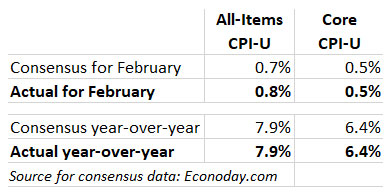
The facts. The Consumer Price Index for All Urban Consumers (CPI-U) increased 0.5% in July on a seasonally adjusted basis, the BLS said. Over the last 12 months, the all-items index increased 5.4%. While 0.5% indicated brisk inflation, the July number was well below the 0.9% inflation recorded in June. The July numbers came close to the consensus estimates, so they shouldn’t cause a market surprise this morning.

Core inflation, which removes food and energy, rose 0.3% in July, a bit below the consensus estimate of 0.4%. But year-over-year core inflation was 4.3%, matching the estimate. This was the smallest monthly increase in core inflation in four months. But, no surprises.

The report disclosed some disturbing trends in the prices of consumer “basics.” For example, the price of food increased 0.7% in July and is now up 3.4% year-over year. Gas prices surged 2.4% higher and are up 41.8% for the year. Shelter costs rose 0.4% in July, and are up 2.8% over the last year.

On the other hand, prices for used cars and trucks — a major trigger for higher inflation over recent months — rose only 0.2% for the month, after rising 10.5% in June. The index for new vehicles rose 1.7% and is up 6.4% for the year.

The index for motor vehicle insurance was one of the few major component indexes to decline in July, falling 2.8% after rising in each of the last 6 months. The index for airline fares fell slightly in July, declining 0.1% after rising sharply in recent months.

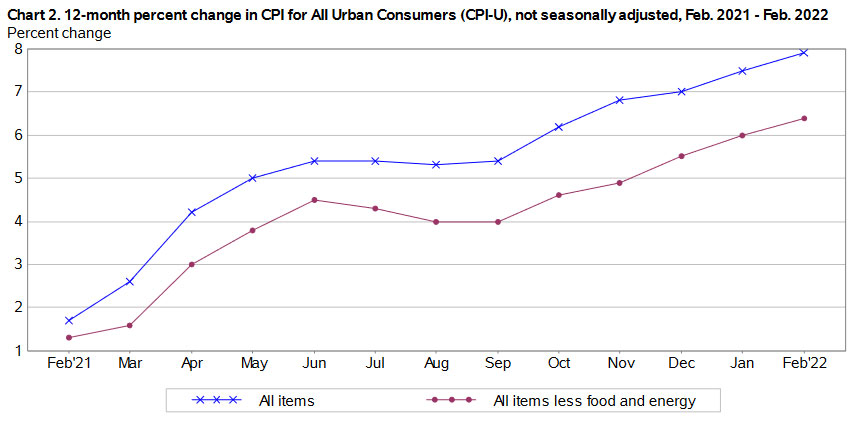
Here is the 12-month trend for both all-items and core inflation, showing the strong surge higher since February, as economic stimulus continued at a brisk pace while the U.S. economy was reopening:

What this means for TIPS and I Bonds

Investors in Treasury Inflation-Protected Securities and U.S. Series I Bonds are also interested in non-seasonally adjusted inflation, which is used to adjust principal balances on TIPS and set future interest rates for I Bonds. For July, the BLS set the inflation index at 273.003, an increase of 0.48% for the month and 5.4% over the last 12 months. This was the seventh month in a row that non-seasonally adjust inflation ran higher than 0.40%.

For TIPS. The July inflation report means that principal balances for all TIPS will increase 0.48% in September, following increases of 0.90% in July and 0.93% in August. In September, principal balances will have increased 5.4% over the previous 12 months, a lofty number. Here are the new September Inflation Indexes for all TIPS.

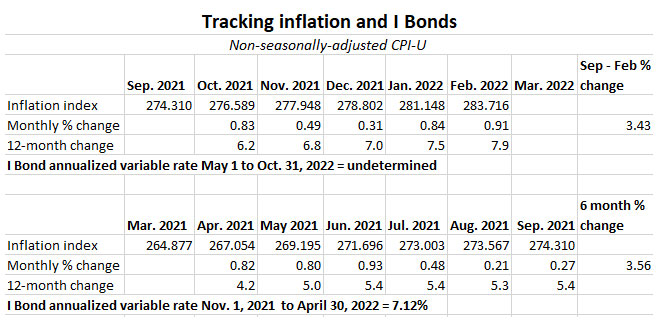
For I Bonds. The July inflation report was the fourth in a six-month string that will determine the I Bond’s new inflation-adjusted variable rate, which will be reset on November 1. As of July, non-seasonally adjusted inflation in that four-month period ran at 3.07%, which would translate to an annualized variable rate of 6.14% for all I Bonds for six months. Obviously, that would make I Bonds an extremely attractive investment, but keep in mind that two months remain and inflation can be quite finicky in the summer months.

Here are the data so far:

You can find a lot more information on I Bonds on my “Inflation and I Bonds” page, where I track all the monthly inflation updates.

What this means for the Social Security COLA

The July inflation report is the first of three — for July to September — that will set the Social Security Administration’s cost of living adjustment for 2022. The SSA uses a three-month average of a different index, the Consumer Price Index for Urban Wage Earners and Clerical Workers (CPI-W), to set its COLA.

For July, the BLS set CPI-W at 267.789, an increase of 5.4% over the last 12 months. But remember, it will be the average of July to September inflation indexes — compared to the same three-month average a year ago — that will determine the Social Security COLA. In a recent article, I had predicted a COLA increase in the range of 5.8% to 6.2%.

At this point, the data are pointing to a 5.7% increase in the Social Security COLA, but that will rise if inflation continues to surge in the next two months. Here are the numbers so far, with the July inflation report setting the first of three data-points that will determine the COLA:

What this means for future interest rates

Because U.S. job growth seems to be surging and inflation is running much higher than the Federal Reserve’s target of “maybe 2.5%,” the Fed governors are pondering a tapering of their $120 billion in bond purchases a month. But I think an announcement of a future tapering date is still a few months away, and then we’ll see how the market reacts. In theory, medium and longer-term interest rates should rise, as they did in 2013.

Any increase in short-term interest rates is probably a year off, I’d guess.

The huge unknown factor is the effect of the delta variant of COVID-19 on the U.S. economy. If the current surge slows down, as it has in Europe, then it’s possible the economy will continue running very hot. That would force an earlier Fed action. But too much is unknown. Right now, with the 10-year Treasury yielding 1.34%, the market doesn’t seem to fear Fed tapering.

* * *

David Enna is a financial journalist, not a financial adviser. He is not selling or profiting from any investment discussed. The investments he discusses can purchased through the Treasury or other providers without fees, commissions or carrying charges. Please do your own research before investing.

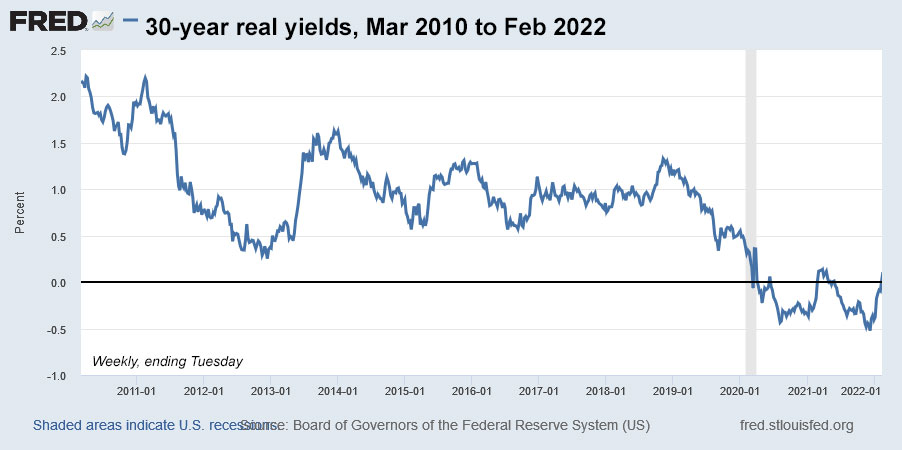
Posted in I Bond, Inflation, Investing in TIPS, Retirement, Social Security | 7 Comments

Any chance the Treasury will raise the I Bond’s fixed rate in November?

Let’s be realistic. It won’t happen.

By David Enna, Tipswatch.com

This is a question I’ve been getting often in reader e-mails: “Dave, do you think the Treasury will raise the I Bond’s fixed rate in November? Should I wait until November to buy?”

Here is my in-depth analysis:

  • Could the Treasury raise the I Bond’s fixed rate in November? Yes, it could.
  • Will the Treasury raise the I Bond’s fixed rate in November? No, it won’t.

The Treasury does not disclose how it sets the fixed rate on Series I Savings Bonds, and so this leads people to speculate about what’s coming at the next reset, on November 1. This is a very important decision, because the I Bond’s fixed rate stays with that investment until redemption or maturity in 30 years. The fixed rate is combined with an inflation-adjusted rate (I call it the “variable rate” but that’s not the official term) that adjusts every six months, based on official U.S. inflation.

Want to know more about I Bonds? Read this.

An I Bond purchased today will have a fixed rate of 0.0%, combined with a variable rate of 3.54%, creating a composite rate of 3.54% for six months. The fixed rate will be “reset” on November 1, but I’m predicting with 99% certainty that it will remain at 0.0%. Why not 100% certainty? Because the Treasury occasionally does strange things. But I don’t think that’s coming in November. Not under these market conditions.

I think the best indicator of a future I Bond’s fixed rate is the spread between the fixed rate and the real yield to maturity of a 10-year Treasury Inflation-Protected Security. Under “normal” circumstances, a 10-year TIPS will have a real yield 40 to 50 basis points higher than the I Bond’s fixed rate. This has varied widely, though, because the Treasury does strange things.

Take a look at this chart, which shows every fixed rate reset for the I Bond where the rate was higher than 0.0%, going back to November 2008.

The important thing to note is that in no case, going back 13 years, has the Treasury set the I Bond’s fixed rate above 0.0% when the 10-year TIPS had a negative real yield. Right now, a 10-year TIPS is yielding -1.19%, meaning that an I Bond with a 0.0% fixed rate has a massive 119-basis-point advantage over a 10-year TIPS.

Remember, under “normal” circumstances, a 10-year TIPS would have a 40- to 50-basis-point advantage over an I Bond. (This is justified because of the I Bond’s flexible maturity, tax-deferred interest and better deflation protection.) Now that situation is reversed, with the I Bond having a 119-basis-point advantage, making the I Bond a much, much better investment. There is no way, under these market conditions, that the Treasury would increase the I Bond’s fixed rate.

But things can change, right?

Hey, isn’t it possible that the Federal Reserve could radically change course and halt its bond-buying stimulus and begin raising interest rates, before November 1, causing 10-year real yields to soar well above zero? (I’ll pause here for laughter.) No, that isn’t going to happen.

I’d expect 10-year real yields to drift a bit before November 1, possibly even rise a bit, but not get anywhere near zero in just three months. So expect real yields to remain negative through 2021, and expect the I Bond’s fixed rate to remain at 0.0%.

Here’s a look back at the I Bond’s entire fixed-rate history back to 2008, which includes the Fed’s last periods of bond-buying-tapering (beginning in January 2014) and interest-rate-hiking (beginning in December 2015) and the effect these actions had on the 10-year real yield, and the I Bond’s fixed rate:

Note that the Fed’s initial launch into quantitative easing, in November 2010, set off a string of six consecutive I Bond rate resets to 0.0%. During that time, the 10-year real yield dipped well below zero several times at the reset date, and at each of those times the I Bond got a 0.0% fixed rate.

The fixed rate finally rose above 0.0% in November 2013, after a year of market turmoil caused by the bond market’s “taper tantrum.” Up to this point, the Fed had loudly announced its intention to taper, but didn’t actually begin slowing its bond buying until January 2014. It ended in October 2014.

Where are we right now?

At the moment, the Federal Reserve is holding short-term interest rates near zero and is buying $120 billion of Treasurys and mortgage-backed securities each month. We are solidly in a period of quantitative easing, but the Fed is now hinting it “may” begin scaling back its bond-buying “sometime in the future.”

What time in the past matches up our current conditions? I’d say mid-2012, when both the 5-year and 10-year TIPS had real yields deeply below zero. But by November 2013, when the Fed had announced plans to taper its bond buying — resulting in a bond market “taper tantrum” — the 10-year real yield had soared to 0.40% and the Treasury finally raised the I Bond’s fixed rate to 0.2%, up from 0.0%.

The past indicates we are a year or maybe 18 months away from a higher fixed rate for the I Bond, if the Fed carries through with its hints of an end to aggressive economic stimulus. But this Fed seems stubbornly insistent on keeping the stimulus pumping as long as possible. So who knows? But it won’t happen in 2021.

What this means for an I Bond purchase

If I am correct that the fixed rate will stay at 0.0%, I’d say it makes sense to buy I Bonds now to take advantage of six months of the very attractive composite rate of 3.54%. The next variable rate reset in November could be even higher, possibly has high as 6%, but all I Bonds will get that new variable rate for six months, no matter when they were purchased.

Waiting to purchase after November only makes sense if you think the fixed rate will rise. If it doesn’t, you’ll miss out on 3.54% for six months, an extremely attractive rate in our current market.

Looking back at Fed actions. Here is more on this topic, from a series of articles I wrote speculating on possible results of the Fed’s future actions:

When the Fed begins tapering, what will happen to TIPS?

* * *

David Enna is a financial journalist, not a financial adviser. He is not selling or profiting from any investment discussed. The investments he discusses can purchased through the Treasury or other providers without fees, commissions or carrying charges. Please do your own research before investing.
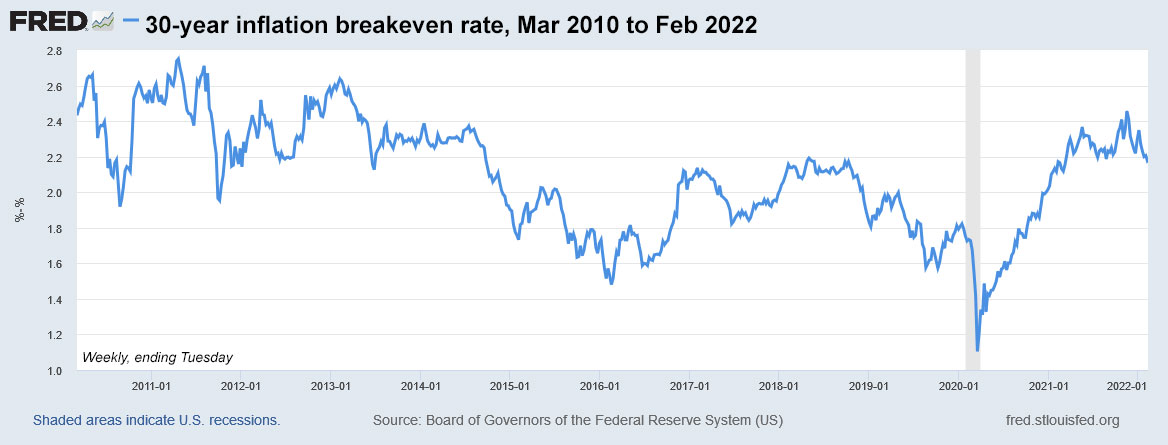
Posted in I Bond, Savings Bond | 2 Comments

A 10-year TIPS matured in July. How did it do as an investment?

Not so well, it turns out, slammed by a decade of lower-than-expected inflation.

By David Enna, Tipswatch.com

Today we will take a look at CUSIP 912828QV5, a 10-year Treasury Inflation-Protected Security that originated on July 15, 2011, with a real yield to maturity of 0.639%. It matured on July 15, 2021. The question: How did it do as an investment, versus a nominal 10-year Treasury note?

I’ve been tracking the performance of every maturing 5- and 10-year TIPS on my Tips vs. Nominals page, and for much of the last decade-plus, TIPS have been a fairly lousy investment, at least versus a nominal Treasury of the same term. The reason: Inflation expectations at the time of issue ended up being higher than actual inflation over the term of the TIPS. When inflation lags expectations, TIPS perform poorly.

Back on July 11, 2011, CUSIP 912828QV5 auctioned with a real yield of 0.639% and a coupon rate of 0.625%, terms that look super appealing today. Yet it’s hard to believe that 0.639% was the second lowest 10-year TIPS auction result in history, up to that point. In July 2011, we were just entering a decade-plus era of Federal Reserve intervention in the bond markets. Just six months later, in January 2012, a new 10-year TIPS auctioned with a real yield of -0.046%, the first of nine straight auctions of this term with a negative real yield.

The key factor in judging the performance of a TIPS versus a nominal Treasury is the inflation breakeven rate, the spread between the real yield of a TIPS and the nominal yield of a Treasury. That spread represents a prediction from investors about future inflation. Unfortunately, this prediction is almost always wrong, too high or too low. And for the last decade, investors have been betting on higher inflation than actually resulted.

Here are the data for maturing 10-year TIPS:

Although CUSIP 912828QV5 had an appealing real yield of 0.639%, on the day of the auction the 10-year Treasury note was yielding 3.03%, creating an inflation breakeven rate of 2.39%, rather high for that period. Ten years later, inflation had averaged just 1.8%, meaning that the TIPS under-performed the nominal Treasury by 0.59% a year.

Investors in this TIPS ended up missing out on a strong month for inflation, because inflation accruals for a TIPS are set by inflation two months prior to the accrual. So, this TIPS did not get a bump from a 0.93% increase in non-seasonally-adjusted inflation in June 2021. If June had counted, the annual inflation rate would have risen to 1.9% and the variance would have dropped to -0.49%.

Some thoughts and qualifications

We just completed a decade-long period of inflation running at less than 2.0%. In general TIPS out-perform nominal Treasurys when the inflation-breakeven rate drops below 2.0%, especially for 10-year TIPS. But the next decade could be entirely different. Never predict the future decade based on the performance of the past decade.

Also, this chart is an estimate of performance, because it uses a full month of inflation in the ending month, when actually TIPS accruals are based on a half month for the first and last months, with the origination and maturity occurring on the 15th of the month.

Keep in mind that interest on a nominal Treasury and the TIPS coupon rate is paid out as current-year income and not reinvested. So in the case of a nominal Treasury, the interest earned could be reinvested elsewhere, which would potentially boost the gain. For certain, we don’t know what the investor could have earned precisely on an investment after re-investments.

In the case of a TIPS, the inflation adjustment compounds over time, and that will give TIPS a slight boost in return that isn’t reflected in the “average inflation” numbers presented in the chart.

* * *

David Enna is a financial journalist, not a financial adviser. He is not selling or profiting from any investment discussed. The investments he discusses can purchased through the Treasury or other providers without fees, commissions or carrying charges. Please do your own research before investing.

Posted in Inflation, Investing in TIPS | 5 Comments

Auction of new 10-year TIPS gets record-low real yield of -1.016%

By David Enna, Tipswatch.com

The U.S. Treasury’s auction today of $16 billion in a new 10-year Treasury Inflation-Protected Security resulted in a real yield to maturity of -1.016%, the lowest in history for any TIPS auction with a 9- to 10-year term.

This is CUSIP 91282CCM1, and it was assigned a coupon rate of 0.125%, the lowest the Treasury will go for any TIPS.

A TIPS is an investment that pays a coupon rate well below that of other Treasury investments of the same term. But with a TIPS, the principal balance adjusts each month (usually up, but sometimes down) to match the current U.S. inflation rate. So the “real yield to maturity” of a TIPS indicates how much an investor will earn above (or in this case, below) inflation.

In the case of CUSIP 91282CCM1, investors were willing to accept a real yield that will lag official U.S. inflation by 1.016% a year for 10 years. Why would they do that? Two reasons: 1) because a TIPS offers protection against unexpectedly high future inflation, and 2) the yield of a nominal 10-year Treasury — currently at 1.25% — is also highly likely to lag inflation, but with no upside potential. For many investors, a TIPS looks like the better option.

Investors at Thursday’s auction had to pay a steep premium price to collect that coupon rate of 0.125%, plus future inflation accruals. The adjusted price for this TIPS was about $112.42 for about $100.44 of value, after accrued inflation and interest are added in. This TIPS will have an inflation index of 1.00387 on the settlement date of July 30.

The auction appears to have gone off without a hitch. The real yield was a bit lower than the Treasury’s yield estimate of -0.98% at the market close Wednesday. But at 12:30 p.m., the most recent 10-year TIPS trading on the secondary market was yielding -1.03%. So -1.016% looks like a reasonable result. The auction’s bid-to-cover ratio was 2.5, a solid if not stellar number.

Here is the year-to-date trend in 10-year real yields, showing the recent dip in yields as the delta variant of COVID-19 raises fears of a future economic slowdown:

This recent dip, however, is remarkable because it has followed the Federal Reserve’s June 16 “talking about talking about” meeting that should be setting a course toward tapering of its aggressive bond-buying program. When that bond buying ends — if it ever ends — both nominal and real yields are almost certain to rise.

Inflation breakeven rate

The one oddity of this auction is a dip the 10-year inflation breakeven rate for this TIPS, which came in at 2.27%, a bit below recent auctions of this term. The breakeven rate is determined by subtracting the real yield of this TIPS (-1.016%) from the current nominal yield of a 10-year Treasury (1.25%). The result is 2.27%. It means that this TIPS will outperform its nominal counterpart if inflation averages more than 2.27% over the next 10 years.

While 2.27% is high by historical standards, it seems reasonable given recent trends, with official U.S. inflation running at an annual rate of 5.4% as of June. So it is interesting to see that inflation expectations are now beginning to ease.

Here is the trend in the 10-year inflation breakeven rate for 2021 year to date:

Reaction to the auction

The TIPS ETF — which holds the full range of TIPS maturities — had been trading slightly higher all morning, indicating slightly lower yields. After the auction’s close at 1 p.m., the ETF ticked up, slightly. Not much to see here. This auction went off as expected.

Investors at today’s auction probably had to hold their noses to accept a record-low real yield for auctions of this term. However, the slight decline in the inflation breakeven rate reinforces the advantage of a TIPS over a nominal Treasury of the same term. Who wants to accept 1.25% for 10 years?

This TIPS will be reopened at auctions in September and November. It will be interesting to watch the trend in real yields through the end of the year.

Here’s a history of recent auctions of the 9- to 10-year term, dating back to January 2020. Note that today’s auction was the 8th in a row to get a negative real yield:

* * *

David Enna is a financial journalist, not a financial adviser. He is not selling or profiting from any investment discussed. The investments he discusses can purchased through the Treasury or other providers without fees, commissions or carrying charges. Please do your own research before investing.
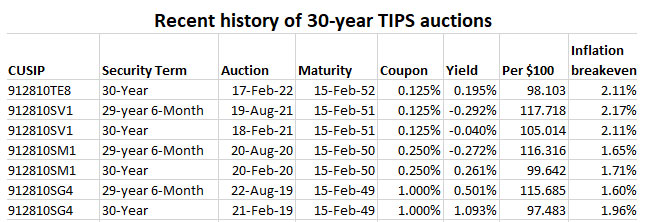
Posted in Investing in TIPS | 3 Comments

Social Security COLA: An increase of 6% looks likely for 2022

(And here’s the esoteric and confusing way that is calculated)

By David Enna, Tipswatch.com

August 11, 2021 update: The July inflation report keeps the COLA on track for an increase of about 6%

Inflation trends through June 2021 make it look likely that next year’s cost-of-living adjustment for Social Security beneficiaries could fall into a range of 5.8% to 6.2% for 2022, the highest increase since a 7.4% bump in 1982. But if inflation continues at its current torrid pace, the COLA could be even higher.

The Social Security Administration’s COLA formula is ridiculously complex and little understood. Is it related to U.S. inflation? Yes, but not the inflation index you hear about each month. Does it reflect 12 months of U.S. inflation? Not really. Does it underestimate actual U.S. inflation? Most years, yes.

U.S. inflation (measured by CPI-U) is running at 5.4% as of June, but the Social Security Administration doesn’t use CPI-U. Instead, it uses the Consumer Price Index for Urban Wage Earners and Clerical Workers (CPI-W). For that index, the June annual increase was actually higher, at 6.1%.

You are going to see that number — 6.1% — used often as the projection for the Social Security COLA in 2022. It is the current estimate of the Senior Citizen’s League, a credible advocacy group. It looks to me to be a reasonable projection, but at this point, the COLA’s complex formula makes things iffy. Let’s take a look at how the COLA comes together …

The Index

CPI-W includes data only from households with at least 50% of income coming from clerical or wage-paying jobs. I’ve noted in the past that CPI-W generally lags slightly behind CPI-U, which means the Social Security COLA also generally lags behind the standard measure of U.S. inflation. This year, at least through June, it is running higher than official inflation.

CPI-W isn’t widely tracked or reported, but the Bureau of Labor Statistics updates the index each month in its overall inflation report. Right now, you could say, “Well, CPI-W is running at an annual rate of 6.1%, so that will likely be the COLA increase for 2020.” But that’s not true. In fact, the June number isn’t necessarily an accurate indicator, as shown in this chart:

June sets the baseline for the COLA increase, but then we come to …

The Formula

The SSA doesn’t look at a full year’s data to determine the COLA. Instead it uses the average CPI-W index for the third quarter — July, August and September. Here is the language from the SSA site:

A COLA effective for December of the current year is equal to the percentage increase (if any) in the average CPI-W for the third quarter of the current year over the average for the third quarter of the last year in which a COLA became effective. If there is an increase, it must be rounded to the nearest tenth of one percent. If there is no increase, or if the rounded increase is zero, there is no COLA.

This wording means that the SSA eliminates years where inflation was zero or negative, and so there isn’t a “bounce-up” effect on benefits after a year of deflation. Instead, it goes back to the last year where there was an increase in benefits. But that won’t matter in this 2022 calculation, because the COLA rose 1.3% last year.

So, although 12-month CPI-W was up 6.1% in June, that number is only the baseline for the 2022 COLA increase. The only inflation numbers that will matter are for the third quarter: July, August and September. Last year, the CPI-W index averaged 253.412 in the third quarter. The June 2021 index was set at 266.412, or 5.1% higher than that average. So if we have zero inflation in the third quarter of 2021, the Social Security COLA be set at 5.1%.

U.S. inflation can be stubbornly finicky in the summer months, so predicting inflation from July to September is an impossible task. Hurricanes, gas shortages, food crop failures, stock market plunges, supply shortages, pandemic resurgence, etc., etc. It’s a guessing game, and nearly every summer brings some surprises.

Projecting the 2022 COLA

At this point, CPI-W is running at 6.1% over the last year, so you’d expect a continued inflationary trend of about 0.5% a month in July, August or September. But what if inflation dips after the multi-month surge so far in 2021? Could it run at 0.0% for three months? Doesn’t seem likely. But what about 0.4% a month? That seems possible.

Let’s take a look at how differences in 3rd-quarter inflation would alter the 2022 COLA:

My thinking is that after months of red-hot U.S. inflation, we could see things cool off a bit this summer. Used car prices aren’t likely to continue surging at a 45% annual pace, for example. Even air fares and hotel costs could slip if pandemic fears keep brewing. But other effects — gasoline and food costs, for example, and a possible spending surge caused by the new child care tax credit — could keep inflation rising a brisk pace.

Another factor is that CPI-W had a mild surge last summer, rising 0.6% in July and then 0.4% in August and 0.2% in September. That will make those numbers a bit harder to top than the June 2020 index, which was up 6.1% in June 2021.

So, if you think that CPI-W inflation will rise on average 0.3% a month in the 3rd quarter, you’d end up with a 5.8% COLA increase in 2022. If the average rises to 0.4%, the COLA would be 6.0% and if it rises to 0.5%, 6.2%. I think those are the most likely results, as I have shown in the chart.

That leads me to project that the 2022 Social Security COLA will fall into a range of 5.8% to 6.2%, and so let’s just go with 6.0% as most likely number.

Where can this go wrong? The stock market was taking a pummeling today, and two things also happened: Crude oil prices dipped sharply (down more than 7% today) and the U.S. dollar is getting stronger (up about 1.2% in the last month). Lower oil prices and a stronger dollar could dampen inflation over the next few months. Summer = market volatility.

What this means for Social Security recipients

The Social Security Administration currently estimates that the average retired beneficiary receives $1,555.25 a month, so a 6% increase would boost that monthly payment to about $1,648.56, an increase of $93.31 a month. If you are in the Social Security “limbo” period — older than 62 but not yet taking benefits — your future benefits would also climb by this percentage.

However, recipients can also expect that Medicare Part B costs will rise in 2022, which will subtract — at least partly — from the higher benefits. The base premium is now $148.50 a month. I could see that rising to $158 a month, cutting the effect of the COLA increase by $9.50 a month. But this is just speculation.

We won’t know the actual COLA number until 8:30 a.m. EDT on October 13, 2021, when the Bureau of Labor Statistics releases the September inflation report and completes the data needed for the 3rd quarter average of CPI-W. I will be tracking these numbers for July, August and September as each inflation report is issued.

I keep a running total of the CPI-W changes on my Social Security COLA page.

One more thing. One interesting side issue is that a 6% increase in benefits in 2022 could speed up Social Security’s path toward depleting its “trust fund” of accumulated payroll taxes. Once that happens, possibly in the early 2030s, Social Security will need to rely on incoming payroll taxes, which could cover only about 75% of projected benefits. Congress could — and should — address this issue quickly by gradually raising the full retirement age, or raising the income cap on payroll taxes, or taxing 100% — instead of 85% — of Social Security benefits for wealthy beneficiaries. Or some combination. We’ll see.

* * *

David Enna is a financial journalist, not a financial adviser. He is not selling or profiting from any investment discussed. The investments he discusses can purchased through the Treasury or other providers without fees, commissions or carrying charges. Please do your own research before investing.
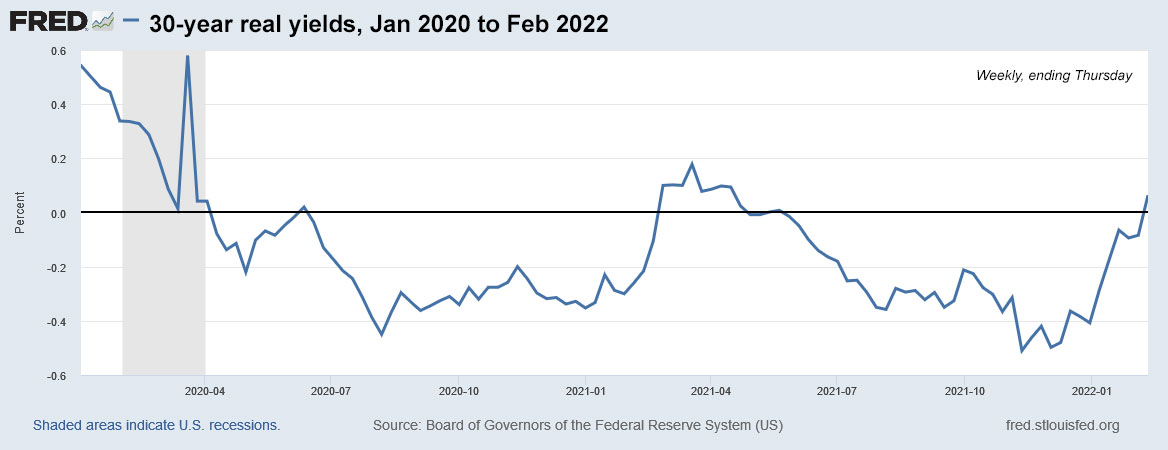
Posted in Retirement, Social Security | 8 Comments