5-year TIPS auction gets a record-low real yield of -1.685%

By David Enna, Tipswatch.com

The U.S. Treasury’s auction of $19 billion in a new 5-year Treasury Inflation-Protected Security generated a real yield to maturity of -1.685%, the lowest ever recorded for any TIPS auction of any term.

This is CUSIP 91282CDC2. Its coupon rate was set at 0.125%, the lowest the Treasury will go for any TIPS. That means investors had a pay a lofty premium at this auction, paying about $109.51 for about $100.14 of value, after accrued inflation and interest are added in. The settlement date is Oct. 29.

A TIPS is an investment that pays a coupon rate well below that of other Treasury investments of the same term. But with a TIPS, the principal balance adjusts each month (usually up, but sometimes down) to match the current U.S. inflation rate. So the “real yield to maturity” of a TIPS indicates how much an investor will earn above (or in this case, below) inflation.

The auction result doesn’t mean that investors were accepting a negative nominal return, but they were willing to pay a 9% premium to par value to collect a 0.125% coupon rate plus five years of inflation accruals. To put this another way, official U.S. inflation will have to increase about 9% before investors reach a breakeven point on this investment.

The previous record low real yield for any TIPS auction was set on April 22, 2021, when a new 5-year TIPS got a real yield of -1.631%. The 5-year term seems especially sensitive to investor fears of near-term inflation, but oddly, this auction’s bid-to-cover ratio was a rather lukewarm 2.45.

Here is the year-to-date trend in 5-year real yields, which are up only about 8 basis points since January but have followed a volatile trend. The market seems to be struggling to adjust to the Federal Reserve’s intention to scale back its monthly purchases of $80 billion in U.S. Treasurys, including TIPS:

Inflation breakeven rate

With a 5-year Treasury note trading at 1.20% at the auction’s close, this TIPS gets a 5-year inflation breakeven rate of 2.89%, by far the highest rate for any 5-year TIPS auction in more than a decade. The 5-year breakeven rate was last at this level in March 2005.

Investors are pricing in higher inflation in the near-term future, which seems logical with U.S. inflation currently running at 5.4% and looking likely to continue at a high rate for many months ahead. A high inflation breakeven rate makes a TIPS a pricey investment versus a nominal Treasury, but it comes with the comforting insurance of protection against runaway inflation.

Here is the year-to-date trend in the 5-year inflation breakeven rate, showing that inflation expectations have been peaking in the last month, up from about 2.4% in mid-September:

Reaction to the auction

The lukewarm bid-to-cover ratio has me stumped, because the real yield to maturity of -1.685% seemed to be a bit lower than market expectations, which indicates decent investor demand. At the market close Wednesday, the U.S. Treasury had estimated the 5-year real yield at -1.61%, about 7 basis points higher.

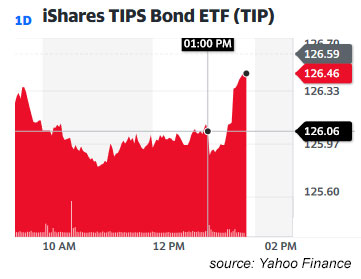
The TIP ETF, which had been trading slightly higher all morning, took a tiny bounce higher after the auction close, again indicating that auction met expectations.

My conclusion is that demand was good and the auction was a success, at least for the Treasury, which gets to pay back investors 1.685% less than the rate of inflation over the next five years.

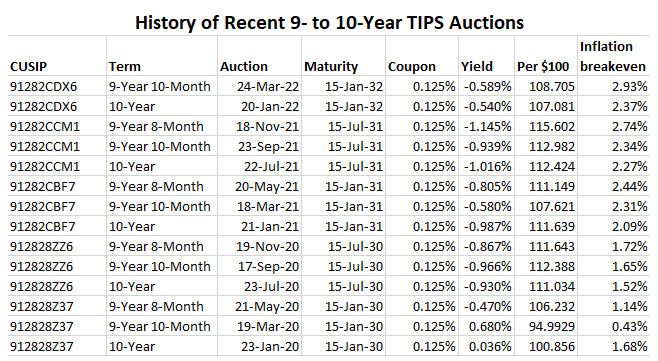
This TIPS will get a reopening auction on December 23. Here’s a history of 4- to 5-year TIPS auctions over the last three years:

* * *

Feel free to post comments or questions below. If it is your first-ever comment, it will have to wait for moderation. After that, your comments will automatically appear.

David Enna is a financial journalist, not a financial adviser. He is not selling or profiting from any investment discussed. The investments he discusses can purchased through the Treasury or other providers without fees, commissions or carrying charges. Please do your own research before investing.

Posted in Investing in TIPS | 4 Comments

I Bond podcast: U.S. Savings Bonds for a risk-free, stellar return over the next year …

By David Enna, Tipswatch.com

Jeremy Keil, a certified financial planner based in Milwaukee, reached out to me this month to help educate his clients on U.S. Series I Savings Bonds, a very hot topic in October 2021. We tried to give a a simple breakdown of how U.S. Series I Savings Bonds work, their benefits, and potential pitfalls.

Listen to the podcast here

(also available on the Apple and Google podcast platforms; search for “Retirement Revealed” podcast).

It’s great to see I Bonds being promoted in the financial planning community, which doesn’t happen often. I enjoyed this process and being able to spread the word about I Bonds.

Referenced in the podcast:

September inflation report sets new I Bond variable rate at 7.12%, annualized.

I Bond Manifesto: Why inflation-linked savings bonds can work as part of your emergency fund

I Bond dilemma: Buy in October? Or wait until November?

Inflation and I Bonds, where I track upcoming rate changes.

Social Security COLA tracking page

* * *

Feel free to post comments or questions below. If it is your first-ever comment, it will have to wait for moderation. After that, your comments will automatically appear.

David Enna is a financial journalist, not a financial adviser. He is not selling or profiting from any investment discussed. The investments he discusses can purchased through the Treasury or other providers without fees, commissions or carrying charges. Please do your own research before investing.

Posted in I Bond, Savings Bond | 2 Comments

A new 5-year TIPS goes to auction Thursday. Here’s what to expect.

By David Enna, Tipswatch.com

With all the attention being drawn to U.S. Series I Savings Bonds these days, the Treasury’s other inflation-protected investment, the Treasury Inflation-Protected Security, seems to be flying under the radar. And that’s probably right. For a small-scale investor, in October 2021, an I Bond makes a heck of a lot more sense than a comparable TIPS.

Because an I Bond can be redeemed after five years with no penalty, it is directly comparable to a 5-year TIPS. An I Bond offers a real return that will match official U.S. inflation over five years. A 5-year TIPS currently has a real yield of about -1.58%, meaning it will under-perform official inflation (and the I Bond) by 158 basis points. The clear winner is the I Bond.

At auction this Thursday, the Treasury will offer $19 billion in a new 5-year TIPS, CUSIP 91282CDC2. It can’t compare with its little brother — the I Bond — but is it an attractive option for investors seeking inflation protection after reaching the I Bond’s $10,000 per person per year purchase cap? Let’s take a look.

A 5-year TIPS has two advantages over an I Bond: 1) there isn’t a purchase cap, and 2) a TIPS can be purchased in a tax-deferred account, allowing an investor to use tax-deferred money to make the purchase. (Although an I Bond is a tax-deferred investment, it can’t be purchased inside a tax-deferred account.) Keeping the transaction inside a tax-deferred account means no immediate tax liability caused by raising money for the purchase.

As I noted above, the U.S. Treasury on Friday estimated a full-term 5-year TIPS would have a real yield of -1.58%. While that sounds miserable, it is in line with other high-safety nominal investments, for example the 5-year Treasury note or an insured 5-year bank CD. Here’s a comparison, showing how a 5-year TIPS will under-perform a nominal Treasury under low inflation scenarios, but easily out-perform the Treasury note if inflation averages 3.0% to 4.0% or higher in the next five years:

This chart shows the clear superiority of the Series I Savings Bond, which will out-perform the other safe investments under any inflation scenario higher than 1%. The I Bond is the only truly attractive investment on the chart. But once inflation rises above 2.5%, the 5-year TIPS begins to out-perform the nominal investments. If you believe inflation is likely to run higher than 3.0% over the next five years, the TIPS is the better investment — versus a nominal Treasury or bank CD.

Here is the trend in 5-year real yields over the last three years, showing the deep dive into negative yields after the Federal Reserve began aggressive bond-buying in March 2020. Next month, in November, the Fed intends to begin tapering away from that bond buying, a many-months process that should cause real yields to climb. But so far, the 5-year real yield has stabilized in a range of about -1.50% to -1.60%.

Thursday’s auction results will set the real yield to maturity for CUSIP 91282CDC2, and its coupon rate will be set at 0.125%, the lowest the Treasury will go for a TIPS. That means investors will be paying a hefty premium for the coupon rate, probably somewhere around $108.25 for $100 of par value, assuming the auctioned real yield comes in at about -1.58%.

In addition, this TIPS will have an inflation index of 1.00093 on the settlement date of Oct. 29, which will push the adjusted price up slightly, but investors will receive a matching amount of accrued principal.

Inflation breakeven rate

With a nominal 5-year Treasury note trading at 1.13%, this new TIPS would have a 5-year inflation breakeven rate of 2.71%, which seems like a reasonable estimate of U.S. inflation in the near-term future. Inflation is currently running at an annual rate of 5.4%, but inflation over the last 5 years has averaged only 1.9%. Investors see inflation trending higher than recent trends, and that looks like a reasonable assumption.

However, a caution: 2.71% is exceptionally high by historic standards. The Treasury provides 5-year inflation breakeven data back to 2003, and you have to go back to May 2006 to see inflation expectations that high. A high inflation breakeven rate makes a TIPS “pricey” versus a nominal Treasury. But will investors care when U.S. inflation is running at a decades-high level of 5.4%?

Here is that big-picture trend in the 5-year inflation breakeven rate, dating back to 2003. During much of the time since the 2008 recession, this rate has lingered at or below 2.0%:

Inflation is currently running at the highest level in 31 years, with 5.4% annual inflation recorded in September, the highest September-to-September rate since 6.2% in 1990. After that peak in 1990, inflation continue to run at or above 2.5% for the next six years. Conclusion: An inflation breakeven rate of 2.7% looks reasonable.

Thoughts on this auction

It’s not attractive, but the real yield doesn’t look likely to set a record low, which was -1.631% for a new 5-year TIPS auctioned on April 15, 2021. With the Fed launching its tapering efforts in a month (or so they say) real yields should begin inching higher. Are more attractive auctions ahead?

One risk-reduction strategy I have been considering: If you own a broad-based TIPS fund (such as TIP or SCHP) in a tax-deferred account, you could sell a small portion and invest it gradually into 5-year TIPS auctions. That way you will be lowering your duration risk and know that in 5 years (or less for reopenings) you will get your money back. But remember that any premium price over par is not guaranteed to be returned at maturity. This strategy retains inflation protection with a little less risk. Just a thought. Let me know if you see flaws.

CUSIP 91282CDC2 will get a reopening auction on Dec. 16. Will the Fed’s actions in the next two months make that future auction more attractive? Could be.

I will be reporting the auction results soon after the close at 1 p.m. Thursday. Non-competitive bids have to be placed by noon. Here’s a listing of recent TIPS auctions of this term, showing the six consecutive auctions with negative real yields, starting in April 2020, as the Fed began aggressively buying Treasurys.

* * *

Feel free to post comments or questions below. If it is your first-ever comment, it will have to wait for moderation. After that, your comments will automatically appear.

David Enna is a financial journalist, not a financial adviser. He is not selling or profiting from any investment discussed. The investments he discusses can purchased through the Treasury or other providers without fees, commissions or carrying charges. Please do your own research before investing.

Posted in Investing in TIPS | 5 Comments

I Bond dilemma: Buy in October? Or wait until November?

My opinion: Long-term investors should buy in October. Short-term term investors could wait until November. But whatever … buy I Bonds in 2021.

By David Enna, Tipswatch.com

With the release of the September inflation report on Wednesday, we got rather stunning news: All U.S. Series I Savings Bonds will have an inflation-adjusted interest rate of 7.12%, annualized, for six months. That rate will launch immediately for I Bonds purchased in November, or in six months for I Bonds purchased in October.

The key thing is: All I Bond investors will get that 7.12% eventually. But if you purchase an I Bond before the end of October, you will get an annualized return of 3.54% for six months, and then the 7.12% for six months. That adds up to a total return of about 5.33% for the year, a stellar number in our dreary world of ultra-low interest rates.

But the obvious question is: Should you buy in October to lock in that 3.54% rate, or wait until November to start off with a bang at 7.12% for six months? Let’s take a look at the pluses and minuses.

Is this a long-term investment?

Do you plan on holding this I Bond for at least five years, when it can be redeemed without the three-month interest penalty? If so, I think buying in October makes more sense than waiting for November’s higher rate. The reason: We don’t know what the next inflation-adjusted rate will be, the one that will follow 7.12%. It will be based on inflation from September 2021 to March 2022. It could be higher, yes, or it could be lower.

But I can assure you that in the next five years, it is highly likely that you will see an inflation-adjusted rate lower than 3.54%. That rate, based on official U.S. inflation from September 2020 to March 2021, was the I Bond’s highest variable rate in 10 years (dating back to the 4.6% variable rate set in May 2011). Because that 3.54% annualized rate is so attractive in today’s market, I encourage long-term I Bond investors to purchase up to the $10,000 per person cap in October, locking in the 3.54% rate for six months, and then 7.12% for six months.

Conclusion: Long-term I Bond investors should make the purchase in October.

Is this a short-term investment?

A lot of investors are looking at dabbling in I Bonds for the first time as a short-term investment, possibly for a period as short as 11 months. You can purchase an I Bond near the end of a month and get full interest credit for that month. Then, in the same month a year later, you can redeem it, near the beginning of the month. That cuts the required holding period to 11 months and a couple days.

This short-term investment makes a lot of sense in our current market, getting way-above-market returns on an extremely safe investment. And if this is the strategy you are considering, I think buying in November makes a bit more sense than buying in October. If you buy in October and redeem after a year, you will lose three months of interest at the 7.12% level, cutting your total return on a $10,000 investment down to $355. By waiting three months longer, you can boost that return to $533, because the three-month penalty will apply to a potentially lower variable rate.

If you buy in November, your worst case scenario is a return of $356 after 12 months, even if the next variable rate drops to 0.0%. (A three-month penalty on zero interest is zero.) So buying in November, and then redeeming in one year, makes more sense than buying in October.

But let’s take a look at potential inflation scenarios for that next rate reset on May 1, determined by inflation from September 2021 to March 2022. That will give us a more accurate picture of the likely effects of redeeming in either 12 or 15 months. Sorry, but here comes a whole bunch of numbers, with the only changes coming in column 2 for “Buy in November.” If you buy in October, you will know your outcomes for 12 and 15 months, because those rates have been set:

In lower-inflation scenarios, buying in October and holding for 15 months will pay off versus the buy-in-November strategy. But that’s not true after 12 months, because of the high-rate three-month interest penalty imposed on the October purchase. In all scenarios, the November strategy wins for a redemption after 12 months.

I have no idea where inflation will be heading from September to March, but I’d guess it will result in a rate reset of 2.5% to 3.5% in May. The higher the variable rate, the higher the advantage for the November purchase strategy.

Conclusion: If you are planning to buy an I Bond and redeem it in 12 months, then the buy-in-November strategy is the winner. If you might hold for 15 months, though, the advantage only comes with higher inflation in the September to March period.

Do you think the Treasury will increase the I Bond’s fixed rate in November?

I think this is highly unlikely, but anything is possible. The Treasury does weird things, sometimes. What if it suddenly decides to give I Bonds a big boost for small-scale savers? Don’t think that will happen. It’s not at all likely.

Here is a chart showing the real yields of 5- and 10-year Treasury Inflation-Protected Securities at the time of every recent I Bond rate reset where the rate was above 0.0%.

Note that in no case was the yield of a 10-year TIPS below zero when the I Bond fixed rate was set above 0.0%. The current 10-year real yield is -0.96%. The Treasury really doesn’t need to do anything to give I Bonds a boost. They already have a 96-basis-point advantage over a 10-year TIPS.

Conclusion: There’s not much hope the Treasury will raise the I Bond’s fixed rate above 0.0% for the November 1 reset. But if you believe there is a chance, go ahead and wait for the reset and buy in November.

Don’t overthink this …

I actually believe that buying I Bonds in October, and/or buying in November, are both good moves. (I bought my 2021 allocation in January, by the way.) For a long-term investor, buy in October to lock down that 3.54% rate for six months. For a short-term investor, especially one looking to redeem in the shortest time possible, buy in November.

But, whatever you decide: Buy I Bonds in 2021. Can’t go wrong with that decision.

* * *

Feel free to post comments or questions below. If it is your first-ever comment, it will have to wait for moderation. After that, your comments will automatically appear.

David Enna is a financial journalist, not a financial adviser. He is not selling or profiting from any investment discussed. The investments he discusses can purchased through the Treasury or other providers without fees, commissions or carrying charges. Please do your own research before investing.

Posted in I Bond, Inflation, Savings Bond | 48 Comments

Inflation report sets I Bond’s inflation-adjusted rate at 7.12% and Social Security COLA at 5.9%

Overall U.S. inflation ran slightly higher than expected in September

By David Enna, Tipswatch.com

The inflation news this morning is historic. So let’s get right to it.

The Consumer Price Index for All Urban Consumers (CPI-U) increased 0.4% in September on a seasonally adjusted basis, the U.S. Bureau of Labor Statistics reported today. Over the last 12 months, the all-items index increased 5.4% before seasonal adjustment. Both of those numbers were slightly higher than the consensus forecasts.

Core inflation, which removes food and energy, matched the forecasts of 0.2% for the month and 4.0% for the year.

The September report was particularly brutal for middle-income consumers. Food costs rose a sharp 0.9% in September and are now up 4.6% over the last 12 months. The index for meats, poultry, fish, and eggs rose 2.2% over the month as the index for beef rose 4.8%.

Shelter costs rose 0.4% and are up 3.2% year over year. The BLS said food and shelter costs contributed more than half of the overall increase in the all-items index. Gasoline prices, however, were also up 1.2% for the month, and up 42.1% year over year. Natural gas prices increased 2.7%.

Some areas saw declining prices. Airline fares were down 6.4% in the month, after falling 9.1% in August. Apparel costs dropped 1.1%. The index for used cars and trucks fell 0.7%, continuing to decline after it decreased 1.5% in August. But used vehicle costs remain 24.4% higher than a year ago.

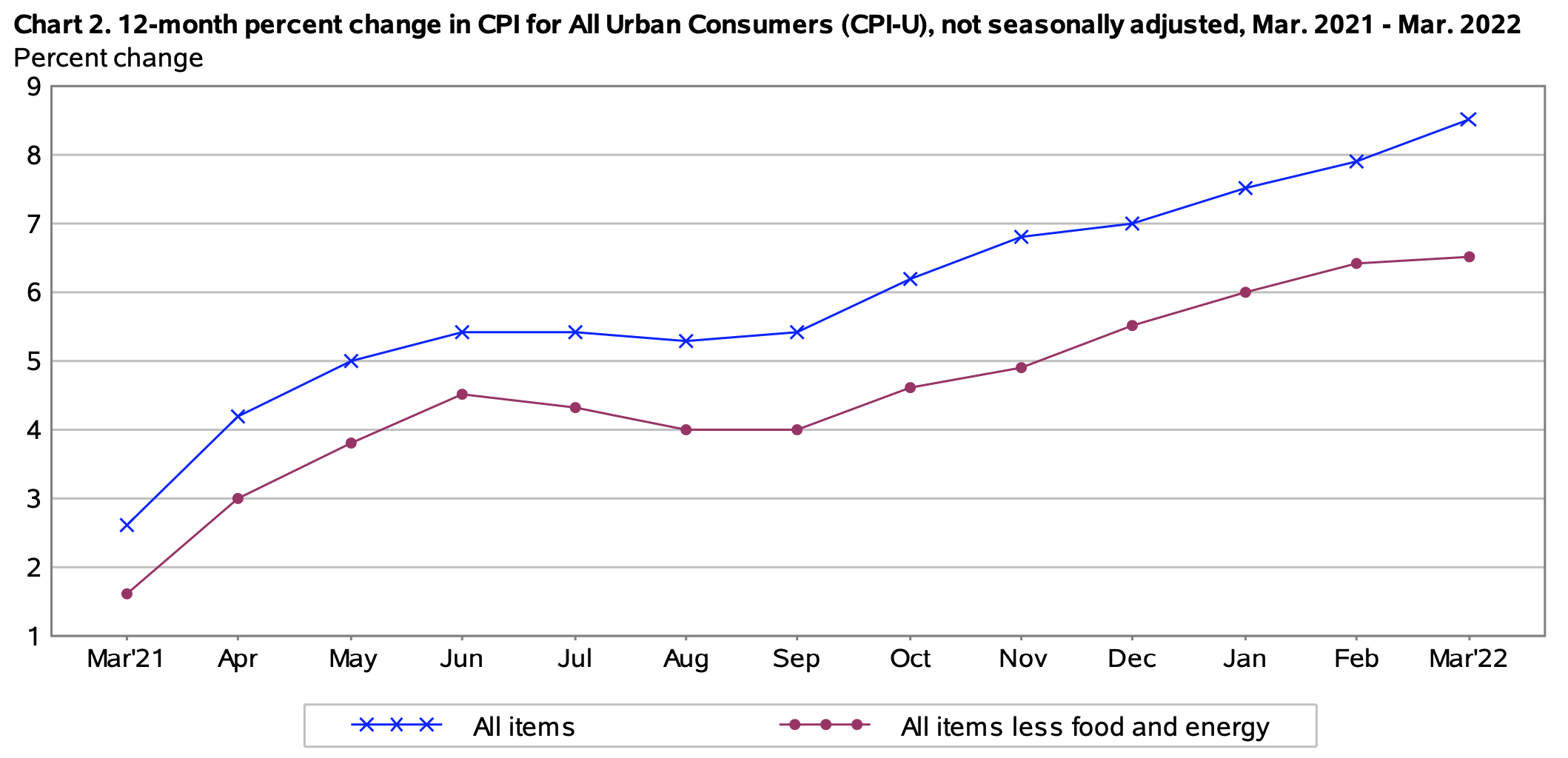
Here is the 12-month trend in all-items and core inflation, showing that the steep increases in inflation are now leveling off at historically high levels.:

What this means for I Bonds and TIPS

Investors in U.S. Series I Savings Bonds and Treasury Inflation-Protected Securities are also interested in non-seasonally adjusted inflation, which is used to set future interest rates for I Bonds and adjust principal balances for TIPS. For September, the BLS set the CPI-U inflation index at 274.310, an increase of 0.27% over the August number.

For I Bonds. The September inflation report was the last of six that will determine the November 1 reset of the I Bond’s inflation-adjusted rate, which is combined with a fixed rate to determine an I Bond’s composite interest rate for six months. Over the March to September period, inflation rose 3.56%, the largest six-month increase in the 23-year history of I Bonds. That increase means the inflation-adjusted rate will rise to 7.12%, annualized, for six months. That is up from 3.54% currently.

Here are the numbers used in this calculation:

The I Bond’s fixed rate — which is currently 0.0% — will also be reset on November 1, but I think it is highly likely to remain at 0.0%, which means the new composite rate will be 7.12%.

All holders of I Bonds will receive this 7.12% annualized rate for six months, but the start date of the higher rate will depend on when the I Bond was purchased. If you buy an I Bond before November 1, you will receive 3.54% for six months, and then 7.12% for six months, beginning in April. That totals out to an annual yield of about 5.33%.

Here is how the higher rate will be rolled out for I Bond investors, from TreasuryDirect:

Issue month of your bondNew rates take effect
JanuaryJanuary 1 and July 1
FebruaryFebruary 1 and August 1
MarchMarch 1 and September 1
AprilApril 1 and October 1
MayMay 1 and November 1
JuneJune 1 and December 1
JulyJuly 1 and January 1
AugustAugust 1 and February 1
SeptemberSeptember 1 and March 1
OctoberOctober 1 and April 1
NovemberNovember 1 and May 1
DecemberDecember 1 and June 1

So now the question arises: If you haven’t bought I Bonds up to the limit in 2021 (there is a purchase cap of $10,000 per person per year) should you buy before November 1, or after November 1? I will be writing more about this soon, but right now I still recommend buying in October to lock down that 5.33% annual return.

Want to know more about I Bonds? Read this: I Bond Manifesto: Why inflation-linked savings bonds can work as part of your emergency fund

For TIPS. The September inflation report means that principal balances for all TIPS will increase 0.27% in November, after an increase of 0.21% in October. TIPS principal balances have increased 5.4% over the last 12 months. Here are the new November Inflation Indexes for all TIPS.

What this means for the Social Security COLA

The September inflation report was the third of three — for July to September — that will set the Social Security Administration’s cost of living adjustment for 2022. The SSA uses a three-month average of a different index, the Consumer Price Index for Urban Wage Earners and Clerical Workers (CPI-W), to set its COLA.

For September, the BLS set CPI-W at 269.086, which produced a three-month average of 268.421, an increase of 5.9% over the same average for 2020. That means the Social Security COLA will be 5.9% for payments beginning in January. That increase (for a change) actually outstrips overall U.S. inflation, which has increased 5.4% over the last year.

This will be the highest Social Security COLA increase in 39 years, since the 7.2% adjustment for payments in 1983.

The Social Security Administration says the average monthly benefit for U.S. retirees is $1.543, so a 5.9% increase will raise that monthly benefit to $1,634. If you are in the Social Security “limbo” period — older than 62 but not yet taking benefits — your future benefits would also climb by this percentage.

However, recipients can also expect that Medicare Part B costs will rise in 2022, which will subtract — at least partly — from the higher benefits. The base premium is now $148.50 a month. I could see that rising to $158 a month, cutting the effect of the COLA increase by $9.50 a month. But this is just speculation.

* * *

Feel free to post comments or questions below. If it is your first-ever comment, it will have to wait for moderation. After that, your comments will automatically appear.

David Enna is a financial journalist, not a financial adviser. He is not selling or profiting from any investment discussed. The investments he discusses can purchased through the Treasury or other providers without fees, commissions or carrying charges. Please do your own research before investing.
Posted in Investing in TIPS | 18 Comments