Opinion: Treasury should raise the I Bond’s fixed rate

But will it? The odds are better now. The data clearly support a higher fixed rate.

By David Enna, Tipswatch.com

How the U.S. Treasury sets the fixed rate on the Series I Savings Bond is wrapped in mystery. No one knows how or why. There is no formula. The Treasury says nothing except to announce the new fixed rate every May and November.

Right now, the common thinking in the I Bond community is this: “Demand for I Bonds is unusually strong and the Treasury doesn’t need to raise the fixed rate.” And, yes, this is true. But as a matter of fairness, the Treasury should raise the fixed rate, to reinforce the idea that an I Bond is a quality long-term holding for small-scale investors.

There is no question that demand for I Bonds is strong, triggered by the current annualized variable rate of 9.62%. This demand will probably continue into 2023 with a new variable rate somewhere around 6.2% to 6.4%. This is from a Barron’s article on the boom in demand in I Bonds:

“The average monthly issuance of $2.7 billion so far in 2022 compares with monthly sales of just $30 million in early 2021 when the rate was just 1.7%.”

The fairness issue

For short-term investors looking to swoop into very attractive I Bond rates for 12 to 15 months, a higher fixed rate doesn’t make much of a difference. But for investors looking to hold I Bonds for many years, a fixed rate above 0.0% is hugely attractive. Why? Because the fixed rate is permanent, staying with an I Bond for a full 30 years, or until it is redeemed.

That is why I say raising the fixed rate is an issue of fairness. While in the short-term a return of 9.62% is extremely attractive, the return on that I Bond is going to — eventually — track down with falling inflation. An I Bond with a 0.0% fixed rate has a “real yield” of 0.0% — meaning it will only track future inflation but not exceed it. That was fine over the last 2 1/2 years, when real yields on a similar investment — Treasury Inflation-Protected Securities — went deeply negative. But right now, 0.0% is a lousy real yield for a longer-term investor seeking inflation protection.

Here is the current real yield curve for TIPS, as estimated Friday by the U.S. Treasury:

Under “normal” circumstances — which admittedly have been rare over the last 12 years — the I Bond’s fixed rate tends to track 50 to 75 basis points below the real yield of a 10-year TIPS. I think that is fair, because I Bonds have several advantages: Tax-deferred interest, better deflation protection, ease of ownership and more efficient compounding.

Right now, however, the I Bond’s fixed rate of 0.0% is a stunning 168 basis points below the real yield of a 10-year TIPS. That makes TIPS — a more complicated investment — more attractive. The Treasury should recognize this and raise the I Bond’s fixed rate. I am going to suggest 0.3% to 0.5%. A 0.5% rate would put the fixed rate where it was in Fed’s last tightening cycle from November 2018 through November 2019. At that time, in November 2018, the 10-year TIPS had a real yield of 1.1%, much lower than it is today.

Here are the data I track on the spread in yield between the I Bond’s fixed rate and the 10-year TIPS real yield. (I used to also track the 5-year spread, but I found it wasn’t a reliable predictor.) In this chart I have highlighted in green the times when the Treasury raised the I Bond’s fixed rate above 0.0%.
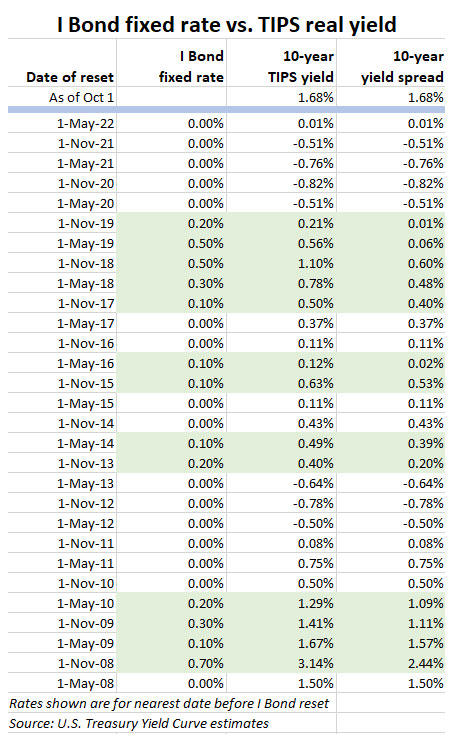
There are some fairly large variations on this chart, but you have to go back to May 2009 to find a yield spread that approaches 168 basis points. Look at November 2019, when the Treasury set a fixed rate of 0.2% when the 10-year TIPS was yielding only 0.21%, a spread of just 1 basis point.

OK, I admit the variations could indicate the Treasury doesn’t even look at the 10-year real yield, and sets the I Bond’s fixed rate on demand alone. If that is true, then the fixed rate will continue at 0.0% from November 2022 to April 2023. But if the Treasury does look at the I Bond/TIPS yield spread — and it should — it will recognize the need to raise the I Bond’s fixed rate on November 1.

Why? Raising the fixed rate reinforces the idea that an I Bond is best used as a longer-term investment. The new crop of short-term investors will still be heading to the exits, most likely later in 2023. But I Bonds are a smart, sensible investment for capital preservation, ideal for the small-scale investor. The Treasury should reinforce that idea with a higher fixed rate that matches market trends.

Of course, this all depends on real yields holding at these high levels through October. Nothing is certain in today’s wild bond market.

Confused by I Bonds? Read my Q&A on I Bonds

Hold off on buying I Bonds?

The obvious question will be … and here it comes … “Should I hold off on buying I Bonds until November to see if the fixed rate increases?” I believe that most of my readers have already bought I Bonds up to the $10,000 per person cap for 2022, so the question is moot. For others, it’s probably a toss up. If the fixed rate rises, you will be happy. If it stays at 0.0%, you miss out on 9.62% for six months.

And remember, if the fixed rate rises in November, it will be available for new purchases in January 2023, up to the $10,000 per person cap. So everyone wins.

I’d put the odds of a higher fixed rate at 50/50 at this point. Most people in the I Bond community believe the odds are much lower, but definitely above zero. We can’t ignore that TreasuryDirect has been overwhelmed this year by demand for I Bonds. Wouldn’t it be adding fuel to the fire by raising the fixed rate? Yeah, I see the dilemma.

But realistically, the fixed rate should be higher. So Treasury … do it.

An addendum, for the nerds …

In the comments I mentioned the Federal Register’s current regulations for I Bonds. Here is the link, which is often useful for understanding how I Bonds work.

Some quotes:

§ 359.10 What is the fixed rate of return?

The (Treasury) Secretary, or the Secretary’s designee, determines the fixed rate of return. The fixed rate is established for the life of the bond. The fixed rate will always be greater than or equal to 0.00% [1] . The most recently announced fixed rate is only for bonds purchased during the six months following the announcement, or for any other period of time announced by the Secretary.

Footnote: [1] However, the fixed rate is not a guaranteed minimum rate. The composite rate is composed of both the fixed rate and a semiannual inflation rate, which could possibly be less than the fixed rate or negative in deflationary situations. In all cases, however, the composite rate will always be greater than or equal to 0.00%.

§ 359.12 What happens in deflationary conditions?

In certain deflationary situations, the semiannual inflation rate may be negative. Negative semiannual inflation rates will be used in the same way as positive semiannual inflation rates. However, if the semiannual inflation rate is negative to the extent that it completely offsets the fixed rate of return, the redemption value of a Series I bond for any particular month will not be less than the value for the preceding month.

* * *

Feel free to post comments or questions below. If it is your first-ever comment, it will have to wait for moderation. After that, your comments will automatically appear.

David Enna is a financial journalist, not a financial adviser. He is not selling or profiting from any investment discussed. The investments he discusses can be purchased through the Treasury or other providers without fees, commissions or carrying charges. Please do your own research before investing.

Posted in I Bond, Investing in TIPS, Savings Bond, TreasuryDirect | 41 Comments

Another milestone: The yield advantage for EE Savings Bonds has disappeared

By David Enna, Tipswatch.com

I’ve been pondering recently whether the Treasury will raise the I Bond’s fixed rate above 0.0% at the November 1 reset, and one side of my brain says, “Well, it should” while the other side says, “No, it won’t.” But that is a topic for another day; I need more time to ponder.

What has caught my eye this week is the fact that the Series EE Savings Bond has suddenly lost its long-held yield advantage over a 20-year Treasury bond. While I Bonds are now the sexy starlet of the financial scene, EE Bonds are the aging actor making a cameo role — pretty much ignored.

But … throughout the last 11 years of interest-rate repression, EE Bonds have maintained an attractive yield advantage over other long-term, very safe investments. EE Bonds currently offer a permanent fixed rate of 0.1%, ridiculous and irrelevant. What makes EE Bonds interesting are these terms:

All Series EE bonds issued since May 2005 earn a fixed rate in the first 20 years after issue. At 20 years, the bonds will be worth at least two times their purchase price. The bonds will continue to earn interest at their original fixed rate for an additional 10 years unless new terms and conditions are announced before the final 10-year period begins.

What this means is that an investment in EE Bonds held 20 years immediately doubles in value, creating an effective annual rate of return of 3.53%. That rate has surpassed the yield on a 20-year Treasury for more than eight consecutive years. Here is the comparison going back to 2011, the year the Federal Reserve began aggressive manipulation of the bond market:

Click on the image for a larger version.

What this means

As long as the 20-year Treasury yield remains higher than 3.53% (it closed yesterday at 4.01%) EE Bonds are no longer so attractive. If you are looking for a very safe 20-year nominal investment, buy the 20-year Treasury bond instead, either on the secondary market or at auction. There is a reopening auction coming up Oct. 19.

EE Bonds do have the advantage of earning tax-deferred interest and proceeds may be able to be used tax-free for education purposes. If this education goal applies to you, EE Bonds are still attractive.

What if you are holding EE Bonds?

Terms for EE Bonds have changed many times over the years, so it is important to consider when you purchased them and their actual terms. This page on TreasuryDirect links to the main categories. Some older EE Bonds might be worth retaining.

But if you bought them anytime after November 2015, they are paying a permanent fixed rate of 0.1%. Since the 20-year doubling is still years away, you could consider redeeming those EE Bonds and investing the money elsewhere. EE Bonds can’t be sold until you hold them 12 months, and if redeemed within 5 years, you lose three months of interest. Since the fixed rate is 0.1%, that is essentially zero. I’d feel comfortable redeeming any EE Bond held less than five years, if there is an attractive alternative (for example, I Bonds purchased now or in January 2023).

If you’ve already held the EE Bond five or more years, you may want to keep it until maturity. Here is how that math works out, ignoring the 0.1% fixed rate, which becomes irrelevant when the bond doubles:

  • After 5 years, the EE Bond would double in 15 years, creating an effective annual return of about 4.8% for the final 15 years..
  • After 10 years, the EE Bond would double in 10 years, creating an effective annual return of about 7.18% for the final 10 years.
  • After 15 years, the EE Bond would double in 5 years, creating an effective annual return of about 14.9% for the final 5 years.

So I’d recommend holding on to any EE Bond that is approaching its doubling term, which has changed several times over the years. After it doubles, redeem it.

  • Back in 1992, EE bonds paid 6% a year and were guaranteed to double in 12 years. After 12 years, they reverted to paying 4% a year to maturity.
  • In March 1993, the doubling term was adjusted to 18 years.
  • In May 1995, it was adjusted tp 17 years.
  • In June 2003, it was brought to 20 years, where it has remained.

What the Treasury needs to do

Obviously, that ridiculous fixed rate of 0.1% needs to go higher — much higher — at the November 1 reset. Here are some examples of higher fixed rate resets in the last 12 years, showing that the Treasury was willing to set the fixed rate above 1% when longer-term Treasury yields were about as high as they are today:

Realistically, to make EE Bonds a stellar investment, the Treasury would need to reduce the doubling period, as it did in 1995, when it dropped from 18 years to 17 years. That would bring EE Bonds back to a favorable status versus a nominal 20-year Treasury. But I don’t think that will happen … this year. Maybe next year if rates continue at high levels.

The Treasury will probably make a cautious move in the November reset, knowing that interest rates are in a volatile phase. But I would expect the EE Bond’s fixed rate to rise above the current 0.1%.

* * *

Feel free to post comments or questions below. If it is your first-ever comment, it will have to wait for moderation. After that, your comments will automatically appear.

David Enna is a financial journalist, not a financial adviser. He is not selling or profiting from any investment discussed. The investments he discusses can be purchased through the Treasury or other providers without fees, commissions or carrying charges. Please do your own research before investing.

Posted in EE Bonds, Savings Bond, TreasuryDirect | 28 Comments

10-year TIPS reopening auction gets real yield of 1.248%, highest in more than 12 years

Investors benefited from turmoil in the financial markets.

By David Enna, Tipswatch.com

In the midst of a highly volatile bond market, the Treasury’s offering of a reopened 10-year TIPS — CUSIP 91282CEZ0 — generated a real to maturity of 1.248%, the highest for any auction of this term since July 2010.

This was a stunning result, but also predicable, after the Federal Reserve yesterday made clear its intention to battle soaring U.S. inflation to the bitter end, suggesting increases in interest rates would continue well into 2023.

The result was also historic, because the real yield was the highest for any TIPS auction of the 9- to 10-year term since July 8, 2010, when a new issue 10-year TIPS got a real yield of 1.295%. Since then, there have been 73 TIPS auctions of this term, all of them with real yields below 1.2%. Until today. And it is amazing to consider that less than a year ago, on Nov. 18, 2021, a 10-year TIPS reopening got an all-time low real yield of -1.145%, 293 basis points below today’s result.

At times this morning, this TIPS was trading on the secondary market with a real yield of 1.28%, so the auction ended up a bit lower, indicating strong demand. The bid-to-cover ratio was 2.54, also indicating decent demand.

Definition: The “real yield” of a TIPS is its yield above official future U.S. inflation, over the term of the TIPS. So a real yield of 1.248% means an investment in this TIPS will exceed U.S. inflation by 1.248% for the next 9 years, 10 months.

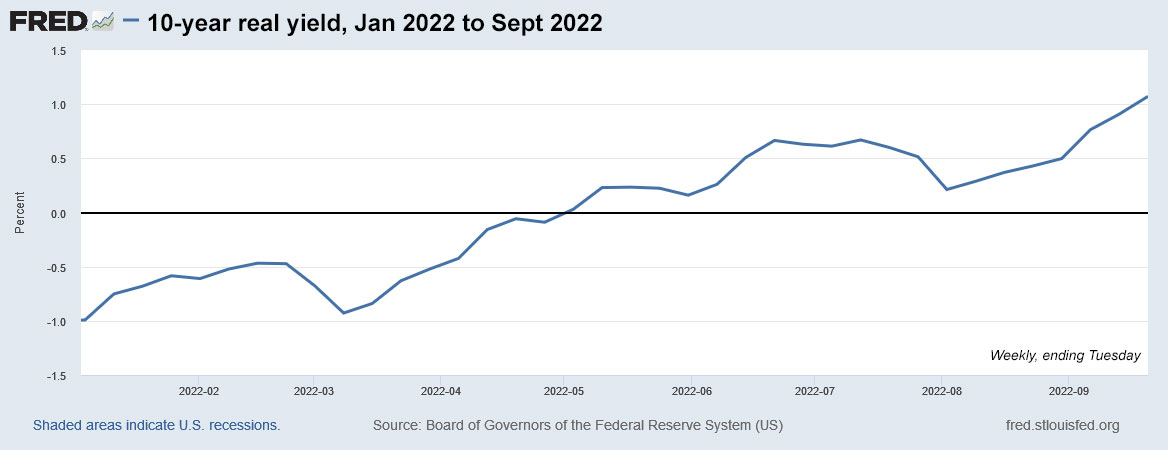
Here is the year-to-date trend in 10-year real yields, showing the steady surge higher since the Federal Reserve unveiled its inflation-fighting plans in March:

Note that this chart shows yields through Tuesday. Click on the image for a larger version.

Pricing for the auction

CUSIP 91282CEZ0 carries a coupon rate of 0.625%, set at the originating auction two months ago, on July 21, when it auctioned with a real yield of 0.630% (attractive at the time, remember?). Because today’s real yield was nearly double the coupon rate, buyers got it at a substantial discount — an unadjusted price of about $94.27 for $100 of par value.

This TIPS will have an inflation index of 1.01972 on the settlement date of Sept. 30, so investors bought an additional 1.97% of principal, plus about 13 cents of accrued interest per $100. The adjusted price was about $96.13 for about $101.97 of principal, once accrued inflation is added in.

An investor putting in an order for $10,000 of this TIPS paid about $9,613 for about $10,197 of principal, as of September 30.

Inflation breakeven rate

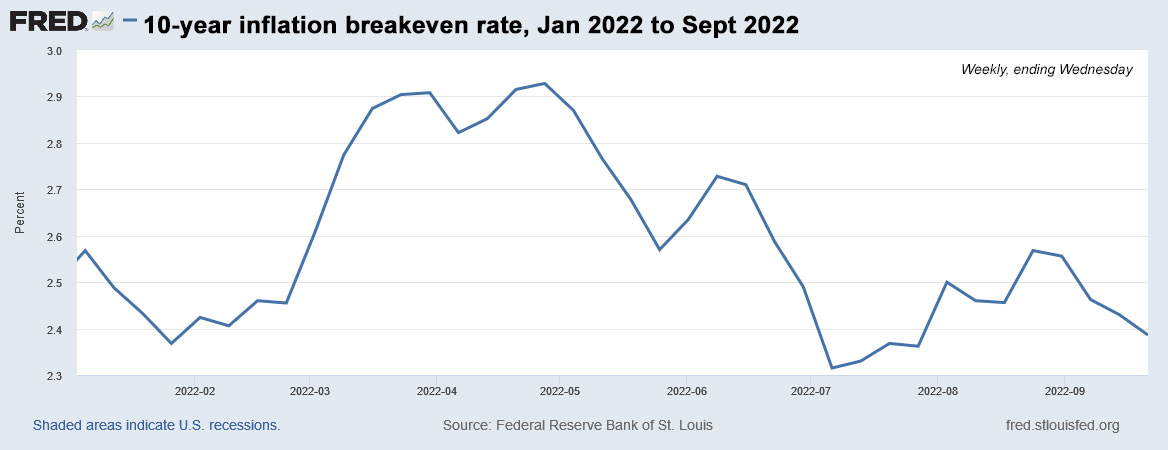
With a 10-year nominal Treasury trading with a real yield of 3.68% at the auction’s close, this TIPS gets an inflation breakeven rate of 2.43%, meaning it will out-perform the nominal Treasury if inflation averages more than 2.43% over the next 10 years. That result is in line with most auctions over the last two years.

Although 2.43% for a 10-year inflation breakeven rate is historically high, it seems very reasonable at a time when U.S. inflation is running at 8.3%. Inflation over the last 10 years, ending in August, has averaged 2.5%.

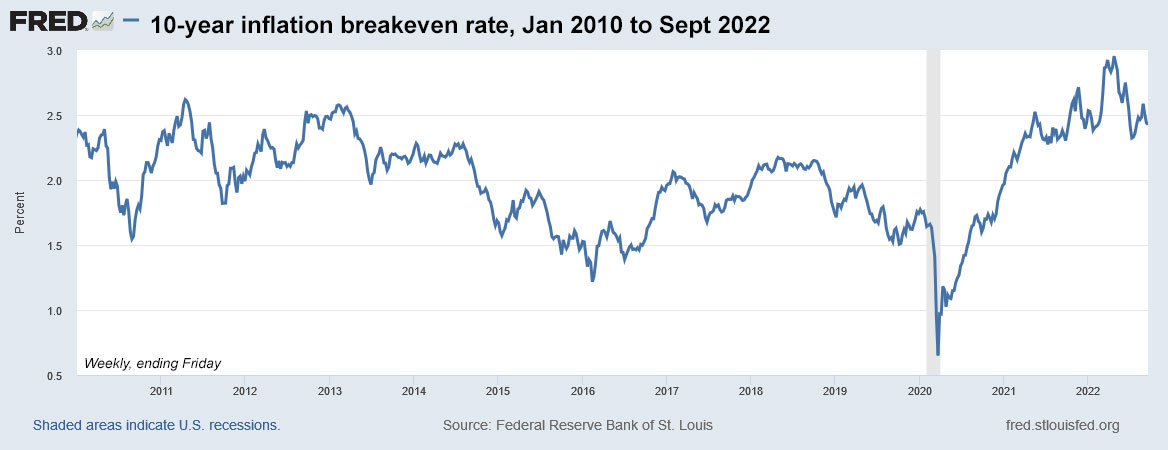
Here is the year-to-date trend in the 10-year inflation breakeven rate, a rather wild track higher into the spring and then much lower through the summer. The financial markets are buying the premise that the Federal Reserve can get U.S. inflation under control.

Click on the image for a larger version.

Reaction to the auction

Investors in today’s auction (I was one of them) benefited from the Fed’s hawkish statements Wednesday and the market disruptions they caused. For investors, getting the highest real yield for this term in more than 12 years was very, very welcome.

Source: Yahoo Finance

As I noted, the auction’s real yield result was actually a bit lower than where this TIPS was trading before the auction close, which indicated decent demand. After the auction’s close at 1 p.m., the TIP ETF — which holds the full range of maturities — got a slight boost higher. It had been trading substantially lower all morning.

The TIPS market has been largely ignored by investors for several years. That includes small-scale investors who have been piling into inflation-tracking I Bonds with a gaudy current annualized rate of 9.62%. But I Bonds carry a real yield of 0.0%, based on the current fixed rate. This 9-year, 10-month TIPS has a real yield of 1.248%. That’s a 125 basis-point advantage.

I Bonds have many advantages over a TIPS: flexible maturity, better deflation protection, tax-deferred interest, ease of ownership. But at this point, as long as real yields remain substantially positive, TIPS are a highly attractive investment to add to your inflation-fighting arsenal.

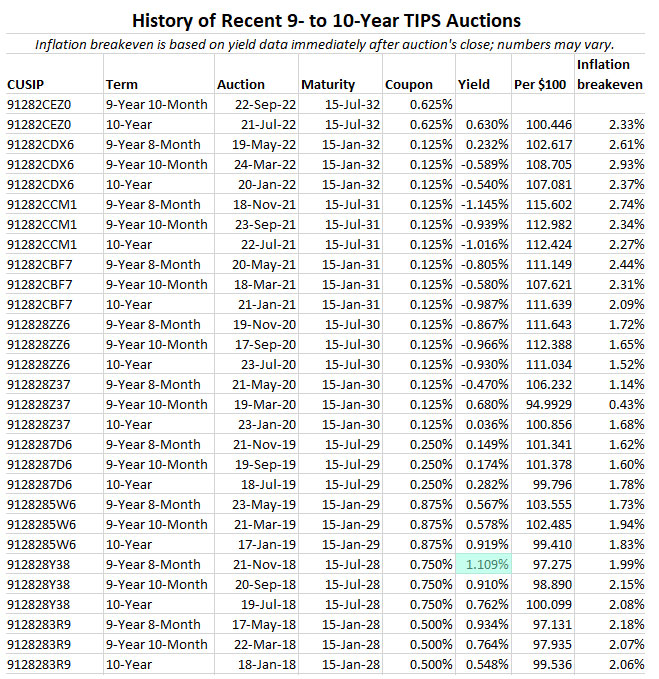
Here is a history of 9- to 10-year TIPS auctions over the last three years:

* * *

Feel free to post comments or questions below. If it is your first-ever comment, it will have to wait for moderation. After that, your comments will automatically appear.

David Enna is a financial journalist, not a financial adviser. He is not selling or profiting from any investment discussed. The investments he discusses can be purchased through the Treasury or other providers without fees, commissions or carrying charges. Please do your own research before investing.
Posted in Federal Reserve, Investing in TIPS | 45 Comments

Short-term Treasurys: Even more attractive now.

By David Enna, Tipswatch.com

Back in early July, I wrote an article suggesting a strategy of staggering purchases of short-term Treasurys to boost your gains on cash holdings. I raised this idea because yields on Treasury bills (often called T-bills) were already higher and rising faster than yields you could find at a bank or money market fund.

Why stagger the purchases, laddering them a few weeks apart? This allows you to gain from rising interest rates, while also giving you easier access to your cash if you need it.

That strategy certainly has worked. Here are the typical cash-equivalent yields I listed in that article on July 4, compared to current returns after several months of Federal Reserve rate hikes:

  • 1-year Treasury bills, yielding 2.79% then. Now: 4.03%
  • 26-week Treasury bills, yielding 2.62% then. Now: 3.86%
  • 1 year bank CDs, yielding 2% then. Now: 3.1%
  • 13-week Treasury bills,yielding 1.73% then. Now: 3.35%
  • 4-week Treasury bills, yielding 1.27% then. Now: 2.57%
  • Vanguard Treasury Money Market, yielding 1.11% then. Now: 2.34%
  • Online bank savings accounts, typically yielding 1% to 1.2%. Now: 1.9%
  • 6-month bank CDs, yielding 1% then. Now: 2.5%
  • Fidelity Treasury Money Market, yielding 0.98% then. Now: 1.86%
  • 3-month bank CDs, about 0.35% then. Now: 1.5%.

As I noted in that July article — and it is still true today — the sweet spot in the T-bill yields seems to be in the 13-week and 26-week maturities. The 26-week is now just 10 basis points lower than the 2-year Treasury, which closed yesterday at 3.86%. The 13-week is desirable because the shorter term allows you to get access faster to future rate increases.

Here is the current nominal yield curve for all Treasury issues, based on the Treasury’s Yield Curve estimates, which are updated daily after the market’s close:

The short-end of the curve still looks the most attractive, but I would be highly tempted to dive into a 5-year Treasury note if the yield surpasses 4.0%, which definitely looks possible. Who knows what will happen to yields over the next 5 years? But it seems to make sense to lock in a rate that is historically attractive. The last time the 5-year yield exceeded 4% was October 2007, just before the Great Financial Crisis cut yields in half.

Obviously these short-term rates will be rising in the next week, in the aftermath of the Federal Reserve’s increase in its federal funds rate, to be announced today. The 4-week T-bill should be rising to around 3.25% if the Fed raises the rate 75 basis points. The 13-week and 26-week probably have already built some of the increase in, but still should move higher.

How to stagger your purchases

Here is the example I used in the July article, supposing that you are looking to put $60,000 in cash to work, using TreasuryDirect. New 13- and 26-week T-bills are auctioned every Monday. (This strategy would also work using a brokerage firm that allows auction purchases without any fees or commissions.):

13-week Treasurys. You could make three purchases of $20,000 each, four weeks apart. Then you can roll these purchases over on TreasuryDirect, meaning you will always have access to $20,000 within about 4 weeks. This strategy will quickly adapt to rising interest rates. Staggering 13-week Treasury bills is a good strategy for someone who might need the cash back in a short time.

26-week Treasurys. You could make three purchases of $20,000 each, eight weeks apart. Again you could roll these purchases over, riding interest rates higher, and always have access to $20,000 within eight weeks. Staggering 26-week Treasurys is a good strategy for someone who feels comfortable with a little longer delay in re-accessing the cash.

A combination. Put $30,000 in staggered 13-week Treasury bills, and $30,000 in staggered 26-week Treasury bills. You’d ride interest rates higher, get a slight yield boost for the 26-week term, and still have access to $10,000 within four weeks.

The July article lays out a step-by-step guide for using TreasuryDirect to make and schedule the purchases. I have used this technique, and it works well. I haven’t used a brokerage to make short-term Treasury purchases, so I can’t say how smooth that process is. But it should be fine.

When to quit this strategy?

I’d be OK with continuing these rollover investments if the Fed announces a “stall” on raising future interest rates (that could happen in 2023, certainly). But at that point, bank CDs might begin catching up with the Treasury rates — or could be offering attractive promo rates. During this time it might be wise to begin paring down the T-bill holdings and looking for longer-term issues.

If you believe the Fed is about to begin cutting interest rates (it will give signals) it will be time to unwind this strategy. In 2019, the 13-week T-bill rate fell from 2.47% on April 29 to 1.55% on Dec. 31. So, in normal circumstances, you will have time.

Video: Another viewpoint

Jennifer Lammer of Diamond NestEgg posted a video Sept. 26 on this same topic from a slightly different approach. As usual, it’s clear and well organized (and she mentioned my site!). Here is the video:

* * *

Feel free to post comments or questions below. If it is your first-ever comment, it will have to wait for moderation. After that, your comments will automatically appear.

David Enna is a financial journalist, not a financial adviser. He is not selling or profiting from any investment discussed. The investments he discusses can be purchased through the Treasury or other providers without fees, commissions or carrying charges. Please do your own research before investing.
Posted in Bank CDs, Cash alternatives, Federal Reserve, TreasuryDirect | 79 Comments

This week’s 10-year TIPS reopening auction is worth a serious look

Have you given up on longer-term Treasurys? It’s time to get back in the game.

By David Enna, Tipswatch.com

You’ll never see me screaming “buy, buy, buy” like CNBC’s resident madman, Jim Cramer, but I do think that sensible, conservative investors should take a look at Thursday’s 10-year TIPS reopening auction.

The Treasury is offering $15 billion in a reopening of CUSIP 91282CEZ0, creating a 9-year, 10-month TIPS. An interesting side note is that $15 billion is the highest-ever amount offered at a 10-year TIPS reopening auction. These offerings have grown from $12 billion in March 2020, to $13 billion in March 2021, to $14 billion in September 2021 and now $15 billion in September 2022. That’s an increase of 25% in 2 1/2 years, and is evidence that the Treasury isn’t de-emphasizing TIPS in these inflationary times.

CUSIP 91282CEZ0 had its originating auction on July 21, 2022, when it generated a real yield to maturity of 0.630%. Its coupon rate was set at 0.625%, making it the first 10-year TIPS with a coupon rate above 0.125% since July 2019.

Definition: The “real yield” of a TIPS is its yield above official future U.S. inflation, over the term of the TIPS. So a real yield of 1.07% means an investment in this TIPS will exceed U.S. inflation by 1.07% for 9 years, 10 months.

Because this TIPS trades on the secondary market, we can track its current real yield and price in real time on Bloomberg’s Current Yields page. It closed Friday with a real yield of 1.07% and a price of $95.84 for $100 of par value. The price is at a discount because the real yield is well above the coupon rate of 0.625%.

If the real yield holds above 1% at Thursday’s auction, this would be the first 9- to 10-year TIPS with a real yield that high since November 2018, very close to the end of the Fed’s last tightening cycle. In fact, since November 2018 there have been 22 TIPS auctions of this term and 12 of them generated real yields negative to inflation. These days, a real yield of 1% or higher is something to celebrate.

In this chart, I am taking a long view of 10-year real yields, back to January 2010, a year before the Federal Reserve began aggressive quantitative easing. The chart shows how yields peaked at the end of the Fed’s last tightening cycle in November 2018, and then went deeply negative after the Covid outbreak in March 2020.

Click on the image for a larger version.

Pricing for this TIPS

CUSIP 91282CEZ0 will carry an inflation index of 1.01972 on the settlement date of September 30, meaning that investors will be purchasing a bit less than 2% of additional principal, but at a discount of $95.84 for $100 of value (a current pricing). That will work out to about $97.73 for $101.97 of principal, plus maybe 13 cents of accrued interest, making the total cost around $97.86 for $101.97 of principal. That is a rough estimate and things can change before Thursday’s auction.

And keep in mind that the inflation index on this TIPS will drift down slightly in October, ending the month at 1.01936, based on slightly negative non-seasonally adjusted inflation in August. The markets know this is coming, and the auction price will reflect the minor change.

Inflation breakeven rate

With a 10-year nominal Treasury note now trading with a yield of 3.45%, this TIPS currently has an inflation breakeven rate of 2.38%, which looks like a reasonable and attractive number. Inflation over the last 10 years, ending in August, has averaged 2.5%. If you believe that inflation will run lower than 2.38% over the next 9 years, 10 months, buy the nominal Treasury. If you believe inflation will run higher, buy the TIPS.

Here is the trend in the 10-year inflation breakeven rate since January 2010, showing how inflation expectations have been backing off since the Fed began tightening measures in March 2022:

Click on the image for a larger version.

Conclusion

It’s no secret that I am a fan of this auction’s potential, as long as real yields continue to hold throughout this week. That’s no sure thing, with a potential market disruption coming Wednesday when the Federal Reserve announces its decision on short-term interest rates. The market expects a 75-basis-point increase. If that what happens, yields should hold. But a month ago, on Aug. 18, the 10-year real yield was sitting at 0.36%. Anything can happen. In fact: Expect anything to happen.

Anyway, I was a buyer of this TIPS at the originating auction on July 21, and I was pleased with the real yield and coupon rate set at 0.625%, which can help cover the effects of any minor deflationary months. For the hold-to-maturity investor, there is very little risk in this TIPS. Obviously, I will be a buyer Thursday, if conditions hold. This is my opinion, and I am a journalist, not an adviser.

How high could real yields rise? This will depend on how high the Federal Reserve allows nominal rates to rise. If the 10-year note reaches 5%, it’s conceivable that the real yield of a 10-year TIPS could rise to 2.2% to 2.5%. But will the Fed sustain the courage to push rates higher, even if the U.S. economy is in turmoil? My gut says “not likely.”

I know there is also a lot of interest in the new 5-year TIPS auction coming up on Oct. 20. That one could produce a coupon rate of 1% — or maybe even 1.125% — and a real yield of about 1.13%. It will be reopened at auction on December 22, when we will know the full extent of the Federal Reserve’s interest rate decisions. In the last tightening cycle, the December 5-year TIPS reopening auctions were always among the best of the year.

Potential investors in CUSIP 91282CEZ0 can check how it is trading in real time on Bloomberg’s Current Yields page. This auction closes at noon Thursday for non-competitive bids, like those made at TreasuryDirect. If you are putting an order in through a brokerage, make sure to place your order Wednesday or very early Thursday, because brokers cut off auction orders before the noon deadline. I’ll be posting the results soon after the auction closes at 1 p.m. EDT.

This same 10-year TIPS will be reopened at auction again on Nov. 17, giving investors one more chance at it. Here’s a history of all 9- to 10-year TIPS auctions dating back to January 2018. I have highlighted the single auction, in November 2018, with a real yield above 1%.

* * *

Feel free to post comments or questions below. If it is your first-ever comment, it will have to wait for moderation. After that, your comments will automatically appear.

David Enna is a financial journalist, not a financial adviser. He is not selling or profiting from any investment discussed. The investments he discusses can be purchased through the Treasury or other providers without fees, commissions or carrying charges. Please do your own research before investing.

Posted in Federal Reserve, Investing in TIPS | 26 Comments